

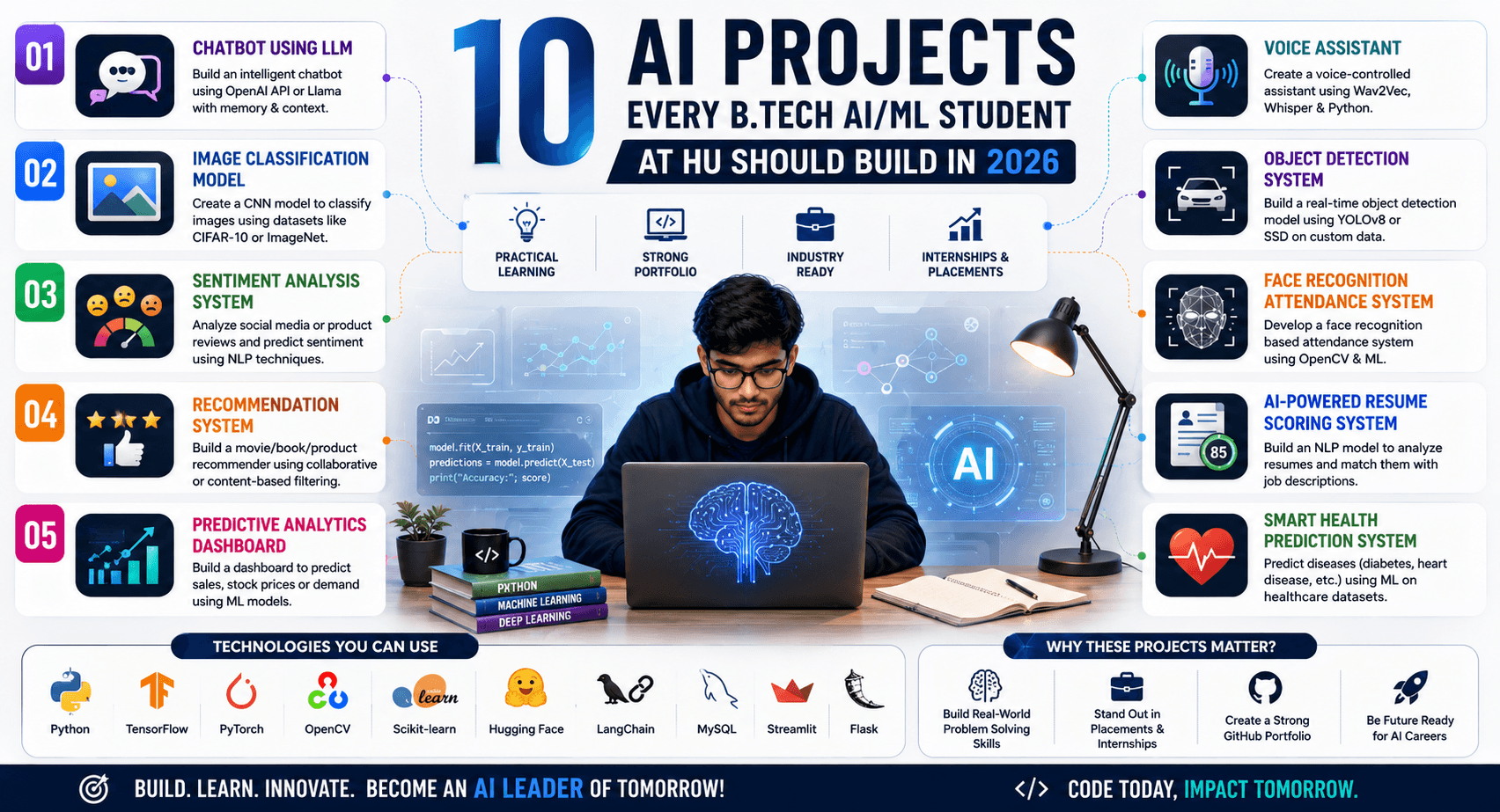
10 AI Projects Every B.Tech AI/ML Student at HU Should Build in 2026
Dr. Himanshu Verma
Associate Professor & HOD, Computer Science & Engineering, Haridwar University
Looking for AI Projects for Engineering Students 2026 ideas? You've landed in the right place. A degree by itself doesn't open doors in AI and machine learning anymore. India's own official AI portal, IndiaAI (Ministry of Electronics and IT), reports that the country's AI talent pool is projected to grow from roughly 6-6.5 lakh professionals to more than 1.25 million by 2027 — meaning demand is rising faster than qualified supply.
Recruiters want to see working code, deployed models, and a GitHub profile that proves you can build, not just read theory. At Haridwar University, our B.Tech AI & ML program is built around exactly this philosophy: every semester pairs classroom learning with a hands-on build. This guide walks you through ten projects, grouped by difficulty and portfolio impact, backed by verified data from HU's own pages and government sources, so you can plan your four years with purpose instead of building random tutorials.
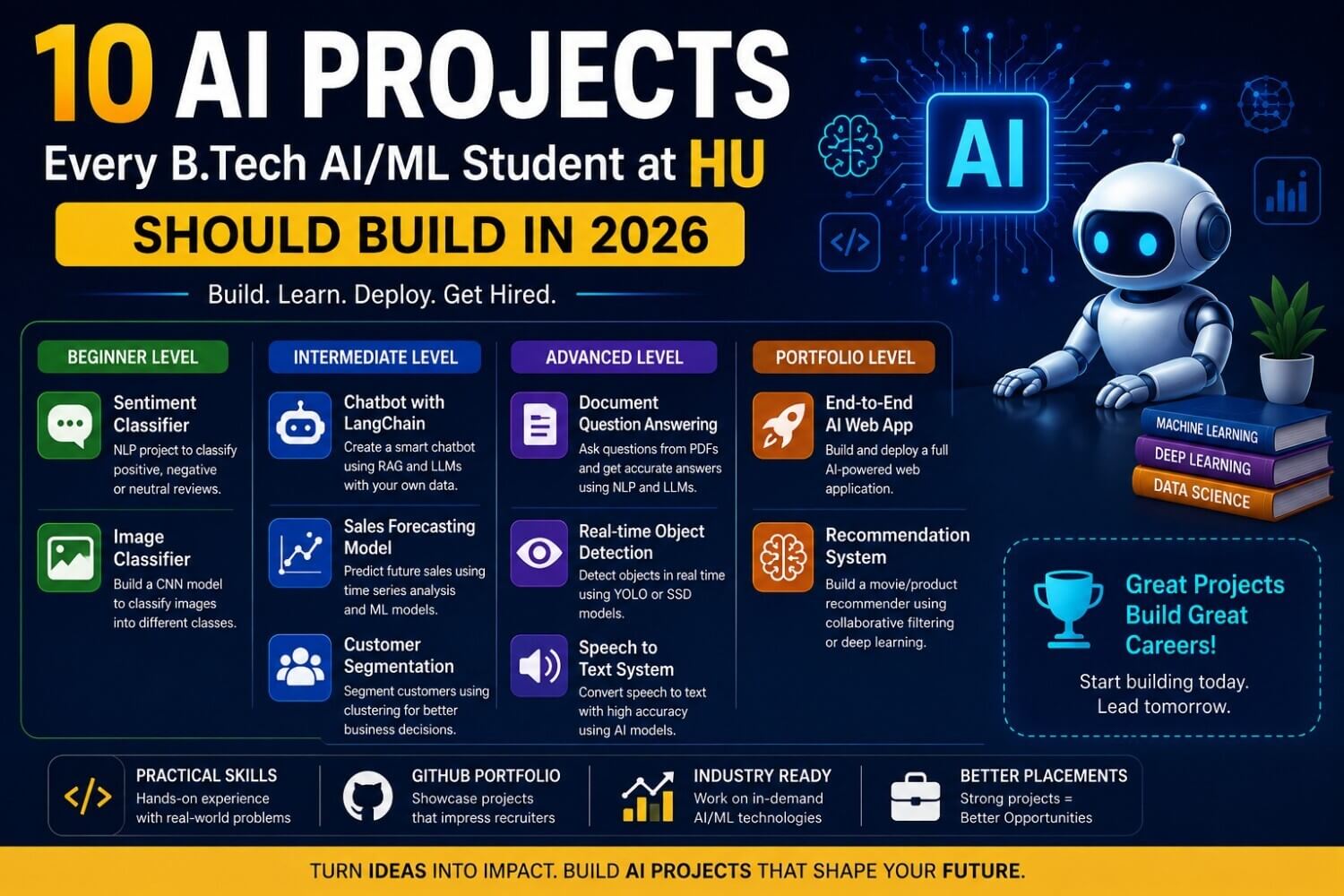
Table of Contents
- 1. Why AI Projects Matter: India's AI Talent Gap
- 2. 10 Projects Grouped by Difficulty and Portfolio Impact
- 3. B.Tech AI & ML Fee Structure at HU (2026-27)
- 4. HU's Verified Placement & Recruiter Record
- 5. Government Support for AI Education in India
- 6. HU AI Labs — Where You'll Build These
- 7. Frequently Asked Questions (FAQs)
1. Why AI Projects Matter: India's AI Talent Gap
This isn't a vague claim — it's backed by numbers from the Government of India. The IndiaAI Mission, approved by the Union Cabinet in March 2024 with an outlay of over ₹10,371 crore, has onboarded more than 38,000 GPUs onto a common compute facility, making them available to Indian students, startups, and academia at a subsidised rate of about ₹65 per GPU-hour.
Under the FutureSkills pillar of the same mission, as confirmed in an official PIB press release, the government reports it is directly supporting 500 PhD fellows, 5,000 postgraduates, and 8,000 undergraduates in AI-related study.
"On the industry side, a NASSCOM-Deloitte study hosted on the official IndiaAI government portal projects that India's AI talent pool will grow from roughly 6-6.5 lakh professionals (2022) to over 1.25 million by 2027, even as the AI software and services market grows 25-35% annually."
Demand will likely keep outpacing supply for at least the next few years. For a B.Tech AI/ML student, that gap is an opportunity: the students who close it fastest, through visible, working projects, are the ones who get shortlisted first.
2. 10 Projects Grouped by Difficulty and Portfolio Impact
Not every project deserves the same place on your resume. A recruiter skimming your GitHub in thirty seconds should see a clear progression — from fundamentals to something genuinely hard. That's why this list of AI/ML project ideas for engineering students is organised into four bands: Beginner, Intermediate, Advanced, and Portfolio. For each project, we've listed the dataset, tools, what you'll actually learn, and why it matters on a resume.
🟢 Beginner Level
1. Sentiment Classifier
Build a model that reads a product or movie review and tags it positive, negative, or neutral. Most students start here for a reason — it forces you through the whole NLP pipeline once, start to finish, before anything gets complicated.
Dataset:- IMDB Movie Reviews or Amazon Product Reviews (public, via
- )
Tools:
- Python, Scikit-learn, NLTK/spaCy, Pandas
Learning Outcomes:
- Text cleaning, TF-IDF/embeddings, train-test evaluation, confusion matrix interpretation
Portfolio Value:
- Signals you understand classic ML before jumping to deep learning — interviewers still ask this as a warm-up question.
2. Image Classifier
Train a convolutional neural network to tell one category of image from another. Cats versus dogs is the usual starting point, but plant-disease and traffic-sign datasets work just as well and teach the same underlying skills.
Dataset:- CIFAR-10, Fashion-MNIST, or a domain dataset from Kaggle
Tools:
- TensorFlow/Keras or PyTorch,
Learning Outcomes:
- CNN architecture, data augmentation, transfer learning basics, overfitting control
Portfolio Value:
- Demonstrates computer vision fundamentals, which almost every AI/ML job description mentions.
🔵 Intermediate Level
3. Chatbot with LangChain
Build an assistant that answers questions from a knowledge base you define yourself — a college FAQ bot, say, or something that reads your own notes and cites where each answer came from.
Dataset:- Your own PDFs/notes, or an open-domain QA dataset like SQuAD
Tools:
- LangChain, an open-source LLM (Llama or Mistral) or an API-based model, FAISS/Chroma vector store
Learning Outcomes:
- Retrieval-Augmented Generation (RAG), prompt engineering, vector embeddings, API integration
Portfolio Value:
- RAG chatbots are the single most in-demand applied-AI skill in 2026 hiring rounds.
4. Recommendation Engine
Build a system that suggests movies, products, or courses based on what a user has already done. It's the same basic idea Netflix and Amazon run on, just at a much smaller scale.
Dataset:- MovieLens dataset or an e-commerce transactions dataset
Tools:
- Python, Surprise library or TensorFlow Recommenders, Pandas
Learning Outcomes:
- Collaborative filtering, content-based filtering, matrix factorisation, cold-start handling
Portfolio Value:
- Recommender systems map directly to e-commerce and media-industry job roles.
5. Fraud Detector
Train a model to flag suspicious transactions as they happen. The hard part isn't the algorithm — it's that genuine fraud makes up less than 1% of the data, so you have to solve for extreme class imbalance before accuracy means anything.
Dataset:- Credit Card Fraud Detection dataset (Kaggle, anonymised European transactions)
Tools:
- Scikit-learn, XGBoost/LightGBM, SMOTE for imbalance handling
Learning Outcomes:
- Handling imbalanced data, precision-recall trade-offs, anomaly detection, model explainability (SHAP)
Portfolio Value:
- Fintech and banking recruiters specifically look for imbalanced-classification experience.
🟠 Advanced Level
6. LLM Fine-Tuning
Take an open-source language model and fine-tune it on a narrow domain — legal text, medical text, or your own campus documents — until it answers more accurately within that one area than a general-purpose model ever could.
Dataset:- A domain corpus you curate, plus a public instruction-tuning set such as Alpaca or Dolly
Tools:
- , LoRA/QLoRA for efficient fine-tuning, Google Colab Pro or campus GPU cluster
Learning Outcomes:
- Parameter-efficient fine-tuning, tokenisation, evaluation of generative outputs, GPU memory management
Portfolio Value:
- Extremely rare skill at the undergraduate level — a strong differentiator for GenAI-focused roles.
7. Computer Vision Safety App
Build a system that watches a live or recorded video feed and catches safety violations — someone without a helmet, a mask not worn, a person entering a restricted zone. Factories already run versions of this on their floors.
Dataset:- Open-source helmet/PPE detection datasets, or your own labelled campus footage (with consent)
Tools:
- YOLOv8/YOLOv9, OpenCV, Roboflow for annotation
Learning Outcomes:
- Object detection, real-time inference optimisation, dataset annotation, deployment on edge devices
Portfolio Value:
- Industrial safety and smart-city applications are a growing hiring segment across manufacturing and infrastructure.
8. Federated Learning Demo
Simulate a handful of "clients" — three departments, or three phones — training one shared model without any of them ever sending their raw data to a central server. It's the same trick behind Google's keyboard-prediction feature.
Dataset:- MNIST or CIFAR-10 split artificially across simulated clients
Tools:
- Flower (flwr) or TensorFlow Federated, PyTorch
Learning Outcomes:
- Privacy-preserving ML, distributed training coordination, communication-efficiency trade-offs
Portfolio Value:
- Healthcare and finance recruiters increasingly ask about privacy-first ML — this project proves you understand it hands-on.
🟣 Portfolio-Grade Projects
9. Multi-Agent System
Design a set of AI agents that split a complex task between them — one researches, one writes, one checks the work — and pass it along automatically. This is close to how real production GenAI systems are actually structured today.
Dataset:- Task-specific (e.g., research queries, code-review requests); no fixed dataset required
Tools:
- LangGraph, CrewAI, or AutoGen; an LLM API or local model
Learning Outcomes:
- Agent orchestration, tool-calling, memory management, task decomposition
Portfolio Value:
- Multi-agent systems are the fastest-growing category in applied GenAI job postings for 2026.
10. MLOps Deployment Pipeline
Take a model you've already built and put it through a real production pipeline — version control, containerisation, CI/CD, monitoring — until it runs reliably somewhere other than your own laptop.
Dataset:- Reuse any earlier project's dataset — the focus here is the pipeline, not the model
Tools:
- Docker, GitHub Actions, MLflow, FastAPI, a free-tier cloud host (Render/AWS free tier)
Learning Outcomes:
- CI/CD for ML, model versioning, containerisation, monitoring and drift detection
Portfolio Value:
- Bridges the gap between "I can train a model" and "I can ship a model" — the exact gap most fresh graduates struggle to close.
3. B.Tech AI & ML Fee Structure at HU (2026-27)
Before you commit four years to any of these projects, it helps to know the actual cost. Here is the verified, published fee structure for the B.Tech Hons. AI & ML program at HU's Roorkee College of Smart Computing, taken directly from the university's official Fees & Scholarships page for the 2026-27 academic year.
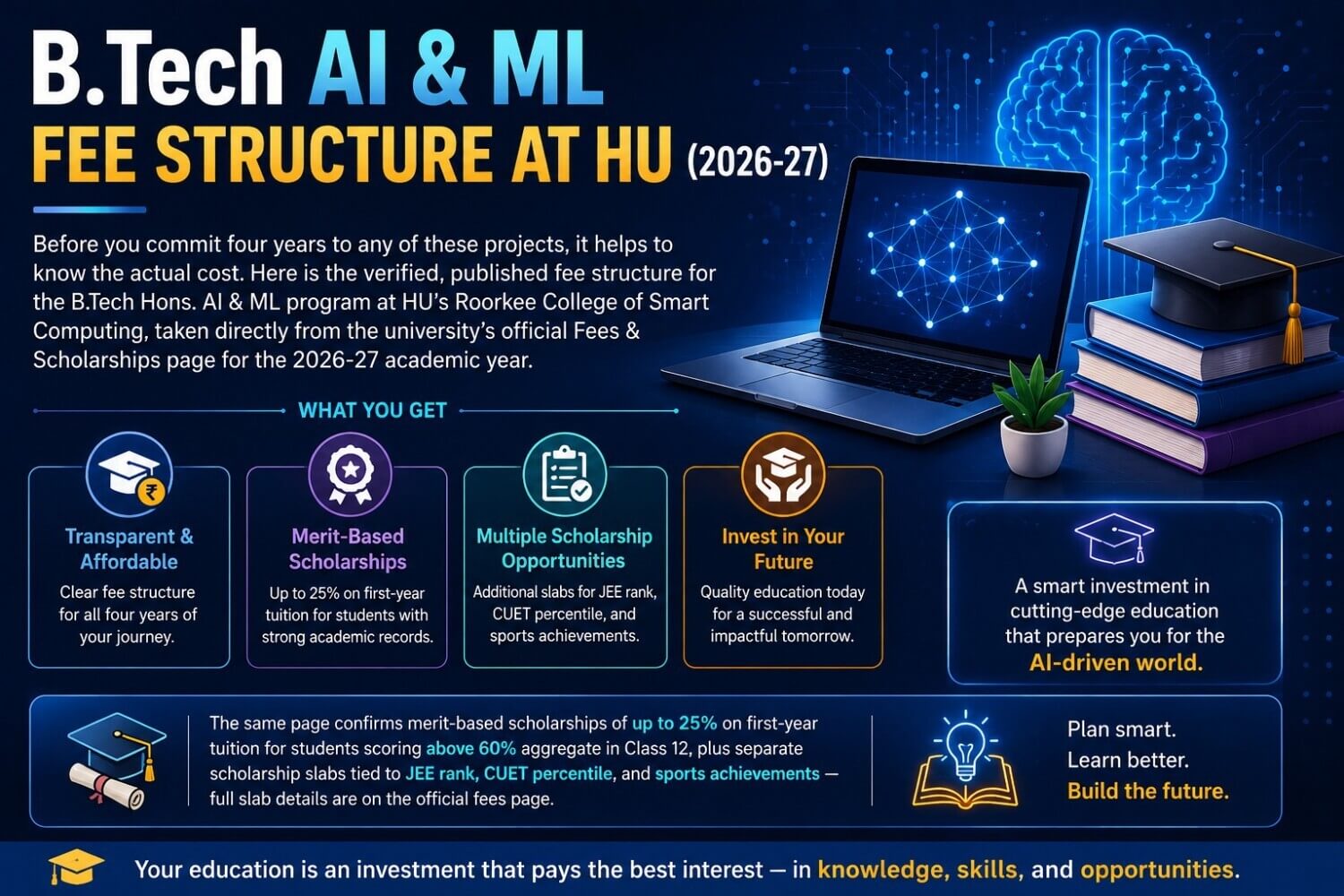
The same page confirms merit-based scholarships of up to 25% on first-year tuition for students scoring above 60% aggregate in Class 12, plus separate scholarship slabs tied to JEE rank, CUET percentile, and sports achievements — full slab details are on the official fees page.
4. HU's Verified Placement & Recruiter Record
Projects only matter if they eventually lead to a job — so it's worth looking at where HU students actually get placed. According to the university's official Placement Overview page, Haridwar University was the first university in North India to formally partner with NASSCOM Foundation and L&T EduTech to deliver practical, application-oriented industry training to students — directly relevant to the applied AI/ML projects in this guide.
The same page lists recent top recruiters including:
Building the ten projects in this guide is exactly the kind of preparation recruiters from these companies screen for at the resume-shortlisting stage.
5. Government Support for AI Education in India
It's not just universities pushing applied AI education — the Government of India is putting real money behind it too. Beyond the IndiaAI Mission figures cited earlier, HU itself operates under the regulatory oversight of national bodies: the All India Council for Technical Education (AICTE), which approves and monitors technical programs including B.Tech AI & ML, and the University Grants Commission (UGC), which recognises the university's degrees nationally. Both are official Government of India regulatory bodies, and their approval is a baseline check worth verifying for any engineering program you shortlist.
6. HU AI Labs — Where You'll Build These
You don't need to assemble all of this alone. The Roorkee College of Smart Computing at Haridwar University runs dedicated AI Labs with mentor-led project sprints and hackathons, where a list like this one turns into an actual working prototype over the course of a semester.
What separates a half-finished GitHub repo from something you can talk through confidently in a placement interview is usually the mentorship along the way — which is why so many students pick these hands-on AI/ML builds as their semester deliverables rather than one-off tutorials. Students also get access to placement support and research guidance for those who want to push a project into a publishable paper.
Curious about the curriculum, labs, and faculty behind these projects?
→ See B.Tech AI & ML at HUWhichever band you start from, treat this list as a roadmap rather than a checklist — a beginner classifier in Year 1 and an MLOps pipeline in Year 4 tell a coherent growth story that recruiters notice. If you're comparing fees and scholarships before committing to a program, HU's merit-based scholarships on JEE rank, board percentage, and CUET score are worth checking before admission season closes.
Ready to start building your own AI portfolio?
→ Apply B.Tech AI & ML at HU7. Frequently Asked Questions (FAQs)
1. Which AI project should a first-year B.Tech student start with?
Start with the Sentiment Classifier or the Image Classifier. Both run on public datasets with plenty of documentation and beginner-friendly libraries, so you get through the whole workflow — loading data, training, evaluating — without fighting infrastructure along the way.
2. Do I need a powerful laptop or GPU to build these projects?
No. Beginner and most intermediate projects run comfortably on a standard laptop using free cloud GPUs from Google Colab. For advanced projects like LLM fine-tuning, the government-backed IndiaAI Compute facility now offers GPU access at a subsidised rate of about ₹65 per hour, and university labs typically provide additional access.
3. How long does it take to build one project end-to-end?
A beginner project can be completed in one to two weeks of part-time effort. Intermediate projects usually take three to four weeks, while advanced and portfolio-grade projects — especially multi-agent systems and MLOps pipelines — are better planned as a full-semester deliverable.
4. Are these projects enough to get shortlisted for AI/ML internships?
They help a lot. Recruiters are scanning resumes for actual evidence of applied skills, and a GitHub profile that shows progress from classical ML through to GenAI and deployment gives them exactly that. Add a clear README and a short demo video and the effect is even stronger.
5. Should I build these projects solo or in a team?
Solo works fine for beginner and intermediate projects. Once you get to the advanced and portfolio-grade builds — the multi-agent system and the MLOps pipeline especially — a small team of two or three is closer to how these get built in industry, and it reads stronger on a resume too.
6. What datasets are safe and legal to use for these projects?
Kaggle, the UCI Machine Learning Repository, and Hugging Face Datasets all publish datasets under clear public licences — stick to those. If you're collecting your own data instead, say campus footage for the safety app, get explicit consent first and strip out anything that identifies a person.
7. How do I showcase these projects effectively to recruiters?
Put the code on GitHub with a proper README, get at least one project actually deployed — a free-tier host is enough — and write a short LinkedIn post walking through the problem, what you did, and how it turned out. One working demo link does more for you than a dozen resume bullets ever will.
8. Is Haridwar University's AI & ML program officially recognised?
Yes. Haridwar University operates under the regulatory oversight of the AICTE and is recognised by the UGC, both official Government of India bodies, as confirmed on the university's own admissions pages.
9. Does Haridwar University support students in building these AI projects?
Yes. The AI Labs under the B.Tech AI & ML program, combined with HU's NASSCOM Foundation and L&T EduTech partnership, provide mentorship, industry-oriented training, and hackathon-style sprints specifically designed around project-based learning.