

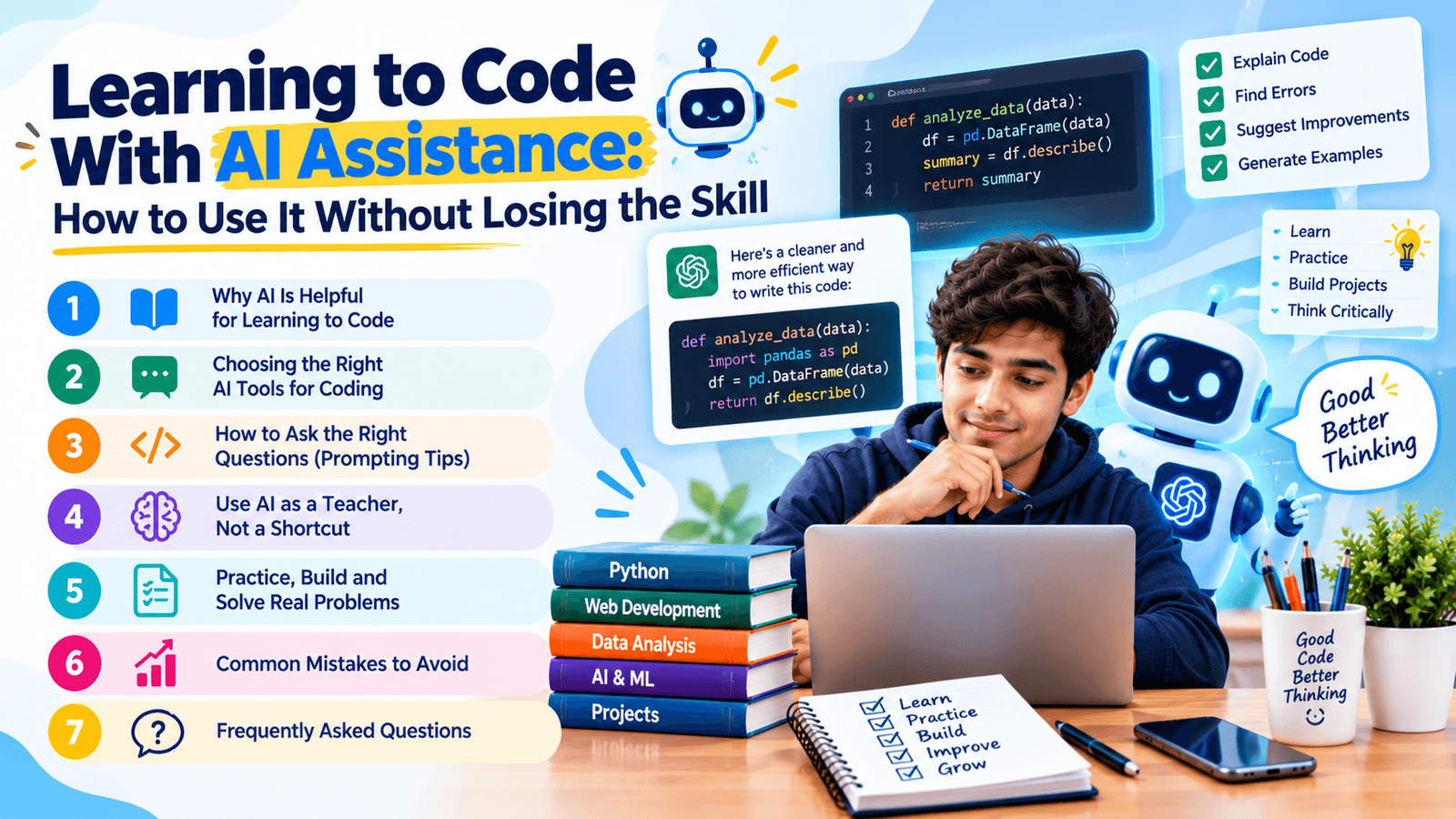
Ask a first-year student how their last program finally ran and there is a fair chance the answer is “the chatbot fixed it.” Nothing wrong with that, until exam day arrives and the chatbot isn't in the room. Learning to Code With AI Assistance can speed you up, but only if you stay the person doing the thinking.
Used carelessly, it swaps practice for copy-paste, and deliberate practice is the only thing that builds enduring programming skill. This guide covers what empirical research reveals, a simple 3-step routine to follow, and how students at Haridwar University can keep their core computer science fundamentals razor-sharp.
Quick Comparison: AI as a Tutor vs AI as a Shortcut
Table of Contents
- 1. What the Research Says About AI and Coding Skills
- 2. A Think-First Routine That Keeps You in Charge
- 3. Build the Basics Away From the Chatbot
- 4. Debugging and Code Review: The Skills AI Can't Hand You
- 5. Use AI Safely, Privately and Honestly
- 6. Where Haridwar University Fits Into Skill-First Learning
- 7. Frequently Asked Questions (FAQs)
- 8. Stay in Charge of the Code You Write
1. What the Research Says About AI and Coding Skills
Start with what industry developers report in global practice. The Stack Overflow Developer Survey 2026 (AI Chapter) found that 48% of respondents trust AI answers only when they can easily verify them independently. Furthermore, concern over losing programming skills to AI, cited by 17%, was the single most-reported reason for developers avoiding AI tools in professional and academic settings.
Beginners have even greater cause for deliberate caution. In a randomized controlled trial published via arXiv (2601.20245, Shen & Tamkin), researchers affiliated with Anthropic examined 52 developers learning an unfamiliar Python library—half using an AI coding assistant and half working without one.
The findings were revealing:
- The AI-assisted cohort scored 17% lower overall on subsequent comprehension evaluations, with the widest performance deficit appearing in complex debugging tasks.
- However, the research did not condemn AI assistance itself. The three usage cohorts that averaged 65% to 86% comprehension actively used AI to ask conceptual questions, requested line-by-line theoretical explanations, and posed follow-up queries to understand the code logic.
- Conversely, the cohorts that averaged a meager 24% to 39% were those who passively instructed the AI to write entire routines or resolve bugs without self-reflection.
The takeaway for computer science and engineering students is unequivocal: AI does not erode your skills; using AI as an intellectual shortcut does.
2. A Think-First Routine That Keeps You in Charge
To ensure AI augments your technical abilities rather than replacing them, integrate this straightforward three-step protocol into your daily programming workflow:
Step 1: Try the Problem Yourself First
Give every programming assignment at least ten honest, uninterrupted minutes before opening a chat window. Write down the algorithmic steps in pseudocode, sketch the loop iterations on paper, or write a rough function that fails. That initial attempt exposes exactly where your mental model stops. If you skip this step, every AI answer looks deceptively intuitive.
Step 2: Ask for Explanations, Not Answers
Replace prompts like “Write a Python script to sort this dictionary” with “Why does my nested loop cause an IndexError on edge cases?” or “What is the algorithmic time complexity tradeoff between a list and a set here?” Conceptual inquiries were the hallmark of top-performing developers in empirical trials.
Step 3: Retype It, Then Deliberately Break It
Never copy-paste generated code into your IDE. Minimize the chat interface, retype the solution from memory, alter key parameters, and predict how the program will react when you pass unexpected inputs. The cognitive struggle of translating thought into code is where true neuroplastic learning happens.
When a complex computational concept still does not click after genuine self-effort, seek guidance from peers and mentors. Haridwar University's Student Welfare Service maintains dedicated Student Care Centres in each academic block, fostering active faculty-student mentoring, academic counselling, and peer tutorial support.
3. Build the Basics Away From the Chatbot
Certain computer science proficiencies cannot be accelerated through prompts; they require slow, structured, deliberate immersion.
For foundational pythonic concepts, standard academic curricula like the NPTEL Chennai Mathematical Institute course, Programming, Data Structures and Algorithms Using Python (Prof. Madhavan Mukund), provide the rigorous mathematical grounding required to evaluate whether generated algorithms are optimal or fundamentally flawed.
Complement formal lectures with primary reference sources such as the Official Python Tutorial (Python Software Foundation). Reading official technical documentation instills an essential developer habit that AI summaries bypass: locating authoritative syntax specifications, understanding standard library nuances, and validating edge behaviors.
Use AI assistance as a secondary testing tool. Once you have studied a topic from a textbook or lab manual, ask an LLM to generate challenging practice scenarios, solve them independently, and maintain a personal handwritten Error Log documenting every bug you resolved independently.
4. Debugging and Code Review: The Skills AI Can't Hand You
In 2026, generating boilerplate code has become commoditized. The premium in the software industry has shifted decisively toward engineers who can analyze, verify, secure, and debug complex distributed systems.
According to the Stack Overflow 2026 findings, 69% of developers use AI to generate code in familiar domains, and 64% leverage it for debugging and refactoring. However, reviewing generated code requires a higher level of architectural comprehension than writing basic code from scratch.
To hone this skill during your undergraduate or postgraduate studies:
- Always parse and interpret the error stack trace before querying any external assistant.
- Write unit tests for edge cases (null inputs, empty arrays, extreme values) for any generated function.
- Conduct peer code reviews with classmates to cultivate critical evaluation skills.
At Haridwar University, the Roorkee College of Smart Computing designs curricula centered on hands-on laboratory exercises, capstone engineering projects, real-world internships, hackathons, and open-source contributions—ensuring students possess verified problem-solving capabilities that hold up under technical interview scrutiny.
5. Use AI Safely, Privately and Honestly
Professional software engineering entails ethical, regulatory, and security considerations. Adhere to three non-negotiable standards when employing AI in your coding coursework:
- Data Privacy & Statutory Compliance: Never feed proprietary datasets, student records, personal identifiers, or API credentials into third-party cloud tools. India's Digital Personal Data Protection Act (DPDP Act 2023) mandates strict standards for processing digital personal data. Professional compliance habits must begin during university projects.
- Security & Package Hallucinations: LLMs frequently recommend deprecated libraries or invent non-existent package names ("package hallucinations") that malicious actors exploit via typosquatting. Always verify library existence via official package indexes (PyPI, npm) before installation.
- Academic Integrity & Transparency: Abide by departmental guidelines regarding generative AI usage in submitted assignments. Disclose when AI tools aided in exploratory research, and ensure you can defend every algorithm during oral examinations (viva voce).
6. Where Haridwar University Fits Into Skill-First Learning
A formal degree programme provides structural advantages that no standalone online chatbot can match: an industry-aligned syllabus, real-time lab mentoring, collaborative peer environments, and rigorous evaluative benchmarks.
The Roorkee College of Smart Computing at Haridwar University offers specialised degree pathways tailored to the evolving technological ecosystem:
- B.Tech. (Hons.) in Computer Science & Engineering, AI & Machine Learning, Cyber Security, and Data Science.
- BCA with specialized tracks in AI & ML, Data Science, and Cyber Security.
- MCA with Artificial Intelligence integration.
- M.Tech. in Computer Science and Engineering.
Source: Verified from Haridwar University Fee Structure 2026-27. Charges include tuition, examination, enrolment, and uniform fees. Hostel accommodation and transportation are charged separately.
Merit Scholarships & Financial Aid: HU rewards academic achievement with first-year tuition scholarships spanning 10% to 80% based on JEE Main ranks, Class 12 aggregate percentages, or CUET scores. In addition, female candidates receive a 25% first-year tuition scholarship, and sports achievements grant 10% to 50% fee concessions. Consistent academic toppers scoring 85%+ in semester examinations earn an additional ₹5,000 Academic Excellence award.
On the placement front, HU's Corporate Training & Placement Cell maintains active hiring connections with leading technology firms, providing industry guest lectures, live project internships, and structured pre-placement interview coaching. Prospective students can review the seamless admission procedures on the HU Admission Overview page.
7. Frequently Asked Questions (FAQs)
Is it okay to use AI while learning to code?
Yes, provided you use it to deepen conceptual comprehension rather than replace your own problem-solving effort. Attempt the exercise first, ask why an algorithm works, and retype the code yourself. Your objective is to explain every line you write.
How do I know if I'm relying on AI too much?
Close your AI chat assistant and tackle a related coding problem from scratch. If you are unable to structure the basic logic, or cannot explain code you submitted last week, you are over-reliant. Dial back and restrict your prompts to conceptual explanations only.
Which programming language should a beginner start with?
Python is an excellent introductory language due to its readable syntax and comprehensive standard library documentation. Commit to one language for at least 4 to 6 months before diversifying into C++, Java, or JavaScript.
Can AI replace learning data structures and algorithms?
No. Strong foundations in data structures and algorithmic complexity (Big-O notation) are essential to determine whether generated code is scalable, memory-efficient, and correct under edge cases.
Is AI-generated code safe to use in projects?
Always treat generated code as unreviewed. Verify that referenced packages are authentic, sanitize inputs against injection vulnerabilities, and avoid committing hardcoded credentials or sensitive personal information.
Which Haridwar University programmes suit someone who wants to code?
Roorkee College of Smart Computing offers B.Tech. Hons. CSE, AI & ML, Cyber Security, and Data Science, alongside BCA, MCA with AI, and M.Tech. Check HU's academic programmes for comprehensive curriculum details.
What are the fees for B.Tech. CSE and BCA at HU?
Under the 2026-27 fee structure, B.Tech. Hons. CSE is ₹1,32,000 in Year 1 and ₹1,15,000 annually for Years 2 to 4. BCA is ₹82,000 in Year 1 and ₹65,000 annually for Years 2 and 3.
Are scholarships available for computing students at HU?
Yes. First-year merit scholarships range from 10% to 80% of tuition, girl students receive 25%, and sports quota awards grant 10% to 50% tuition support.
How can I apply to Haridwar University?
You can complete the online application form on HU's Apply Now portal or visit the campus admission cell in Roorkee. Seat confirmation requires a ₹25,000 registration advance.
8. Stay in Charge of the Code You Write
Learning to code with AI assistance isn't about shunning modern tools or pretending LLMs don't exist. It is about establishing disciplined professional habits so that when the assistant is unavailable, wrong, or offline, you still understand every line of logic and know exactly what to build next.
Treat AI as an on-demand technical tutor, not an intellectual proxy. Keep your fundamentals solid, build projects that stretch your problem-solving endurance, and ensure you remain the software engineer driving the solution.
Master Modern Computing & AI Engineering at Haridwar University
Step into future-ready engineering with industry-aligned B.Tech., BCA, and MCA programmes at Roorkee College of Smart Computing. Learn hands-on development, AI architecture, and secure software engineering with state-of-the-art computing labs.