

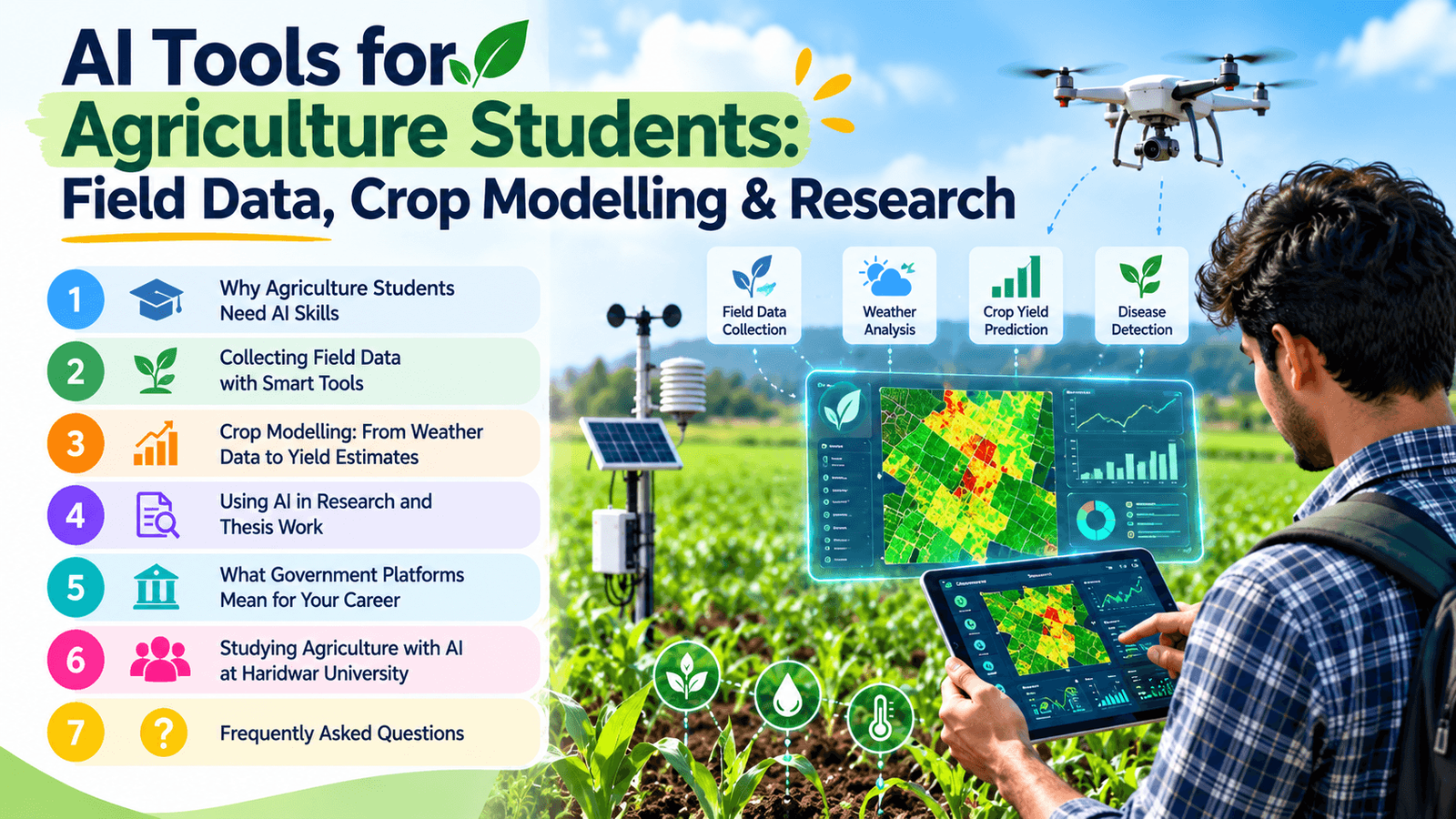
AI Tools for Agriculture Students: Field Data, Crop Modelling & Research
Dr. Roshan Kumar Thakur
HOD, Agricultural Sciences, Haridwar University
AI Tools for Agriculture Students are no longer something only computer science laboratories talk about. A student who walks a wheat experimental plot in the morning can photograph leaf damage, log soil electrical conductivity readings on a smartphone, and run a calibrated yield estimate before dinner.
At Haridwar University, established in 2010 on an expansive 20-acre campus beside the Ganga Canal in Roorkee (learn more on our About Us page), agricultural sciences sit directly alongside computing, engineering, and management. This interdisciplinary environment ensures the digital side of farming is always within reach. This guide explains where AI genuinely aids agricultural students, which open data portals are worth learning, and how our specialized degree programmes are structured.
Table of Contents
- 1. Why Agriculture Students Need AI Skills
- 2. Collecting Field Data with Smart Tools
- 3. Crop Modelling: From Weather Data to Yield Estimates
- 4. Using AI in Research and Thesis Work
- 5. What Government Platforms Mean for Your Career
- 6. Studying Agriculture with AI at Haridwar University
- 7. Frequently Asked Questions
1. Why Agriculture Students Need AI Skills
Farming generates continuous data: precipitation, soil nutrient ratios, canopy height, pest counts, market arrivals, and fluctuating mandi prices. Historically, most of this data remained trapped in field notebooks or unstructured phone galleries. That is where AI creates real value—enabling students to clean, compare, and forecast rather than relying on guesswork.
At Haridwar University, the Roorkee College of Agricultural Sciences places precision farming, crop observation, and field internships at the center of student training.
Crucially, technology never replaces field agronomy. A computer vision model may flag leaf chlorosis, but only a trained student can inspect the lower stem, assess fungal sporulation, and determine whether the symptom reflects nitrogen deficiency or root rot. AI is a powerful assistant, not a substitute for ground truth.
2. Collecting Field Data with Smart Tools
Trustworthy models depend on high-quality field records. Before applying machine learning algorithms, students must cultivate the habit of systematically recording observations with date, growth stage, plot ID, and GPS coordinates. Consistency matters far more than sheer volume: 50 clean, well-annotated samples provide far higher analytical utility than 500 noisy images.
Soil and Plot Records
Soil parameters form the cornerstone of balanced nutrition. India's Soil Health Card Scheme (launched in February 2015) was designed to evaluate soil nutrient status nationwide. Adopt that structured methodology for your university plots: record sampling points, nitrogen-phosphorus-potassium (NPK) values, micronutrient levels, and organic carbon, then track seasonal variations over successive crop rotations.
Plant Imagery and Mobile Sensors
Automated pest and disease identification is one of the most accessible applications of deep learning. In Haridwar University's specialized B.Sc. Agriculture (Hons.) with AI programme, students learn computer vision for foliar disease classification, automated soil mapping, and predictive yield estimation using structured frameworks.
3. Crop Modelling: From Weather Data to Yield Estimates
Crop simulation models (such as DSSAT and APSIM) require daily meteorological records, soil physical properties, and management practices. Gathering daily solar radiation and rainfall from individual field gauges can be slow and fragmented.
NASA's POWER Project provides free global access to satellite and model-derived meteorological data specifically formatted for agroclimatology (NASA Technical Documentation). Students can download point or regional weather datasets in standard DSSAT formats for direct model integration.
A Structured Student Modelling Workflow
- Extract latitude and longitude coordinates for your experimental research plot.
- Download daily minimum/maximum temperature, solar radiation, and precipitation for the full crop duration.
- Input sowing date, cultivar coefficients, irrigation schedule, and initial soil moisture.
- Simulate phenological growth stages and compare predicted biomass/yield against actual harvested crop data.
4. Using AI in Research and Thesis Work
Research is where AI tools save the most time when handled ethically. Large language models can assist with structuring literature reviews and proofreading drafts, while Python and R packages streamline data cleaning, ANOVA calculations, and publication-ready charting.
Remember the golden rule of academic integrity: verify everything. AI summaries are starting points, never citations. Raw field measurements must remain archived, and every statistical claim must be backed by reproducible code. Haridwar University offers post-graduate M.Sc. Agriculture (Agronomy) and Ph.D. in Agriculture programmes, providing a seamless pathway from undergraduate experimentation into peer-reviewed research. When navigating academic deadlines, students have access to dedicated institutional guidance through the HU Student Welfare Service.
5. What Government Platforms Mean for Your Career
Public investments signal massive career shifts. On 2 September 2024, the Union Cabinet approved the Digital Agriculture Mission with an outlay of ₹2,817 crore (PIB Digital Agriculture Release). The mission establishes AgriStack (integrating a Farmers' Registry, geo-referenced village cadastral maps, and Crop Sown Registry) and the Krishi Decision Support System (Krishi DSS).
These national initiatives create significant career opportunities for agricultural graduates who understand remote sensing, geospatial analytics, and soil profile databases. To explore how soil health parameters are systematically categorized across India, explore the national Soil Health Card Portal.
6. Studying Agriculture with AI at Haridwar University
Haridwar University is AICTE approved and UGC recognised, as detailed in the HU Admission Overview. Our agricultural college offers B.Sc. Agriculture (Hons.) with AI (with ICAR-aligned syllabus), M.Sc. Agriculture (Agronomy), and Ph.D. programmes. Admission eligibility requires 10+2 (Science) with Biology / Agriculture and a minimum of 50% marks, with selection via JEE Main, State Agricultural Entrance Examinations, or qualifying merit.
Fee Structure (Roorkee College of Agricultural Sciences)
Figures published on Haridwar University's official Fees and Scholarships page (verified October 2026). Total amounts include tuition, enrollment, admission, examinations, and uniform fees.
| Programme | Tuition Fee | 1st Year Total | Subsequent Years |
|---|---|---|---|
| B.Sc. Agriculture (Hons.) with AI (4 Years) | ₹40,000 | ₹87,000 | ₹70,000 per year (2nd to 4th) |
| M.Sc. Agriculture (Agronomy) (2 Years) | ₹40,000 | ₹77,000 | ₹60,000 (2nd year) |
| Ph.D. in Agriculture | ₹80,000 | ₹1,00,000 | ₹90,000 per year (2nd & 3rd) |
Scholarships and Hostel Facilities
Merit-based scholarships on first-year tuition range from 10% to 80% (above 90% earns 80%, above 80% to 90% earns 50%, above 70% to 80% earns 20%, and above 60% to 70% earns 10%). A 25% first-year tuition waiver supports girls' education, and students maintaining 85%+ semester scores earn a ₹5,000 Academic Excellence award. Annual hostel accommodation fees range from ₹85,000 (Standard), ₹95,000 (Semi-Deluxe), to ₹1,05,000 (Deluxe AC), inclusive of mess meals and laundry.
Ready to combine core agricultural sciences with modern AI and precision technologies?
Build Your Skills at HU → Roorkee College of Agricultural Sciences
7. Frequently Asked Questions
Which AI tools for agriculture students are best to learn first?
Start with a smartphone camera and a habit of labelling images, a spreadsheet, and basic Python or R. Then practise with free NASA POWER weather data and the Soil Health Card portal.
Do I need coding skills to use AI in agriculture?
Not on day one, because many tools work through menus and uploads. Basic coding still helps you clean data, repeat analyses and understand what a model is doing.
Can AI replace field visits?
No. AI works only on the data you collect, and weak field observation gives weak predictions. Use it to support fieldwork, not to skip it.
Where can I find free weather data for crop modelling?
NASA's POWER project offers free meteorological and solar data, with agroclimatology as a target group. Enter coordinates, choose parameters, download, then compare with local readings.
What is the Digital Agriculture Mission?
It is a Government of India umbrella scheme approved on 2 September 2024 with an outlay of Rs. 2,817 crore. It builds AgriStack, the Krishi Decision Support System and soil profile maps.
What is the fee for B.Sc. Agriculture Hons. with AI at HU?
The first-year total is ₹87,000, of which tuition is ₹40,000. The second, third and fourth years cost ₹70,000 each. Transport and hostel are charged separately.
What scholarships can agriculture students get at HU?
First-year tuition scholarships range from 10% to 80% on merit, with 25% for girls' education and 10% to 50% under the sports quota. Only one scholarship can be claimed.
What is the eligibility for B.Sc. Agriculture Hons. with AI?
Applicants need 12th (Science) with Biology and at least 50% marks. Admission is through JEE Main, a State Agricultural Entrance Examination or merit.
How much does hostel accommodation cost at HU?
A normal room is ₹85,000, semi deluxe ₹95,000 and deluxe AC ₹1,05,000 per year, including lodging, mess and laundry. Non-veg meals cost ₹20,000 extra per year.
Shape the Future of Smart Farming at Haridwar University
Step into modern agriculture with B.Sc. Agriculture (Hons.) with AI and post-graduate agronomy programmes at Roorkee College of Agricultural Sciences. Master precision agriculture, remote sensing, and field data intelligence.