

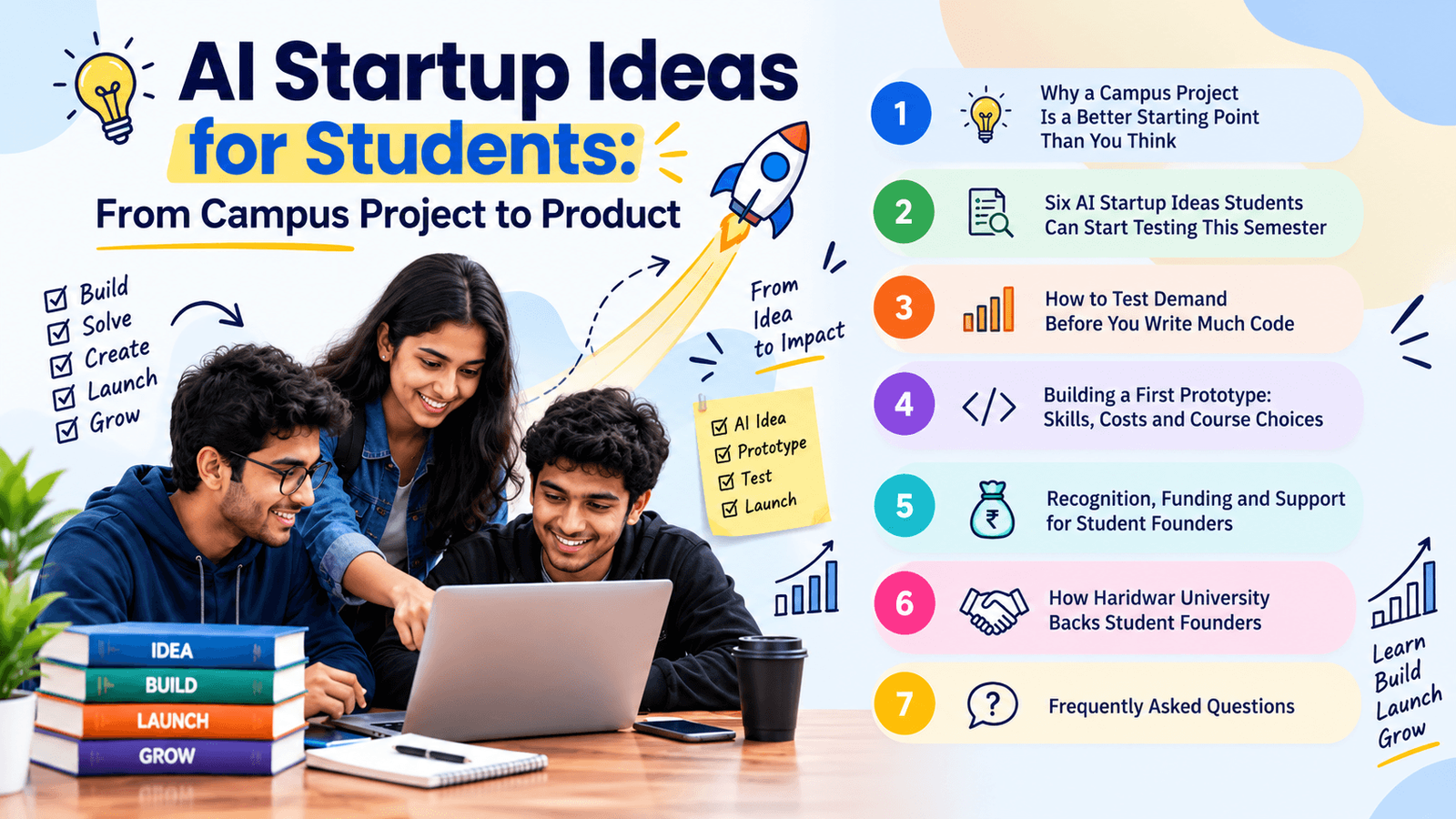
Every semester, a student somewhere builds a final-year project that quietly solves a real problem, gets evaluated by an internal examiner, and is never opened again. This guide is about changing that ending. If you want practical AI startup ideas for students that can be validated with one laptop, a few classmates, and the people already walking around your campus, read on.
Haridwar University, Roorkee began in 2010 and has grown into a multidisciplinary campus comprising engineering, smart computing, pharmacy, agriculture, management, and commerce. Being on such a diverse campus gives student founders an unusually broad view of real-world operational challenges worth solving. Below are six practical sections—from founder mindset and venture ideas to rapid demand testing, prototype building, government funding, and campus incubation.
Table of Contents
- 1. Why a Campus Project Is a Better Starting Point Than You Think
- 2. Six AI Startup Ideas Students Can Start Testing This Semester
- 3. How to Test Demand Before You Write Much Code
- 4. Building a First Prototype: Skills, Costs and Course Choices
- 5. Recognition, Funding and Support for Student Founders
- 6. How Haridwar University Backs Student Founders
- 7. Frequently Asked Questions (FAQs)
- 8. Turn Your Campus Project Into a Lasting Product
1. Why a Campus Project Is a Better Starting Point Than You Think
A startup rarely begins with a grand, world-changing vision. It begins with friction: a repetitive process that wastes hours, an official form nobody reads, an unaddressed student query, or a localized operational bottleneck.
University campuses are packed with these frictions. As a student, you already possess granular insider insight into timetable coordination hassles, attendance reporting, the struggle to find targeted mentorship, and the gap between curriculum notes and technical job interviews. That organic user insight is a founder's most potent initial advantage—and it costs absolutely zero capital.
The macroeconomic timing is also exceptionally favorable. In March 2024, the Union Cabinet approved the comprehensive IndiaAI Mission with an outlay of ₹10,371.92 crore, establishing subsidized public AI computing clusters of 10,000+ GPUs, indigenous foundational models, and dedicated venture financing mechanisms for homegrown AI startups.
A standard college project is judged once by an internal examiner for marks. A viable commercial product is judged every single day by active users who return to it, recommend it to friends, and eventually pay for its value.
2. Six AI Startup Ideas Students Can Start Testing This Semester
The following venture concepts do not require multi-million-dollar R&D facilities. Students at the Roorkee College of Smart Computing—whether enrolled in B.Tech. Hons. (AI & ML), BCA (AI & ML), or MCA with AI—can begin rapid prototyping on any of these this semester:
Idea 1: Adaptive Exam Revision & Study Planner
Feed the tool a course syllabus, sessional exam dates, and previous quiz scores. The model analyzes weak topics and generates a dynamic daily revision schedule. Start by testing it on a single difficult engineering subject with 20 classmates. If peers open it every morning before tests, you have validated your core demand signal.
Idea 2: Hyper-Local Vernacular Crop Advisory for Smallholders
Farmers need immediate answers regarding pest infestations, fertilizer dosage, and localized sowing windows. Build a voice-first Hindi conversational assistant grounded on verified ICAR and Krishi Vigyan Kendra advisories. Pair a computer science student with an agriculture student and validate it directly across farming blocks in Haridwar and Roorkee.
Idea 3: Multi-Generational Medication Regimen Assistant
Pharmacy and nursing students observe how frequently elderly patients mix up dosage timings and complex prescription names. Develop a computer-vision tool that scans prescription slips, generates pictorial reminders, and sends WhatsApp voice alerts to family caregivers. Keep it purely informational and strictly compliant with medical privacy standards.
Idea 4: AI Mock Interview Coach for Campus Placements
Engineering freshers often freeze during their first technical or HR interview. Build an interactive audio-visual coach that conducts role-specific interviews, flags repetitive filler words, analyzes speaking cadence, and provides constructive feedback on technical clarity. You and your batchmates serve as the initial test cohort.
Idea 5: Micro-Merchant Ledger Digitiser & Cash-Flow Helper
Local kirana stores, canteens, and stationery shops near campus still record customer credit (khata) in paper notebooks. A joint team of commerce and computing students can use OCR and lightweight LLMs to convert ledger snapshots into weekly sales summaries and automated payment reminders. Begin testing with three neighboring campus shops.
Idea 6: Automated Campus Sentiment & Grievance Analyser
Student feedback on hostel amenities, mess meals, laboratory equipment, and library books frequently gets buried inside static Google Forms. An NLP pipeline that clusters open-ended student comments, prioritizes recurring complaints, and tracks resolution timelines provides immense value to college administrators and can easily be packaged for other institutions.
For additional technical inspiration, explore our in-depth guides on generative AI project ideas and AI projects for engineering students.
3. How to Test Demand Before You Write Much Code
The costliest mistake made by student founders is locking themselves in a hostel room for four months writing 5,000 lines of code—only to discover that nobody actually wants the product.
Always validate user demand before writing backend code:
- Conduct 10 Qualitative Discovery Interviews: Sit down with 10 prospective target users. Do not pitch your AI idea. Instead, ask how they presently handle the task, how much time it consumes, and what workarounds they rely on. If they shrug and say it isn't an issue, pivot the idea immediately.
- Build a "Wizard of Oz" or No-Code Prototype: Assemble the simplest possible demonstration: an interactive spreadsheet, an automated WhatsApp bot, or a static landing page with an intake form. Fulfill the logic semi-manually behind the scenes to test whether users genuinely engage with the output.
- Track Retention and Willingness to Pay: After two weeks of active testing, evaluate three definitive metrics: Did users return voluntarily? Did they request expanded features? Would they pay a nominal subscription or fee to continue using it?
Structured incubation streamlines this crucial validation stage. The Haridwar University Incubation Centre fosters early-stage venture creation through formal pre-screening, faculty mentorship, prototype validation, industry networking, and commercialization guidance.
4. Building a First Prototype: Skills, Costs and Course Choices
A functional Minimum Viable Product (MVP) requires far fewer technical components than most candidates assume. Rather than spending weeks training heavy transformer models from scratch, integrate reliable pre-trained models via commercial or open-source APIs (such as OpenAI, Anthropic, or Hugging Face Inference Endpoints), wrapped in a responsive web frontend (FastAPI, React, or Streamlit) and a lightweight relational database.
Core Technical Stack: Python, basic linear algebra and statistics, data pre-processing, RESTful API design, and Git version control cover the vast majority of early AI architectures. More importantly, cross-pollinate with domain expertise: a computing tool built alongside an agriculture, pharmacy, or finance student immediately stands apart from generic classroom demos.
Prospective students and families evaluating academic programmes at Haridwar University can review the official, verified computing tuition schedules below:
Source: Verified from official Haridwar University Fee Structure 2026-27. Figures include tuition, enrollment, admission, examination, and uniform fees. Transportation and hostel accommodation are charged separately.
5. Recognition, Funding and Support for Student Founders
Once your prototype demonstrates consistent user engagement, formal recognition unlocks vital intellectual property protection, tax exemptions, and government funding pipelines.
DPIIT Startup Recognition: Student founders can register their incorporated entity (Private Limited Company or LLP) for recognition by the Department for Promotion of Industry and Internal Trade through the Startup India portal. The Ministry charges zero government fees, and recognition remains valid for up to 10 years from incorporation as per the official DPIIT user guide.
Seed Funding Channels: Flagship initiatives like the Startup India Seed Fund Scheme (SISFS) have provided up to ₹20 lakh as a proof-of-concept grant and up to ₹50 lakh via convertible debentures/debt for market commercialization. While the initial round of SISFS applications concluded on 31 May 2026 as per the official Seed Fund portal, retaining active DPIIT recognition positions your venture for state-level incubation grants, BIRAC BioNEST funds, and subsequent central ministry schemes.
Financing also extends to personal educational security. Haridwar University's Student Welfare Service assists students with bank loan applications covering tuition, hostel charges, books, and laptops through partner financial institutions (including SBI, PNB, and HDFC Bank). Its dedicated Student Care Centre guarantees grievance solutions within 24 hours, ensuring student entrepreneurs have a stable academic foundation.
6. How Haridwar University Backs Student Founders
Haridwar University's 20-acre lush green campus is situated on the banks of the Ganga Canal, five kilometers from Roorkee. Recognized by the UGC and approved by AICTE, HU brings together five constituent colleges on a unified campus, making interdisciplinary founder collaboration effortless.
The campus actively fosters student innovation through the Institution's Innovation Council (IIC), regular national hackathon participation (see our guide on hackathons in India), and internal project funding.
Scholarship Architecture: To support ambitious learners, HU provides substantial first-year tuition fee waivers:
- Merit Scholarships: 10% to 80% tuition concession based on JEE rank, 10+2 PCM aggregate, or CUET score bands.
- Girls' Education Scholarship: 25% tuition fee waiver in the first year for female candidates.
- Sports Quota: 10% to 50% concession based on state and national athletic achievements.
- Academic Excellence Award: Cash award of ₹5,000 each semester for students securing 85%+ marks on their first attempt.
Admission details, eligibility criteria, and counseling steps are transparently detailed on the Haridwar University Admission Overview page. Seat confirmation involves a standard registration advance of ₹25,000.
7. Frequently Asked Questions (FAQs)
Can a first-year student start an AI startup?
Yes, but keep your initial scope disciplined. Validate problem demand through user interviews and simple spreadsheets before deep-diving into complex neural architectures. Partner with classmates possessing complementary strengths.
Do I need deep machine learning knowledge at the start?
Not necessarily. Most modern AI venture MVPs leverage pre-trained foundational models via cloud APIs. Your primary requirements are a well-defined customer pain point, solid Python fundamentals, and continuous real-world user feedback.
How much does an AI-focused course cost at HU?
As per the verified 2026-27 fee structure, B.Tech. Hons. (AI & ML) is ₹1,62,000 in Year 1 and ₹1,45,000 annually for subsequent years. BCA (AI & ML) totals ₹92,000 in Year 1 and ₹75,000 annually in Years 2 and 3.
What scholarships does HU offer?
HU provides first-year merit concessions from 10% to 80% on tuition, 25% for female students, and 10% to 50% for athletic achievements. Only one scholarship applies per student.
Does DPIIT recognition cost money?
No. The Ministry of Commerce and Industry charges zero application fees. Founders register directly on the Startup India portal or National Single Window System, and recognition remains valid for 10 years.
Can I still apply to the Startup India Seed Fund Scheme?
The initial SISFS call closed on 31 May 2026. However, completing DPIIT recognition keeps your startup prepared for follow-on schemes, regional incubator allocations, and state venture funds.
Can I run a startup alongside my degree?
Yes. Many successful founders started during their college years. Coordinate early with faculty advisors, utilize campus incubation resources, and align venture development around semester milestones.
Which skills should I learn first?
Focus on Python, basic statistics, API development, version control with Git, and frontend wireframing. Pair technical fluency with deep domain knowledge in a field like agriculture, healthcare, or retail.
How do I apply at HU?
Begin on the official HU Apply Now portal or visit the university admission cell in Roorkee. Seat confirmation requires a standard ₹25,000 registration advance.
8. Turn Your Campus Project Into a Lasting Product
The difference between an archived college assignment and a thriving tech startup is not the complexity of the neural network—it is whether someone uses it to solve a real, recurring problem.
Step outside the classroom, observe operational inefficiencies across industries, build your prototype with focus, and take full advantage of university incubation. The next transformative AI product could easily start in your hostel room.
Transform Your AI Project Into a High-Growth Venture at Haridwar University
Join industry-recognized B.Tech., BCA, and MCA computing programmes backed by active campus incubation, faculty mentorship, advanced computing labs, and early-stage startup support.