

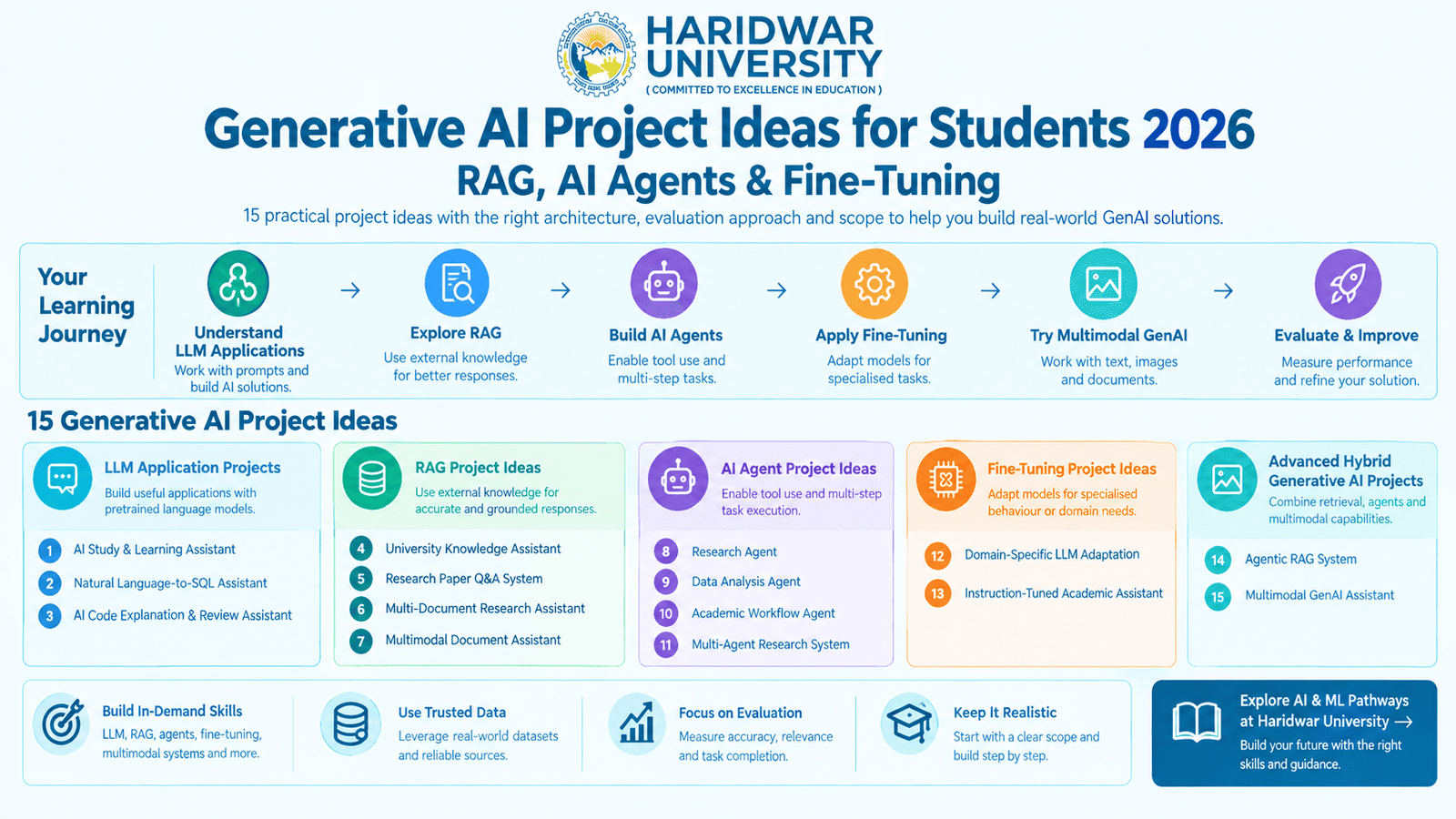
Generative AI Project Ideas for Students 2026: RAG, AI Agents & Fine-Tuning
Dr. Rohit Kumar
Head, Computer Applications, Haridwar University
Roorkee College of Smart Computing | Generative AI Project Roadmap
Architectural decision framework covering RAG, AI agents, parameter-efficient fine-tuning (PEFT), and multimodal GenAI systems.
Generative AI projects are moving rapidly beyond simple chatbot demonstrations. Students can now build systems that retrieve information from private documents, use tools to complete multi-step tasks, adapt pretrained models to specialised domains, and combine text with images or documents.
But this also creates a critical engineering problem: a student project can sound advanced simply because it includes an LLM, RAG, or an AI agent. That buzzword inclusion does not necessarily make the underlying project academically strong, reproducible, or technically sound.
“What specific problem are you solving, and which Generative AI architecture actually fits it?”
This guide brings together 15 generative AI project ideas for students, organized around that fundamental architectural decision. The focus is not simply on collecting flashy project names. Each idea is connected to an appropriate architecture, technical scope, and rigorous evaluation approach.
For a broader collection covering traditional AI, machine learning and other engineering applications, see HU's guide to 25 AI Projects for Engineering Students. This article takes a narrower, deeper approach to GenAI project ideas, particularly RAG, AI agents, fine-tuning, and multimodal systems.
Table of Contents
1. How to Choose a Generative AI Project by Architecture
2. Master Table: 15 Generative AI Project Ideas for Students
3. LLM Application Project Ideas (Projects 1–3)
4. RAG Project Ideas for Knowledge-Based Applications (Projects 4–7)
5. AI Agent Project Ideas for Multi-Step Tasks (Projects 8–11)
6. Fine-Tuning Project Ideas for Specialised Models (Projects 12–13)
7. Advanced Hybrid Generative AI Project Ideas (Projects 14–15)
8. How to Evaluate a Generative AI Project Properly
9. How to Scope a GenAI Project for Final-Year Work
10. Frequently Asked Questions (FAQs)
11. Choosing the Right GenAI Architecture & Academic Pathways at HU
1. How to Choose a Generative AI Project by Architecture
Not every GenAI problem requires an autonomous AI agent or full parameter fine-tuning. In fact, adding unnecessary architectural complexity can make an undergraduate or postgraduate student project significantly harder to debug, test, benchmark, and defend in a technical viva.
A practical, industry-standard architectural selection framework is summarized below:
| Project Requirement | Architecture to Consider |
|---|---|
| Generate or transform text | LLM application |
| Answer questions using private or changing information | Retrieval-Augmented Generation (RAG) |
| Complete tasks using external tools | AI agent |
| Adapt a model to specialised behaviour or terminology | Fine-tuning (PEFT / LoRA) |
| Work with text plus images/documents | Multimodal GenAI |
| Retrieve information and then take actions | Agentic RAG |
Retrieval-Augmented Generation (RAG)
RAG connects an LLM to information retrieved from external knowledge sources. Google describes it as a way to ground model responses using retrieved knowledge, providing access to private, changing data beyond the cutoff date of training.
AI Agents (Tool Use & Planning)
An AI agent goes further by allowing a model to reason about a task, invoke tools, and execute actions. Anthropic distinguishes agents from fixed workflows because agents dynamically direct their own processes and decide when to call tools.
Fine-Tuning & PEFT
Fine-tuning adapts a pretrained model to a specific task or stylistic domain using supervised data. Parameter-Efficient Fine-Tuning (such as LoRA) updates a fraction of parameters, making adaptation feasible on student computing hardware.
That distinction should shape your project proposal long before you write your first line of Python or select an API framework.
2. Master Table: 15 Generative AI Project Ideas for Students
The following projects move deliberately from relatively accessible LLM applications towards RAG, autonomous agents, fine-tuning, and hybrid multimodal systems:
| # | Project | Main Architecture | Difficulty |
|---|---|---|---|
| 1 | AI Study & Learning Assistant | LLM + structured prompting | Beginner–Int |
| 2 | Natural Language-to-SQL Assistant | LLM + database tools | Intermediate |
| 3 | AI Code Explanation & Review Assistant | LLM + code analysis | Intermediate |
| 4 | University Knowledge Assistant | RAG | Intermediate |
| 5 | Research Paper Q&A System | RAG | Intermediate |
| 6 | Multi-Document Research Assistant | RAG | Int–Advanced |
| 7 | Multimodal Document Assistant | Multimodal RAG | Advanced |
| 8 | Research Agent | Agent + search/tools | Advanced |
| 9 | Data Analysis Agent | Agent + Python/data tools | Advanced |
| 10 | Academic Workflow Agent | Agent + workflow tools | Advanced |
| 11 | Multi-Agent Research System | Multi-agent architecture | Advanced |
| 12 | Domain-Specific LLM Adaptation | Fine-tuning / PEFT | Advanced |
| 13 | Instruction-Tuned Academic Assistant | Fine-tuning / PEFT | Advanced |
| 14 | Agentic RAG System | RAG + agent | Advanced |
| 15 | Multimodal GenAI Assistant | Multimodal + tools | Advanced |
This progression is deliberate. Students can begin with a structured LLM application, understand document chunking and vector retrieval, then move towards controlled tool use and parameter adaptation rather than attempting to construct a fragile autonomous multi-agent system from day one.
For students who need a comprehensive foundation in conventional machine learning workflows before advancing into GenAI, HU's 20 Machine Learning Projects for Beginners: Datasets, Code & Learning Paths covers classification, regression, NLP, computer vision, and standard evaluation metrics.
3. LLM Application Project Ideas (Projects 1–3)
1. AI Study & Learning Assistant
Beginner–IntermediateBuild an AI assistant that helps students understand course material, generate practice questions, and explain difficult academic concepts. Keep the project strictly focused on a defined subject or curriculum (e.g., Data Structures or Operating Systems) rather than trying to build a generic, unfocused tutor.
2. Natural Language-to-SQL Assistant
IntermediateCreate an intelligent query pipeline that converts natural language questions into syntactically valid and semantically accurate SQL queries against a structured academic or relational business database.
3. AI Code Explanation & Review Assistant
IntermediateDevelop an assistant that parses source code, identifies syntax vulnerabilities or logical bottlenecks, explains time/space complexity, and suggests idiomatic refactoring for defined languages (such as Python, Java, or C++).
4. RAG Project Ideas for Knowledge-Based Applications (Projects 4–7)
Retrieval-Augmented Generation (RAG) is particularly valuable when the system's accuracy depends on information outside the foundational model's built-in weights. A student should build a tightly curated, validated knowledge base rather than attempting an unmanageable general-purpose web crawler.
RAG is not automatically reliable simply because vector retrieval is wired up. Google researchers emphasize that retrieval quality is critical: retrieving irrelevant, noisy, or truncated chunks will directly mislead the language generator, causing hallucinated or out-of-context outputs.
4. University Knowledge Assistant
IntermediateCreate an accurate, grounded question-answering assistant over university academic regulations, degree syllabus documents, hostel rules, or admission circulars.
5. Research Paper Q&A System
IntermediateAllow researchers and students to upload a collection of academic papers (arXiv or conference publications) and pose deep cross-cutting inquiries across them.
6. Multi-Document Research Assistant
Intermediate–AdvancedBuild a system that ingests conflicting or complementary technical reports, market summaries, or research articles, synthesizes the core findings, and generates a structured executive research brief.
7. Multimodal Document Assistant
AdvancedExtend retrieval beyond raw ASCII text to technical PDFs containing complex tabular data, mathematical charts, flowcharts, and embedded schematics. This project represents an ideal intersection between NLP, vector retrieval, and computer vision.
For deeper study into text representation and retrieval, read HU's Natural Language Processing Project Ideas: 20 NLP Projects from Beginner to Advanced, which details the step-by-step evolution from bag-of-words to Transformer embeddings.
5. AI Agent Project Ideas for Multi-Step Tasks (Projects 8–11)
AI agents become essential when the system must execute concrete actions rather than simply generating descriptive text. A student can connect an agent to a calculator, SQL database, Python REPL, web search API, or file system tool.
Anthropic advises developers to start with the simplest workflow possible and add autonomous agentic loops only when they provide a measurable, indispensable benefit. Unbounded agents significantly increase latency, operational costs, and the risk of cascading errors across multi-step execution chains.
8. Research Agent
AdvancedConstruct an autonomous agent that takes a complex topic, formulates targeted sub-queries, searches verified open-access archives, evaluates source credibility, extracts key data points, and compiles a comprehensive research summary.
9. Data Analysis Agent
AdvancedEquip the agent with structured CSV/Parquet datasets and a secure sandboxed Python environment. Given a research question, the agent inspects column distributions, writes pandas/numpy code, generates visualization charts, and interprets statistical results.
10. Academic Workflow Agent
AdvancedDesign an agent to automate constrained, deterministic academic tasks: collecting assignment submissions, checking formatting against an institutional rubric, validating citations against BibTeX records, and producing a feedback report.
11. Multi-Agent Research System
AdvancedDeploy distinct specialized agents—such as a Retrieval Agent, a Statistical Critic Agent, and a Technical Synthesis Agent—coordinated by a central Supervisor/Orchestrator to tackle multi-faceted literature reviews.
6. Fine-Tuning Project Ideas for Specialised Models (Projects 12–13)
Fine-tuning should never be chosen merely because it sounds prestigious. A scientifically valid fine-tuning project begins with a clear objective where supervised adaptation is proven necessary to alter tone, vocabulary, or structured task behavior.
Hugging Face formally defines fine-tuning as continuing training of a pretrained checkpoint on a smaller, domain-specific dataset. For resource-constrained university labs, Parameter-Efficient Fine-Tuning (PEFT) techniques like Low-Rank Adaptation (LoRA) and QLoRA freeze base model weights and train low-rank adapter matrices, drastically reducing GPU VRAM demands.
12. Domain-Specific LLM Adaptation
AdvancedAdapt an open-weights foundation model (e.g., Llama-3-8B or Mistral-7B) to a specialized field such as IT system administration logs, statutory legal terminology, or agricultural telemetry reports.
13. Instruction-Tuned Academic Assistant
AdvancedConstruct a verified instruction dataset (question-context-response triplets) and test whether supervised instruction tuning enhances the model's reliability in generating structured academic responses without off-topic drift.
7. Advanced Hybrid Generative AI Project Ideas (Projects 14–15)
14. Agentic RAG System
AdvancedCombine knowledge retrieval with dynamic decision-making. Instead of single-shot retrieval, the agent analyzes the initial retrieved documents, identifies missing information, reformulates search queries, calls external tools, and verifies evidence before providing the final answer.
15. Multimodal GenAI Assistant
AdvancedBuild a comprehensive assistant that ingests paired image and text data—such as laboratory microscope slides alongside clinical case notes, or engineering blueprints alongside BOM parts lists—and generates structured analytical reports.
8. How to Evaluate a Generative AI Project Properly
A generative AI capstone project must never be evaluated solely by clicking through an attractive web UI during a demonstration. Different GenAI architectures require fundamentally different empirical evidence:
| Project Type | Useful Evaluation Focus |
|---|---|
| Text generation | Relevance, factual quality, coherence, and human expert assessment. |
| RAG systems | Retrieval relevance (Precision@K, MRR), answer correctness, and groundedness. |
| AI Agents | Task completion rate, tool-call accuracy, trajectory step efficiency, and failure handling. |
| Summarisation | ROUGE-1, ROUGE-2, ROUGE-L, BERTScore, plus qualitative human review. |
| Fine-tuning | Task-specific benchmark scoring, loss curves, and perplexity against the unadapted baseline. |
| Multimodal systems | Output accuracy, cross-modality alignment, and modality-specific evaluation metrics. |
For RAG, groundedness is paramount. Google defines groundedness strictly in terms of whether generated assertions are provably supported by supplied reference passages. An answer may sound fluent and convincing, but if it introduces unsubstantiated claims, it fails the groundedness test.
For autonomous agents, evaluation must inspect the entire sequence of actions, not merely the final conversational answer. Anthropic's research on agent evaluation emphasizes the compound challenges introduced by multi-step tool use, shifting intermediate environment state, and error propagation.
This is where a project becomes academically meaningful: instead of telling your university committee “the chatbot worked,” present an empirical error analysis demonstrating where the pipeline succeeded and where it broke down across your test set.
Students looking at the wider model-development side can also refer to HU's 15 Deep Learning Project Ideas for Final-Year Students, which similarly emphasizes baselines, loss curves, confusion matrices, and realistic compute scope.
9. How to Scope a GenAI Project for Final-Year Work
The strongest student project is almost never the one with the biggest diagram. Overly ambitious projects often fail because students underestimate token costs, latency bottlenecks, and evaluation overhead.
I strongly advise student teams to divide their capstone project into Core Scope and Extended Scope:
Core Scope (Mandatory for Defense)
- Clearly defined, bounded language/data problem
- Documented data or knowledge source
- Simple baseline system for comparative benchmarking
- Proposed Generative AI architecture
- Measurable, objective evaluation metrics
- Working end-to-end demonstration
- Documented failure modes and limitations
Extended Scope (Optional Enhancements)
- Additional third-party tool integrations
- Multimodal inputs (image, audio, document layout)
- Autonomous multi-agent workflows
- Parameter-efficient fine-tuning (LoRA / QLoRA)
- Production cloud deployment and containerization
- Real-time telemetry and latency monitoring
- Advanced guardrails and prompt-injection defenses
This two-tier structure gives your team something academically complete and defensible even if complex extended features encounter unexpected engineering hurdles.
A final-year engineering team interested in exploring broader formats can consult HU's 25 Final-Year Project Ideas for CSE & AI/ML Students, which covers AI/ML alongside cloud, IoT, and cybersecurity. Students can also review HU's B.Tech AI & ML programme guide for academic curriculum context.
10. Frequently Asked Questions (FAQs)
What are some good generative AI project ideas for students?
Useful options include RAG-based document assistants, research systems, data-analysis agents, natural-language-to-SQL tools, specialised LLM adaptation and multimodal document assistants. The appropriate choice depends on the student's skills, data and available computing resources.
What are RAG project ideas for final-year students?
University knowledge assistants, research-paper Q&A systems, multi-document research assistants and multimodal document systems are practical RAG directions. Their evaluation should include retrieval quality and whether generated answers are supported by retrieved information.
What are AI agent project ideas for students?
Research agents, data-analysis agents and constrained academic workflow agents are possible starting points. Multi-agent systems are more complex and should generally follow successful single-agent or workflow experiments.
Is fine-tuning necessary for a GenAI project?
No. Fine-tuning is one possible approach. If the main requirement is access to external or changing knowledge, RAG may be more appropriate. If the requirement is specialised model behaviour, fine-tuning can be investigated.
Can students build GenAI projects without training a large model from scratch?
Yes. Students can build applications around pretrained models, retrieval systems, APIs or parameter-efficient adaptation methods. Training a foundation model from scratch is generally a substantially different scale of project.
How should a GenAI project be evaluated?
Start with a defined test set and baseline. Then select metrics appropriate to the task, such as retrieval relevance and groundedness for RAG, task completion and tool accuracy for agents, or task-specific benchmarks for fine-tuned models.
Which GenAI project is suitable for a final-year student?
The choice should depend on the student's technical foundation, available data, compute budget, project duration and evaluation plan. A smaller RAG or controlled agent project with strong experimentation can provide a clearer academic contribution than an oversized autonomous system.
11. Choosing the Right GenAI Architecture & Academic Pathways at HU
The most useful generative AI project ideas are not necessarily the most complicated ones. A strong student project connects a defined problem with a justified architecture and measurable evidence.
If the challenge is knowledge access, investigate RAG. If it requires actions and multi-step tool use, consider an agent. If the goal is specialised model behaviour, investigate fine-tuning. If the project combines these capabilities, an agentic RAG or multimodal architecture may be appropriate.
That decision framework keeps the focus where it belongs: not on how many AI buzzwords a project contains, but on whether the student can build it, evaluate it, and explain why it works.
Related Technical Project Guides at Haridwar University:
- HU's 25 AI Projects for Engineering Students – Traditional AI, search, heuristics, and predictive models.
- HU's 20 Machine Learning Projects for Beginners – Supervised learning, classification, regression, and data splits.
- HU's Natural Language Processing Project Ideas (20 Projects) – From TF-IDF to Transformers, NER, and text classification.
- HU's 15 Deep Learning Project Ideas for Final-Year Students – CNNs, RNNs, transfer learning, and neural modeling.
- HU's 25 Final-Year Project Ideas for CSE & AI/ML Students – Complete guide to problem scope and rubric scoring.
- HU's B.Tech AI & ML Programme Guide – Core curriculum, lab infrastructure, and honors degree pathways.
- HU's AI & Innovation Laboratories – High-performance GPU computing clusters dedicated to student machine learning research.
- Computer Vision Projects for Students – OpenCV, YOLO object detection, and visual pipelines.
- Robotics Projects for Engineering Students – Hardware integration and autonomous robots.
- Cloud Computing Projects for Students – Deploying containerized microservices on AWS, Azure, and GCP.
- Cybersecurity Project Ideas for Students – Threat detection, SIEM, and vulnerability analysis.
- Blockchain Project Ideas for Students – Smart contracts, decentralized consensus, and dApps.
- IoT Project Ideas: Sensor-to-Cloud – Embedded firmware, MQTT, and telemetry dashboards.
Build Advanced Generative AI & Computing Systems at Haridwar University
If you want to master Generative AI, Retrieval-Augmented Generation, and Autonomous Agents through structured coursework, high-performance GPU computing clusters, and direct faculty mentorship, explore our computing and engineering degree programs at Haridwar University.