

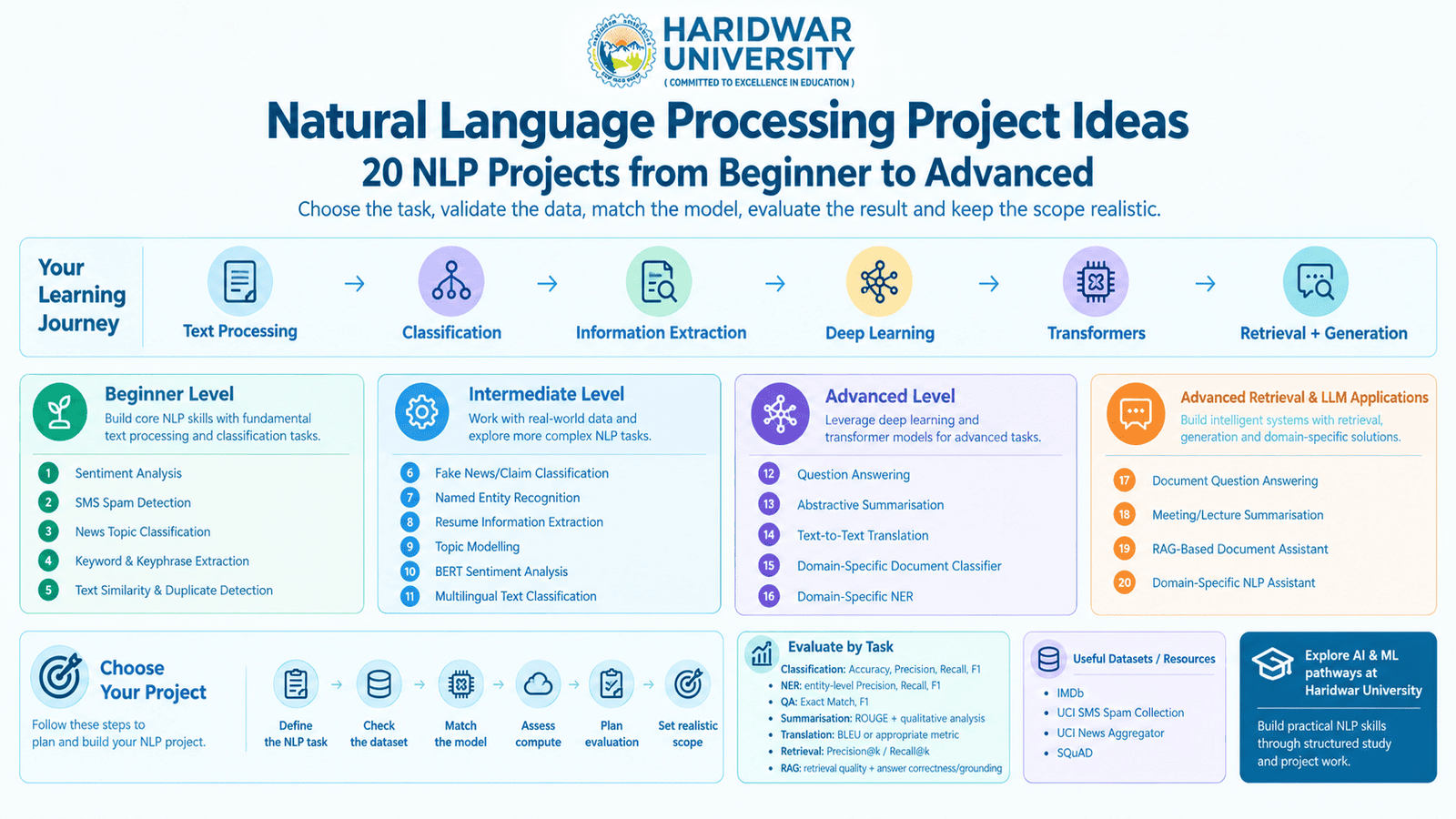
Natural Language Processing Project Ideas: 20 NLP Projects from Beginner to Advanced
Dr. Himanshu Verma
Head of CSE, Haridwar University
Roorkee College of Smart Computing | NLP Project Roadmap
From classical text representations to fine-tuned Transformers, question answering, and grounded RAG architectures.
Natural Language Processing (NLP) becomes much easier to understand when students stop treating it as a list of algorithms and start treating it as a sequence of problems. A sentiment classifier, a named-entity recogniser, a question-answering system, and a retrieval-augmented generation (RAG) assistant all work with human language, but they require fundamentally different datasets, architectural choices, and evaluation metrics.
When I review student project ideas in our Department of Computer Science & Engineering, I look for four non-negotiable fundamentals first:
Is the language problem specific, measurable, and clearly bounded rather than just a buzzword?
Is there an authenticated public benchmark or an ethically collected and annotated text corpus?
Can the proposed pipeline be benchmarked against an established baseline with proper metrics?
Can the complete end-to-end system be built, tested, and demonstrated with available compute?
This comprehensive guide brings those considerations together in 20 natural language processing project ideas, systematically moving from beginner-friendly classification and text processing to Transformer-based systems and modern retrieval-augmented applications.
Table of Contents
1. What Makes a Good NLP Project
2. How to Choose an NLP Project (Task → Data → Model)
3. Master Table: 20 NLP Projects from Beginner to Advanced
4. Projects 1–5: Beginner NLP Projects
5. Projects 6–10: Intermediate NLP Projects
6. Projects 11–15: Advanced NLP Projects
7. Projects 16–20: Transformer, Retrieval and LLM Projects
8. How NLP Projects Progress from Classical Methods to Transformers
9. How to Evaluate an NLP Project
10. What Students Should Demonstrate (The 10-Point Defense Checklist)
11. Frequently Asked Questions (FAQs)
12. Choosing the Right NLP Project & Engineering Pathways at HU
1. What Makes a Good NLP Project
A good NLP project starts with a defined language problem rather than a technology name. Saying "I want to build a BERT project" or "I want to make an LLM bot" is not a problem statement. In contrast, "Classify incoming customer support messages into predefined urgency categories" or "Extract biomedical entities and relationships from research abstracts" is a real engineering objective.
NLP covers tasks ranging from text classification and token classification to question answering, summarisation, translation, and text generation. Modern Transformer workflows support many of these tasks through fine-tuning or inference with pretrained models. For academic projects and capstone evaluations, I assess student work against six rigorous factors:
| Factor | What to Check |
|---|---|
| Problem | Is the language problem specific, measurable, and grounded in a real operational need? |
| Data | Is there a legitimate, benchmarked dataset or a defensible, reproducible collection and annotation method? |
| Method | Does the model architecture actually match the task (e.g. sequence labelling for NER, encoder-decoder for summarisation)? |
| Compute | Can the model be trained or fine-tuned within available laboratory GPU/CPU and memory resources? |
| Evaluation | Are suitable metrics (Accuracy, F1, ROUGE, BLEU, Exact Match) defined before testing on held-out data? |
| Scope | Can the complete pipeline—from raw text ingestion to prediction output—be finished, evaluated, and demonstrated? |
For example, the Stanford Large Movie Review Dataset (IMDb) contains 25,000 labelled training reviews, 25,000 test reviews, and additional unlabelled reviews, making it a well-established standard benchmark for binary sentiment classification. Selecting a recognised benchmark is considerably more defensible during viva evaluations than downloading an unexplained, uncleaned dataset from an arbitrary repository.
2. How to Choose an NLP Project
When mentoring students, I consistently advise following a clear order of decisions: Task first → Dataset second → Model third. A common pitfall is downloading a pre-packaged Transformer without knowing what data format it expects or how the output should be scored.
A beginner does not necessarily need a multi-billion parameter large language model. A TF-IDF representation with a conventional linear classifier (such as Logistic Regression or Linear SVM) makes an outstanding first project because the student can inspect the vocabulary, understand feature sparsity, track n-gram weights, and debug the complete pipeline. Once that foundation is solid, pretrained Transformers provide a seamless upgrade path.
Furthermore, your project choice must reflect available computing resources. Fine-tuning a compact pretrained model (like DistilBERT) and building an embedding-backed retrieval system is far more realistic and defensible for an academic deadline than attempting to pre-train a language model from scratch.
3. Master Table: 20 NLP Projects from Beginner to Advanced
The projects below deliberately progress in conceptual and computational complexity. They also leverage datasets with established citations wherever a public benchmark is required:
| # | Project Name | Level | Main NLP Task | Suggested Dataset / Resource |
|---|---|---|---|---|
| 1 | Sentiment Analysis | Beginner | Text classification | Stanford Large Movie Review (IMDb) |
| 2 | SMS Spam Detection | Beginner | Binary classification | UCI SMS Spam Collection (5,574 messages) |
| 3 | News Topic Classification | Beginner | Multiclass classification | UCI News Aggregator (>422k records) |
| 4 | Keyword & Keyphrase Extraction | Beginner | Information extraction | Domain-specific text corpus / Inspec |
| 5 | Text Similarity & Duplicate Detection | Beginner–Int | Semantic similarity | Quora Question Pairs / STS benchmark |
| 6 | Fake News or Claim Classification | Intermediate | Text classification | Labelled news / LIAR claim dataset |
| 7 | Named Entity Recognition (NER) | Intermediate | Token classification | CoNLL-2003 / OntoNotes NER data |
| 8 | Resume Information Extraction | Intermediate | NER & slot extraction | Appropriately licensed resume corpus |
| 9 | Text Topic Modelling | Intermediate | Topic discovery (LDA/BERTopic) | Large unlabelled text corpus / 20 Newsgroups |
| 10 | Document Sentiment Analysis with BERT | Intermediate | Transformer fine-tuning | IMDb or domain reviews via Hugging Face |
| 11 | Multilingual Text Classification | Intermediate–Adv | Cross-lingual classification | Multilingual labelled corpus / XNLI |
| 12 | Question Answering System | Intermediate–Adv | Extractive question answering | Stanford SQuAD 2.0 (with unanswerables) |
| 13 | Abstractive Text Summarisation | Advanced | Text generation / Seq2Seq | CNN/DailyMail / XSum |
| 14 | Text-to-Text Translation | Advanced | Sequence-to-sequence | Established parallel corpus (OPUS / Tatoeba) |
| 15 | Domain-Specific Document Classifier | Advanced | Transformer domain adaptation | Legal, financial, or scientific papers |
| 16 | Domain-Specific NER with Transformers | Transformer | Specialist entity extraction | NCBI Disease / BioNLP / Legal NER |
| 17 | Document Question Answering | Retrieval + QA | Retrieval + QA pipeline | Institutional reports or public policy docs |
| 18 | Meeting or Lecture Summarisation | Advanced | Long-form dialogue summarisation | AMI / ICSI Meeting Corpus / Academic talks |
| 19 | RAG-Based Document Assistant | RAG / LLM | Dense retrieval + grounded generation | Curated technical documentation collection |
| 20 | Domain-Specific NLP Assistant | Integrated | Classification, retrieval & generation | Curated university handbook or clinical corpus |
4. Projects 1–5: Beginner NLP Projects
Beginner projects establish core discipline: raw string cleaning, tokenisation, vocabulary construction, term weighting, vectorisation, and train/validation/test splits.
1. Sentiment Analysis
Beginner • ClassificationClassify text as positive or negative, beginning with TF-IDF vectorisation and a conventional linear classifier (Logistic Regression or Support Vector Machine) before comparing performance against a fine-tuned pretrained Transformer.
2. SMS Spam Detection
Beginner • Binary ClassificationBuild a lightweight classifier that distinguishes spam from legitimate (ham) messages. This is an ideal introduction to tackling severe class imbalance, precision-recall trade-offs, and short-message text normalisation.
3. News Topic Classification
Beginner • Multiclass ClassificationCategorise news articles into predefined thematic categories (such as Business, Science & Technology, Entertainment, and Health). This introduces multi-class decision boundaries, macro vs. micro averaging, and confusion matrix analysis.
4. Keyword and Keyphrase Extraction
Beginner • Information ExtractionExtract the most salient topical terms and multi-word phrases from articles, scientific abstracts, or domain-specific documents without requiring extensive manual labelling.
5. Text Similarity and Duplicate Detection
Beginner–Intermediate • Semantic SimilarityDetermine whether two pieces of text express identical or semantically overlapping information despite using different wording, syntax, or phrasing.
5. Projects 6–10: Intermediate NLP Projects
Intermediate projects transition from document-level labels to token-level classification, contextual representations, unsupervised topic modeling, and fine-tuning Transformer encoders.
6. Fake News or Claim Classification
Intermediate • Text ClassificationTrain a machine learning or deep neural model to classify claims, articles, or social statements into verified vs. fabricated categories.
7. Named Entity Recognition (NER)
Intermediate • Token ClassificationIdentify and classify entity spans in unstructured text into predefined categories such as Person (PER), Organisation (ORG), and Location (LOC).
seqeval framework.8. Resume Information Extraction
Intermediate • NER / Slot FillingExtract structured attributes—including technical skills, university degrees, years of experience, and contact metadata—from semi-structured PDF/DOCX resumes.
9. Text Topic Modelling
Intermediate • Topic DiscoveryDiscover recurring latent themes across large collections of unlabelled text without requiring human supervision or predefined categories.
10. Document Sentiment Analysis with BERT
Intermediate • Transformer ClassificationFine-tune a pretrained bidirectional Transformer (such as DistilBERT or RoBERTa) on long-form reviews or customer feedback for high-accuracy sentiment classification.
6. Projects 11–15: Advanced NLP Projects
Advanced projects tackle multilingual processing, extractive reading comprehension, generative sequence-to-sequence summarisation, machine translation, and specialised domain adaptation.
11. Multilingual Text Classification
Advanced • Cross-Lingual EvaluationBuild a classifier capable of processing and categorising content across multiple languages, including Indian regional languages (e.g. Hindi, Bengali, Tamil) and English.
mBERT or XLM-RoBERTa. The scholarly value lies in stratifying and reporting performance across individual languages rather than presenting only one aggregated score.12. Question Answering System
Advanced • Reading ComprehensionBuild a machine reading comprehension system that pinpoints the exact answer span within a supplied reference passage in response to a natural language query.
13. Abstractive Text Summarisation
Advanced • Sequence-to-Sequence GenerationDevelop an encoder-decoder neural system that generates a fluent, coherent summary of a long-form article using novel phrases rather than simply extracting verbatim sentences.
14. Text-to-Text Translation
Advanced • Neural Machine TranslationBuild a neural translation pipeline between a specific language pair using an authentic parallel corpus, evaluating linguistic adequacy and fluency.
15. Domain-Specific Document Classifier
Advanced • Transformer Domain AdaptationAdapt and fine-tune a Transformer model for specialised verticals such as legal court judgements, healthcare records, financial filings, or enterprise incident tickets.
7. Projects 16–20: Transformer, Retrieval and LLM Projects
The final tier of projects addresses modern production architectures: domain-adapted token classifiers, multi-stage retrieval pipelines, long-form meeting summarisation, and production-grade Retrieval-Augmented Generation (RAG).
16. Domain-Specific NER with Transformers
Transformer • Entity ExtractionAdapt a pretrained domain model (e.g. BioBERT, ClinicalBERT, or Legal-BERT) to identify technical entities like diseases, chemicals, legal statutes, or financial metrics.
17. Document Question Answering
Retrieval + QABuild an end-to-end question answering system that operates over raw multi-page PDF documents, institutional policies, or corporate technical manuals.
18. Meeting or Lecture Summarisation
Advanced • Dialogue SummarisationConvert conversational, multi-speaker transcripts from university lectures or business meetings into concise executive summaries with extracted action items.
19. RAG-Based Document Assistant
RAG / LLM • Grounded GenerationCombine dense vector retrieval with an autoregressive language model so that user answers are strictly grounded in an authenticated, curated document repository.
20. Domain-Specific NLP Assistant
Integrated ArchitectureIntegrate multiple NLP components—intent classification, entity extraction, vector retrieval, and grounded text generation—into a cohesive, narrowly scoped assistant.
8. How NLP Projects Progress from Classical Methods to Transformers
Understanding this historical and architectural progression is vital. Students who appreciate what changed at each paradigm shift make vastly superior engineering decisions rather than blindly treating Transformers as black-box magic.
| Stage | Typical Methods | What the Student Learns |
|---|---|---|
| Classical NLP | Tokenisation, stopword removal, stemming, lemmatisation, TF-IDF, n-grams | Discrete text representations, vocabulary sparsity, and statistical term weighting |
| Machine Learning | Naive Bayes, Logistic Regression, Linear SVM, Random Forests | Supervised classification pipelines, decision boundaries, hyperparameter tuning |
| Representation Learning | Dense word embeddings (Word2Vec Skip-Gram/CBOW, Stanford GloVe, FastText) | Distributed vector semantics, similarity spaces, and geometric word analogies |
| Deep Learning | Recurrent Neural Networks (RNN), LSTMs, Gated Recurrent Units (GRU) | Sequential dependency modelling, hidden states, vanishing gradients |
| Transformers | BERT, DistilBERT, RoBERTa, DeBERTa, T5, BART (Self-Attention mechanism) | Contextual embeddings, bidirectional representations, pretraining + fine-tuning |
| Retrieval + Generation | Dense vector embeddings, Vector DBs (Chroma/FAISS), LangChain/LlamaIndex, LLMs | Grounded language applications, context injection, prompt engineering, verification |
Pretrained word-vector approaches such as Stanford's GloVe provide a concrete historical example of the representation-learning stage, while current Transformer ecosystems (e.g. Hugging Face) make state-of-the-art models readily accessible.
This is precisely why I advise against jumping straight into a complex multi-agent RAG system in year one. Understanding a TF-IDF classifier first equips a student to defend subsequent architectural choices with solid technical reasoning.
9. How to Evaluate an NLP Project
Evaluation metrics must be chosen strictly according to the language task. Relying on global accuracy alone is one of the most frequent errors in student project submissions.
| Project Type | Useful Evaluation Metrics & Protocols |
|---|---|
| Classification | Accuracy, Precision, Recall, Macro/Weighted F1-score, Confusion Matrix |
| Named Entity Recognition | Entity-level Precision, Recall, and F1 (via seqeval span matching) |
| Semantic Similarity | Pearson correlation, Spearman rank correlation, cosine similarity distributions |
| Question Answering | Exact Match (EM) percentage and token-level F1-score |
| Summarisation | ROUGE-1, ROUGE-2, ROUGE-L, BERTScore, plus qualitative human checks for hallucination |
| Translation | BLEU score, chrF, METEOR, and error classification on held-out sentences |
| Information Retrieval | Precision@k, Recall@k, Mean Reciprocal Rank (MRR), NDCG@k |
| RAG Systems | Retrieval quality (Context Relevance, Context Recall) + Answer correctness/faithfulness |
Never report accuracy alone when working with imbalanced classes. Furthermore, for generative text systems, a single automated metric (such as BLEU or ROUGE) does not tell the full story. A strong project report must articulate the baseline, testing protocol, metrics, explicit failure modes, and architectural limitations. A high score achieved on a flawed dataset does not make a strong project.
10. What Students Should Demonstrate in an NLP Project
A finished NLP project should showcase far more than an interface or a web demo. In an examination or capstone defense, I expect the student to answer the following ten questions with clarity and technical precision:
What precise language task is being solved, and who does it serve?
Where did it come from, how was it labelled, and what are its limitations?
What exact transformations occur before the model receives the raw text?
What simple, classical benchmark method was tested first for comparison?
Why was this particular architecture selected over existing alternatives?
Which metrics were calculated on test sets, and why are they suitable?
Where and why does the system fail? What samples cause misclassification?
What capabilities have been deliberately omitted or not claimed?
Can an independent evaluator reproduce the primary experimental findings?
What concrete iterations would improve the system with more data or compute?
Students seeking a comprehensive project pathway can also explore our companion technical guides at Haridwar University:
Related Technical Project Guides at Haridwar University:
- HU's 25 Final-Year Project Ideas for CSE & AI/ML Students – Defining problem scope, technology stacks, and evaluation rubrics.
- HU's B.Tech AI & ML Programme Guide – Comprehensive curriculum covering deep learning, computer vision, and NLP.
- HU's AI & Innovation Laboratories – High-performance GPU computing clusters dedicated to student machine learning research.
- Computer Vision Projects for Students – From OpenCV image processing basics to edge deployment.
- Deep Learning Project Ideas – Neural networks, CNNs, and sequence modeling.
- Machine Learning Projects for Students – Supervised and unsupervised modeling workflows.
- Robotics Projects for Engineering Students – Hardware-in-the-loop and autonomous systems.
11. Frequently Asked Questions (FAQs)
Q1. What is an NLP project?
An NLP project applies computational methods to a language-related problem such as classification, information extraction, question answering, summarisation, translation, or text generation.
Q2. Which NLP project is suitable for beginners?
Sentiment analysis, SMS spam detection, and basic text classification are practical starting points because their objectives, vectorisation pipelines, and evaluation methods are relatively clear and well understood.
Q3. Which NLP projects are suitable for final-year students?
Final-year students can consider projects involving Transformers, domain-specific NER, question answering, summarisation, retrieval, or RAG, provided the scope, dataset lineage, and evaluation metrics are realistic and thoroughly defended.
Q4. Can NLP projects be built using Python?
Yes. Python is the industry and academic standard for NLP workflows, including data preparation, tokenisation, model training, and evaluation. Libraries such as Hugging Face Transformers, spaCy, NLTK, and PyTorch provide extensive, well-documented workflows for every NLP task.
Q5. What dataset can I use for an NLP project?
The appropriate dataset depends entirely on the task. Examples include the IMDb dataset for binary sentiment classification, UCI's SMS Spam Collection for spam detection, the UCI News Aggregator for multi-class news categorisation, and SQuAD for extractive reading comprehension.
Q6. Is ChatGPT an NLP system?
ChatGPT is an application built upon large autoregressive language models. NLP is the comprehensive scientific field covering tasks such as understanding, classifying, parsing, retrieving, and generating human language, rather than the name of one proprietary model.
Q7. What should an NLP project report contain?
A strong report should explain the problem statement, dataset lineage, preprocessing pipeline, baseline comparison, model architecture, hyperparameter choices, evaluation metrics, results, error analysis, limitations, and future improvements. A working user interface alone is not enough to establish whether the underlying NLP model performs well.
12. Choosing the Right NLP Project & Engineering Pathways at HU
The best NLP project is never simply the most technically complex one. It is the project where the problem, dataset, model architecture, and evaluation metrics fit together seamlessly, and where the scope can be executed, benchmarked, and defended with total confidence.
Starting with a manageable classification task and progressing systematically towards Transformers, dense vector retrieval, and LLM-based architectures enables students to develop durable, industry-grade technical foundations.
Build Your Engineering Career at Haridwar University
If you want to develop artificial intelligence and natural language processing capabilities through structured study, state-of-the-art laboratory computing clusters, and mentorship from experienced researchers, explore our computing and engineering degree programs at Haridwar University.