

Machine learning projects are one of the most practical ways to move from tutorials to applied skills. A beginner can learn the syntax of Python, pandas and scikit-learn in isolation, but a project introduces the harder questions: Where does the data come from? Which features matter? How should the data be split? Which metric actually reflects performance?
The best machine learning projects therefore do more than produce a prediction. They give learners a complete problem to investigate, from dataset preparation to model evaluation. This guide brings together 20 projects across classification, regression, clustering, NLP, computer vision and deployment, with datasets, suggested tools, difficulty levels and the main skill each project develops.
1. What Makes Machine Learning Projects Worth Building?
2. 20 Machine Learning Projects for Beginners and Beyond (Master Table & Deep-Dives)
3. How to Choose Machine Learning Projects by Skill Level
4. How to Build Machine Learning Projects in Python
5. How to Evaluate Machine Learning Projects Properly
6. How to Turn Machine Learning Projects Into Portfolio Evidence
8. A Practical Next Step & AI/ML Programmes at Haridwar University
1. What Makes Machine Learning Projects Worth Building?
A truly useful project should have three distinct characteristics: a clearly defined problem, a dataset that can be examined and reproduced, and an evaluation method that goes beyond simply reporting a high accuracy score.
That distinction matters enormously. Google's Machine Learning Crash Course notes that data preparation and transformation can account for around 80% of the work in a typical machine learning project. It also stresses that dataset quality and clean feature representation can have a far larger positive effect on model results than simply choosing a more complex algorithm.
There are also reliable public benchmark datasets available for learners. The UCI Machine Learning Repository maintains 689 datasets as of September 2026, including timeless foundational options such as Iris, Wine Quality, Student Performance, Bank Marketing, and Online Retail. For beginners, this eliminates the confusion of downloading unexplained CSV files from random blogs: learners can start with well-documented metadata and focus squarely on mastering the data science lifecycle.
You know exactly what you are predicting (binary label, continuous price, or anomaly cluster) before writing a single line of code.
Working with documented repositories like UCI, Kaggle, or PlantVillage allows anyone reviewing your work to reproduce results.
Performance is tested against unseen holdouts using precision, recall, RMSE, or F1 scores rather than superficial train accuracy.
2. 20 Machine Learning Projects for Beginners and Beyond
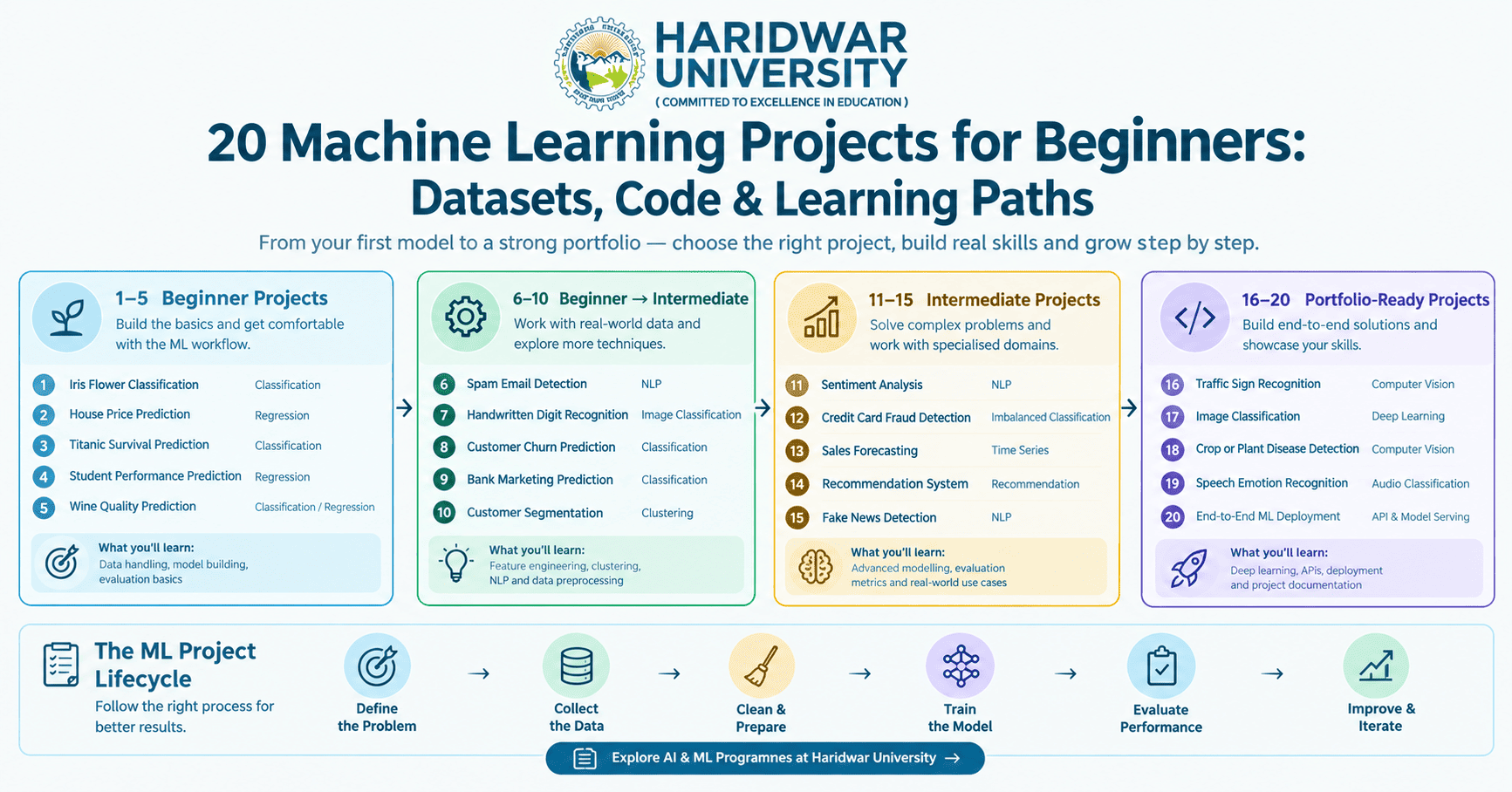
The 20 machine learning projects below are arranged systematically from accessible first builds to demanding portfolio-grade implementations. They are deliberately curated — not a superficial list of 100 generic ideas — so that each build has an unambiguous technical learning purpose.
| # | Project Name | Dataset / Source | Main Concept | Difficulty Level |
|---|---|---|---|---|
| 1 | Iris Flower Classification | UCI Iris (150 instances, 4 features) | Multi-class classification | Beginner |
| 2 | Kaggle House Prices Regression | Kaggle / Open housing data | Continuous regression & feature engineering | Beginner |
| 3 | Titanic Survival Prediction | Kaggle Titanic Disaster | Binary classification & missing-value handling | Beginner |
| 4 | Student Performance Prediction | UCI Student Performance (649 instances, 33 features) | Regression / Categorical prediction | Beginner |
| 5 | Wine Quality Prediction | UCI Wine Quality (4,898 instances, 11 features) | Regression & score binning | Beginner |
| 6 | Spam Email / SMS Detection | SMS Spam Collection | NLP tokenisation, TF-IDF & Naive Bayes | Beginner |
| 7 | Handwritten Digit Recognition | MNIST (70,000 28x28 grayscale images) | Computer vision & feedforward/CNN | Beginner |
| 8 | Customer Churn Prediction | Telco-style open churn records | Business churn & retention modelling | Beginner |
| 9 | Bank Marketing Prediction | UCI Bank Marketing (45,211 instances) | Deposit subscription classification | Beginner–Inter. |
| 10 | Customer Segmentation | UCI Online Retail (541,000+ transactions) | Unsupervised K-Means / RFM clustering | Intermediate |
| 11 | Sentiment Analysis | IMDb 50k Large Movie Review Dataset | NLP embeddings & sequence modelling | Intermediate |
| 12 | Credit Card Fraud Detection | Kaggle / European cardholder transactions | Highly imbalanced classification (SMOTE / PR-AUC) | Intermediate |
| 13 | Sales Demand Forecasting | UCI / Open retail time-series | ARIMA, Prophet & lagged regression | Intermediate |
| 14 | Recommendation System | MovieLens 100k / 1M | Collaborative filtering & matrix factorization | Intermediate |
| 15 | Fake News Detection | ISOT / Open Fake News Corpus | N-gram TF-IDF & semantic credibility scoring | Intermediate |
| 16 | Traffic Sign Recognition | GTSRB Benchmark (50,000+ signs, 43 classes) | Convolutional neural networks & data augmentation | Intermediate |
| 17 | Image Classification (CIFAR-10) | CIFAR-10 (60,000 32x32 color images) | Transfer learning (ResNet / MobileNet) | Intermediate |
| 18 | Crop or Plant Disease Detection | PlantVillage Dataset (54,000+ leaf images) | Vision-based agricultural diagnostic AI | Intermediate |
| 19 | Speech Emotion Recognition | RAVDESS Emotional Speech & Song | Audio signal MFCC extraction & 1D-CNN / LSTM | Intermediate |
| 20 | End-to-End ML Deployment Pipeline | Self-selected tabular or vision dataset | FastAPI, Docker, Streamlit & drift monitoring | Portfolio Capstone |
Projects 1–5: The First Machine Learning Projects
Iris Classification is an exceptional first project because the UCI dataset contains only 150 instances, four numeric features (sepal length, sepal width, petal length, petal width), and three balanced species classes. It allows a learner to grasp the complete scikit-learn workflow — from dataset splitting to confusion matrix inspection — without getting bogged down in messy imputation.
House Price Prediction introduces the core concepts of multivariable regression, feature transformation (such as log scaling of prices), and multicollinearity. Titanic Survival Prediction introduces binary classification, handling missing values (such as passenger age and cabin allocations), and encoding categorical labels like gender and embarkation ports.
Student Performance (UCI describes it with 649 instances and 33 features) and Wine Quality (4,898 instances, 11 chemical features) bridge the gap to realistic tabular data. UCI designates Wine Quality as suitable for both continuous regression and discrete grade binning, offering learners a realistic arena to compare linear models against decision trees.
Projects 6–10: Building Stronger Fundamentals
Spam Email Detection is the classic gateway to natural language processing. Learners extract text tokens, apply stopword filtering, compute TF-IDF matrices, and train multinomial Naive Bayes models. Handwritten Digit Recognition transitions learners into computer vision: the official TensorFlow dataset provides 60,000 training and 10,000 testing 28x28 grayscale images for MNIST.
Customer Churn and Bank Marketing bring machine learning into real corporate decision-making. The UCI Bank Marketing dataset contains 45,211 telephone campaign records designed to predict whether a prospective client subscribes to a term deposit.
Customer Segmentation changes the paradigm from supervised learning to unsupervised discovery. Instead of predicting a target label, learners use RFM (Recency, Frequency, Monetary) metrics and K-Means clustering on the UCI Online Retail dataset (541,000+ rows) to uncover natural customer purchasing cohorts.
Projects 11–15: Moving Towards Portfolio-Level Projects
Sentiment Analysis using the IMDb 50k dataset advances NLP skills by encouraging students to compare traditional n-gram models against word embeddings and recurrent or transformer architectures.
Credit Card Fraud Detection is essential learning because it highlights severe class imbalance (often under 0.2% fraud instances). Students learn why accuracy is completely meaningless here and master evaluation using Precision-Recall curves, AUPRC, and SMOTE resampling techniques.
Sales Demand Forecasting introduces seasonal decomposition, stationarity testing, and autoregressive models (ARIMA / Prophet). MovieLens Recommendation explores collaborative filtering and user-item matrix factorization, while Fake News Detection requires robust textual feature engineering to identify misleading semantic patterns.
Projects 16–20: More Demanding Machine Learning Projects
Traffic Sign Recognition (GTSRB) and Image Classification (CIFAR-10) introduce convolutional neural networks. For learners with limited GPU compute, transfer learning represents the industry standard. PyTorch's official tutorials demonstrate how a pretrained ResNet backbone can achieve high accuracy on specialized vision tasks with minimal fine-tuning.
Crop & Plant Disease Detection uses the PlantVillage dataset (54,000+ images) to build real-world diagnostic applications for agricultural sustainability — an area of active student research at Haridwar University. Speech Emotion Recognition (RAVDESS) introduces acoustic signal processing, teaching students to extract Mel-Frequency Cepstral Coefficients (MFCCs) for audio classification.
Project 20: End-to-End ML Deployment is the ultimate portfolio differentiator. Rather than leaving models trapped inside a Jupyter notebook, learners wrap an inference pipeline into a lightweight FastAPI microservice, package it with Docker, build an interactive Streamlit interface, and implement basic data-drift logging.
3. How to Choose Machine Learning Projects by Skill Level
Not every project should be attempted immediately after finishing a basic syntax tutorial. A disciplined, sequential progression prevents cognitive burnout and builds genuine problem-solving stamina.
| Current Student Skill | Suitable Projects | Primary Technical Objective |
|---|---|---|
| Python basics | Iris, Titanic, House Prices | Learn the fundamental ML workflow |
| Python + pandas | Student Performance, Wine Quality, Churn | Data cleaning, imputation & feature preparation |
| scikit-learn basics | Bank Marketing, Customer Segmentation, Fraud | Model comparison, hyperparameter tuning & metrics |
| NLP fundamentals | SMS Spam, Sentiment Analysis, Fake News | Text tokenisation, TF-IDF & sequence embeddings |
| Neural network basics | MNIST, CIFAR-10, Traffic Signs | Convolutional networks & transfer learning |
| Strong ML foundation | Sales Demand Forecasting, Recommendation | Time-series decomposition & collaborative matrices |
| Portfolio capstone stage | End-to-End ML Deployment Pipeline | Build, containerise, serve and monitor a live system |
A practical golden rule: choose a project that is slightly harder than the last one you completed, rather than jumping straight into a multi-modal deep learning application.
For students actively preparing final-year capstone submissions, you can also cross-reference these ideas with our comprehensive guide: 25 Final-Year Project Ideas for CSE & AI/ML Students, which explores campus incubation, departmental mentor allocation, and multidisciplinary lab projects.
4. How to Build Machine Learning Projects in Python
Python remains the uncontested industry standard for machine learning because a developer can transition seamlessly from raw data manipulation to mathematical modelling and microservice packaging within a single language ecosystem.
For a first tabular machine learning project, the optimal technology stack is:
Python 3.11+ → pandas → NumPy → matplotlib / seaborn → scikit-learn
As your requirements expand, computer vision builds introduce TensorFlow or PyTorch, while NLP workloads progress from scikit-learn's CountVectorizer toward Hugging Face Transformers.
Crucial Insight on Source Code: Machine learning projects with source code should never degenerate into thoughtless copy-and-paste exercises. Public source code is an invaluable implementation reference, but true competence means you can articulate why you chose median imputation over mean, why a Random Forest outperformed Logistic Regression, and how your test fold was protected against data leakage.
5. How to Evaluate Machine Learning Projects Properly
A machine learning project is not successful simply because a notebook cell produces a “95% accuracy” printout.
Google's ML evaluation guidance clarifies that the appropriate performance metric is strictly governed by the underlying problem formulation, dataset balance, and the asymmetrical real-world cost of false positives versus false negatives.
- Dataset Profile: Sample size, feature types, target distribution, and missingness report.
- Preprocessing Decisions: Clear rationale for scaling, encoding, and imputation methods.
- Baseline Model: A simple heuristic (e.g., majority class prediction or mean regressor) establishing minimal viable skill.
- Model Comparison: Comparative performance table across at least two or three candidate algorithms.
- Task-Appropriate Metrics: Precision, recall, and PR-AUC for imbalanced data; RMSE and MAE for regression.
- Rigorous Holdout Testing: Final numbers recorded strictly on a sequestered test split that was never touched during tuning.
- Known Limitations & Next Iterations: Honest appraisal of edge cases, data drift vulnerability, and computational tradeoffs.
Build Applied AI/ML Projects at Haridwar University
Haridwar University offers industry-aligned programmes in Artificial Intelligence, Machine Learning, and Data Science featuring dedicated high-performance computing labs, faculty research mentorship, and live industry capstones.
6. How to Turn Machine Learning Projects Into Portfolio Evidence
The defining difference between a forgotten classroom exercise and an eye-catching recruitment portfolio is technical documentation.
A well-structured GitHub repository tells a complete story. Instead of dumping an uncommented Untitled1.ipynb, create a concise, professional README.md detailing:
- Business / Problem Framing: What question does this model answer?
- Dataset Attribution & Schema: Source citation and feature descriptions.
- Environment Setup: Reproducible
requirements.txtor Dockerfile. - Iteration Narrative: Document how changing feature representations improved your baseline from a lower initial score to the final metric.
- Interactive Demo: A live link to a Hugging Face Space, Streamlit Community Cloud app, or video walkthrough.
In interview settings, recruiters and engineering leads probe for defensibility. They will ask why you chose a specific dataset, how you mitigated overfitting, what would happen if live input data exhibited distribution shift, and how your model would behave at scale.
Deep-dive guides from Haridwar University faculty:
• B.Tech AI & ML Complete Programme Guide (2026)
• B.Sc. Computer Science (Data Science) Curriculum & Career Paths
• 10 AI Projects for B.Tech AI & ML Students
7. Frequently Asked Questions
What are the best machine learning projects for beginners?
Iris classification, house price prediction, Titanic survival prediction, student performance prediction and wine quality prediction are accessible starting points because they introduce core classification and regression workflows without requiring advanced deep learning.
Can beginners build machine learning projects in Python?
Yes. Python, pandas and scikit-learn are sufficient for many introductory machine learning projects. More advanced projects can later introduce TensorFlow, PyTorch or specialised NLP libraries.
Which dataset is best for a beginner machine learning project?
There is no single best dataset. Iris is particularly simple, while UCI's Student Performance and Wine Quality datasets provide more realistic tabular problems. The choice should match the learner's current skill level.
Are machine learning projects with source code useful?
They can be useful for studying implementation, but copying code does not demonstrate understanding. A stronger project modifies the approach, explains the decisions and evaluates the resulting model independently.
Which machine learning projects are suitable for final-year students?
Final-year students can consider projects such as fraud detection, recommendation systems, fake news detection, computer vision, forecasting or an end-to-end deployed model. The right choice depends on available data, technical skills, project duration and evaluation requirements.
How do machine learning projects help a resume?
A well-documented project can demonstrate practical skills in data preparation, Python, modelling, evaluation and communication. Its value is stronger when the student can explain the problem, technical choices, limitations and results.
How should someone start their first machine learning project?
Start with a documented dataset and a clearly defined prediction or classification problem. Build a simple baseline first, evaluate it on unseen data and then make one improvement at a time. That progression keeps the project manageable while building genuine understanding.
8. A Practical Next Step & AI/ML Programmes at Haridwar University
The path forward is simple: choose one project that matches your current skill level, reproduce the baseline implementation, document every major engineering decision, and then introduce one meaningful improvement. That process produces vastly stronger evidence of competence than racking up ten copied notebooks.
Students considering a formal, structured academic journey into artificial intelligence and machine learning can explore degree offerings at Roorkee College of Smart Computing, Haridwar University, encompassing specialized curricula, high-performance computing clusters, and comprehensive placement training.
Launch Your Career in Artificial Intelligence & Data Science at HU
Master real-world machine learning with hands-on lab projects, expert faculty mentoring, and university placement partnerships. Explore admissions, syllabus details, and scholarship opportunities.