

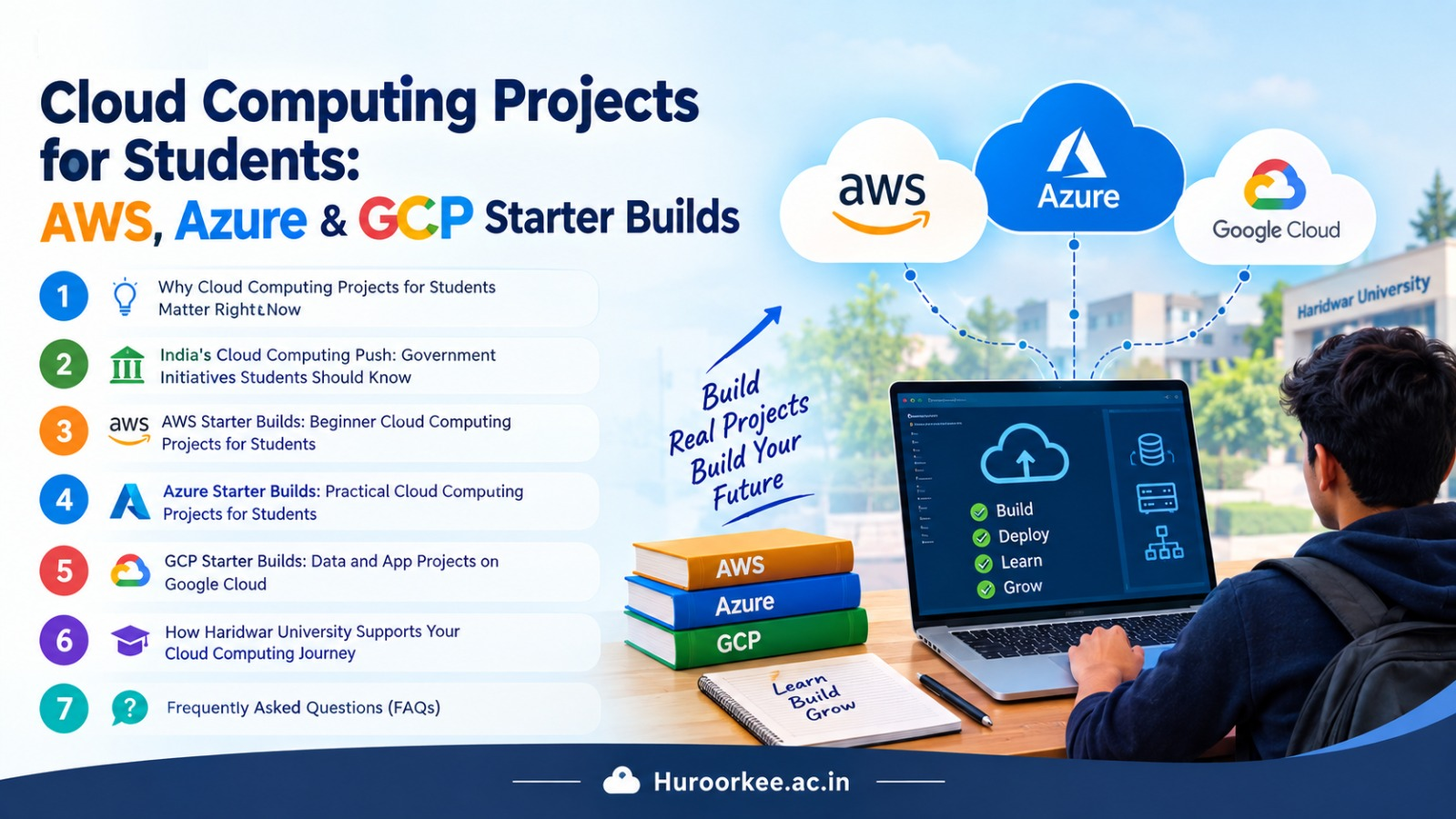
Cloud Computing Projects for Students have moved decisively from being an optional elective add-on to a core requirement of every modern computer science curriculum. Whether you are a first-year student trying to understand how web applications stay globally resilient, or a final-year graduate assembling a placement-ready portfolio, building real projects on Amazon Web Services (AWS), Microsoft Azure, or Google Cloud Platform (GCP) teaches engineering skills that textbooks alone can never convey.
This comprehensive guide outlines verified, beginner-friendly starter builds across all three hyperscalers, explains the free student credits and educational sandboxes available without credit cards, and highlights how the Department of Computer Science & Engineering at Haridwar University supports your cloud journey from initial prototype to campus deployment.
1. Why Cloud Computing Projects for Students Matter Right Now
2. India's Cloud Computing Push: Government Initiatives Students Should Know
3. AWS Starter Builds: Beginner Cloud Computing Projects for Students
4. Azure Starter Builds: Practical Cloud Computing Projects for Students
5. GCP Starter Builds: Data and App Projects on Google Cloud
6. Cloud Student Programs & Free Credits Comparison Table
7. How Haridwar University Supports Your Cloud Computing Journey
1. Why Cloud Computing Projects for Students Matter Right Now
Virtually all contemporary software — from unified digital payment gateways and streaming services to enterprise banking portals — runs on distributed cloud infrastructure rather than isolated on-premise hardware.
Consequently, technical recruiters and software engineering managers expect entry-level computer science graduates to understand how to provision virtual instances, configure virtual private clouds (VPCs), manage managed databases, and deploy containerised microservices. A student who has actually launched a serverless function, configured an S3 bucket with strict CORS policies, or managed an Azure VM has verifiable proof of capability that a paper certificate cannot match.
At the Department of Computer Science & Engineering, Haridwar University — established in 2010 and ranked among the top 40 engineering colleges in India — this practical methodology is woven into the core curriculum across B.Tech Hons. Computer Science, AI & ML, Data Science, and Cyber Security. Projects are guided by experienced faculty as formal coursework submissions rather than peripheral hobbies.
2. India's Cloud Computing Push: Government Initiatives Students Should Know
Cloud computing adoption across India is propelled by decisive national policy frameworks that provide direct real-world context for student projects:
- GI Cloud (MeghRaj): Spearheaded by the Ministry of Electronics and Information Technology (MeitY) under the Digital India umbrella, the MeghRaj initiative accelerates the delivery of e-services in the country by optimising ICT spending of government departments through secure, scalable cloud infrastructure.
- FutureSkills Prime: A flagship MeitY–NASSCOM national skilling platform that officially designates Cloud Computing among its ten core emerging technologies, offering curated training pathways with international industry partners.
Understanding these initiatives gives undergraduate projects immediate credibility: building a simulated public distribution portal or student grievance dashboard on cloud infrastructure directly mirrors India's ongoing digital governance transformations.
3. AWS Starter Builds: Beginner Cloud Computing Projects for Students
Amazon Web Services (AWS) represents the largest global hyperscaler. Through AWS Educate, students receive free, self-paced access to interactive cloud labs without requiring a personal credit card. Here are three high-impact starter projects:
📦 1. Static Website Hosting on Amazon S3
Upload an HTML/CSS/JavaScript personal portfolio or project showcase to an Amazon Simple Storage Service (S3) bucket. Configure public read permissions, bucket policies, index document endpoints, and optionally route it through Amazon CloudFront CDN for global caching and HTTPS.
🖥️ 2. Dynamic Web Application on Amazon EC2
Launch an Amazon Elastic Compute Cloud (EC2) t2.micro or t3.micro Linux virtual machine within the free tier. SSH into the instance, install Node.js/Python, configure inbound Security Group firewall rules (ports 22, 80, 443), and connect your web application to an Amazon RDS MySQL database.
⚡ 3. Serverless Contact Form with AWS Lambda & API Gateway
Build an event-driven submission pipeline. A front-end web form triggers an Amazon API Gateway REST endpoint, which invokes an AWS Lambda function to validate the payload and stores the enquiry in DynamoDB or dispatches an email alert via Amazon Simple Notification Service (SNS).
4. Azure Starter Builds: Practical Cloud Computing Projects for Students
Through Microsoft's Azure for Students program, university students receive USD 100 in free Azure credits valid for 12 months (renewable annually while enrolled), with zero credit card obligation. Recommended starter builds:
🌐 1. Web App Deployment on Azure App Service
Deploy an interactive portfolio, student blog, or campus directory using Azure App Service (PaaS). Connect your GitHub repository directly for automated CI/CD deployments on git push without managing Linux servers or web servers manually.
📝 2. Serverless Task Tracker with Azure Functions & Cosmos DB
Pair Azure Functions with Azure Cosmos DB to build a responsive task-management and to-do application. Because it is serverless, compute resources scale to zero when idle, costing virtually nothing while teaching distributed NoSQL document design.
🐧 3. Disposable Linux Virtual Machine Lab
Spin up an Ubuntu Linux virtual machine to practise shell scripting, firewall rules (Network Security Groups), and web server configurations in a safe, disposable environment that can be recreated or destroyed in seconds.
5. GCP Starter Builds: Data and App Projects on Google Cloud
Google Cloud for Students delivers hands-on lab access via Google Cloud Skills Boost, granting free cloud credits and verifiable LinkedIn skill badges. Excellent starter builds include:
🗄️ 1. Static Showcase on Google Cloud Storage
Deploy an interactive resume showcase directly out of a Cloud Storage multi-regional bucket. Configure web endpoints and compare storage bucket access control lists (ACLs) against AWS S3 for cross-cloud architectural literacy.
🚀 2. Compute Engine Virtual Web Server
Provision an e2-micro compute VM running a lightweight Python Flask or Express.js API. Master GCP Virtual Private Cloud (VPC) network peering, external IP reservation, and Google Cloud Logging monitoring.
📊 3. BigQuery Public Data Analytics Dashboard
Analyse terabytes of real-world open data — including global climate records, transport patterns, and public healthcare metrics — using BigQuery's free monthly query allocation (1 TB free per month) without standing up any database servers. Connect your query outputs to Google Looker Studio for executive visualizations.
6. Cloud Student Programs & Free Credits Comparison Table
| Platform Program | Free Student Allowance | Credit Card Needed? | Best Beginner Build |
|---|---|---|---|
| AWS Educate | Self-paced labs & credits | No Credit Card Required | Static S3 site • EC2 Micro instance |
| Azure for Students | USD 100 credit for 12 months | No Credit Card Required | App Service • Serverless Cosmos DB |
| Google Cloud for Students | Skills Boost labs & skill badges | No Credit Card Required | BigQuery Analytics • Cloud Storage |
7. How Haridwar University Supports Your Cloud Computing Journey
Transforming a weekend cloud tutorial into a structured, production-grade academic project requires expert faculty oversight, dedicated laboratory infrastructure, and comprehensive student support services.
At Haridwar University, cloud computing and distributed systems are integrated directly into our degree pathways under the Roorkee College of Smart Computing:
Access to high-speed networks and high-performance computing in our Research & Innovation Laboratories.
Up to 80% tuition fee waiver for top JEE ranks, 25% for girl students / Uttarakhand domiciles on our Fees & Scholarships page.
Comprehensive non-academic wellbeing, campus housing, and mentoring via Student Welfare Service.
Build Your Skills at Haridwar University
Ready to deploy live cloud applications and prepare for top-tier IT placements? Explore computer science and smart computing programmes with guided faculty mentorship.
8. Frequently Asked Questions (FAQs)
1. What is a good first cloud computing project for a beginner?
A static website hosted on Amazon S3 or Google Cloud Storage is usually the easiest starting point. It needs no server management, uses each platform's free tier, and still teaches core concepts like storage buckets, permissions, and public access.
2. Do I need to pay to try AWS, Azure, or GCP as a student?
No. AWS Educate, Azure for Students, and Google Cloud for Students all offer free credits or free-tier access specifically for verified students, and none of them require a credit card to get started.
3. Which cloud platform should I learn first?
There is no single right answer. AWS has the largest job market share and the most learning material, Azure integrates well if you already use Microsoft tools, and GCP is strong for data and analytics projects. Many recruiters value comfort with core concepts over loyalty to one platform.
4. Can I put these starter projects on my resume?
Yes. A working, deployed project with a public link or a short demo video is far more convincing to recruiters than simply listing "AWS" or "Azure" as a skill on your resume.
5. Do I need coding experience to start a cloud computing project?
Basic familiarity with HTML/CSS or a scripting language like Python or JavaScript is enough for the static-website and serverless-function builds described above. Deeper programming skills help for VM-based or data-analytics projects.
6. How long does a starter cloud computing project usually take?
Most of the beginner builds listed in this guide can be completed within one to three weekends, making them realistic as a mid-semester assignment or a quick portfolio addition before placement season.
7. Is cloud computing covered in the Haridwar University curriculum?
Cloud computing concepts are covered through electives and project mentorship within the B.Tech Hons. Computer Science, AI & ML, Data Science, and Cyber Security programs under the Roorkee College of Smart Computing at Haridwar University.
8. Can BCA or B.Sc. students also build cloud computing projects?
Yes. Static website hosting, simple web-app deployments, and beginner serverless builds are all well within reach for BCA and B.Sc. Computer Science students with basic web development knowledge.
9. How can I get expert guidance for a cloud computing project at Haridwar University?
Students can approach the Computer Science & Engineering department directly for project mentorship, or reach out through the admissions team to discuss lab access and ongoing research areas before finalising a project idea.
9. Start Your Cloud Journey at Haridwar University
Whether you begin with a static resume bucket on AWS S3, a serverless function on Azure, or an open data query on Google BigQuery, the decisive step is to deploy a live application and document your architecture.
Bring that project to Haridwar University, where expert faculty mentors, state-of-the-art computer labs, and a proven placement ecosystem turn your technical initiative into a defining career asset.
Launch Your Cloud & Computer Science Career at Haridwar University
Join Roorkee College of Smart Computing. Explore degree programmes, review admission criteria, evaluate merit scholarships up to 80%, or apply online today.