

Dr. Himanshu Verma leads the Department of Computer Science & Engineering at Haridwar University, guiding student project development, practical lab research, and corporate cybersecurity readiness.

Before diving into cybersecurity project ideas for students, it helps to understand why these builds matter so much right now. India logs a very large volume of cyber-incident reports every year, and demand for trained defenders is climbing faster than most computer science branches can supply talent. For an undergraduate, a well-documented security project is proof of applied skill in a way that grades alone cannot match — recruiters increasingly ask candidates to walk through a GitHub repository before they ask about semester marks.
A strong project also forces a student to combine several disciplines at once: networking fundamentals, operating systems, cryptography, and a working knowledge of how attackers actually think.
For students enrolled in a dedicated programme such as the B.Tech Hons. Cyber Security or the BCA Cyber Security course, projects are usually built into the coursework as internal assessments, live projects, or a final capstone. But even students from mainstream CSE, AI & ML, or Data Science backgrounds benefit from picking up a small security project alongside their core curriculum, since almost every modern application — web, mobile, or cloud — now needs someone on the team who understands how it can be broken before it ships.
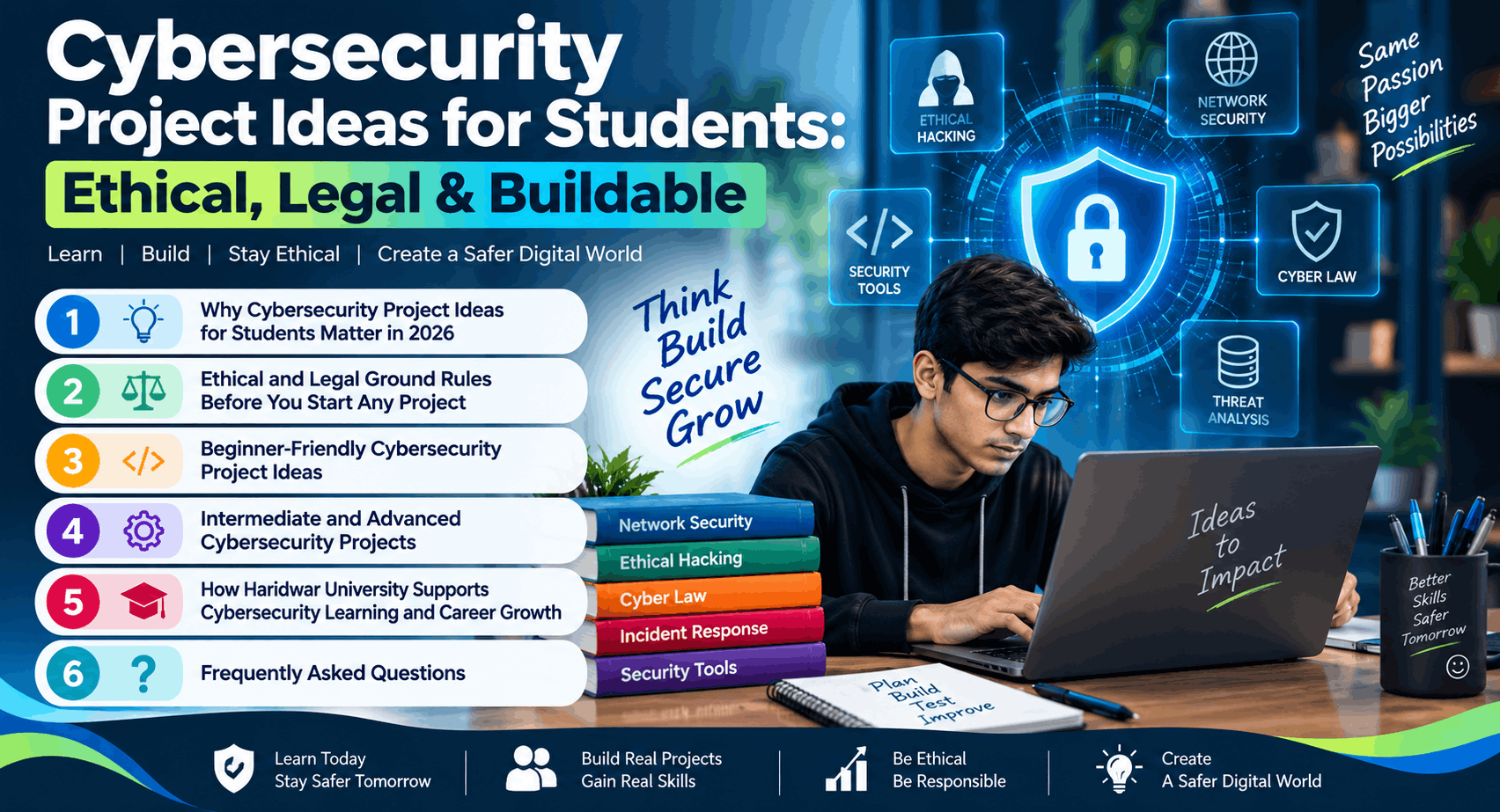
- 1. Why Cybersecurity Project Ideas for Students Matter in 2026
- 2. Ethical and Legal Ground Rules Before You Start Any Project
- 3. Beginner-Friendly Cybersecurity Project Ideas
- 4. Intermediate and Advanced Cybersecurity Projects for Final-Year Students
- 5. How Haridwar University Supports Cybersecurity Learning and Career Growth
- 6. Frequently Asked Questions (FAQs)
- 7. Build Your Cyber Security Skills at Haridwar University
1. Why Cybersecurity Project Ideas for Students Matter in 2026
Modern hiring workflows in engineering and cybersecurity have shifted decisively toward hands-on verification. While textbook understanding of the OSI model or cryptographic primitives establishes baseline eligibility, technical interviewers want to see how you troubleshoot a packet drop, isolate a malicious payload, or harden a compromised configuration.
Building an end-to-end security project demonstrates three key capabilities that grades alone cannot communicate:
- Cross-Disciplinary Mastery: Security operates at the intersection of operating systems, networking protocols, application architecture, and cryptography.
- Adversarial Thinking: Understanding defensive architecture requires anticipating attacker methodology — knowing how reconnaissance occurs, how vulnerabilities are weaponized, and how footprints are erased.
- Defensive Engineering: Building tools that monitor, alert, and patch flaws reinforces software quality and system reliability across modern web and cloud deployments.
Recruiters from specialized cybersecurity firms and enterprise technology teams increasingly ask candidates to walk through a GitHub repository before they ask about semester marks. A well-documented, reproducible project repository with architecture diagrams and test results is your strongest placement asset.
Whether you are pursuing a dedicated degree like the B.Tech Hons. Cyber Security, the BCA Cyber Security, or studying general Computer Science, these projects provide the portfolio foundation needed for SOC analyst, penetration tester, and security engineer roles.
2. Ethical and Legal Ground Rules Before You Start Any Project
Before opening a terminal, every student needs to understand where curiosity ends and a criminal offence begins. India's Information Technology Act, 2000 treats unauthorised access to a computer system as a punishable offence under Sections 43 and 66, regardless of whether any real damage was caused.
This means a 'harmless' scan of a website you do not own, run without written permission, can expose you to legal risk even if your intention was purely educational.
Under Sections 43 & 66 of the IT Act, 2000, unauthorized penetration testing, port scanning against live third-party servers, or credential testing without explicit, written consent is illegal in India. Always obtain formal authorization, or build entirely inside an isolated lab sandbox.
The safest and most professional habit is to build and test everything inside an isolated lab: a local virtual machine, a deliberately vulnerable practice application, or a sandboxed network that never touches the public internet.
The Indian Computer Emergency Response Team (CERT-In), the national nodal agency for incident response under the IT Act, publishes advisories and a responsible vulnerability-disclosure process that every serious student should read at least once. If your project ever touches infrastructure that could be classified as critical — banking, power, telecom, or government systems — the National Critical Information Infrastructure Protection Centre (NCIIPC) is the relevant authority, and such systems must never be probed without explicit written authorisation.
If you accidentally discover a real vulnerability while researching — for example, on a college portal or a public website — do not exploit it further. Report it responsibly through the National Cyber Crime Reporting Portal or directly to the organisation's security team, and keep a written record of the timeline. Students working on live projects at Haridwar University can also route such findings through the university's Research & Innovation Laboratories, where faculty can guide the disclosure process.
Treat 'ethical' as a working method, not a marketing label — permission, documentation, and restraint are what actually separate a security researcher from an intruder.
3. Beginner-Friendly Cybersecurity Project Ideas
The best entry point is a project that can be finished, demoed, and explained in under fifteen minutes. These beginner cybersecurity project ideas for students need only a laptop, free tools, and a weekend of focused work:
1. Password Strength Analyser & Breach Checker
Difficulty: BeginnerProblem: Users repeatedly create predictable passwords like "P@ssw0rd123" that meet simple character-length policies but remain trivial to crack via dictionary and credential-stuffing attacks.
Tech Stack: Python zxcvbn / hashlib HaveIBeenPwned API (k-anonymity) Streamlit / Tkinter
2. Packet Sniffer and Traffic Visualiser
Difficulty: BeginnerProblem: Students struggle to grasp abstract networking protocols without visually inspecting live frame exchanges across their local network.
Tech Stack: Python Scapy Socket API Wireshark PCAP Matplotlib
3. Phishing Email Detector
Difficulty: Beginner/IntermediateProblem: Phishing remains the #1 initial access vector in enterprise breaches, tricking employees through spoofed sender domains and urgent calls to action.
Tech Stack: Python scikit-learn (Naive Bayes / Random Forest) TF-IDF Regular Expressions Flask API
4. Personal Firewall or Port Scanner
Difficulty: BeginnerProblem: Unnecessary open ports and misconfigured local network services present attack surfaces for lateral movement and reconnaissance.
Tech Stack: Python socket library threading / asyncio iptables / netsh rule automation
5. Two-Factor Authentication (2FA) Demo App
Difficulty: BeginnerProblem: Single-factor password authentication leaves accounts vulnerable to credential stuffing, phishing, and database leak exploits.
Tech Stack: Python / Flask / Django PyOTP (RFC 6238 TOTP) qrcode library Google Authenticator / Aegis
6. File Integrity Monitor (FIM)
Difficulty: BeginnerProblem: Silent file tampering, unauthorized configuration changes, and web shell drops often go unnoticed without automated baseline hashing.
Tech Stack: Python hashlib (SHA-256) OS Watchdog / inotify SQLite / JSON logging
4. Intermediate and Advanced Cybersecurity Projects for Final-Year Students
Final-year and postgraduate students who want a capstone-worthy topic should look for projects that pair a real security problem with measurable results — attack success rate, detection accuracy, or response time.
All of the following should still be built and tested inside a sandbox you fully control:
1. Web Application Penetration Testing Report
Difficulty: Intermediate/AdvancedScope: Practise on deliberately vulnerable applications such as OWASP Juice Shop or DVWA (Damn Vulnerable Web Application) running in local Docker containers.
Tech Stack: Burp Suite Community OWASP ZAP SQLMap Docker CVSS v3.1 Scoring
2. Network Intrusion Detection using Machine Learning
Difficulty: AdvancedScope: Train a machine-learning classifier (Random Forest, XGBoost, or a lightweight neural network) on benchmark cybersecurity datasets such as NSL-KDD or CICIDS to differentiate benign traffic from DDoS, brute-force, and port-sweep signatures.
Tech Stack: Python Scikit-learn / PyTorch Pandas & NumPy SHAP explainability
3. IoT Device Authentication Framework
Difficulty: AdvancedScope: Design a lightweight mutual authentication and key exchange protocol tailored for resource-constrained edge microcontrollers, tested on hardware (ESP32 / Raspberry Pi) or a QEMU emulator.
Tech Stack: C / C++ or MicroPython ESP32 MCU / QEMU MQTT-SN / CoAP Elliptic Curve Cryptography (ECC / ECDSA)
4. SIEM-Style Log Correlation Dashboard
Difficulty: AdvancedScope: Deploy an open-source log aggregation pipeline using Elasticsearch, Logstash, and Kibana (ELK stack) or Wazuh to collect telemetry from simulated lab endpoints and write automated correlation alerts.
Tech Stack: ELK Stack (Elasticsearch, Logstash, Kibana) Wazuh Agent Docker Compose Syslog / Winlogbeat
5. Blockchain-Based Secure Voting Prototype
Difficulty: AdvancedScope: Implement a permissioned-blockchain proof of concept guaranteeing immutable, tamper-evident vote records with cryptographically verified voter anonymity.
Tech Stack: Solidity / Ethereum Sepolia Testnet Hyperledger Fabric Web3.js / Ethers.js React Frontend
6. Ransomware Behaviour Simulator (Sandboxed)
Difficulty: Advanced (Defensive Research)Scope: Inside a fully isolated, air-gapped virtual machine with zero network access, simulate file-encryption behavioral patterns (never real malware) to study heuristic detection signatures and canary-file tripwires.
Tech Stack: Isolated VirtualBox / VMware VM Python (AES-256 simulation script) Windows Sysmon / Linux auditd Canary files & entropy analysis
Students at Haridwar University working on a final-semester submission can also browse the university's dedicated Final-Year Project Ideas for CSE and AI & ML guide and check current campus placement openings through the Placement & Training Cell, since a well-documented security project regularly becomes the centrepiece of a placement interview.
5. How Haridwar University Supports Cybersecurity Learning and Career Growth
Picking a good project idea is only half the equation — the environment around a student decides whether that project actually gets finished, mentored, and placed in front of recruiters.
Haridwar University's Roorkee College of Smart Computing runs dedicated B.Tech Hons. Cyber Security and BCA Cyber Security programmes where practical labs, live projects, and internships are built into the semester structure rather than left to self-study.
Note: Tuition fees are spread across semesters. Transport and hostel accommodation charges, where applicable, are billed separately as published on the official Fees & Scholarships page.
Scholarship Opportunities at Haridwar University
To support talented candidates, Haridwar University provides comprehensive financial assistance:
- Merit-Based Scholarships: Up to 80% fee waiver on first-year tuition based on JEE Main ranks, 12th board percentages, or CUET scores.
- Girl Student Scholarship: A dedicated 25% scholarship across programmes to encourage women in engineering and technology.
- Sports & Defense Quota: Special scholarship provisions for state and national-level athletes and wards of defense personnel.
Beyond the classroom, the university's Student Welfare Service handles orientation, insurance, and grievance redressal, so students working late nights on a lab project or a hackathon submission have a support system to fall back on.
Cybersecurity is one of the rare fields where a strong project can matter more than a strong transcript, but only when it is built the right way — inside a sandbox, with permission, and with documentation that shows your thinking. Start with one beginner build this month, keep detailed notes on what broke and what you fixed, and let that project grow into the final-year showcase piece that gets you noticed. Whichever of these cybersecurity project ideas for students you choose first, treat ethics and legality as part of the build, not an afterthought bolted on at the end.
6. Frequently Asked Questions (FAQs)
1. Is ethical hacking legal in India?
Ethical hacking is legal only when performed with explicit written permission from the system owner. Without that authorisation, the same actions fall under Sections 43 and 66 of the Information Technology Act, 2000, and can be prosecuted as unauthorised access.
2. Do I need permission before testing a project on a real website?
Yes. Always get written consent first, or better, build and test entirely inside a virtual lab using deliberately vulnerable practice applications (such as OWASP Juice Shop or DVWA) so that no live system is ever put at risk.
3. What is the best cybersecurity project for a first-year student?
A password strength analyser with breach checking or a simple network packet sniffer built with Python is ideal — both need minimal setup, teach core concepts, and can be completed comfortably in a weekend.
4. What tools do most student cybersecurity projects use?
Common tools include Wireshark and Scapy for packet analysis, Nmap for scanning a lab network you own, Python for automation scripts, and safe practice platforms such as OWASP Juice Shop or DVWA.
5. Is a B.Tech in Cyber Security a good career choice at Haridwar University?
Yes — the programme combines core computer science with dedicated security labs, live projects, and placement support through the university's training and placement cell, preparing students for high-demand roles such as SOC analyst, penetration tester, and security engineer.
6. What is the fee for B.Tech Hons. Cyber Security at Haridwar University?
As per the university's official fees and scholarships page, first-year tuition is ₹1,42,000, reducing to ₹1,25,000 in each subsequent year; transport and hostel charges, where applicable, are billed separately.
7. Can I get a scholarship for the Cyber Security programme?
Yes. Merit-based scholarships on first-year tuition go up to 80% depending on JEE rank, board percentage, or CUET score, with additional provisions for sports quota candidates and a 25% scholarship for girl students, as listed on the official fees page.
8. What is the difference between BCA Cyber Security and B.Tech Hons. Cyber Security?
BCA Cyber Security is a three-year degree focused on applied, industry-ready skills, while B.Tech Hons. Cyber Security is a four-year engineering degree with a deeper foundation in mathematics, core CS theory, and research exposure.
9. What should I do if I accidentally find a security flaw on a website?
Stop testing immediately, do not exploit or share the flaw, and report it through the National Cyber Crime Reporting Portal or directly to the organisation, keeping a written record of what you found and when.
Build Your Skills at HU — Explore Cyber Security Programmes
Ready to move from reading about projects to actually building them? Explore Haridwar University's specialized cyber security degree programmes with modern lab facilities, industry mentoring, and up to 80% merit scholarships.