

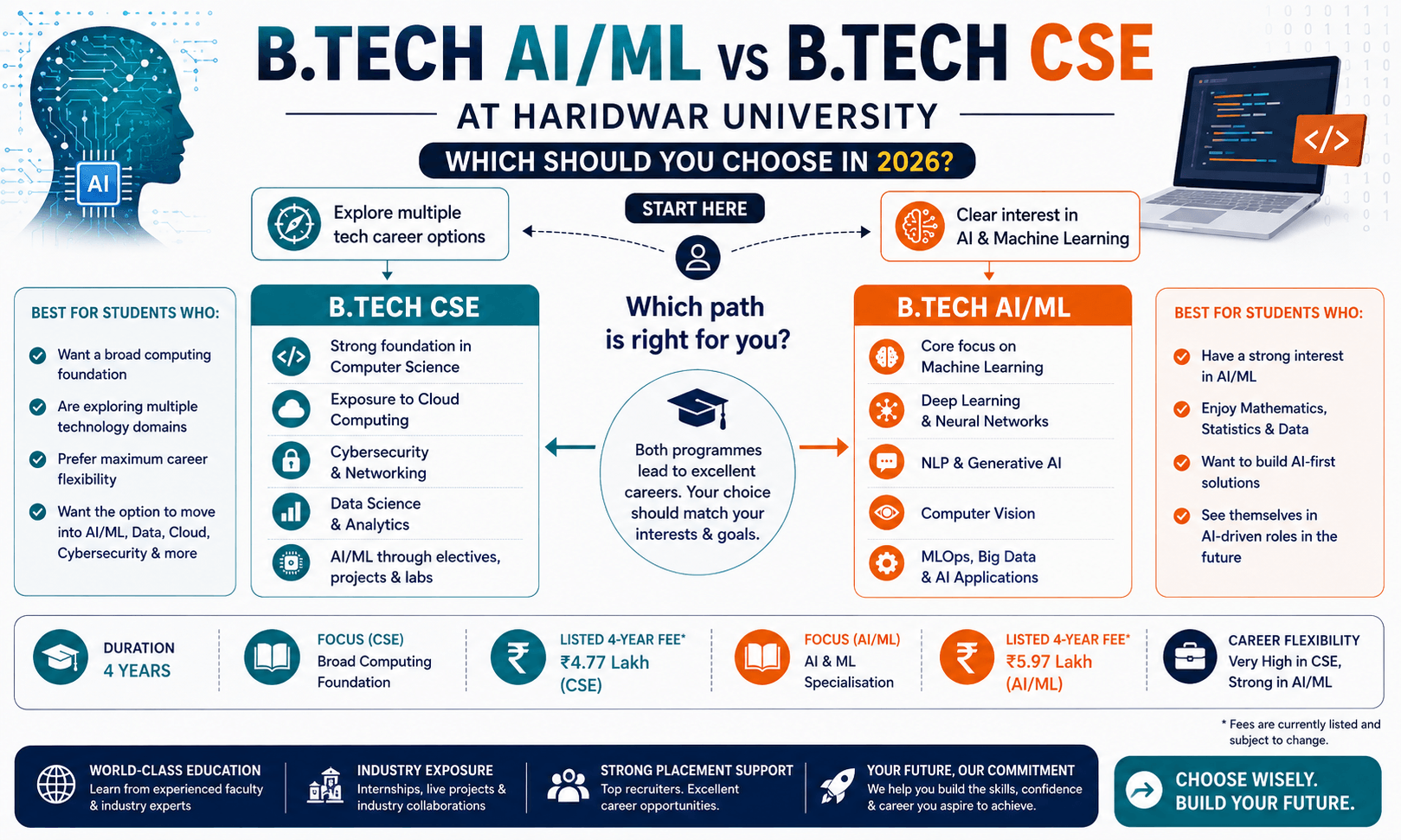
When students ask me whether they should choose B.Tech CSE or B.Tech AI/ML, I usually begin with one question: Do you want breadth first, or do you already know that AI is the direction you want to pursue?
At Haridwar University, both programmes share a strong computing foundation, but their emphasis is different. B.Tech CSE keeps the field broad, with exposure to software development, AI/ML, cloud computing, cybersecurity and data science. B.Tech AI/ML moves earlier and deeper into machine learning, statistics, neural networks and related AI applications. That distinction is more useful than simply asking which degree is "better".
Table of Contents
- B.Tech AI/ML vs B.Tech CSE: Quick Comparison
- Curriculum: Breadth vs Specialisation
- Career Roles and Indicative Salary Ranges
- When B.Tech CSE Is the Better Choice
- When B.Tech AI/ML Is the Better Choice
- What About Electives and Overlap at HU?
- Programme Fees and Eligibility at HU
- A Simple Decision Framework
- Conclusion
- Frequently Asked Questions
B.Tech AI/ML vs B.Tech CSE: Quick Comparison
| Factor | B.Tech CSE | B.Tech AI/ML |
|---|---|---|
| Duration | 4 years | 4 years |
| Core focus | Broad Computer Science | AI and Machine Learning |
| Programming | Strong foundation | Strong foundation with greater AI/data application |
| Mathematics | Engineering mathematics + computing concepts | Greater emphasis on probability, statistics and linear algebra |
| Breadth | Wider technology exposure | More specialised AI/ML exposure |
| AI/ML exposure | Through curriculum, electives and projects | Central to the programme |
| Career flexibility | Very high | Strong, particularly for AI/data-oriented roles |
| Best suited for | Students exploring multiple technology careers | Students with a clear AI/ML career goal |
My observation is simple: CSE gives you more doors at the beginning; AI/ML takes you further down one particular corridor.
Curriculum: Breadth vs Specialisation
The difference becomes clearer when we look at how the programmes progress.
| Stage | B.Tech CSE | B.Tech AI/ML |
|---|---|---|
| Early years | Programming, mathematics, physics, digital electronics | Programming, mathematics, physics and engineering fundamentals |
| Core stage | Data structures, OOP, DBMS, operating systems, algorithms | Data structures, OOP, DBMS, probability and statistics |
| Advanced stage | AI, ML, cloud computing, web technologies, software engineering | ML, deep learning, neural networks, NLP, computer vision |
| Final stage | Cybersecurity, data science, major project, internship | GenAI, advanced NLP, reinforcement learning, big data, MLOps, major project |
| Main advantage | Wider computing foundation | Deeper AI/ML orientation |
At Haridwar University, the CSE curriculum already introduces students to AI, machine learning, cloud computing, cybersecurity and data science. That means choosing CSE does not close the door on AI, it simply builds a broader computing foundation first. If you want a detailed look at the semester-wise curriculum, projects and career pathways, explore our B.Tech CSE at Haridwar University: Complete Programme Guide (2026).
The AI/ML programme, meanwhile, places machine learning and related areas much closer to the centre of the degree. Its later semesters move into areas such as deep learning, NLP, computer vision, generative AI and MLOps. For a semester-wise look at this progression, the skills students build and the career roles it can lead to, see our B.Tech AI & ML at Haridwar University: Complete Programme Guide and Career Scope (2026).
Career Roles and Indicative Salary Ranges
This is where the distinction between the two degrees becomes practical. CSE keeps several technology routes open, while AI/ML concentrates the student’s preparation around data-driven and intelligent systems. HU’s CSE programme lists roles including Software Engineer, Full Stack Developer, AI/ML Engineer, Cloud Engineer, Cybersecurity Analyst, Data Scientist and DevOps Engineer. The AI/ML pathway is more focused on roles such as ML Engineer, Data Scientist, AI Researcher and MLOps Engineer.
| Career Level | B.Tech CSE Pathway | B.Tech AI/ML Pathway |
|---|---|---|
| Fresher / 0–1 year | Software Engineer / Developer: ₹3–8 LPA | AI/ML Engineer: ₹4–10 LPA |
| Early to mid career | Software Engineer / Developer: ₹6–15 LPA | Machine Learning Engineer: ₹7–18 LPA |
| Experienced / specialised roles | Senior software, cloud and data roles: ₹12–25+ LPA | Senior AI/ML roles: ₹15–30+ LPA |
*Indicative India-market salary bands, not salary guarantees or HU-specific programme outcomes. HU's CSE guide gives role-wise estimates compiled from AmbitionBox and NASSCOM FutureSkills Prime, while its AI/ML guide cites current industry estimates for AI/ML roles.
The important point is not the upper end of these ranges. Salary varies substantially with experience, role, employer, location and technical specialisation. CSE graduates can move into software, cloud, data or AI roles, while AI/ML graduates have a more direct route towards ML and AI engineering roles.
What Recruiters Look For
| Skill Area | CSE | AI/ML |
|---|---|---|
| Programming fundamentals | ✓ | ✓ |
| Data structures & algorithms | ✓ | ✓ |
| Software development | ✓✓ | ✓ |
| Statistics & mathematical modelling | ✓ | ✓✓ |
| Machine learning | ✓ | ✓✓ |
| Projects and portfolio | ✓✓ | ✓✓ |
| Internship experience | ✓✓ | ✓✓ |
In my view, recruiter demand should be read through the role rather than the degree label. A software engineering opening may prioritise programming and problem-solving, while an ML role may additionally require statistics, model development and deployment skills. The strongest profile is therefore the one that matches the role with demonstrable projects and practical experience.
I would not use salary as the deciding factor alone. The role, technical capability, internship experience, portfolio and employer matter more than the programme title.
When B.Tech CSE Is the Better Choice
I generally recommend CSE to students who are still exploring their interests within technology. Choose CSE if you:
- Want a broad foundation in Computer Science.
- Are considering software development, cloud, cybersecurity, data or AI.
- Have not yet decided which technology specialisation suits you.
- Want greater flexibility to change direction during or after the degree.
- Prefer to build core programming and system knowledge before specialising.
This flexibility is one of CSE's strongest advantages. At HU, AI/ML, cloud computing, cybersecurity and data science already form part of the programme's broader technology exposure.
When B.Tech AI/ML Is the Better Choice
AI/ML makes more sense when the student already has a clear interest in artificial intelligence, machine learning and data-driven applications. Choose AI/ML if you:
- Enjoy mathematics, statistics and programming.
- Want to work specifically towards AI/ML-oriented roles.
- Are interested in neural networks, NLP, computer vision or generative AI.
- Want AI-focused projects and skills to form a larger part of your undergraduate study.
- Are comfortable choosing a more specialised route from the beginning.
The HU AI/ML curriculum moves from programming and mathematical foundations towards machine learning, deep learning, NLP, computer vision, generative AI and MLOps.
What About Electives and Overlap at HU?
| CSE-oriented Project | AI/ML-oriented Project |
|---|---|
| Full-stack web application | Predictive ML model |
| Cloud-based application | Computer vision system |
| Database-driven software | NLP application |
| Cybersecurity solution | Recommendation system |
| Software automation tool | Generative AI application |
The boundary is not absolute. A CSE student can build an AI project, while an AI/ML student still needs strong programming and software fundamentals to develop deployable systems.
Students interested in seeing how AI concepts can translate into practical applications can also explore our AI project ideas for students.
The choice is not completely irreversible. There is meaningful overlap between the two pathways.
| Area | CSE | AI/ML |
|---|---|---|
| Programming | Core | Core |
| Data structures & algorithms | Core | Core |
| Database systems | Core | Core |
| Artificial Intelligence | Exposure/core curriculum | Central focus |
| Machine Learning | Exposure/elective | Central focus |
| Cloud | Exposure | Supporting skill |
| Data Science | Exposure/elective | Closely connected |
| Cybersecurity | Elective exposure | Less central |
This is why I would frame the choice as breadth versus depth, rather than one programme being universally superior.
For students who want to understand the broader CSE pathway first, our B.Tech CSE programme guide provides the detailed curriculum and career breakdown. For students already committed to AI, the B.Tech AI/ML programme guide goes deeper into the specialised pathway.
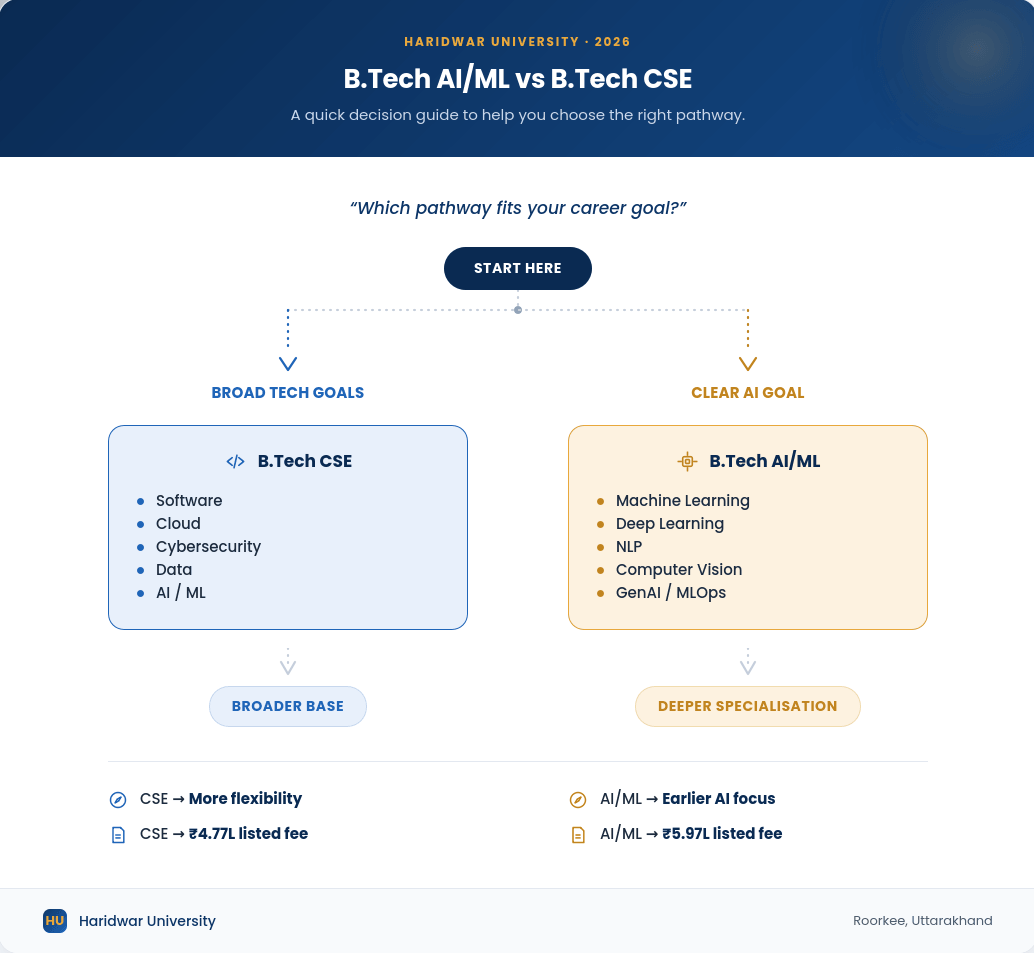
B.Tech AI/ML vs CSE at Haridwar University: A decision framework comparing programme focus, career pathways, fees and flexibility.
Programme Fees and Eligibility at HU
| Factor | B.Tech CSE | B.Tech AI/ML |
|---|---|---|
| Duration | 4 years | 4 years |
| 1st year | ₹1,32,000 | ₹1,62,000 |
| 2nd year | ₹1,15,000 | ₹1,45,000 |
| 3rd year | ₹1,15,000 | ₹1,45,000 |
| 4th year | ₹1,15,000 | ₹1,45,000 |
| Total listed programme fee | ₹4,77,000 | ₹5,97,000 |
| Eligibility | 10+2 with Physics, Chemistry and Mathematics; minimum 60% | 10+2 with relevant subjects; 60% aggregate, 55% for SC/ST/OBC |
| Entrance requirement | As per university norms | As per university norms |
The figures above reflect the currently listed programme fees. Since fee structures, scholarships and applicable charges can change, students should check the Haridwar University Fee Structure & Scholarships page for the latest programme-wise details before applying.
The fee difference is therefore a practical consideration alongside curriculum fit. Students should compare the programme structure and their intended career direction rather than treating the higher fee of AI/ML as an indicator of better career outcomes.
A Simple Decision Framework
| If you are thinking... | Consider |
|---|---|
| "I want the broader computing foundation and may specialise later." | B.Tech CSE |
| "I want to explore software, cloud, cybersecurity, data and AI." | B.Tech CSE |
| "I already want an AI/ML career." | B.Tech AI/ML |
| "I enjoy mathematics, statistics and model building." | B.Tech AI/ML |
| "I want deeper exposure to ML, NLP, computer vision and GenAI." | B.Tech AI/ML |
| "I am comparing the programmes mainly on salary." | Compare roles and skills, not degree titles |
My final observation: if your career goal is still developing, CSE gives you a safer broad foundation. If AI is already the destination you have chosen, AI/ML lets you start building towards it earlier.
Frequently Asked Questions
Is B.Tech AI/ML better than B.Tech CSE?
Neither is universally better. CSE offers broader computing exposure, while AI/ML provides deeper specialisation in artificial intelligence and machine learning.
Can CSE students work in AI/ML?
Yes. HU's CSE programme includes AI and ML exposure, and students can build further expertise through electives, projects and independent learning.
Is AI/ML more difficult than CSE?
It can involve greater emphasis on mathematics, probability, statistics and linear algebra, particularly as students move into machine learning.
Which is better for software development?
CSE is generally the more direct choice because software development remains central to its broader curriculum.
Which should I choose if I want to become an ML Engineer?
AI/ML is the more direct undergraduate pathway, although a strong CSE graduate can also move into ML through relevant coursework and projects.
Can I switch from CSE to AI/ML later?
A CSE graduate can develop AI/ML expertise through electives, projects, certifications, postgraduate study and industry experience. The exact academic process for changing programmes during the degree depends on university rules.
Which degree gives more career flexibility?
CSE generally provides broader flexibility because it covers a wider range of computing domains.
What should I compare before taking admission at HU?
Compare the curriculum, your mathematical and technical interests, intended career role, programme structure, fees, internship opportunities and the kind of projects you want to build.