

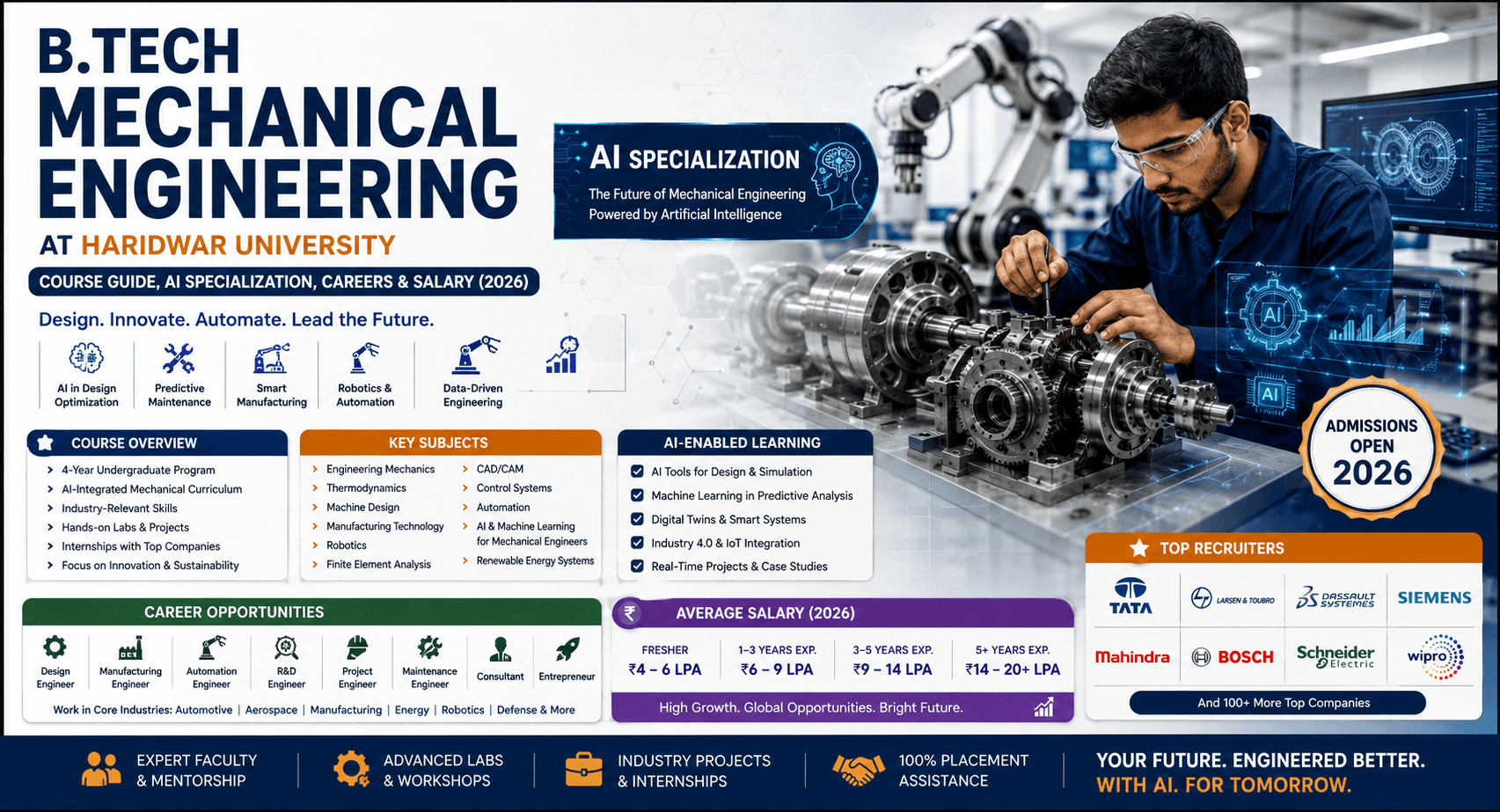
B.Tech Mechanical Engineering at Haridwar University: Course Guide, AI Specialization, Careers & Salary (2026)
Mr. Abhinav Bhatnagar
Head, Mechanical Engineering, Haridwar University
Table of Contents
- 1. Introduction: Is Mechanical Engineering Still a Good Career After AI?
- 2. Why This Programme Looks Different in 2026
- 3. What You Will Learn
- 4. What You Will Study in B.Tech. Honours in Mechanical Engineering with AI Specialization
- 5. Learning Beyond the Classroom
- 6. Practical Learning Inside Mechanical Laboratories
- 7. Career Opportunities After B.Tech. Mechanical Engineering with AI Specialization
- 8. Placement Support at Haridwar University
- 9. Higher Education Options
- 10. Is B.Tech. Honours in Mechanical Engineering with AI Specialization the Right Choice for You?
- 11. Frequently Asked Questions (FAQs)
1. Introduction: Is Mechanical Engineering Still a Good Career After AI?
Mechanical Engineering has never been limited to engines, machines, or manufacturing floors. In 2026, it is increasingly defined by intelligent systems, automation, robotics, predictive maintenance, and data-driven decision-making. That shift is changing what employers expect from graduates.
As Head of the Department, I am often asked a simple question: "Is Mechanical Engineering still a good career after AI?"
My answer is equally straightforward: AI is not replacing Mechanical Engineers. It is changing how they design products, monitor equipment, optimise manufacturing, and solve industrial problems. Engineers who understand both mechanical fundamentals and AI-enabled technologies will be better prepared for modern industry.
That thinking is reflected in our programme at Haridwar University. Rather than teaching Artificial Intelligence as a separate discipline, we offer B.Tech. Honours in Mechanical Engineering with AI Specialization, integrating core mechanical engineering with AI applications used across manufacturing, robotics, Industry 4.0, smart factories, and predictive maintenance.
At a Glance
| Particular | Details |
|---|---|
| Programme | B.Tech. Honours in Mechanical Engineering with AI Specialization |
| Duration | 4 Years (8 Semesters) |
| Eligibility | 10+2 (PCM) or equivalent with a minimum of 50% marks in Physics, Chemistry and Mathematics (45% for SC/ST candidates) |
| Entrance | JEE Main, HUAET or equivalent state-level entrance examination |
| First Year Fee | ₹1,27,000 |
| Second to Fourth Year | ₹1,10,000 per year |
2. Why This Programme Looks Different in 2026
The strongest Mechanical Engineering graduates today understand more than machines. They understand how machines generate data.
That is why our curriculum combines traditional engineering with AI-enabled applications, including:
- Robotics and intelligent automation
- Predictive maintenance using AI
- Smart manufacturing and Industry 4.0
- Machine learning for design optimisation
- Computer-aided design and simulation
- IoT-enabled manufacturing systems
These are taught alongside the mechanical engineering foundations that remain essential in every industry: thermodynamics, manufacturing science, machine design, fluid mechanics, strength of materials, and power plant engineering.
In my experience, employers continue to value graduates who can bridge classical engineering principles with emerging digital technologies rather than treating them as separate disciplines.
3. What You Will Learn
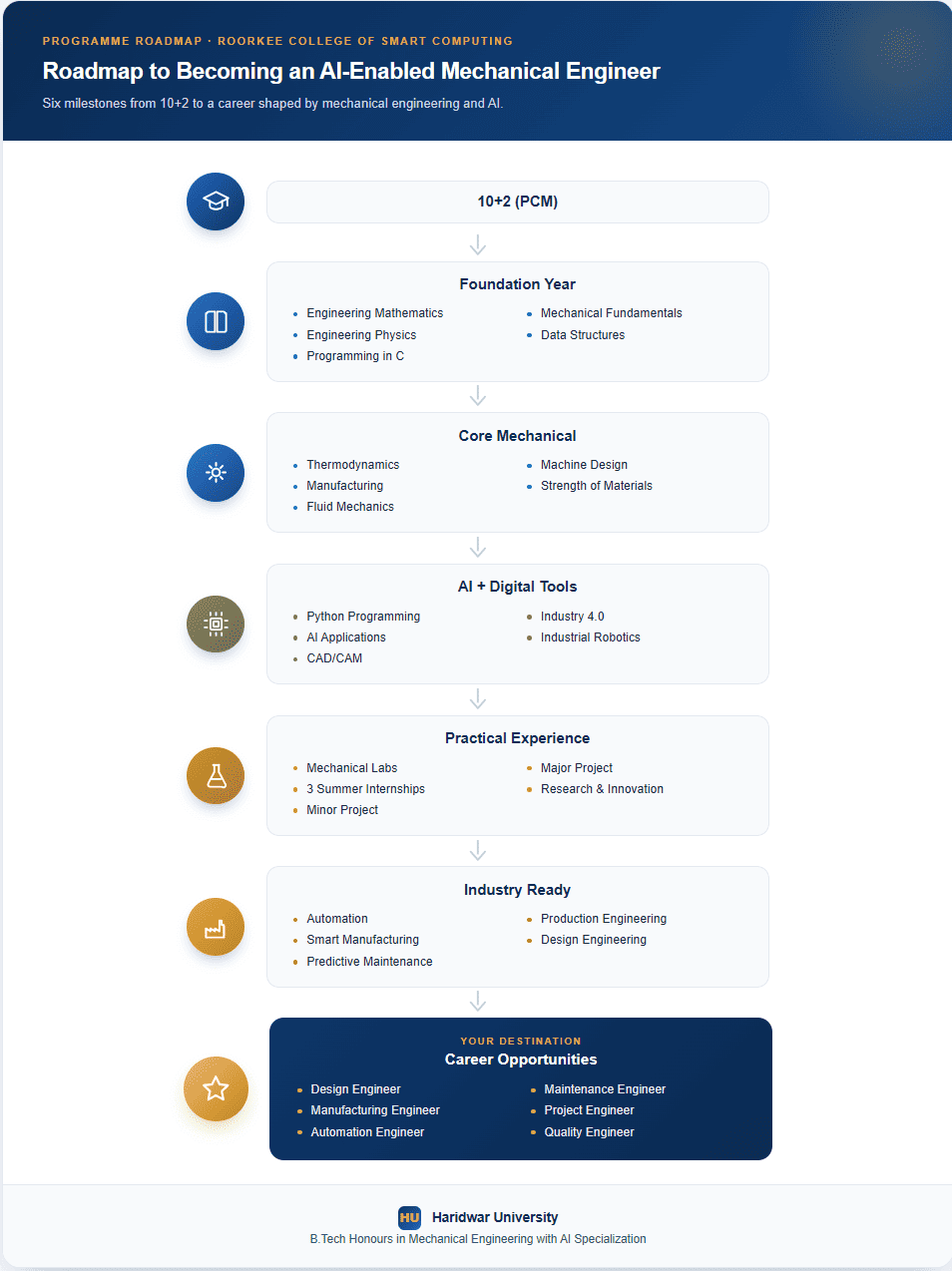
Instead of introducing AI only in the final year, the programme gradually builds technical capability across eight semesters.
| Foundation | Core Mechanical Engineering | AI & Digital Integration |
|---|---|---|
| Engineering Mathematics | Thermodynamics | Python Programming |
| Engineering Physics | Manufacturing Technology | AI for Electronics & Electrical Engineering |
| Programming in C | Machine Design | Industrial Robotics |
| Data Structures | Fluid Mechanics | Industry 4.0 |
| Electrical Engineering | Heat Transfer | CAD/CAM & Simulation |
This progression ensures students first develop engineering fundamentals before applying AI tools to real mechanical systems.
4. What You Will Study in B.Tech. Honours in Mechanical Engineering with AI Specialization
When students ask me whether Mechanical Engineering has become outdated, I usually answer with another question: "Who will build intelligent machines if mechanical engineers stop learning AI?"
At Haridwar University, our programme is officially offered as B.Tech. Honours in Mechanical Engineering with AI Specialization. The curriculum has been designed so that students first become strong mechanical engineers and then learn how Artificial Intelligence can improve design, manufacturing, automation and industrial decision-making.
Rather than replacing engineering fundamentals, AI is introduced where it creates measurable value.
Curriculum Snapshot
| Year | Primary Learning Focus | Industry Outcome |
|---|---|---|
| First Year | Engineering fundamentals, Mathematics, Programming, Physics | Strong technical foundation |
| Second Year | Core Mechanical Engineering + Python + AI introduction | Analytical and computational skills |
| Third Year | Machine Design, Manufacturing, Industry electives, Internships | Practical engineering capability |
| Final Year | Industry 4.0, Robotics, CAD/CAM, Projects, Research | Career readiness for modern manufacturing |
This gradual progression reflects how engineers actually grow in industry.
Subjects That Build Strong Mechanical Engineers
A common misconception is that AI dominates the curriculum. It does not. Mechanical Engineering remains the core discipline. Students study subjects including:
- Engineering Mathematics
- Concepts of Mechanical Engineering
- Material Science & Metallurgy
- Thermodynamics
- Fluid Mechanics
- Manufacturing Science & Technology
- Strength of Materials
- Dynamics of Machines
- Machine Design
- Heat & Mass Transfer
- Power Plant Engineering
- Automobile Engineering
- Refrigeration & Air Conditioning
- Computational Fluid Dynamics
- Renewable Energy
These subjects develop engineering judgement that software alone cannot replace.
Where AI Enters the Curriculum
Instead of teaching AI as a separate theoretical topic, we expose students to technologies that solve engineering problems. Examples from the curriculum include:
| AI & Digital Skill | Engineering Application |
|---|---|
| Computational Thinking & Programming in C | Engineering problem solving |
| Data Structures | Efficient data processing |
| Python Programming | Automation and AI implementation |
| AI for Electronics and Electrical Engineering | Intelligent industrial systems |
| Industrial Robot and Automation | Smart manufacturing |
| Introduction to Industry 4.0 | Connected production systems |
| CAD/CAM | Digital product development |
This approach prepares students for today's manufacturing environment, where software increasingly complements mechanical systems rather than replacing them.
5. Learning Beyond the Classroom
Engineering education should not remain confined to lectures. Our curriculum therefore integrates practical learning throughout the programme. Students complete:
- Three industry internships
- Laboratory-based practical courses
- Minor Project
- Major Project
- MOOC/SWAYAM learning
- Innovation, Entrepreneurship and Patent activities
- Research publication or startup-based academic work
By the eighth semester, students are expected to demonstrate the ability to solve an engineering problem instead of simply answering examination questions.
6. Practical Learning Inside Mechanical Laboratories
One observation I consistently make is that confidence grows much faster inside laboratories than inside classrooms.
Our Mechanical Engineering laboratories allow students to understand how engineering structures and machine components behave under real loading conditions. Students perform experiments, analyse bending moments, shear forces, axial loads and structural behaviour while learning how engineering decisions affect safety and performance.
This practical exposure develops the habit of validating theoretical concepts through experimentation—an essential skill for every practising mechanical engineer.
"The engineers industry values today are not those who only know Mechanical Engineering or only know AI. They are professionals who understand machines first and then use intelligent technologies to improve them. That philosophy shapes the curriculum we follow at Haridwar University."
7. Career Opportunities After B.Tech. Mechanical Engineering with AI Specialization
One question I hear from parents almost every admission season is: "Will my child still find good opportunities in Mechanical Engineering?"
My answer is yes, provided the student graduates with both engineering fundamentals and the ability to work in an AI-enabled industrial environment.
Mechanical Engineering continues to power manufacturing, automotive, energy, infrastructure and production industries. What has changed is the workplace itself. Modern factories increasingly rely on automation, robotics, predictive maintenance and data-driven decision-making, making AI literacy an advantage rather than an alternative to mechanical engineering.
Career Paths After Graduation
Graduates of B.Tech. Honours in Mechanical Engineering with AI Specialization can pursue opportunities across multiple engineering domains.
| Career Path | Typical Work |
|---|---|
| Design Engineer | Product design, CAD/CAM and simulation |
| Manufacturing Engineer | Production planning and process optimisation |
| Quality Engineer | Inspection, quality assurance and process improvement |
| Maintenance Engineer | Equipment reliability and predictive maintenance |
| Automation Engineer | Industrial automation and robotics support |
| Production Engineer | Plant operations and manufacturing efficiency |
| HVAC Engineer | Refrigeration and air-conditioning systems |
| Project Engineer | Planning, execution and coordination of engineering projects |
These roles build directly upon the curriculum, which combines core mechanical engineering with programming, automation and Industry 4.0 concepts.
Salary Outlook (Indicative)
Salary depends on the employer, location, technical skills and internship experience. The figures below represent typical industry ranges for graduates entering the engineering sector.
| Career Stage | Typical Experience | Indicative Annual Salary* |
|---|---|---|
| Entry Level Engineer | 0–2 Years | ₹3.5–6 LPA |
| Mid-Level Engineer | 3–7 Years | ₹6–12 LPA |
| Senior Engineer / Engineering Lead | 8–15+ Years | ₹12–22+ LPA |
*Source: Indicative industry salary ranges based on data from AmbitionBox, Glassdoor, and Indeed. Actual salaries vary by employer, role, location, skills, and experience. Figures are for guidance only and are not Haridwar University placement packages.
8. Placement Support at Haridwar University
As Head of the Department, I believe placement preparation begins well before the final semester. Our curriculum integrates:
- Summer Internships
- Soft Skills and Verbal Communication
- Quantitative Aptitude and Logical Reasoning
- Industry-oriented projects
- Practical laboratory learning
These components help students develop both technical competence and professional confidence before campus recruitment begins.
Recruiters Visiting Haridwar University
Students from Haridwar University have received opportunities with several leading organisations across engineering, manufacturing, IT and diversified industries. Some of the prominent recruiters featured on the University's placement page include:
- Tata Consultancy Services (TCS)
- Infosys
- Wipro
- HCLTech
- Tech Mahindra
- Capgemini
- Nagarro
- Bajaj Motors
- Alembic Pharmaceuticals
- Gold Plus Glass Industry
- Shree Cement Ltd.
- Chetu
- Xcoders Technologies
Haridwar University publishes its recruiter network on the placement page. The University does not publish company-wise hiring numbers, role-wise recruitment data or recruiter-specific salary packages.
9. Higher Education Options
Some students choose to begin their careers immediately after graduation, while others continue their academic journey. Common progression pathways include:
| Pathway | Purpose |
|---|---|
| M.Tech. | Advanced technical specialisation |
| MBA | Engineering management and business leadership |
| GATE | Entry to postgraduate programmes and PSU opportunities |
| Research | Innovation and higher studies in mechanical engineering |
| International Master's Programmes | Global academic and research opportunities |
The right choice depends on individual career goals rather than a single prescribed route.
10. Is B.Tech. Honours in Mechanical Engineering with AI Specialization the Right Choice for You?
Every engineering programme is an investment of four years. The real question is not whether Mechanical Engineering has a future, but whether you are ready to build that future.
If you enjoy understanding how machines work, solving engineering problems and exploring how Artificial Intelligence is transforming manufacturing, automation and smart industries, B.Tech. Honours in Mechanical Engineering with AI Specialization can provide a balanced pathway between core engineering and emerging technologies.
At Haridwar University, the programme combines mechanical engineering fundamentals with AI-oriented learning, practical laboratory work, industry internships, project-based learning and professional skill development to prepare students for evolving engineering careers.
Students seeking admission may also appear for the Haridwar University Admission Entrance Test (HUAET), conducted as part of the University's admission process.
Mechanical Engineering continues to evolve, not disappear. As educators, our responsibility is to prepare graduates who understand engineering principles while adapting to technological change. That is the vision behind the B.Tech. Honours in Mechanical Engineering with AI Specialization at Haridwar University, and the vision I hope every aspiring engineer will carry into the future.
11. Frequently Asked Questions (FAQs)
1. What is B.Tech. Honours in Mechanical Engineering with AI Specialization?
B.Tech. Honours in Mechanical Engineering with AI Specialization at Haridwar University is a four-year undergraduate programme that combines core Mechanical Engineering with Artificial Intelligence applications in manufacturing, robotics, predictive maintenance and smart industrial systems.
2. What is the eligibility for B.Tech. Mechanical Engineering with AI at Haridwar University?
Candidates must have passed 10+2 (PCM) or an equivalent examination with a minimum of 50% marks in Physics, Chemistry and Mathematics (45% for SC/ST candidates). Admission is based on JEE Main or an equivalent state-level engineering entrance examination, as per university norms.
3. What is the fee structure for B.Tech. Mechanical Engineering with AI at Haridwar University?
The programme fee is ₹1,27,000 for the first year and ₹1,10,000 per year from the second to the fourth year, as per the latest fee structure published by Haridwar University.
4. What career opportunities are available after B.Tech. Mechanical Engineering with AI?
Graduates can explore careers as Design Engineers, Manufacturing Engineers, Production Engineers, Quality Engineers, Maintenance Engineers, Automation Engineers, HVAC Engineers and Project Engineers across manufacturing, automotive, energy and industrial sectors.
5. Does Haridwar University provide internship opportunities during the programme?
Yes. The curriculum includes three summer internships, along with laboratory work, minor and major projects, helping students gain practical engineering experience throughout the programme.
6. What AI-related subjects are included in the curriculum?
The curriculum includes subjects such as AI for Electronics and Electrical Engineering, Python Programming, Data Structures, Industrial Robot and Automation, Fundamentals of CAD/CAM, and Introduction to Industry 4.0, alongside core Mechanical Engineering subjects.
7. Can I pursue higher studies after completing this programme?
Yes. Graduates may choose higher education pathways such as M.Tech., MBA, GATE preparation, research programmes, or international postgraduate studies, depending on their career goals.
8. Why choose Haridwar University for Mechanical Engineering?
Haridwar University offers a curriculum that combines Mechanical Engineering fundamentals with AI-focused learning, practical laboratory training, industry internships, project-based learning and placement support, helping students prepare for modern engineering careers.
Ready to Build the Future of Mechanical Engineering with AI?
Apply now for B.Tech Mechanical Engineering with AI Specialization at Haridwar University for Session 2026.