

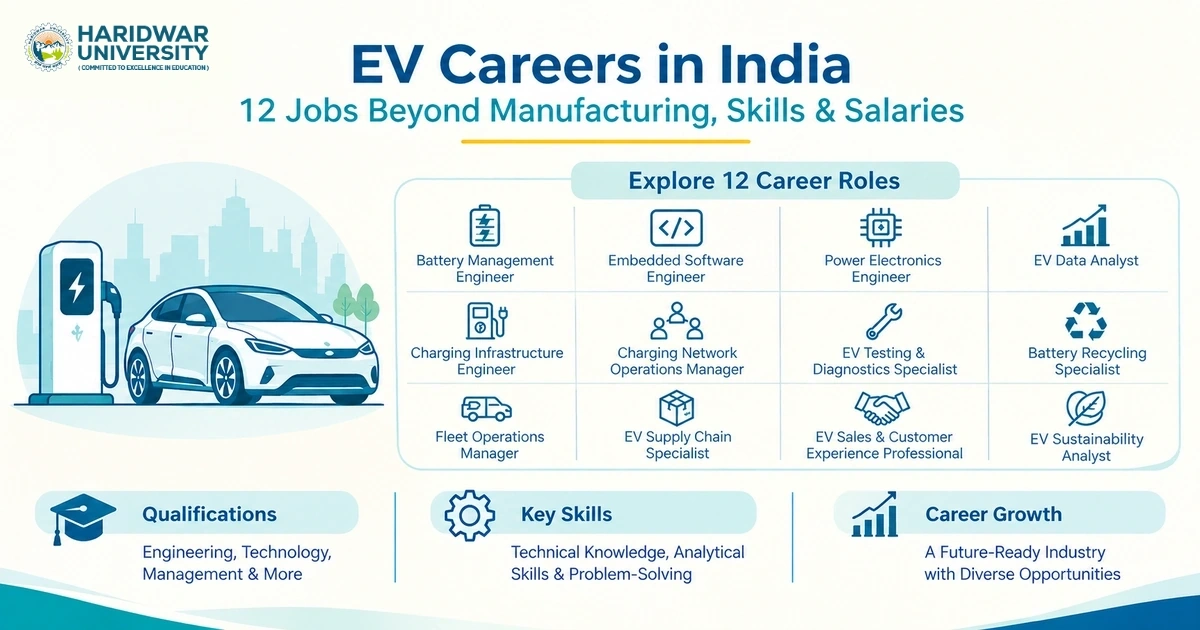
EV Careers in India: 12 Jobs Beyond Manufacturing, Skills & Salaries
Mr. Prajwal Chaudhary
Head, Training & Placement, Haridwar University
An electric vehicle is more than a motor, battery, and set of wheels. It depends on software, power electronics, charging networks, data systems, battery management, logistics, and customer support. That wider ecosystem is creating career opportunities for graduates from engineering, computer science, management, and other disciplines.
The scale of the transition is becoming clearer. NITI Aayog’s India Electric Mobility Index 2025 reports that EV sales penetration reached 8.25% in 2025–26, with more than 8.7 million EVs on Indian roads. Meanwhile, an Adecco India report projects 30–40 million EV-linked jobs by 2030, of which 85–90% could be indirect roles rather than direct manufacturing jobs. These are projections, not guaranteed vacancies, but they show why students should look beyond conventional automobile careers.
I would encourage students to approach EV careers in India as a choice of industry, not a single job title. The right route depends on what they study, what they can demonstrate, and which part of the electric mobility ecosystem interests them.
Table of Contents
- 1. Why India's EV Industry Is Creating New Career Opportunities
- 2. EV Careers Beyond Manufacturing Across the Industry Value Chain
- 3. 12 Career Roles to Explore in India's Electric Vehicle Industry
- 4. Qualifications and Degrees That Can Lead to EV Careers
- 5. Technical and Professional Skills Employers Look For
- 6. EV Job Salaries and Career Growth in India
- 7. How to Start a Career in the EV Industry After Graduation
- 8. Challenges and Skills Gaps in India's EV Job Market
- 9. The Future of EV Careers in India Towards 2030
- 10. Frequently Asked Questions (FAQs)
- 11. Choosing an EV Career That Matches Your Skills
1. Why India's EV Industry Is Creating New Career Opportunities
India's EV transition is creating demand across several connected industries. Vehicle manufacturers need engineers, but they also depend on battery suppliers, software developers, charging operators, electricity providers, logistics companies, service networks, and recycling businesses.
The employment estimates need careful interpretation. Adecco India projects 30–40 million jobs by 2030, with most expected to be indirect. Its report also anticipates annual hiring growth of 15–20%. The estimate is based on insights from more than 100 companies in Adecco India's network, so it should be read as an industry projection rather than a count of confirmed openings.
The important point for students is that EV careers in India are not limited to mechanical engineering or vehicle assembly. A computer science graduate may work on vehicle software, while an electrical engineering graduate may specialise in charging systems. A management graduate may enter procurement, fleet operations, or sales.
2. EV Careers Beyond Manufacturing Across the Industry Value Chain
An EV passes through several stages before and after it reaches a customer. Each stage creates different professional requirements across the value chain:
- Research and Development: Battery design, motor systems, vehicle electronics, and software.
- Energy and Charging: Charging equipment, installation, network management, and smart grid integration.
- Digital Services: Vehicle connectivity, telemetry, data analytics, diagnostics, and cloud software platforms.
- Operations: Fleet management, logistics, component procurement, and after-sales support.
- Sustainability: Battery collection, recycling, material recovery, and environmental ESG reporting.
A February 2026 report by Climate Policy Initiative (CPI) mapped 147 job roles across EV manufacturers, research and development, supply chains, corporate functions, sales, and services. It identified 36 EV-specific roles, particularly in battery engineering, electronics, motor design, and drivetrain development. The report also notes that many support roles overlap with those in the conventional automobile industry.
3. 12 Career Roles to Explore in India's Electric Vehicle Industry
The following roles represent different entry points into the EV ecosystem. Not every position requires the same degree or level of technical specialisation:
| Career Role | What the Professional Does | Relevant Background |
|---|---|---|
| 1. Battery Management Systems (BMS) Engineer | Develops systems that monitor battery temperature, voltage, charging, state of health, and cell balancing. | Electrical Engineering, ECE, Electronics |
| 2. Embedded Software Engineer | Works on firmware and embedded code controlling vehicle electronics, motor control units, sensors, and CAN bus protocols. | ECE, Computer Science & Engineering, Electronics |
| 3. Power Electronics Engineer | Develops and tests DC-DC converters, on-board chargers, inverters, and high-efficiency motor drives. | Electrical Engineering, EEE |
| 4. EV Data Analyst | Studies telematics telemetry, real-world battery degradation patterns, driver behavior, and route efficiency. | Computer Science, Data Science, Statistics |
| 5. Charging Infrastructure Engineer | Plans, installs, and commissions AC/DC fast chargers, grid substations, load management, and safety grounding. | Electrical Engineering, EEE |
| 6. Charging Network Operations Manager | Monitors charging station uptime, OCPP communication, payment gateway integrations, and field repairs. | Engineering, Operations, Management |
| 7. EV Testing and Diagnostics Specialist | Conducts dyno testing, thermal cycling, hardware-in-the-loop (HIL) simulations, and fault diagnostics. | Mechanical, Electrical, ECE |
| 8. Battery Recycling Specialist | Manages safe pack discharge, hydrometallurgical processing, black mass recovery (lithium, cobalt, nickel), and environmental compliance. | Chemical, Materials, Environmental Science |
| 9. Fleet Operations Manager | Oversees commercial electric vehicle fleets, route planning, battery swap schedules, maintenance, and operating costs. | Management, Operations, Engineering |
| 10. EV Supply Chain Specialist | Coordinates raw material sourcing (cells, rare earth magnets), vendor relationships, import compliance, and inventory. | Supply Chain, Operations, Management |
| 11. EV Sales and Customer Experience Professional | Educates prospective buyers on range, charging requirements, total cost of ownership (TCO), and after-sales support. | Business, Marketing, Communications |
| 12. EV Sustainability Analyst | Conducts life-cycle assessments (LCA), carbon footprint tracking, circular economy modeling, and ESG reporting. | Environmental Science, Engineering, Sustainability |
The distinction matters. A BMS engineer and a charging network manager both work in the EV sector, but their daily responsibilities, tools, and technical requirements are completely different. Students should choose a specific career direction first and then build the concrete skills required to enter it.
4. Qualifications and Degrees That Can Lead to EV Careers
There is no single degree that qualifies someone for every EV job. The best academic route depends entirely on your chosen specialization:
- Mechanical Engineering: Vehicle chassis design, thermal management systems, battery packaging, structural safety, vibration testing, and component fabrication. Explore HU's guide to B.Tech Mechanical engineering careers including EV roles.
- Electrical and Electronics Engineering: Motor drives, inverters, power converters, battery pack wiring, high-voltage safety, and public charging infrastructure. Learn more about B.Tech ECE careers in IoT and semiconductors.
- Computer Science and Engineering: Embedded firmware, IoT telematics, battery data modeling, connected vehicle applications, and charging station cloud platforms. Discover the comprehensive career options after B.Tech CSE.
- Chemical and Materials Engineering: Battery chemistry (LFP, NMC, solid-state), electrolyte behavior, cell manufacturing quality control, and hydrometallurgical recycling.
- Management and Commerce: EV procurement, supply chain logistics, fleet unit economics, dealership operations, product marketing, and sustainable finance.
- Diploma and ITI Pathways: EV repair, high-voltage electrical installation, diagnostic tool operation, and service station maintenance supported by practical apprenticeships.
At Haridwar University, students can explore these interdisciplinary academic pathways through the engineering programmes and diploma courses listed by Roorkee College of Engineering. If you are comparing core engineering specializations, read our decision guide on which B.Tech branch to choose before finalizing your degree.
5. Technical and Professional Skills Employers Look For
An engineering degree provides the theoretical foundation, but EV employers actively look for proof that candidates can apply their knowledge to real hardware and software problems.
The Climate Policy Initiative report highlights major talent shortages in battery pack design, BMS firmware, power electronics, embedded systems, high-voltage safety, diagnostics, and data analysis. Students can build a competitive profile across these focus areas:
- Electrical Fundamentals: Circuit analysis, electric motor principles (BLDC, PMSM, induction motors), power distribution, and high-voltage safety protocols.
- Software and Programming: C, C++, embedded C, Python, MATLAB/Simulink, and CAN/LIN communication protocols.
- EV Systems Knowledge: Battery chemistry, state-of-charge (SOC) and state-of-health (SOH) estimation algorithms, regenerative braking, and thermal management.
- Engineering Tools: CAD software (SolidWorks, CATIA), FEA/CFD simulation packages (ANSYS), and PCB design tools (Altium, KiCad).
- Data Skills: SQL, Python (Pandas, NumPy), Excel modeling, and telematics data visualization.
- Professional Skills: Cross-functional collaboration, technical documentation, root-cause failure analysis, and structured problem-solving.
Placement Insight: I place particular importance on demonstrable project evidence. A student who can explain a functioning battery monitoring circuit prototype, an EV charging station feasibility assessment, or a telematics data analysis dashboard has something concrete and impressive to discuss during campus placement interviews.
6. EV Job Salaries and Career Growth in India
Salary expectations vary widely depending on specialisation, technical competence, employer tier, and location. A fresher entering general maintenance cannot expect the same package as an engineer specialized in battery management or power electronics.
Technician & Service Roles
₹2.0 – 5.0 LPA
Indicative starting packages for diploma/ITI graduates working on field diagnostics, charging installations, and vehicle servicing.
Graduate Engineer Trainee (GET)
₹4.0 – 6.5 LPA
Standard entry-level engineering positions across mechanical testing, power electronics, quality assurance, and operations.
Specialized Battery & Powertrain
₹7.0 – 14.0 LPA
Adecco India's 2026 Salary Guide benchmark for high-skill engineers with 0–3 years experience in BMS design, firmware, and cell engineering.
These figures should be treated as informative benchmarks rather than guaranteed offers. Real-world compensation depends directly on the company's scale, your demonstrable project portfolio, and your depth of technical understanding.
7. How to Start a Career in the EV Industry After Graduation
Students should not wait until their final semester to begin preparing. A methodical, proactive approach during your college years will set your resume apart:
- Choose a Clear Career Direction: Decide early whether you want to specialize in battery systems, embedded software, charging infrastructure, testing, or operations.
- Master Technical Fundamentals: Build a firm command over core engineering principles rather than collecting random, superficial online certificates.
- Build a Practical Capstone Project: Design a micro-BMS simulation, analyze real EV telematics data, or build an intelligent charging scheduling prototype.
- Target Strategic Internships: Apply to EV OEMs, Tier-1 auto component suppliers, charging network operators, and clean-tech startups. Refer to our comprehensive guide on finding and preparing for B.Tech internships.
- Craft a Role-Specific Technical Resume: Highlight specific tools, software libraries, test setups, and tangible project deliverables rather than generic skill lists.
- Track Industry Job Requirements: Follow technical job descriptions from companies like Tata Motors, Mahindra Electric, Ather, Ola Electric, and ABB to identify emerging tool requirements.
8. Challenges and Skills Gaps in India's EV Job Market
While industry headlines point to millions of projected jobs, graduates should recognize real hiring dynamics. A rapid transition creates distinct challenges:
- Specialized Technical Gaps: General engineering knowledge is rarely enough for specialized roles. Companies face severe shortages of engineers skilled in BMS firmware, power stage design, and high-voltage safety compliance.
- Geographic Clustering: High-end research, engineering, and manufacturing roles remain heavily concentrated in established automotive clusters (Pune, Bengaluru, Chennai, NCR), whereas charging infrastructure and fleet operations are geographically dispersed nationwide.
- Practical Lab Experience: EV testing involves costly specialized equipment (dynamometers, battery cyclers, climatic chambers) that many undergraduate curricula do not yet feature. Students must bridge this gap through collaborative projects, university workshops, and internships.
9. The Future of EV Careers in India Towards 2030
The next phase of Indian electric mobility will be powered by deeper domestic manufacturing, cell localization, battery swapping policies, and software-defined vehicle platforms.
According to CPI projections, public charging infrastructure employment alone will expand from roughly 73,500 jobs in FY2025 to over 111,350 by FY2030. Similar acceleration is taking place across commercial fleet electrification (delivery e-rickshaws, electric buses, 2-wheeler logistics), battery second-life applications, and end-of-life recycling facilities.
For engineering students, the primary takeaway is to focus on transferable competencies. Strong foundations in electronics, code optimization, data analysis, and power systems will keep your career durable across the entire mobility ecosystem for decades to come.
10. Frequently Asked Questions (FAQs)
1. Is the EV industry a good career option in India?
Yes, electric mobility offers high growth potential across engineering, embedded software, clean energy, fleet operations, and sustainability. However, building tangible technical skills and gaining hands-on internship experience is vital to securing attractive roles.
2. How can I start a career in the EV industry after Class 12?
Enroll in a recognized undergraduate degree or polytechnic diploma program in Electrical Engineering, Electronics and Communication, Mechanical Engineering, or Computer Science. Complement your studies with self-directed projects and automotive competitions.
3. Which engineering branch is best for EV careers?
Electrical and Electronics Engineering (EEE) and Electronics & Communication Engineering (ECE) have the highest direct applicability to battery management and powertrain electronics. Mechanical Engineering is crucial for structural design and thermal management, while Computer Science leads vehicle software and connectivity.
4. What is the average salary for electric vehicle jobs in India?
Fresher technician and service roles typically start at ₹2–5 LPA, while entry-level graduate engineers earn ₹4–6.5 LPA. Candidates entering specialized battery technology, power electronics, and embedded software can command packages of ₹7–14 LPA within their first three years.
5. Can non-engineering graduates work in the EV industry?
Absolutely. The expanding clean-tech ecosystem requires professionals in supply chain management, vendor procurement, product marketing, corporate finance, customer experience, and commercial fleet management.
6. What skills are required to become an EV engineer?
Key requirements include circuit simulation, battery chemistry principles, C/C++ embedded programming, power converters, CAN bus communication, testing methodologies, and adherence to high-voltage safety standards.
7. Will EV careers remain relevant after 2030?
Yes. Even as specific vehicle models and chemistries evolve, the underlying foundations of power electronics, battery health management, renewable charging integration, and software engineering will remain critical across all forms of electric transport and grid storage.
11. Choosing an EV Career That Matches Your Skills
The EV sector offers multiple avenues into the future of automotive technology and sustainability. A student passionate about circuits and power electronics will find rewarding challenges in battery systems and fast-charging networks; someone who loves code can lead developments in embedded firmware and cloud telematics. Others will build fulfilling careers in supply chain resilience, commercial fleet operations, and after-sales support.
My core advice to students is to avoid chasing a role simply because it is trending in the news. Study the actual day-to-day work, understand what skills employers demand, and build demonstrable project evidence through laboratory experiments and structured internships. A clear technical focus, backed by solid practical ability, is your strongest launching pad into India's green mobility future.
Ready to Advance Your Education at Haridwar University?
Explore NEP-aligned, industry-driven engineering degree programmes in ECE, EEE, Mechanical, and Computer Science with hands-on lab training, smart mobility project opportunities, and dedicated placement support. Applications are open for the 2027-28 academic session.