
Water and Waste Management Careers for Civil and Environmental Students
Dr. Aadesh K. Arya
Pro Vice-Chancellor, Haridwar University
Every tap that runs clean and every bin that gets emptied on schedule is somebody’s engineering job. Water and Waste Management Careers for Civil and Environmental Students have moved from the edge of the profession toward its middle, because money, statutory rules and hiring pressure are all landing in the same place at once. This guide covers what the work looks like, which missions and regulatory frameworks sit behind the demand, how graduates enter the sector, and what a civil engineering degree at Haridwar University costs.
Start with the snapshot below outlining major functional pathways across municipal, state, and industrial infrastructure.
| Career Route | What the Work Involves | Where You Typically Work |
|---|---|---|
| Drinking water supply | Designing and maintaining treatment plants, reservoirs, intake structures and distribution pipe networks | State water supply boards, municipal corporations, EPC consulting firms |
| Sewage and wastewater | Planning, constructing and operating sewage treatment plants (STPs), sewer mains and pumping stations | Urban local bodies (ULBs), river basin authority projects, infrastructure contractors |
| Solid waste management | Designing source segregation logistics, transfer stations, waste-to-energy plants and engineered sanitary landfills | Municipal corporations, waste-processing concessionaires, environmental consultancies |
| Environmental compliance | Environmental impact monitoring, consent audits, effluent lab testing and statutory regulatory documentation | Pollution control boards (SPCB/CPCB), industrial EHS departments, third-party audit agencies |
| River and catchment projects | Delivering basin rejuvenation schemes, stormwater drainage networks and real-time river water quality telemetry | Special purpose project agencies, infrastructure developers, water research institutions |
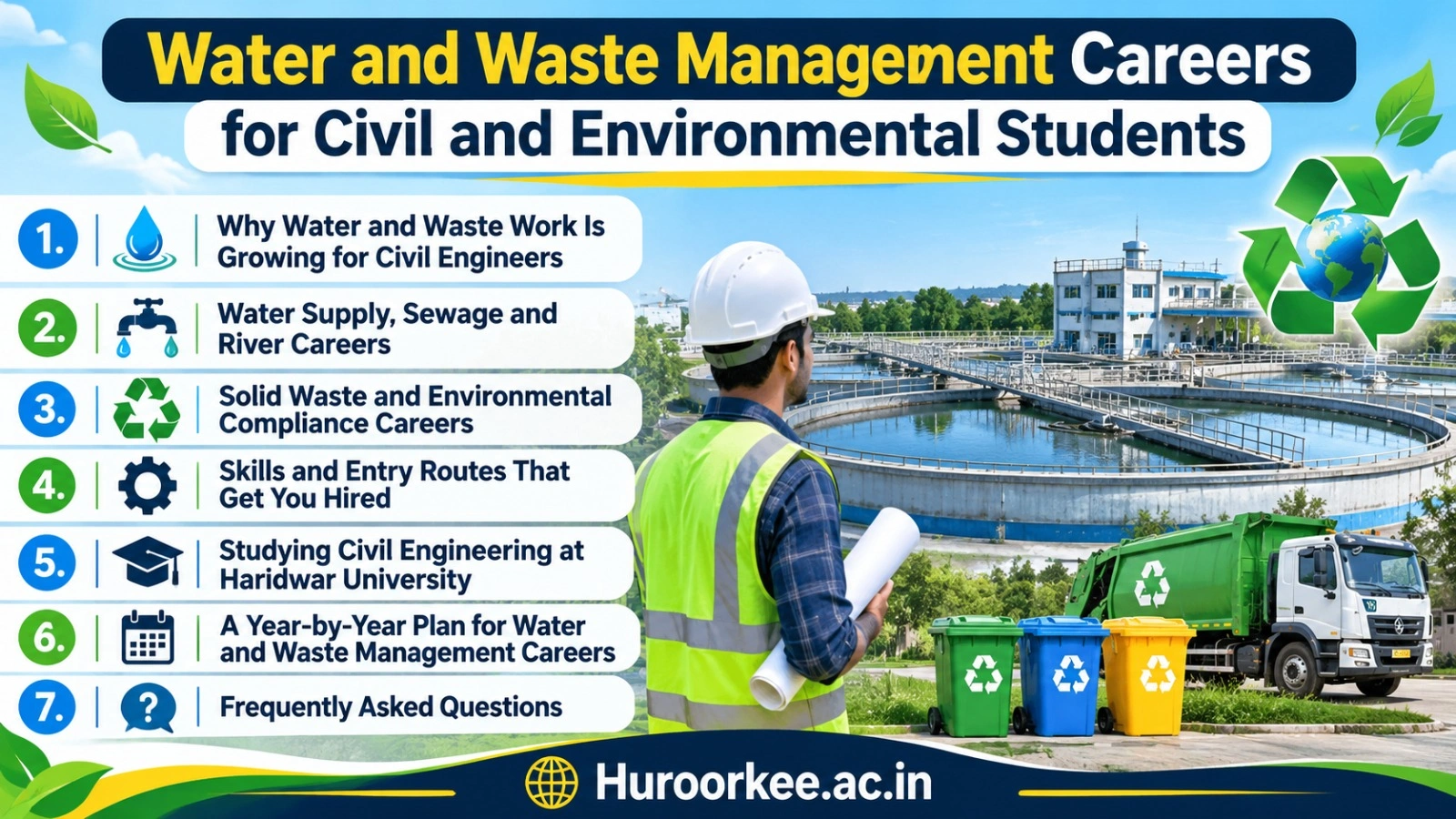
Table of Contents
- 1. Why Water and Waste Work Is Growing for Civil Engineers
- 2. Water Supply, Sewage and River Careers
- 3. Solid Waste and Environmental Compliance Careers
- 4. Skills and Entry Routes That Get You Hired
- 5. Studying Civil Engineering at Haridwar University
- 6. A Year-by-Year Plan for Water and Waste Management Careers
- 7. Frequently Asked Questions
1. Why Water and Waste Work Is Growing for Civil Engineers
On the waste management front, the Ministry of Environment, Forest and Climate Change notified the Solid Waste Management Rules, 2026 on 27 January 2026. Replacing the earlier 2016 framework, they took effect on 1 April 2026. Waste must now be separated at source into four distinct streams (wet, dry, sanitary and special care), bulk waste generators have statutory compliance mandates, and every stage from door-to-door collection to final scientific disposal is tracked through a centralised online regulatory portal (see the official PIB release on Solid Waste Management Rules).
Public water infrastructure is scaling rapidly in parallel. The Union Cabinet extended Jal Jeevan Mission 2.0 up to December 2028 with an enhanced outlay of ₹8.69 lakh crore, according to the official Ministry of Jal Shakti announcement. Because water supply is administered by states, state water boards and public health engineering departments (PHED) carry primary responsibility for ground implementation, creating extensive recruitment across site supervision, quality testing, and pipeline execution.
River rejuvenation initiatives add a substantial third dimension. Under the Namami Gange Programme, 4,263 MLD of sewage treatment capacity had been generated by June 2026, and 219 comprehensive sewerage projects costing an estimated ₹35,970 crore have been sanctioned to achieve 6,610 MLD capacity (review the PIB update on Namami Gange progress). Qualified civil and environmental engineers are required to survey terrain, engineer hydraulic pipelines, construct treatment structures, and operate facilities reliably over multi-decade lifecycles.
2. Water Supply, Sewage and River Careers
Drinking water and distribution networks
Engineers in drinking water supply calculate water demand, size intake headworks, design conventional and membrane filtration plants, calculate reservoir capacities, and model high-pressure pipe distribution networks. Early career roles focus heavily on field execution: supervising site excavation, monitoring ductile iron (DI) and HDPE pipeline laying, checking concrete pours, and verifying hydrostatic pressure tests.
Sewage and wastewater treatment engineering
Modern sewage treatment plants (STPs) and common effluent treatment plants (CETPs) integrate biochemical process engineering with heavy reinforced concrete design. Environmental engineering graduates often lead biological process balancing (activated sludge, SBR, MBBR, and MBR systems), while civil engineering professionals take charge of structural design, trunk sewer hydraulics, trenchless pipe jacking, and lift pumping stations.
River and catchment rejuvenation projects
Large-scale basin management combines tributary interception and diversion (I&D), riverside ghat development, wetland bio-remediation, and online water telemetry. For engineers who thrive on field problem-solving and multidisciplinary project management, river rejuvenation programmes offer an exceptional training ground.
3. Solid Waste and Environmental Compliance Careers
Solid waste infrastructure under the 2026 Rules
With mandatory four-stream segregation at source, urban local bodies must overhaul their entire municipal waste infrastructure. Civil engineers design material recovery facilities (MRF), transfer stations, automated composting layouts, and engineered sanitary landfills with composite geomembrane liners and leachate capture systems. Environmental specialists optimise anaerobic biomethanation, refuse-derived fuel (RDF) preparation, and odor mitigation.
Environmental compliance, audits and monitoring
Every industrial factory, mining concession, commercial township, and treatment facility must operate strictly within its Consent to Establish (CTE) and Consent to Operate (CTO). This necessity drives employment for environmental engineers in State Pollution Control Boards, corporate Environmental Health and Safety (EHS) divisions, and third-party sustainability audit consultancies. These positions reward rigorous technical documentation and regulatory fluency as much as engineering calculation.
4. Skills and Entry Routes That Get You Hired
Water and waste management careers reward candidates who pair core civil and environmental engineering theory with modern digital modelling tools:
- Core Technical Competencies: Hydraulics and open-channel flow, water and wastewater quality analysis (BOD, COD, TSS), soil mechanics for landfill foundations, and quantity estimation.
- Software & Digital Modelling: Computer-aided drafting in AutoCAD, spatial mapping with QGIS or ArcGIS, water distribution network simulation using EPANET, and stormwater drainage modelling using SWMM.
- Regulatory Knowledge: Deep understanding of the Solid Waste Management Rules 2026, Water (Prevention and Control of Pollution) Act, and Central Public Health and Environmental Engineering Organisation (CPHEEO) design manuals.
Government and PSU career pathways
Public sector hiring operates through structured competitive examinations: SSC Junior Engineer (Civil), State Public Service Commission (AE/JE) examinations for Public Health Engineering Departments (PHED) and Irrigation Departments, and PSU recruitment through the Graduate Aptitude Test in Engineering (GATE). Job notifications publish exact eligibility guidelines, reservation rosters, and pay scales on their official portals.
Private consulting, EPC contractors and postgraduate studies
International and domestic engineering consultancies, urban concessionaires, and turnkey EPC contractors recruit engineers based on design portfolios, software competence, and internship experience. For students targeting senior design and research roles, pursuing an M.Tech in Civil Engineering provides advanced depth in environmental structures and computational hydraulics.
5. Studying Civil Engineering at Haridwar University
For students aiming to launch a water and waste engineering career from a solid foundation, Haridwar University provides accredited undergraduate and postgraduate degree programmes under the Roorkee College of Engineering:
| Programme | Duration | Year 1 Tuition | Total 4-Year Cost |
|---|---|---|---|
| B.Tech. (Hons.) Civil Engineering with AI | 4 years | ₹1,27,000 | ₹4,57,000 |
| M.Tech. Civil Engineering | 2 years | ₹78,000 | ₹1,48,000 |
Fee details and scholarships
The total fee for B.Tech. (Hons.) Civil Engineering with AI across four years is ₹4,57,000 (including tuition, admission, exam, and uniform charges). Annual residential hostel fees are ₹85,000 (Normal Room), ₹95,000 (Semi Deluxe), and ₹1,05,000 (Deluxe AC), covering accommodation, mess meals, and laundry.
Haridwar University provides generous first-year tuition scholarships based on academic merit:
- Above 90% (PCM / JEE / CUET): 80% tuition scholarship
- Above 80% up to 90%: 50% tuition scholarship
- Above 70% up to 80%: 20% tuition scholarship
- Above 60% up to 70%: 10% tuition scholarship
- Girl Students: Dedicated 25% first-year tuition scholarship
Check comprehensive admission criteria on our fees and scholarships portal and learn about student welfare amenities at the Student Welfare Services page.
6. A Year-by-Year Plan for Water and Waste Management Careers
Master fluid mechanics, engineering hydrology, building materials, and environmental chemistry. Learn computer drafting in AutoCAD and basic GIS on the side, and participate actively in department industrial visits.
Execute an applied mini-project (such as a rooftop rainwater harvesting plan or campus waste segregation model). Secure a summer internship with a water authority, municipal corporation, or pipeline contractor.
Complete a capstone design project that generates verifiable data (STP hydraulic design or landfill leachate model). Maintain a clean portfolio of design drawings and technical reports for consulting interviews and PSU selections.
For adjacent engineering career perspectives, students can explore our guides on career paths after B.Tech Civil Engineering and the growing impact of AI in civil engineering.
7. Frequently Asked Questions
Which degree is best for water and waste management jobs?
A Bachelor of Technology (B.Tech.) in Civil Engineering is the most widely recognised and versatile qualification. Environmental engineering and environmental science degrees also feed directly into these sectors. Many professionals pursue an M.Tech for specialised hydraulic design and consultancy careers.
Do I need an M.Tech to work in this field?
No. Site execution, pipeline laying, field testing, and plant operations positions actively recruit B.Tech graduates. However, senior engineering consultancy firms and specialized design research positions often prefer an M.Tech qualification.
Are these jobs only in government departments?
Not at all. While municipal corporations and state water boards employ thousands of engineers, private sector EPC contractors, environmental consultancies, waste-to-energy operators, and industrial EHS teams represent a huge share of commercial employment.
What do the Solid Waste Management Rules, 2026 change?
Effective from 1 April 2026, the new rules mandate source segregation into four streams (wet, dry, sanitary, and special care), assign formal duties to bulk waste generators, and require digital tracking across municipal logistics via a central portal.
Will Jal Jeevan Mission still create engineering work?
Yes. The Union Cabinet extended Jal Jeevan Mission 2.0 up to December 2028 with an enhanced outlay of ₹8.69 lakh crore, guaranteeing sustained demand for rural water supply design, tap-water pipeline execution, and water quality testing infrastructure.
Is GATE compulsory for this career?
GATE is essential for admission into top M.Tech programmes and PSU engineering recruitment. However, state engineering services (AE/JE), municipal corporations, and private EPC firms recruit through independent tests and direct interview assessments.
Which software should I learn first?
Start with AutoCAD for structural and hydraulic drafting, alongside QGIS for geospatial watershed mapping. Then master EPANET for water network analysis and SWMM for stormwater sewer modelling.
What is the total fee for B.Tech Civil Engineering at HU?
The four-year total fee for B.Tech. (Hons.) Civil Engineering with AI is ₹4,57,000 (tuition, enrollment, examination, and uniform fees). Residential hostel options range from ₹85,000 to ₹1,05,000 annually.
Can girl students get a scholarship at HU?
Yes. Haridwar University awards a dedicated 25% first-year tuition scholarship for female candidates across engineering disciplines. Students may also opt for higher merit scholarship slabs (up to 80%) based on academic entrance performance.
Engineer Sustainable Water & Infrastructure Solutions at Haridwar University
Master hydraulic design, environmental engineering, smart city infrastructure, and AI-driven civil systems. Learn in advanced laboratories with field internships, project mentorship, and merit scholarships up to 80%. Admissions open for the 2027-28 academic session.