

AI in Civil Engineering: Applications, Tools & Skills for Students in 2026
Dr. Himanshu Verma
Associate Professor & HOD, Computer Science & Engineering, Haridwar University
Writing from an AI and engineering-education perspective, with a focus on AI methods, tools and applications in civil engineering.
Guide Table of Contents
- How AI Is Changing Civil Engineering Work
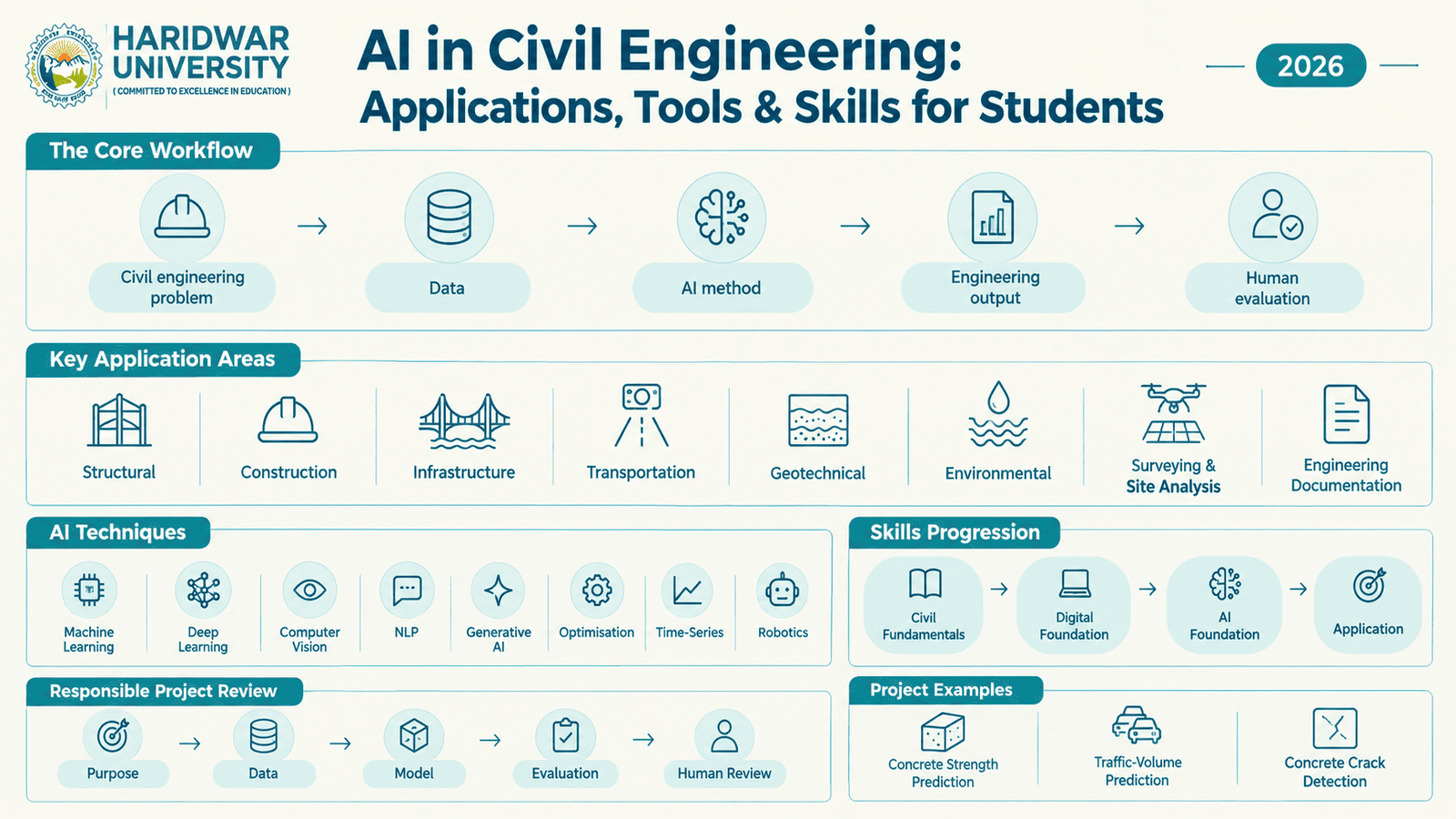
- Where AI Is Being Applied Across Civil Engineering
- Match AI Techniques to the Civil Engineering Problem
- Explore AI Tools for Civil Engineering Workflows
- Use AI in Design, Construction and Infrastructure Monitoring
- Apply AI to Transportation, Geotechnical and Environmental Engineering
- Build AI Skills That Complement Civil Engineering Knowledge
- Start With Practical AI Projects for Civil Engineering Students
- Use AI Responsibly in Safety-Critical Engineering Work
- Build a Practical AI Learning Path for Civil Engineering Students
- Frequently Asked Questions (FAQs)
Civil engineering is becoming increasingly data-driven. Structural bridge inspections generate thousands of high-resolution drone photographs, modern construction sites stream real-time telemetry from IoT sensors and BIM models, urban highway systems log continuous traffic video feeds, and municipal water utilities manage extensive sensor networks.
From an engineering-education perspective, the most valuable applications of artificial intelligence in civil engineering connect a genuine physical problem with verified data, an appropriate computational algorithm, and rigorous human evaluation.
AI can assist with predictive regression, visual defect inspection, schedule optimisation, and automated documentation, but it does not diminish the need for foundational engineering principles. In this comprehensive guide, we explore how undergraduate and postgraduate students can master AI tools, apply machine learning to infrastructure, and prepare for high-impact careers through programmes at Haridwar University and its specialized Roorkee College of Engineering.
How AI Is Changing Civil Engineering Work
AI is not a replacement for civil engineering fundamentals. Its primary value stems from empowering engineers to process massive visual and telemetry datasets, detect structural anomalies early, and support complex multi-variable decisions that would otherwise require weeks of manual calculation.
Recent roadmap initiatives by the American Society of Civil Engineers (ASCE) highlight applications ranging from structural design optimisation and computer vision inspection to automated traffic management and decision support systems. Crucially, professional engineering bodies emphasise that human oversight must govern every safety-critical deployment.
Where AI Is Being Applied Across Civil Engineering
AI adoption now spans virtually all sub-disciplines of civil and infrastructure engineering:
| Civil Engineering Area | Example AI Application & Use Case |
|---|---|
| Structural Engineering | Automated concrete crack segmentation, damage severity rating, and generative design topology optimisation. |
| Construction Management | Computer vision safety PPE compliance, automated progress tracking via site cameras, and schedule risk forecasting. |
| Infrastructure & Bridges | Drone-assisted visual condition assessment, vibrational sensor telemetry, and predictive maintenance schedules. |
| Transportation Engineering | Real-time traffic flow prediction, vehicle classification, intelligent traffic signal timing, and accident hot-spot modeling. |
| Geotechnical Engineering | Machine learning prediction of soil shear strength, foundation settlement, slope stability, and liquefaction risk. |
| Environmental Engineering | River basin water quality forecasting, stormwater runoff prediction, and municipal pollutant dispersion models. |
| Surveying & Geomatics | LiDAR point-cloud classification, digital elevation model (DEM) generation, and drone orthomosaic feature extraction. |
Match AI Techniques to the Civil Engineering Problem
Avoid selecting a trending algorithm before defining your engineering objective. Always let the physical problem dictate the mathematical tool:
Regression & gradient boosting for predicting concrete compressive strength from mix proportions (water-cement ratio, fly ash, aggregates).
Convolutional networks for surface crack segmentation on concrete bridges, pothole detection on asphalt, and drone survey inspection.
LSTM and transformer models for urban highway traffic volume prediction, dam reservoir inflow estimation, and structural vibration telemetry.
Information extraction from IS codes, building bylaws, tender documents, contract clauses, and construction daily progress logs.
Explore AI Tools for Civil Engineering Workflows
Modern AI in civil engineering extends far beyond conversational chatbots. Tools are organized by professional function:
- Data & Machine Learning Libraries: Python, NumPy, pandas, scikit-learn, and XGBoost for numerical tabular analysis. Check our guide on Python Libraries for Machine Learning.
- Computer Vision Frameworks: OpenCV, PyTorch, and YOLOv8 for automated site inspection and drone footage defect classification. Refer to Computer Vision Projects for Students.
- BIM & AEC Platforms: Autodesk Forma, Revit with generative design, and OpenBIM plugins integrating automated clash detection and energy modeling.
- Geospatial & Remote Sensing: QGIS with semi-automatic classification plugins and Python rasterio/geopandas for flood mapping and slope stability.
Use AI in Design, Construction and Infrastructure Monitoring
1. Design and Analysis Optimisation
AI surrogate models approximate complex Finite Element Analysis (FEA) simulations in fractions of a second, enabling engineers to test hundreds of design iterations against wind loads and seismic forces. However, an algorithm's output is an exploratory recommendation—never an approved structural plan until verified against national building codes (such as IS 456 and IS 800).
2. Smart Construction Management
Deep-learning visual computing on jobsites automatically flags missing safety gear (helmets, vests, harnesses), calculates daily earthmoving equipment cycle times, and tracks physical progress against BIM milestones.
3. Structural Health Monitoring (SHM)
Drones equipped with high-resolution optical and thermal cameras capture bridge superstructures, dams, and highways. Convolutional neural networks segment hairline cracks and spalling that escape manual visual inspection, enabling proactive asset management.
Build AI Skills That Complement Civil Engineering Knowledge
A civil engineering student does not need to become a theoretical AI researcher. The winning strategy is an integrated skill stack:
The Integrated Student Skill Stack:
↓
Digital Foundation: Python programming → Tabular data handling → Descriptive statistics → GIS & BIM awareness
↓
AI Competencies: Scikit-learn regression → Computer vision segmentation → Time-series modeling
↓
Capstone Application: Real-world civil dataset → Baseline evaluation → Human engineering verification
Civil Engineering Degree Options at Haridwar University
Explore comprehensive undergraduate and postgraduate programmes at the Roorkee College of Engineering, including career pathways detailed in our B.Tech Civil Engineering Guide and Career After B.Tech Civil Guide.
Start With Practical AI Projects for Civil Engineering Students
For course capstones and final-year submissions, select manageable projects with quantifiable metrics:
| Project Title & Civil Domain | Primary AI Method | Target Evaluation Metric |
|---|---|---|
| Concrete Compressive Strength Prediction | Random Forest / XGBoost | RMSE & R² Score (>0.90) |
| Pavement Crack & Pothole Detection | YOLOv8 Object Detection | [email protected] & Inference Latency |
| Highway Corridor Traffic Volume Forecasting | LSTM / Prophet Time-Series | Mean Absolute Percentage Error (MAPE) |
| Soil Shear Strength & Settlement Prediction | Multivariate Regression | Cross-Validated Mean Absolute Error |
| Construction Site PPE Compliance Monitoring | MobileNet / Faster R-CNN | Precision-Recall AUC |
For additional technical builds across computing disciplines, consult our guide on AI Projects for Engineering Students.
Use AI Responsibly in Safety-Critical Engineering Work
Safety-Critical Engineering Standards
Civil infrastructure failures can endanger human lives and cause catastrophic economic losses. An algorithm's outputs—whether a concrete strength forecast, a retaining wall stability index, or a structural load calculation—must always be treated as advisory inputs that require licensed human professional sign-off.
Every capstone project report must document: Purpose → Data Provenance → Model Architecture → Rigorous Evaluation → Human Review Safeguards.
Build a Practical AI Learning Path for Civil Engineering Students
Strengthen core civil domain knowledge and tabular Excel/CSV data skills.
Master NumPy, pandas, matplotlib, and basic probability/statistics.
Train linear models, decision trees, and ensemble regressions in scikit-learn.
Choose computer vision, structural prediction, or transportation modeling.
Develop a working project with real public or laboratory datasets.
Quantify edge-case failures, evaluate RMSE/mAP, and document limits.
Explore digital twins, sensor IoT feeds, and generative design tools.
Frequently Asked Questions (FAQs)
1. What is AI in civil engineering?
AI in civil engineering means applying methods such as machine learning, computer vision, natural language processing (NLP), and mathematical optimisation to engineering problems involving prediction, inspection, structural analysis, site monitoring, and decision support.
2. What are the main applications of AI in civil engineering?
Major applications include structural damage detection, construction schedule and safety monitoring, infrastructure condition assessment, urban traffic prediction, geotechnical soil behavior forecasting, environmental hydrological modeling, and automated engineering documentation.
3. Which AI tools are useful for civil engineering students?
The appropriate tools depend on the engineering problem. Students can begin with Python (NumPy, pandas, scikit-learn), then progress into computer vision (OpenCV, PyTorch, YOLO), geospatial analytics (QGIS, GeoPandas), and BIM-integrated AI platforms as their coursework demands.
4. How can civil engineering students learn AI?
Start by mastering Python, descriptive statistics, and exploratory data analysis, then progress into supervised machine learning. From there, select a concrete civil application—such as concrete strength regression or pavement crack segmentation—and build an end-to-end evaluated model.
5. Can AI replace civil engineers?
No. AI automates repetitive calculations and detects visual patterns, but civil engineering fundamentally requires professional judgement, statutory code compliance, public safety accountability, and physical site verification. ASCE standards consistently emphasize that AI remains a tool under human oversight.
6. What AI projects can civil engineering students build?
Promising student projects include concrete compressive strength prediction, highway traffic volume forecasting, road pothole and crack segmentation, site safety helmet detection, and geotechnical soil settlement prediction.
7. Is AI useful for a civil engineering career?
Yes, AI literacy provides a substantial competitive edge as infrastructure consultancies, construction conglomerates, and transportation authorities increasingly adopt automated BIM workflows, digital twins, and sensor-driven asset management.
Advance Your Engineering Career at Haridwar University
Explore premier undergraduate and postgraduate engineering programmes across civil, computing, and emerging technologies with state-of-the-art laboratory infrastructure in Roorkee.