

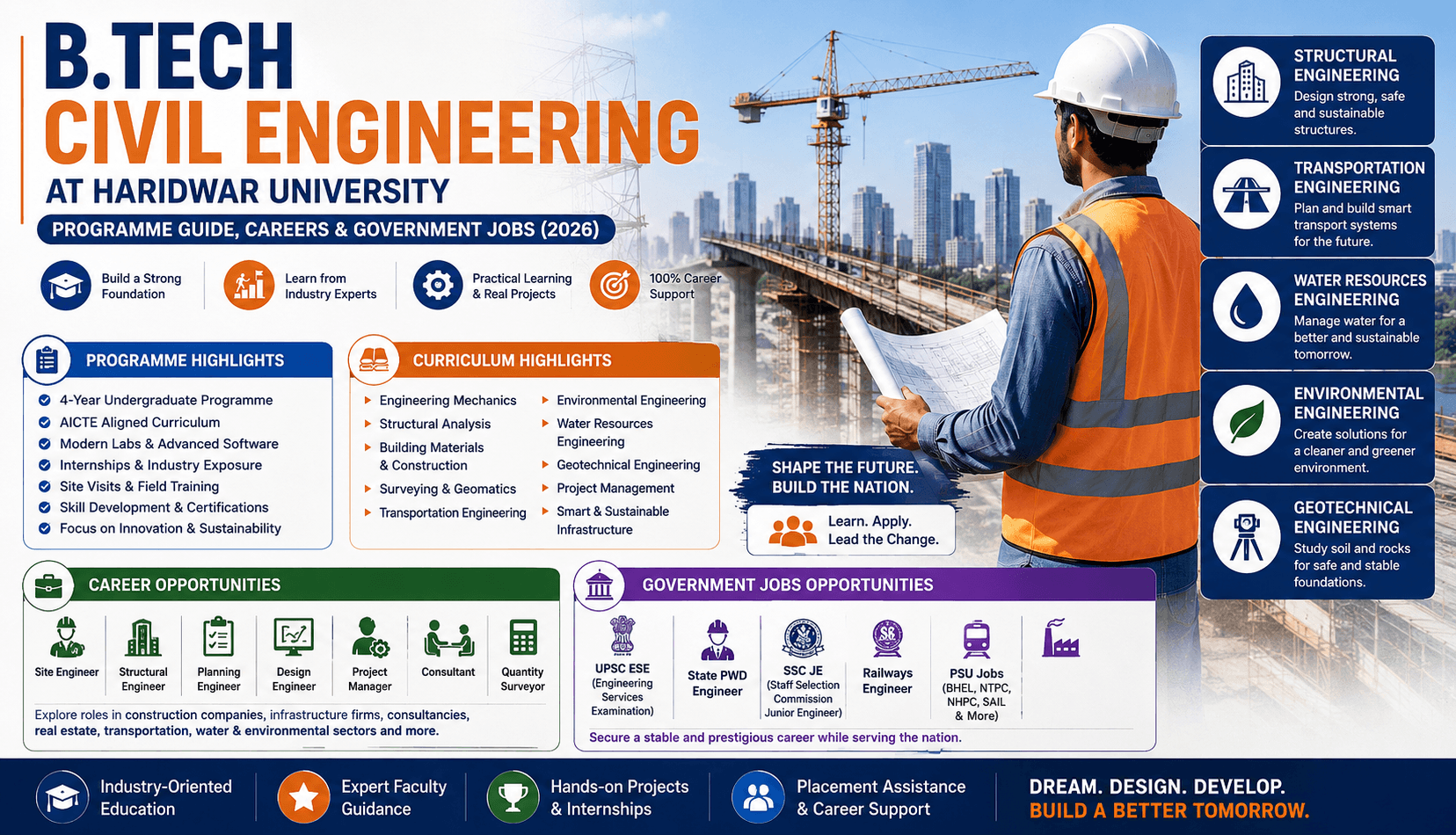
B.Tech Civil Engineering at Haridwar University: Programme Guide, Careers & Government Jobs (2026)
Mr. J. Chaudhary
Assistant Professor – Civil Engineering, Haridwar University
Table of Contents
- 1. What Is B.Tech Civil Engineering at Haridwar University in 2026?
- 2. The 4-Year, Semester-Wise HU Curriculum
- 3. Career Roles After B.Tech Civil Engineering
- 4. The Government Job Angle — HU's Big Differentiator
- 5. 2026 Salary Ranges (With Sources)
- 6. Top Recruiters
- 7. Fees & Eligibility for B.Tech Civil Engineering at Haridwar University
- 8. Frequently Asked Questions (FAQs)
Building the Future with Civil Engineering at Haridwar University
So you're weighing engineering options for 2026? Here's the thing — a degree certificate alone won't get you very far these days. What actually matters is picking a course that keeps two doors open at once: the private construction industry, and a real shot at government service. That's exactly why B.Tech Civil Engineering Haridwar University is built the way it is. The curriculum moves semester by semester toward infrastructure and smart-city careers, with genuine, structured preparation built in for SSC-JE, State PSC AE/JE, RRB-JE, and GATE-based PSU recruitment. Below, you'll find the programme structure, where the career paths lead, what 2026 salaries roughly look like, fees, eligibility, and answers to the questions parents and aspirants keep asking us.
1. What Is B.Tech Civil Engineering at Haridwar University in 2026?
Forget the old image of civil engineering as just roads and buildings. Three shifts are reshaping the field right now — a massive infrastructure push across the country, cities turning 'smart' faster than most people realise, and construction that actually has to answer for its environmental footprint. So what does studying B.Tech Civil Engineering Haridwar University really involve in 2026? Core structural and geotechnical fundamentals, sure — but also the digital tools and sustainable-design habits that recruiters now simply assume a fresh graduate already has. If you're curious how the university approaches teaching more broadly, its About Us page is worth a look.
India's Infrastructure Boom
Highway expansion, metro-rail lines, high-speed rail, airports, irrigation works — none of these wrap up in a year or two. They run for years, and that's good news if you're a civil engineer, because it means steady demand. Government money keeps flowing into roads, railways, and urban infrastructure, and it's still one of the biggest job-creating forces the profession has, giving new graduates plenty of entry points to choose from.
Smart Cities and Urban India
With the Smart Cities push and rapid urbanisation reshaping how India builds, civil engineers today are expected to know more than the traditional core subjects. GIS mapping, building information modelling (BIM), traffic and utility planning, and integrated urban design are fast becoming everyday skills — and HU's labs and electives are built to introduce exactly these, alongside the classical fundamentals.
Sustainability in Construction
Nobody treats green building codes as a nice-to-have anymore. Energy-efficient materials, water-sensitive design, waste-water recycling — these now show up as baseline requirements, on government tenders and private builds alike. Graduates who genuinely understand sustainable construction, not just the buzzwords, are increasingly the ones both government departments and private developers want on their teams.
2. The 4-Year, Semester-Wise HU Curriculum
Four years, eight semesters — that's the shape of the B.Tech Civil Engineering programme at Haridwar University. Year one is foundation work — mathematics, mechanics, engineering drawing, nothing flashy. Things get more interesting in the middle semesters, once structural analysis, geotechnical engineering, fluid mechanics, and transportation engineering enter the picture. And by the final semesters, it's mostly design projects, electives, and an internship out in the field.
Here's a quick semester-wise snapshot:
| Semesters | Key Core Subjects & Practical Focus |
|---|---|
| Semester 1–2 | Engineering Mathematics, Mechanics, Engineering Graphics, Basic Civil & Environmental Engineering, Surveying fundamentals |
| Semester 3–4 | Strength of Materials, Fluid Mechanics, Building Materials & Construction, Surveying Lab, Concrete Technology |
| Semester 5–6 | Structural Analysis, Design of RCC & Steel Structures, Geotechnical Engineering, Transportation Engineering, Environmental Engineering Lab |
| Semester 7–8 | Estimation & Costing, Construction Management, Design Project, Electives (Earthquake Engineering, Highway Engineering, Water Resources), Internship & Major Project |
All this classroom learning is backed by hands-on lab work — dedicated departmental laboratories that run alongside the coursework each semester:
Surveying Laboratory
Step into the Surveying Lab and you're doing chain and compass surveying, levelling, working the theodolite and total station, even GPS/GIS-based mapping. It's not filler — this is where the early-semester surveying theory actually clicks, and it's groundwork students draw on again later for site engineering and highway alignment work.
Structural Engineering Laboratory
The Structural Engineering Lab is where students test concrete, steel, and other building materials for strength and durability, alongside model-based load and deflection studies. It ties directly back to the Strength of Materials, RCC, and Steel Structure design subjects taught in the middle semesters, and it's really where the practical foundation for a Structural Engineer career gets built.
Environmental Engineering Laboratory
Over in the Environmental Engineering Lab, the focus is on water and waste-water quality testing, treatment-process demonstrations, and basic air- and noise-pollution monitoring. It supports the Environmental Engineering coursework students take in later semesters and reflects where the industry as a whole is heading — sustainable, compliant construction.
There's more beyond these three labs too — concrete-testing setups, geotechnical facilities, and hands-on training with design software like AutoCAD and STAAD Pro. Want the full breakdown of courses, electives, and lab facilities? That's all listed on the Academic Programmes page.
3. Career Roles After B.Tech Civil Engineering
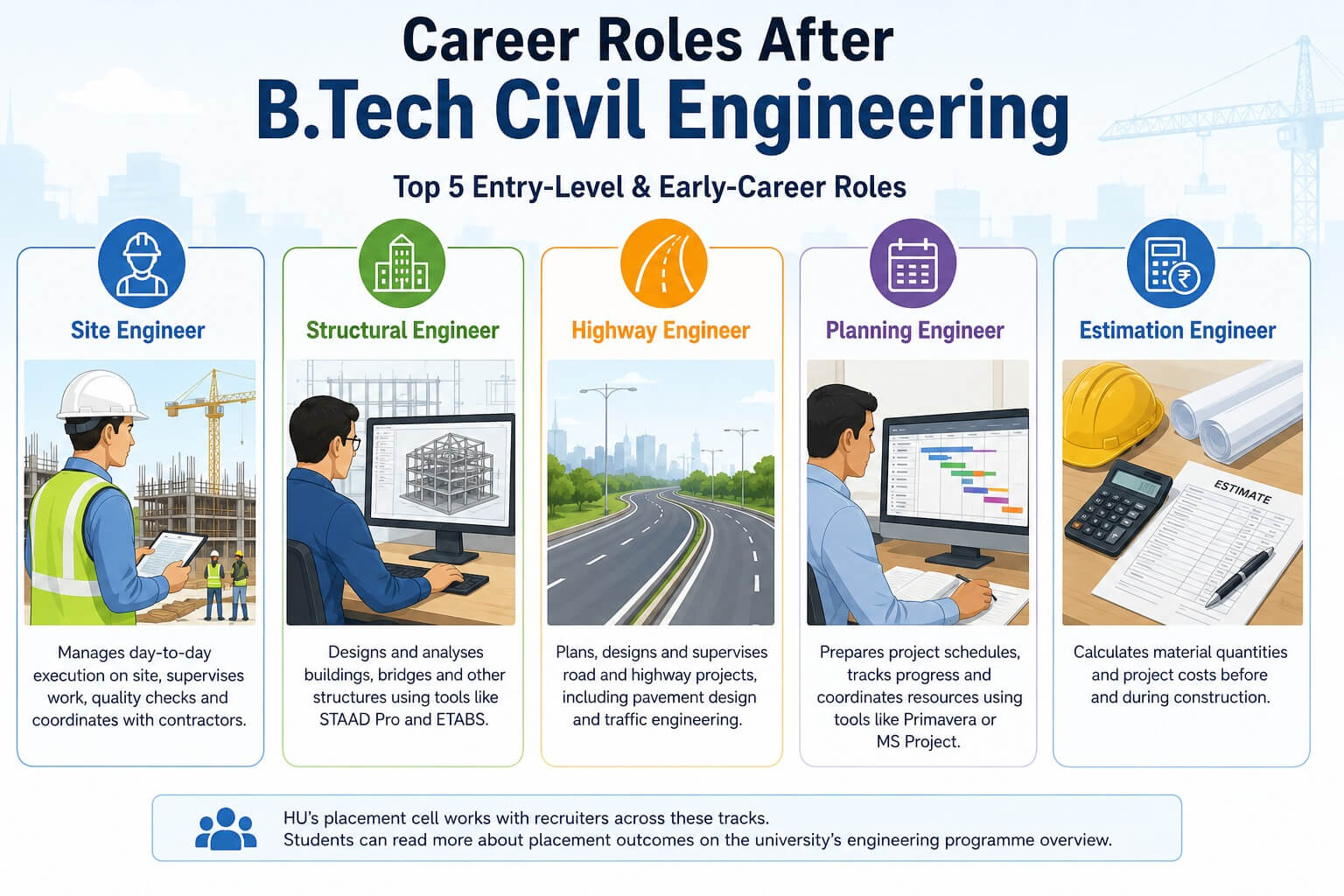
A B.Tech in Civil Engineering doesn't lock you into a single path — it opens up a wide spread of career tracks across construction, infrastructure, and planning. Here are five of the roles most graduates step into early on:
Site Engineer
Site Engineers handle the day-to-day on construction sites — supervising labour, checking drawings against what's actually being built, running quality checks, and coordinating with contractors. It's usually the first job fresh graduates land, with solid scope to grow into project management roles from there.
Structural Engineer
Structural Engineers work on the design and safety analysis of buildings, bridges, and other structures, using tools such as STAAD Pro and ETABS. This role needs strong fundamentals in structural analysis and design — exactly what HU's mid-programme semesters spend a lot of time building.
Highway Engineer
Highway Engineers plan, design, and supervise road and highway projects, including pavement design and traffic engineering. With the national highway expansion programme still going strong, this is an area seeing steady demand.
Planning Engineer
Planning Engineers are the ones keeping the schedule honest — building timelines, checking whether a project's actually on pace, juggling resources across big construction jobs. Primavera and MS Project are the usual tools of the trade here.
Estimation Engineer
Estimation Engineers work out material quantities and project costs, both before construction starts and while it's underway — a role that leans directly on the Estimation & Costing coursework covered in the final year of the HU curriculum.
HU's placement cell works with recruiters across all these tracks; students can find more on placement outcomes on the university's engineering programme overview.
4. The Government Job Angle — HU's Big Differentiator
What really sets B.Tech Civil Engineering Haridwar University apart from a purely private-sector-focused programme is how seriously it takes government-exam readiness. Civil engineering is one of the few branches where a single B.Tech degree qualifies graduates for a wide range of central and state government technical posts — often the single biggest differentiator students look for while choosing a college.
SSC-JE (Junior Engineer)
The SSC-JE exam happens every year — that's how the Staff Selection Commission recruits Junior Engineers for departments like CPWD, MES, and BRO. Pay sits under Level-6 of the 7th Central Pay Commission. Keep an eye on the official SSC website for notifications and eligibility details, since these get updated each cycle.
State PSC AE/JE
Prefer to stay closer to home? State Public Service Commissions recruit Assistant Engineers and Junior Engineers for departments like PWD, irrigation, and urban development. Each state runs its own exam, a B.Tech or equivalent diploma is usually the baseline requirement, and this route stays popular for exactly that reason — no need to relocate.
RRB-JE (Railway Recruitment Board)
Indian Railways hires Junior Engineers through Railway Recruitment Boards, and civil engineering candidates usually take up the largest chunk of JE vacancies in any given cycle. Watch the Indian Railways recruitment portal and your zonal RRB website for notifications.
PSUs via GATE
Many Public Sector Undertakings recruit civil engineers directly through their GATE score, skipping a separate written exam altogether. Registration and exam details are published each year on the official GATE portal — which is exactly why it's worth final-year students appearing for GATE alongside campus placements.
5. 2026 Salary Ranges (With Sources)
Here's the honest answer on salary — it depends a lot on sector, city, and your specialisation. Pulling from 2026 industry salary trackers and official pay-commission notifications, here's a rough sense of the numbers:
| Career Path / Role Level | 2026 Salary / Pay Structure | Key Perks / Source Notes |
|---|---|---|
| Fresh B.Tech Graduate (Private Sector) | ₹3–6 Lakh per annum | Varies based on recruiter, location, and site role |
| SSC-JE / RRB-JE (Central Govt) | Basic ₹35,400 to ₹1,12,400 (Level 6) | 7th Pay Commission Level-6 plus DA, HRA, TA & allowances |
| PSU Roles (via GATE) | ₹6–14 Lakh per annum | Fresh entry package + government-style benefits & medical |
| Mid-Career Professional (5+ Years) | ₹8–18 Lakh per annum | Structural analysis / Project management specialisations |
Where do these numbers come from? Current SSC and RRB pay-scale notifications, plus independent trackers like Payscale's Civil Engineer salary report for India. Your actual offer will still come down to the employer, the city, and what you specialise in.
6. Top Recruiters
Who actually hires HU's civil engineering graduates? On the private side — large construction and infrastructure companies, EPC contractors, project-management consultancies, real-estate developers. Clear the right exam, and government departments open up too: CPWD, PWD, Railways, plus various state Public Works and irrigation departments.
More on how HU supports students through campus placement and recruiter connect is available on the university's engineering placement blog.
7. Fees & Eligibility for B.Tech Civil Engineering at Haridwar University
Eligibility-wise, you're looking at a 10+2 pass with Physics, Chemistry, and Mathematics. The minimum aggregate percentage — and any category-wise relaxation — gets set fresh by the university each year, so it's worth confirming before assuming anything from an older prospectus. For admission, HU works off JEE Main scores, its own HUAET entrance test, or select state-level entrance exams, with document verification to follow.
Fees come annually, and how much you pay depends on your specialisation and whether you qualify for a scholarship — merit-based, JEE rank, CUET score, sports quota, take your pick. Hostel stays separate and optional; the HU Hostel page has those details. On the recognition front, Haridwar University holds UGC and AICTE approval, and it's on record as an approved private university of Uttarakhand per the Uttarakhand Raj Bhawan's official list of private universities. Before applying, though, it's worth double-checking the current fee schedule, scholarship slabs, and document checklist on the university's admission overview page — these do get revised.
8. Frequently Asked Questions (FAQs)
Q1. What is the duration of B.Tech Civil Engineering at Haridwar University?
Four years, eight semesters total. Qualify for lateral entry and you skip straight to semester three.
Q2. What is the eligibility criteria for B.Tech Civil Engineering at HU?
You'll need a 10+2 pass with Physics, Chemistry, and Mathematics, meeting the minimum aggregate percentage set by the university, along with a valid JEE Main or HUAET score.
Q3. Does Haridwar University prepare students for government engineering jobs?
Definitely. The department pushes students toward SSC-JE, State PSC AE/JE, RRB-JE, and GATE prep alongside the regular coursework — a B.Tech Civil Engineering degree already ticks the core eligibility box for every one of these exams.
Q4. What is the fee structure for B.Tech Civil Engineering at HU?
Annually, and it varies by scholarship and category. Fee slabs get revised each admission cycle, so it's best to check the university's official admission page for the exact current-year figures rather than go by an older prospectus.
Q5. Which entrance exams does Haridwar University accept for B.Tech admission?
HU accepts JEE Main scores, its own HUAET entrance test, and select state-level engineering entrance exams, subject to the university's current admission policy.
Q6. What is the average starting salary for a civil engineer in 2026?
In the private sector, freshers usually start somewhere around ₹3–6 lakh a year. Go the government route — SSC-JE, RRB-JE — and you're looking at a basic pay of ₹35,400 a month to start, plus allowances on top.
Q7. Can civil engineering graduates apply for GATE and PSU jobs?
Yes — a good GATE score lets civil engineering graduates apply directly to many Public Sector Undertakings, often bypassing a separate written exam, and it opens doors to M.Tech admissions as well.
Q8. What labs and infrastructure does HU's civil engineering department have?
Three dedicated labs — Surveying, Structural Engineering, and Environmental Engineering — plus concrete-testing and geotechnical facilities that students use right through the four-year programme.
Q9. What placement support does HU offer civil engineering students?
The placement cell handles campus drives, internships, and recruiter connect sessions with construction, EPC, and consultancy firms — and separately, guides students gearing up for government-sector exams too.
So, What's Next for You?
Maybe that's walking through the labs in person, maybe it's checking out the hostel, or maybe you're ready to just lock in your seat for the 2026 batch. Pick whatever fits below — our admissions team will take it from there.