

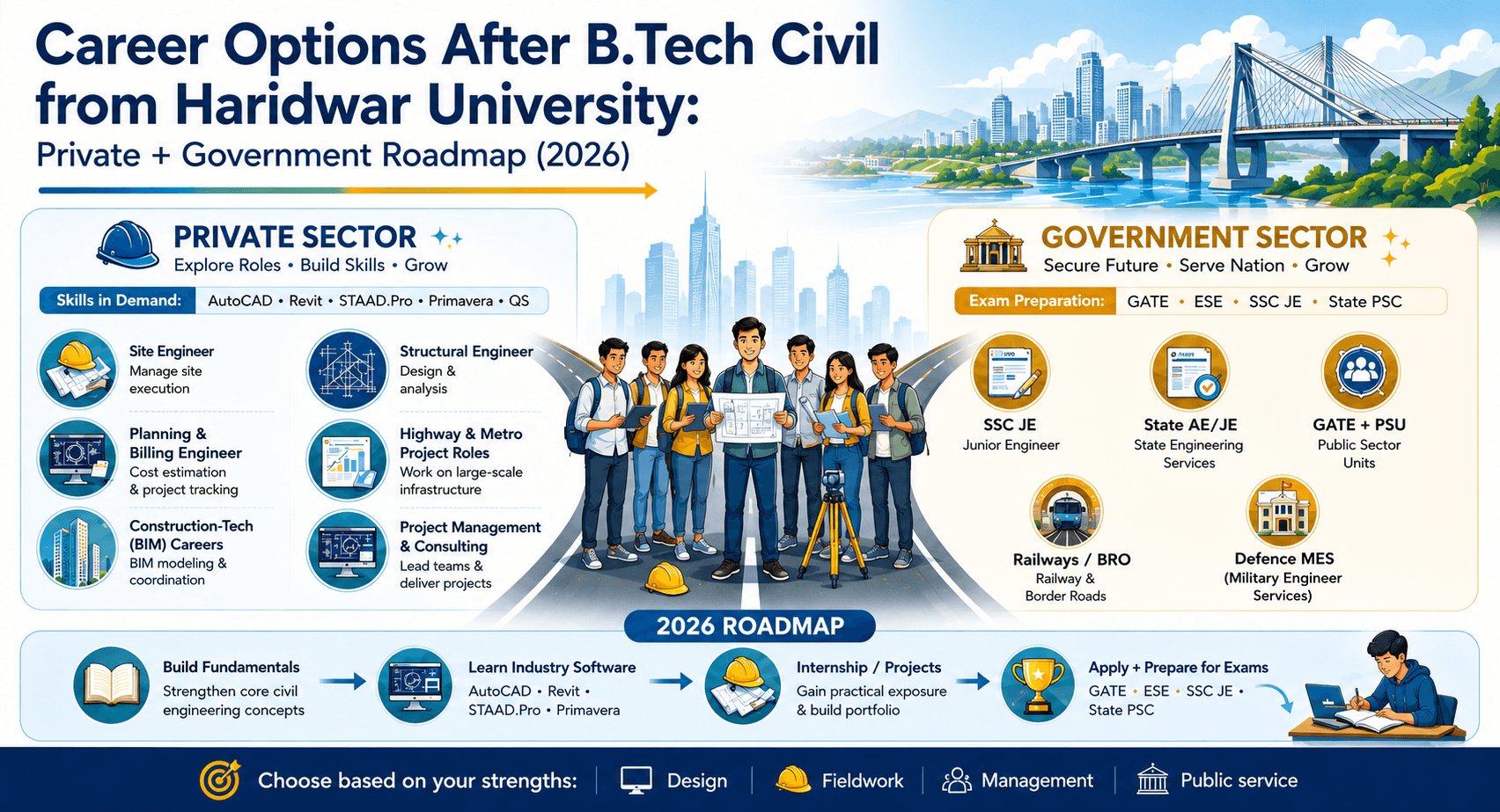
Choosing a career after B.Tech Civil Haridwar University often comes down to one question — private sector or government job? The good news is that a Civil Engineering degree keeps both doors open at once.
This roadmap walks through five private-sector roles, five government recruitment routes, and where the pay and job security sit in each. Fee and scholarship figures below come directly from HU’s official admission pages; exam, salary, and pay-scale details are drawn from named government portals (SSC, RRB, GATE, MES, UKPSC) and salary-data sources such as PayScale India, cited and dated wherever they are used.
Table of Contents
1. Two Career Tracks After B.Tech Civil at HU
2. Private-Sector Roles for Civil Engineers
3. Government Roles — The Big Draw
4. Salary Snapshot: Private vs Government
5. Fees & Scholarships for B.Tech Civil (2026-27)
1. Two Career Tracks After B.Tech Civil at HU
Haridwar University (about the university) runs its Civil Engineering programme — B.Tech. Hons. CE with AI — out of the Roorkee College of Engineering. Once you graduate, the career map splits into two broad tracks.
The private track (construction firms, consultancies, EPC contractors) hires faster and gets you on-site experience sooner. The government track (SSC JE, RRB JE, state AE/JE, PSUs, defence establishments) takes longer to crack but offers pensionable, transfer-based service. Most Civil graduates prepare for both at the same time, since the core subjects overlap heavily.
2. Private-Sector Roles for Civil Engineers
Private-sector Civil roles generally start on-site and branch into design, planning, or specialised construction technology as you gain experience.
Site Engineer
The most common entry point for a fresher. A site engineer supervises daily construction activity, coordinates with contractors and labour, and checks work against drawings and specifications — the fastest route from campus to a pay cheque.
Structural Designer
Structural designers move from site to the design office, using STAAD Pro or ETABS to size beams, columns, and foundations. This role usually needs an extra software layer on top of the core B.Tech curriculum, picked up through short certification courses.
Planning & Billing Engineer
Planning and billing engineers handle quantity surveying, running bills, and project scheduling on tools like MS Project or Primavera — a good fit for graduates who prefer documentation and cost-control work over daily site supervision.
Highway & Metro Project Roles
Large road and metro projects, usually run through EPC contractors, hire Civil graduates for survey, execution, and quality-control roles. HU’s placement records list Civil alumni placed at infrastructure and construction firms such as TCS, Tech Mahindra, and ITC Limited on these projects.
Construction-Tech (BIM) Careers
Building Information Modelling (BIM) is the fastest-growing niche in Civil engineering right now. Tools like Revit and Navisworks are increasingly asked for by Tier-1 contractors, and this specialisation lines up naturally with the AI-integrated coursework in HU’s Civil programme.
3. Government Roles — The Big Draw
For most Civil Engineering families, a government job is still the bigger draw — job security, defined pay scales, and a clear promotion ladder.
SSC JE (Junior Engineer, Civil)
The Staff Selection Commission conducts SSC JE every year to recruit Junior Engineers (Civil, Mechanical, Electrical) into central government departments. Candidates with a degree or diploma in Civil Engineering can apply, up to age 32 (varies by post — check the specific notification), through ssc.gov.in. Notification is typically released in March, with Paper 1 in the May–June window, per SSC's official exam calendar; exact dates per cycle are announced on the official site only.
State AE/JE (Uttarakhand and Other States)
Every state runs its own recruitment for Assistant Engineer (AE) or Junior Engineer (JE) posts in departments like PWD, Irrigation, and Jal Nigam, through its own Public Service Commission or Subordinate Selection Commission. In Uttarakhand, this is handled by UKPSC (psc.uk.gov.in). Pay follows each state's own matrix, not a central scale — always check the specific recruitment notification for the exact pay level being offered.
RRB JE (Indian Railways)
Railway Recruitment Boards run the RRB JE exam (CBT 1 followed by CBT 2) to hire Junior Engineers across Indian Railways zones, via the common portal rrbapply.gov.in. Selected candidates are placed on the 7th Pay Commission Level 6 matrix, ₹35,400–₹1,12,400, per the RRB's official CEN pay-matrix notification on rrbapply.gov.in.
PSUs via GATE
Several public-sector undertakings — including NHAI (Deputy Manager, Technical) and NHPC (Trainee Engineer) — recruit Civil graduates directly on their GATE Civil Engineering score, without a separate written exam. GATE is conducted jointly by IISc and the IITs on a rotational basis; the 2026 edition was hosted by IIT Guwahati at gate2026.iitg.ac.in. Pay and stipend are set by each PSU's own recruitment notice — there is no single central scale across PSUs. Graduates who want to strengthen their GATE attempt can also pursue HU's M.Tech Civil Engineering programme, for which GATE-qualified M.Tech candidates at HU are eligible for the AICTE PG scholarship, AICTE's national stipend scheme for GATE-qualified postgraduate students at approved institutions.
Defence MES (Military Engineer Services)
MES is not a separate stand-alone entrance exam. Its civilian Junior Engineer (Group B) posts are recruited through the same SSC JE examination, while its Group A engineering officers (Indian Defence Service of Engineers) enter through the UPSC Indian Engineering Services (IES) exam. MES, under the Ministry of Defence, works on cantonment, airfield, and defence-infrastructure projects — see mes.gov.in for current recruitment notices.
4. Salary Snapshot: Private vs Government
Private-sector figures below are named-source averages, not guarantees — actual offers vary by employer, city, and software skills. Government figures reflect the published pay-band structure, not the eventual in-hand salary after allowances. The one entry-level figure below with a checkable number comes from PayScale India, checked 27 Aug 2026; the other private-sector roles are discussed in prose below since PayScale does not publish a separate dated figure for each.
Private-Sector Salary Data
| Private-Sector Role | Entry-Level Annual Package (approx.) | Source |
|---|---|---|
| Site Engineer / general Civil fresher | ₹2.4L – ₹4.5L | PayScale India (Uttarakhand/UP entry-level data) |
Beyond the general fresher band above, PayScale does not publish separate dated figures for these specialised roles, so treat them directionally rather than as fixed numbers: Structural Designers (STAAD/ETABS-trained) typically earn above the general fresher band; Planning & Billing Engineers start close to the site-engineer band and rise with Primavera/MSP skills; and BIM/Construction-Tech roles command a premium once a Revit or Navisworks certification is added. Confirm current figures for these roles directly with recruiters or a live PayScale/Glassdoor search before quoting them to students.
Government Route Pay Structure
| Government Route | Pay Structure | Source |
|---|---|---|
| SSC JE (Civil) | 7th CPC Level 6, ₹35,400–₹1,12,400 (JE cadre matrix) | ssc.gov.in |
| RRB JE (Civil) | 7th CPC Level 6, ₹35,400–₹1,12,400 | rrbapply.gov.in |
| MES civilian JE (via SSC JE) | Same Level 6 JE cadre matrix | mes.gov.in |
| State AE/JE (e.g., Uttarakhand) | Follows the state's own pay matrix — check the specific notification | psc.uk.gov.in |
| PSU (via GATE) | Set by each PSU's own notice; no single central scale | Company-specific (e.g., NHAI, NHPC) |
5. Fees & Scholarships for B.Tech Civil (2026-27)
The figures below come directly from HU's official fees and scholarships page, verified as of 27 August 2026, for the B.Tech. Hons. Civil Engineering (CE) with AI programme.
B.Tech Civil Fee Structure
| Year | Annual Fee Amount |
|---|---|
| Year 1 (Sem 1 + Sem 2) | ₹1,27,000 |
| Year 2 | ₹1,10,000 |
| Year 3 | ₹1,10,000 |
| Year 4 | ₹1,10,000 |
| 4-Year Total | ₹4,57,000 |
(Tuition, enrollment, admission, examination and uniform fee combined; transport charges extra as per route).
Scholarships — a student may claim only one of the following:
- Merit Scholarship (by JEE rank / Class 12 PCM% or Agg.% / CUET percentile), first year only: above 90% → 80%; 80–90% → 50%; 70–80% → 20%; 60–70% → 10%. Not available to private candidates.
- Sports Quota (all courses), first year only: National level → 50%; State level → 30%; District level → 20%; School level → 10%.
- 25% First-Year Category Scholarship: 25% first-year scholarship for students scoring above 60% aggregate in Class 12 whose parents belong to the Armed Forces, are Freedom Fighters or Martyrs, or who are HU/RCE alumni, siblings of HU/RCE students, orphan children, or children of university employees (applicable to 2025 and 2026 Class 12 pass-outs).
- Uttarakhand (UK) Domicile Scholarship: 25% first year only, for 2025 and 2026 Class 12 pass-outs.
- Girls' Education Scholarship: 25% first year only.
- Academic Excellence Award: ₹5,000 in any semester where a student scores 85% or above (not limited to first year).
6. Which Track Should You Choose?
If you want to start earning and building a portfolio quickly, the private track — starting as a Site Engineer and specialising later — gets you there faster. If job security and a defined pay ladder matter more to you, start SSC JE / RRB JE preparation from your second year onward, since the core subjects (Strength of Materials, Surveying, Structural Analysis) overlap with your regular syllabus. HU's placement cell supports both paths — private recruiter drives on one side, and government-exam orientation on the other — so you don't have to choose until much later in the programme.
For students exploring related discipline-specific exam prep and university guidelines, check our guides on Government Jobs After B.Pharm and Hostel Rules & Discipline Policy at HU.
7. Frequently Asked Questions
Q1: Is a government job better than a private job after B.Tech Civil?
A: Neither is universally "better" — private roles hire faster and build hands-on experience sooner, while government roles offer pensionable service and a defined pay ladder. Most students prepare for both tracks in parallel.
Q2: Do SSC JE and RRB JE need separate preparation?
A: Both test overlapping core Civil subjects, but they run on different application cycles and are conducted by different bodies (SSC and RRB respectively), so you do need to track each notification separately.
Q3: Can I appear for GATE right after graduating from HU?
A: Yes. GATE eligibility covers final-year students and graduates of a recognised engineering programme, so you can appear for GATE in your final year or immediately after.
Q4: Is Military Engineer Services (MES) its own separate exam?
A: No. MES recruits its civilian Junior Engineers through the SSC JE exam, while its Group A engineering officers enter through the UPSC Indian Engineering Services (IES) exam — there is no standalone MES entrance test.
Q5: What's the difference between State AE and State JE posts?
A: AE (Assistant Engineer) and JE (Junior Engineer) are different grades within the same state technical cadre, each carrying its own pay level under that state's own pay matrix — check the specific state notification for the exact grade and scale on offer.
Q6: Which private-sector role should a Civil fresher target first?
A: Site Engineer is usually the fastest entry point, since it needs the least additional software training and gives you the on-site exposure that other private roles, like structural design or planning, are usually built on.
Q7: Does a construction-tech/BIM career need extra certification?
A: It helps. BIM tools like Revit and Navisworks sit on top of the core B.Tech curriculum, and short certification courses in these tools make you a stronger candidate for Tier-1 contractors and design firms.
Q8: How much is the total 4-year fee for B.Tech Civil at HU?
A: The 4-year total for the B.Tech. Hons. CE with AI programme is ₹4,57,000, verified as of 27 August 2026 on HU's official fees and scholarships page.
Q9: Can I claim more than one HU scholarship at the same time?
A: No. HU's fee and scholarship policy allows a student to claim only one scholarship scheme, even if they are eligible for more than one.