

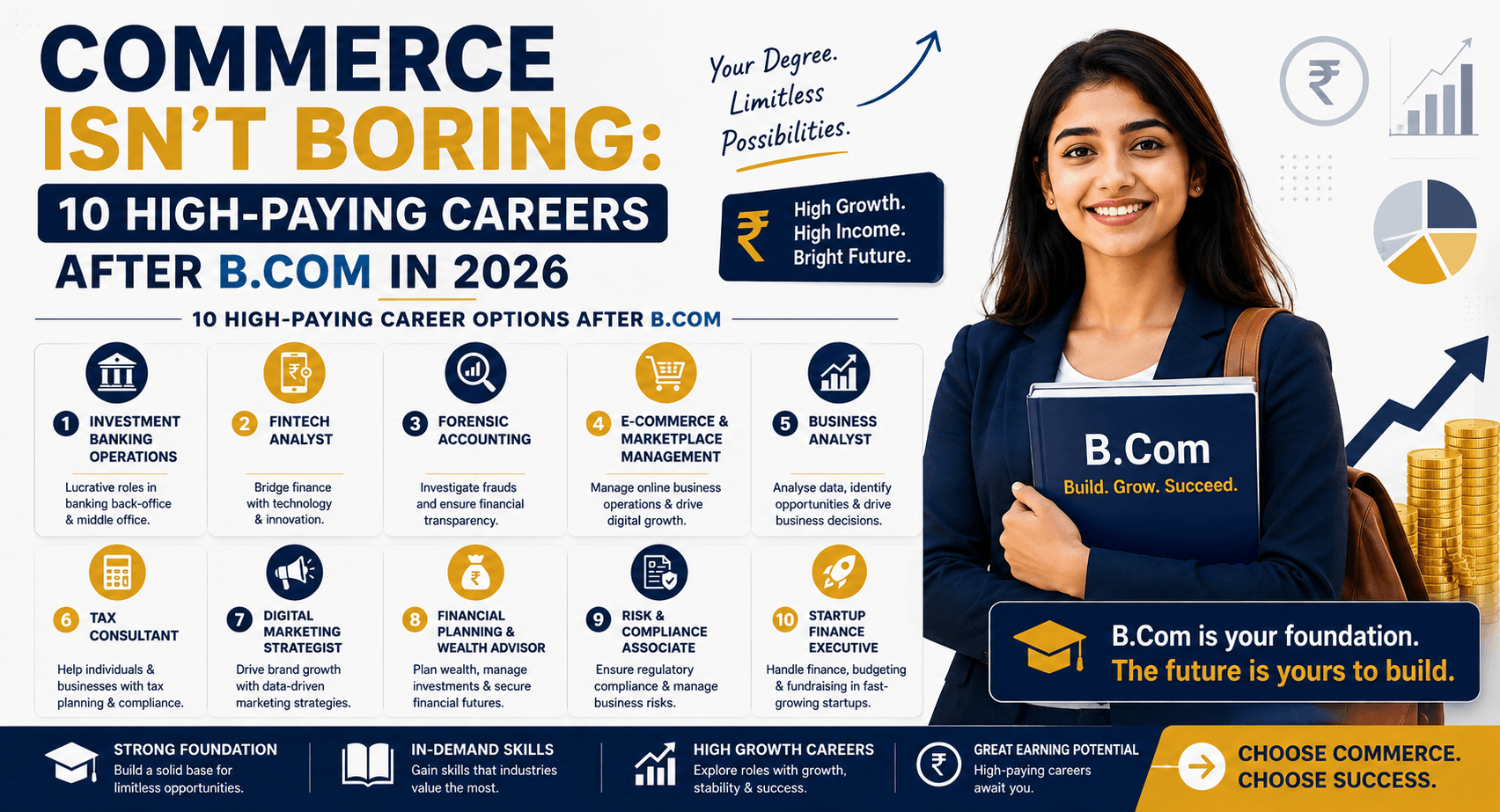
Commerce Isn't Boring: 10 High-Paying Careers After B.Com in 2026
Ms. Dharna Panwar
Assistant Professor, Business Studies, Haridwar University
Table of Contents
1. Commerce Beyond the Ledger
When most people picture a B.Com degree, they imagine a future spent behind a calculator, tallying ledgers under fluorescent office lights. That image is decades out of date. India's commerce ecosystem has expanded into fintech, forensic investigation, e-commerce, treasury, and startup finance, and each of these fields is actively hiring commerce graduates. This guide walks through 10 High-Paying Careers After B.Com in 2026, with realistic salary ranges, the certifications that open each door, and the myths that quietly keep students from exploring them.
2. Why B.Com Graduates Should Look Beyond 'Accountant'
Accounting is still a respected, stable career — but it is one branch on a much bigger tree. The same core skills a B.Com programme builds (financial statements, taxation basics, business law, and quantitative reasoning) transfer directly into investment banking operations, data analytics, e-commerce strategy, and treasury management. The difference between these roles and a traditional accounting job usually isn't the degree; it's a single certification, a specific software skill, or an internship that signals you can operate outside a general ledger. The ten roles below show how far that transferable base can stretch.
3. 10 High-Paying Careers After B.Com in 2026
Each career below includes what the job actually involves, a realistic salary band with its source, the certification stack that gets you hired, and a quick myth-vs-reality check.
1. Investment Banking Operations
What it is: The back-office and mid-office engine of an investment bank or brokerage — trade settlement, reconciliation, client reporting, and compliance support that keeps every deal from unravelling after it's signed.
Salary: Glassdoor India's 2026 salary data places investment banking analyst pay (which includes operations and support roles) in a typical range of about ₹6 lakh to ₹24 lakh a year, with entry-level operations positions generally starting toward the lower half of that band.
Certification stack: NISM Series VI (Depository Operations) and Series VIII (Equity Derivatives), NSE Academy's NCFM modules, and CFA Level 1 for longer-term progression into research or advisory.
Myth vs Reality: Myth: You need an MBA from a top B-school to enter investment banking. Reality: Operations and support desks hire B.Com graduates directly; the MBA matters more for client-facing deal roles, not the settlement backbone that keeps trades running.
2. FinTech Analyst
What it is: Working inside a digital payments company, neobank, or lending platform on product analytics, credit risk scoring, and regulatory compliance for India's fast-growing digital finance sector.
Salary: Business analyst roles focused on finance and banking in India typically pay between ₹6.25 lakh and ₹14 lakh annually (25th–75th percentile), averaging around ₹9.35 lakh according to Glassdoor India data, with top earners crossing ₹20 lakh.
Certification stack: NISM certifications for markets exposure, SQL and Python for analytics, and IIBF's Certified Digital Banker or an NPCI-recognised payments course.
Myth vs Reality: Myth: FinTech is an engineer-only industry. Reality: FinTech firms specifically need commerce-trained analysts who understand lending economics, RBI regulation, and unit economics that a pure coding background rarely covers.
3. Forensic Accounting
What it is: Investigating financial fraud, misstatement, and misconduct for Big 4 forensic divisions, banks, law firms, and corporate risk teams — part accountant, part detective.
Salary: ERI SalaryExpert's 2026 India data puts the average forensic accountant salary at around ₹17 lakh a year, with entry-level professionals (1–3 years) averaging about ₹12.3 lakh and senior professionals (8+ years) around ₹19.4 lakh (a CFE credential adds ₹2–4 lakh).
Certification stack: ICAI's Certificate Course in Forensic Accounting and Fraud Detection, and the globally recognised Certified Fraud Examiner (CFE) credential from the ACFE.
Myth vs Reality: Myth: Only Chartered Accountants can work in forensic accounting. Reality: Many forensic teams hire B.Com graduates who add the CFE certification rather than requiring the full CA route.
4. GST Practitioner
What it is: A government-recognised tax professional who files GST returns and represents registered businesses before tax authorities, either independently or inside a CA firm or corporate tax team.
Salary: Independent GST practitioners typically build income through recurring monthly retainers as their client base grows, while salaried GST executives at CA firms and corporates start in early-career finance bands before scaling with volume.
Certification stack: Enrolment as a GST Practitioner under Rule 83 of the CGST Rules on the official GST Portal (commerce, law, and banking graduates are explicitly listed as eligible categories).
Myth vs Reality: Myth: You must be a CA to handle GST work. Reality: CBIC rules directly permit any commerce, law, or banking graduate to enrol as a GST Practitioner after meeting prescribed conditions.
5. Financial Planner (CFP)
What it is: Advising individual clients on investments, retirement, tax, insurance, and estate planning — a client-facing role that rewards both financial knowledge and people skills.
Salary: Financial planners and wealth advisors earn a base salary plus client-linked incentives. FPSB reported over 236,000 CFP professionals practising worldwide as of 2025.
Certification stack: The CERTIFIED FINANCIAL PLANNER (CFP) credential from FPSB India, built on four pillars — Education, Examination, Experience, and Ethics.
Myth vs Reality: Myth: Financial planning is just insurance selling with a fancy title. Reality: CFP certification requires clearing multiple specialist exams and a formal financial-plan assessment.
6. Data Analyst in Finance
What it is: Turning transaction, budgeting, and risk data into dashboards and forecasts for banks, NBFCs, insurers, and corporate finance teams.
Salary: Data analysts in India start between ₹3.5 lakh and ₹6 lakh as freshers, with national average sitting around ₹6.5–6.9 lakh and climbing to ₹14–22 lakh for analysts with 5–8 years of finance-focused experience.
Certification stack: Advanced Excel and Power BI, SQL, NSE Academy's Financial Markets beginner module, and an introductory Python-for-finance course.
Myth vs Reality: Myth: Data analytics is a technology-only career. Reality: A commerce graduate who understands a P&L statement can read financial data more sharply than a coder without business context.
7. E-commerce Category Manager
What it is: Owning pricing, vendor relationships, and profit-and-loss for a product category on platforms such as Amazon, Flipkart, or Myntra — effectively running a small business inside a large one.

Salary: Commerce-trained category managers in India average around ₹14 lakh annually, with typical pay between ₹10 lakh and ₹20.6 lakh (25th–75th percentile) at mid-size to large firms.
Certification stack: Advanced Excel, Google Ads/Analytics certifications, and a category-management or retail-strategy short course.
Myth vs Reality: Myth: E-commerce roles belong to marketing and tech graduates only. Reality: Category managers are mini-CEOs of a product line; margins, GST, and inventory costing sit at the core of the job.
8. Treasury Executive
What it is: Managing a company's cash position, banking relationships, foreign-exchange exposure, and short-term borrowing — the function that keeps a business solvent day to day.
Salary: Indeed India compensation data puts the average treasury manager salary at about ₹11.8 lakh a year, while PayScale reports a wider band of roughly ₹5.3 lakh to ₹30 lakh depending on seniority.
Certification stack: ICAI/ICSI treasury-management courses, NISM's debt and forex market modules, and the globally recognised Certified Treasury Professional (CTP) credential.
Myth vs Reality: Myth: Treasury work is just bank reconciliation. Reality: Treasury executives manage working capital, hedge currency risk, and directly influence how cheaply a company can borrow.
9. Internal Audit
What it is: Independently reviewing a company's internal controls, risk management, and regulatory compliance — a role that touches every department in the business.
Salary: PayScale 2026 data shows early-career internal audit professionals averaging around ₹9.4 lakh and mid-career around ₹14.6 lakh annually, while senior internal audit managers average roughly ₹30.4 lakh.
Certification stack: ICAI's internal-audit pathway, the Certified Internal Auditor (CIA) credential from IIA, and CISA for IT audit specialists.
Myth vs Reality: Myth: Internal audit is a dead-end compliance job. Reality: Because auditors see every part of a business, internal audit is one of the more common launchpads into CFO-track roles.
10. Startup Finance
What it is: Building the finance function at an early- or growth-stage startup — fundraising decks, burn-rate tracking, statutory compliance, and investor reporting.
Salary: Finance roles at funded startups commonly pay in the ₹6–15 lakh band for 2–5 years' experience, with ESOPs adding further upside.
Certification stack: Financial modelling and valuation certifications, CA/CMA Intermediate, and a short course on cap-table and ESOP management.
Myth vs Reality: Myth: Startups can't offer a stable finance career. Reality: Early-stage companies often need a finance lead more urgently than large corporates precisely because there's no existing team to fall back on.
4. Where to Build This Foundation: B.Com with AI at Haridwar University
For students weighing where to start, Haridwar University runs a B.Com with AI programme under its Roorkee College of Business Studies, designed around exactly this shift toward tech-enabled commerce careers.
Fee Breakdown & Scholarship Details:
- First-Year Tuition: ₹67,000 total (₹57,000 in Semester 1 and ₹10,000 in Semester 2).
- Second & Third Year Tuition: ₹50,000 per year.
- Scholarships: Up to 25% tuition scholarship for eligible categories including girl students, Uttarakhand domicile holders, and dependents of university employees or alumni.
Students can review the full B.Com with AI course details or check current scholarship eligibility before applying for the 2026-27 admission cycle.
Frequently Asked Questions (FAQs)
1. Is B.Com still a good degree in 2026, or should I switch to BBA or BCA?
B.Com remains a strong foundation for finance, accounting, and analytics roles. Paired with a focused certification — GST, CFP, CFE, or a data-analytics stack — it competes well with BBA or BCA for corporate and fintech hiring.
2. Do I need to become a CA to earn a high salary after B.Com?
No. While Chartered Accountancy remains a strong route, non-CA careers such as forensic accounting, treasury, data analytics, and e-commerce category management can offer comparable pay once the right certification is added.
3. Which certification should I pursue first after B.Com?
Match it to your interest: NISM or NCFM modules for capital markets, GST Practitioner enrolment for taxation, or Excel, SQL, and Power BI for analytics-focused roles.
4. Is a B.Com with AI specialisation actually useful for these careers?
Yes. Programmes that combine core accounting and finance with data tools directly support roles like Data Analyst in Finance and FinTech Analyst, which increasingly expect basic comfort with spreadsheets, SQL, or dashboards.
5. How much can a fresher expect to earn right after B.Com?
Entry-level pay varies by role and city, but typically falls between roughly ₹3 lakh and ₹8 lakh in the first year, with data-heavy and BFSI-adjacent roles generally sitting at the higher end of that range.
6. Are these careers open to B.Com graduates without an MBA?
Most are. Roles like GST Practitioner, forensic accounting associate, internal audit executive, and data analyst hire directly at the graduate level; an MBA mainly helps for later client-facing leadership positions.
7. What is the difference between a GST Practitioner and a Chartered Accountant?
A GST Practitioner is registered under the CGST Rules specifically to file returns and represent taxpayers on GST matters, while a CA holds a broader qualification spanning audit, taxation, and corporate law.
8. Does Haridwar University's B.Com programme support placements?
Haridwar University runs its B.Com with AI course through the Roorkee College of Business Studies and publishes placement information on its official placements page, which prospective students can review before applying.
9. How do I decide which of these 10 careers suits me?
Match the role to your working style: choose analytics-heavy paths like data analyst or fintech analyst if you enjoy numbers and tools, and choose people-facing paths like financial planner or category manager if you enjoy client or vendor relationships.
6. Final Word and Next Steps
Commerce is no longer a fallback degree — it is a launchpad into finance, technology, and business strategy. Whichever of these High-Paying Careers After B.Com you choose, the gap between an average salary and a strong one usually comes down to one certification and one internship, started early.
Ready to Build Your Commerce Career?
Explore Haridwar University's B.Com with AI programme and take the first step towards a high-growth career in finance and analytics.