

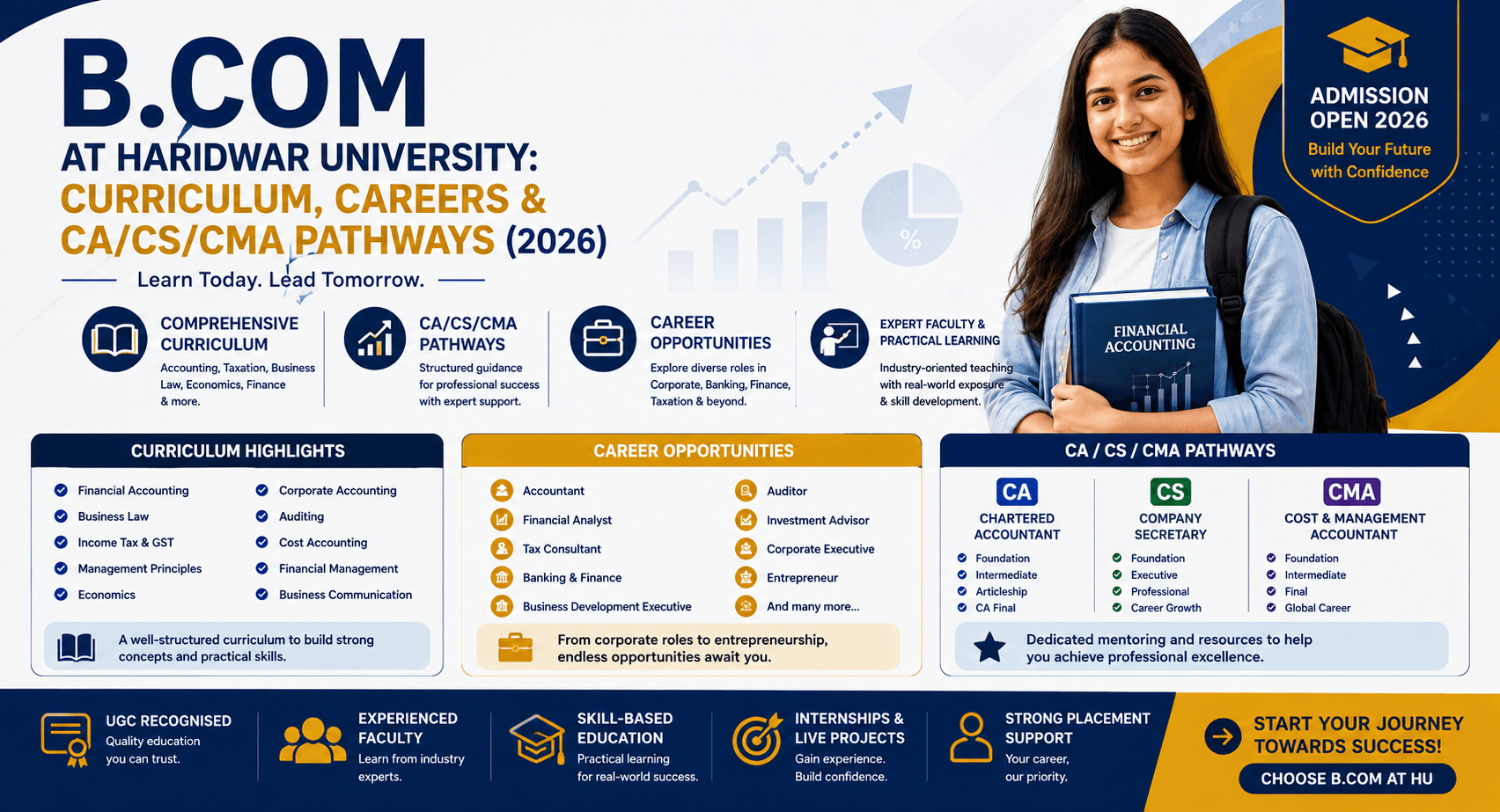
B.Com at Haridwar University: Curriculum, Careers & CA/CS/CMA Pathways (2026)
Dr. V.K. Saini
Director, Haridwar University
Table of Contents
Ask ten commerce teachers what B.Com is for and you'll get ten slightly different answers. At its core, B.Com at Haridwar University is a three-year undergraduate degree that trains students in accounting, taxation, business law and economics. HU runs it through the Roorkee College of Business Studies, and honestly, it works well for two very different kinds of students. The first kind already knows they want to become a Chartered Accountant, Company Secretary, Cost Accountant, banker or tax consultant, and they use the three years to build a base before their professional exams. The second kind isn't sure yet, and that's fine too, because a commerce degree keeps doors open across accounting, banking, government jobs and postgraduate study without forcing an early decision.
The degree itself carries real weight. Haridwar University is a UGC-recognised state private university, listed on the Uttarakhand Raj Bhawan's official roster and empowered under Section 2(f) of the UGC Act to award its own degrees — it isn't affiliated to another university for this. That means it holds up for further study, for job applications, and for the competitive exams that simply ask for a bachelor's degree in any discipline. You can verify UGC recognition details on the UGC website.
1. What Is B.Com and Who It's For
The Bachelor of Commerce (B.Com) at Haridwar University is designed to deliver comprehensive knowledge in financial management, corporate accounting, regulatory frameworks, and commercial practices. Grounded in contemporary industry standards, the programme equips students with both theoretical depth and functional expertise.
2. 3-Year HU Curriculum
Six semesters, four subject pillars, and a fair amount of overlap with what professional courses expect you to already know. That's roughly how the B.Com curriculum at HU is structured. Alongside the core papers there are applied electives and hands-on practical sessions, which fits the university's general approach of not letting theory sit unused until final year.
Accounting
This starts with financial accounting and moves through corporate and cost accounting before students get into accounting standards and financial statement analysis. There's also practical, computer-based accounting work using Tally, the kind of software most small and mid-sized firms actually run on.
Taxation
Two threads run here: direct tax, meaning income tax computation, deductions and return filing, and indirect tax, which is mostly GST — registration, structure, compliance. Between the two, students come out with a working sense of how India's tax system actually functions, not just the textbook version of it. Guidelines are aligned with official standards from the Income Tax Department.
Business Law
Expect the Indian Contract Act, Company Law, the Sale of Goods Act and consumer protection law, plus a look at corporate governance. The point isn't to make lawyers out of commerce students; it's to make sure they know where the legal edges of a business actually are.
Economics
Micro and macro theory, how the Indian economy is put together, and enough statistics to handle the numerical sections that show up in almost every competitive exam later. This is the part of the syllabus that quietly pays off years down the line.
HU describes its own teaching approach as one that tries to keep up with how fast things change, pairing each semester's theory with practical assignments rather than saving it all for a final-year project. If you want to see how that's framed in more detail, the About HU page covers faculty approach and campus facilities.
3. B.Com Alongside CA/CS/CMA — How the Combination Works and Why It's Powerful
Here's the part most school students don't realise until much later: you don't have to choose between B.Com and a professional qualification. You can run them together, and commerce graduates specifically get a shortcut that other streams don't.
Take the Institute of Chartered Accountants of India (ICAI). Under its Direct Entry Scheme, a commerce graduate with at least 55% aggregate (60% if you're from a non-commerce background) can register straight into CA Intermediate. No CA Foundation exam required. After that, there's an eight-month study period before the CA Intermediate exams, followed by a four-week ICITSS orientation. Under ICAI's New Scheme of Education and Training (effective 1 July 2023), practical training now runs for two years — not three — and starts only after both groups of CA Intermediate are cleared and ICITSS is completed, rather than running alongside Intermediate prep. The Final exam can then be attempted once a six-month post-articleship study period is finished. (Checked against ICAI's official scheme notification as of August 2026 — always confirm the current rules on icai.org before planning your timeline.)
The same idea shows up at the Institute of Company Secretaries of India (ICSI), where commerce graduates are currently exempt from the CS Executive Entrance Test (CSEET) and can register directly for the CS Executive Programme, and at the Institute of Cost Accountants of India (ICMAI), which lets graduates enter directly at CMA Intermediate. Why does this matter practically? Because the B.Com syllabus and these professional courses overlap heavily in accounting, tax and law, so studying both at once doesn't mean learning everything twice. It means reinforcing the same material from two angles.
4. Career Roles: Where a B.Com Degree Leads
So what happens after graduation? A B.Com from HU can take you straight into a job, or it can be the foundation you build a professional qualification on top of. For placement support and the list of recruiters who visit campus, the university's Placements overview page is worth a look. But in terms of where most graduates actually land first, it usually comes down to five roles.
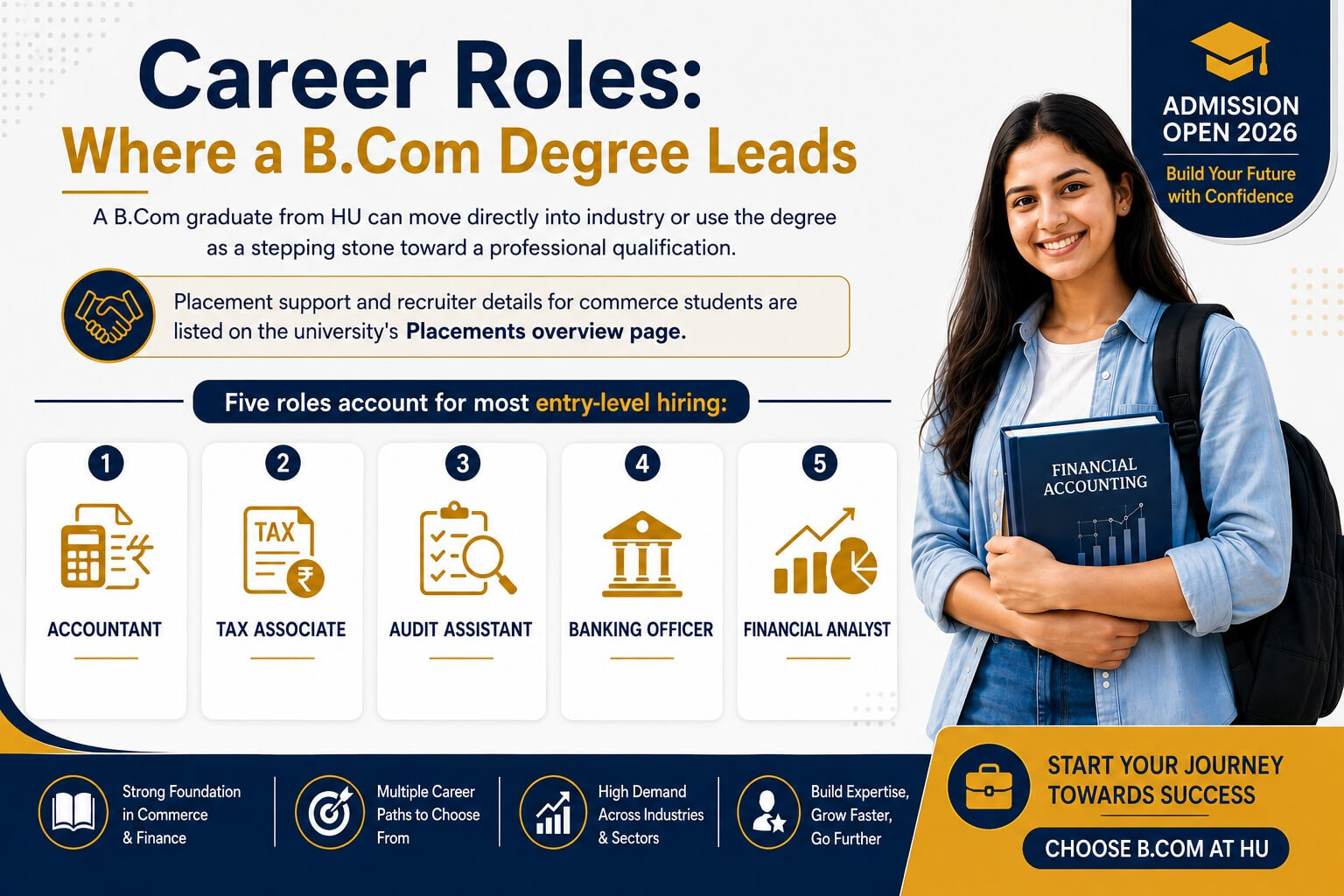
1. Accountant
The classic entry point. You're maintaining ledgers, reconciling accounts, and putting together financial statements for a business. Most commerce graduates take this on as their first job, often while studying for CA or CMA on the side in the evenings.
2. Tax Associate
This role sits inside a CA firm, a tax consultancy, or a company's own tax department. The day-to-day is income tax and GST return preparation, tax computation, and making sure compliance filings actually go out on time.
3. Audit Assistant
Here you're supporting a statutory or internal audit team — checking vouchers, verifying that accounting standards are being followed, and putting together the working papers a qualified auditor eventually signs off on.
4. Banking Officer
Public and private banks both hire graduates for officer and clerical posts, and this is where a B.Com background genuinely helps. The exams run through the Institute of Banking Personnel Selection, and since the eligibility bar is just a bachelor's degree in any discipline, commerce graduates walk in with an advantage on the numerical sections of IBPS PO and Clerk.
5. Financial Analyst
Budgets, forecasts, ratio analysis, business performance reports — that's the daily work here. It's also a role where an extra certification tends to matter over time; a CFA, an MBA in Finance, or CMA all push this career forward faster.
5. 2026 Salary Ranges (With Sources)
Numbers here will move around depending on the city, the size of the employer, and whatever extra qualification a graduate picks up. Still, the entry-level bands that salary-tracking platforms were reporting through 2026 give a reasonably honest starting picture:
| Role | Typical Entry-Level Range (2026) | Source |
|---|---|---|
| Accountant | ₹3.0 – 4.0 LPA (avg. ₹3.08 LPA) | PayScale India, 2026 |
| Tax Associate / Analyst | ₹3.0 – 5.0 LPA | AmbitionBox, 2026 |
| Audit Assistant / Associate | ₹4.0 – 7.0 LPA | Glassdoor India, 2026 |
| Financial Analyst | ₹4.0 – 6.0 LPA (fresher) | AmbitionBox, 2026 |
| Big-4 Graduate Analyst (Non-CA) | ₹4.0 – 7.0 LPA | Glassdoor India, 2026 |
Keep in mind these are entry-level numbers only. They tend to jump sharply once someone clears CA, CS or CMA, or simply puts in three to five years of experience — mid-level tax and audit professionals were reporting ₹10–22 LPA on AmbitionBox and Glassdoor India's 2026 data.
6. M.Com/MBA Pathways After B.Com
Not every B.Com graduate stops at three years. Some want to go deeper into the subject itself, and for them an M.Com makes sense — it sharpens research skills and advanced accounting knowledge, and opens doors into teaching or specialist finance roles. Others are aiming for management rather than pure accounting, and for that crowd an MBA fits better. HU's own postgraduate option here is the MBA with AI programme, which comes with Finance, HR and Marketing specialisations plus IIM/IIT/NIT-linked certification. For a B.Com graduate who wants to move into managerial finance, banking leadership or consulting rather than staying in pure accounting practice, this is usually the more natural next step.
7. Government Exam Eligibility for B.Com Graduates
There's a common misconception that government jobs need a specific degree stream. Mostly, they don't. Central and state recruitment exams generally ask for a bachelor's degree in any discipline, which puts B.Com graduates on equal footing from day one. The clearest example is the Staff Selection Commission's Combined Graduate Level (SSC CGL) exam: any recognised bachelor's degree qualifies, with no stream restriction, for Group B and Group C posts across departments like the Income Tax Department, Customs (CBIC), and Assistant Audit Officer roles — positions where, frankly, a commerce background is more than just adequate, it's genuinely useful. Official updates are published on the Staff Selection Commission (SSC) portal.
Banking exams work the same way. A graduation degree in any stream is enough to sit for Probationary Officer and Clerk exams, and commerce graduates usually do well on these because the numerical and financial reasoning sections play to what they've already studied. You can explore openings across government services on the National Career Service portal.
8. Fees & Eligibility
Getting into B.Com at HU doesn't require anything unusual. A Class 12 (10+2) pass from a recognised board, in any stream, is enough to apply. Selection runs on merit from the qualifying exam or through the university's own entrance process, and UGC-recognised scores like CUET are accepted as well. For the full breakdown, term by term, along with scholarship details, the university keeps everything on its Fees & Scholarships page.
| Year | Semester 1 | Semester 2 | Year Total |
|---|---|---|---|
| 1st Year | ₹57,000 | ₹10,000 | ₹67,000 |
| 2nd Year | — | — | ₹50,000 |
| 3rd Year | — | — | ₹50,000 |
That's the published fee for the 2026–27 academic year, and it covers tuition, enrolment, admission, exams and uniform — hostel and transport come as separate charges. There's also scholarship support: up to 25% off first-year tuition for girl students, UK-domicile candidates, and children of defence or university staff, plus merit scholarships running as high as 80% depending on JEE rank or Class 12/CUET percentile.
9. Frequently Asked Questions
1. Is the B.Com degree from Haridwar University valid and recognised?
It is. HU is a UGC-recognised state private university under Section 2(f) of the UGC Act, it's listed on the Uttarakhand Raj Bhawan's official roster, and it's a member of the Association of Indian Universities (AIU) — AICTE oversight applies to technical programmes and doesn't come into play for B.Com. That combination is what makes the degree hold up for jobs, government exams and further study.
2. What is the eligibility for B.Com admission at HU?
A Class 12 (10+2) pass from a recognised board, in any stream, is all that's required. Admission goes by merit or through the university's own entrance process, and CUET scores are accepted too.
3. Can I pursue CA, CS or CMA while doing B.Com at HU?
Yes, and quite a few students do exactly that. Commerce graduates can enter CA Intermediate, CS Executive or CMA Intermediate directly, and since HU's curriculum overlaps closely with these professional syllabi, it's not double the workload it sounds like.
4. What is the total fee for B.Com at HU?
For the 2026–27 cycle it's ₹67,000 in the first year, then ₹50,000 in each of the second and third years — the official fees page has the full breakdown.
5. Does HU offer scholarships for B.Com students?
It does. First-year tuition scholarships of up to 25% are available for girl students, UK-domicile candidates and a few other categories, and merit-based scholarships can go as high as 80% depending on JEE rank, Class 12% or CUET percentile.
6. What careers can I pursue after B.Com from HU?
Accountant, Tax Associate, Audit Assistant, Banking Officer and Financial Analyst cover most of the entry-level ground, and from there the usual next steps are CA, CS, CMA, M.Com or MBA.
7. Is a B.Com degree enough to apply for government exams like SSC CGL?
More than enough, actually. SSC CGL and most banking-recruitment exams only ask for a bachelor's degree in any discipline, so B.Com meets that bar without needing anything extra tacked on.
8. Can I do an MBA after completing B.Com at HU?
Yes, this is a common path. B.Com graduates are eligible for HU's MBA with AI programme across Finance, HR or Marketing, and it's usually the route students take when they're aiming at management rather than pure accounting.
9. What salary can a B.Com graduate expect after graduating in 2026?
Somewhere between ₹3 LPA and ₹6 LPA at entry level for roles like Accountant or Financial Analyst, though that climbs noticeably once CA, CS or CMA is cleared, or once a few years of experience are on the resume.
Ready to Start Your Career in Commerce?
Explore B.Com & MBA programmes at Haridwar University for Session 2026–27.