

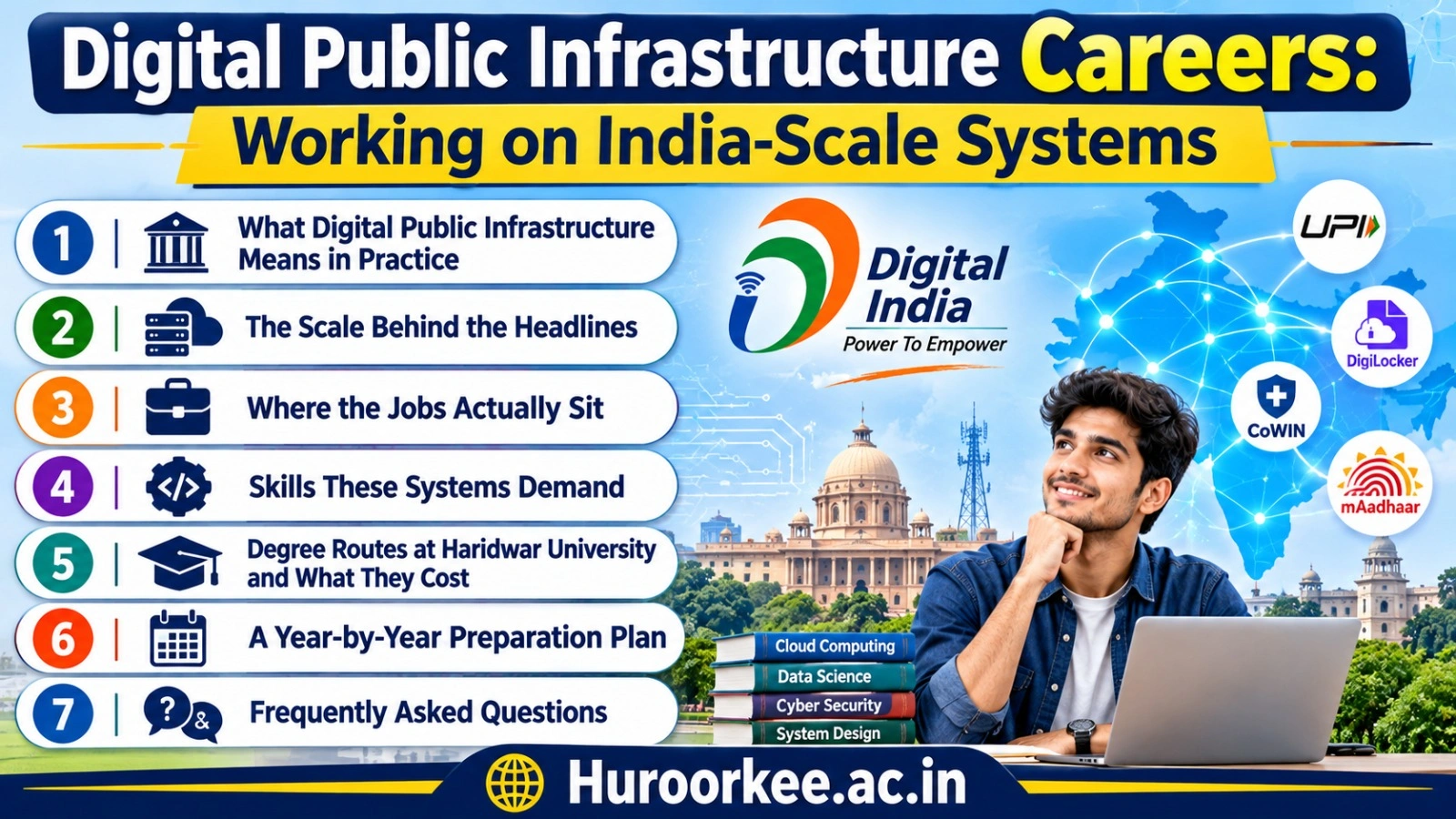
Digital Public Infrastructure Careers: Working on India-Scale Systems
Dr. Himanshu Verma
Associate Professor & HOD, Computer Science & Engineering, Haridwar University
Digital Public Infrastructure Careers: Working on India-Scale Systems sounds grand until you picture the work on an ordinary Tuesday: an engineer chasing down why a payment callback times out, or why a document won’t load for someone on a weak village signal. The scale is real. So is the unglamorous detail. This guide uses official figures to show where the work sits, what it demands, and how a computing student can head toward it.
The table below is the quick map. Every figure in it comes from the Ministry of Electronics and IT’s Lok Sabha reply, released by PIB on 5 August 2026.
| Platform | What It Does | Official Figure (PIB, 5 Aug 2026) |
|---|---|---|
| Aadhaar | Digital identity and authentication | Over 1.44 billion Aadhaar numbers generated |
| UPI | Bank-to-bank payments on one platform | 731 banks; 55.49 crore individuals; 6.5 crore merchants |
| DigiLocker | Issued and shared documents | 71.66 crore users; 936.03 crore documents; 2,822 issuers |
| UMANG | Single app for government services | 2,575 services for individuals |
| e-Sanjeevani | Doctor consultations by phone | Over 48 crore patients served |
Table of Contents
1. What Digital Public Infrastructure Means in Practice
PIB’s release on Digital India initiatives describes digital public infrastructure as affordable data, assisted access points and interoperable public platforms that let citizens reach welfare schemes, make payments, study online and take part in governance. For an engineer, the telling words are “public” and “interoperable”. UPI, for instance, connects 731 banks on a single platform.
Identity, Payments and Documents
Aadhaar gives a person a verifiable identity. UPI moves money between banks. DigiLocker holds documents that issuers sign and others can check. Each is useful alone. Together they let a service confirm who you are, take payment and fetch your papers without a counter in between. None of them is a single app. Each is a set of standards and interfaces that other organisations connect to, so the career question is less “which app?” and more “which layer?”
Why “Public” Changes the Engineering
A private app can pause a feature on a Friday. A platform that welfare transfers depend on can’t. The same release says over ₹52 lakh crore has moved through Aadhaar-linked direct benefit transfers, covering 318 schemes of 56 ministries.
2. The Scale Behind the Headlines
What One Month of UPI Looks Like
NPCI’s UPI statistics for October 2026, as released that month, show 25.47 billion transactions worth ₹31.53 lakh crore, roughly 822 million a day. PIB adds that UPI powers 85% of India’s digital payments and nearly 50% of the world’s real-time digital payments.
What Scale Does to a Job
At that volume, a one-percent failure rate isn’t a rounding error. It’s millions of failed payments a day. So the work leans on retries that never double-charge, monitoring that spots trouble within minutes, and testing for peak days like festival weekends.
That’s the daily reality behind Digital Public Infrastructure Careers: Working on India-Scale Systems: less invention from scratch, more care at enormous volume.
3. Where the Jobs Actually Sit
There’s no single employer called DPI. The work is spread across public bodies, the operators of the platforms, and the companies that build on top of them.
Government Technical Roles
The National Informatics Centre (NIC) ran a 2026 round for 243 Scientist-B posts, with selection built on GATE scores and an interview, at Pay Level 10 (₹56,100 to ₹1,77,500), under Advertisement NIC/SCB/2026/1 on its recruitment portal. Eligible GATE papers were computer science and IT, electronics and communication, and data science and AI. That round has closed, so check the portal for the next one. For preparation guidance, consult our GATE preparation guide.
Platform and Operator Teams
Organisations like NPCI run the rails, and their engineers work on switching, reconciliation and reliability. No pay or headcount figures are quoted for them here, because no official, dated source was available.
Builders on Top
Banks, fintech firms and health and education platforms plug into these systems. PIB says 2,822 issuers are onboarded to DigiLocker, and each one needed engineers to connect. A graduate who can read an API specification and handle failure cases is useful in all of them. Here’s a practical test: can you explain how a request travels from a phone to a bank and back, and what happens at each step when something fails?
4. Skills These Systems Demand
Distributed Systems and Reliability
Databases, networking, queues and operating systems matter more here than fashionable frameworks. Learn what happens when two requests for the same payment arrive together. Add testing habits too: load tests, failure injection and clear logs separate a demo from a service.
Security and Privacy
The Digital Personal Data Protection Act, 2023 requires consent-based processing of personal data. The DPDP Rules, 2025 were notified on 13 November 2025, and PIB says provisions phase in over an eighteen-month transition, including a Data Protection Board. So anyone building on personal data should understand consent, purpose and retention. Rules still being phased in can change, so check the current text. Learn more about secure application design in our guide to cybersecurity specialization at Haridwar University.
Low-Bandwidth Thinking
Data now costs roughly ₹8 to ₹10 per GB, down from ₹269 in 2014, yet 5.01 lakh Common Services Centres still help people reach services in person, as of May 2026. Systems must work on cheap phones and patchy networks. Still choosing a degree? HU’s admission overview lists eligibility and the application process.
5. Degree Routes at Haridwar University and What They Cost
HU’s programme and fee pages, checked on 18 November 2026, list no degree built specifically around public digital infrastructure. They do list computing degrees that cover the base, all under Roorkee College of Smart Computing. The table follows the fee structure on HU’s official fees and scholarships page (headed 2027-28 when checked).
| Programme | Year 1 | Later Years |
|---|---|---|
| B.Tech. Hons. CSE (4 years) | ₹1,32,000 | ₹1,15,000 a year (Years 2–4) |
| B.Tech. Hons. Cyber Security (4 years) | ₹1,42,000 | ₹1,25,000 a year (Years 2–4) |
| B.Tech. Hons. Data Science (4 years) | ₹1,42,000 | ₹1,25,000 a year (Years 2–4) |
| MCA with AI (2 years) | ₹92,000 | ₹75,000 (Year 2) |
| M.Tech. CSE (2 years) | ₹78,000 | ₹70,000 (Year 2) |
Charges include tuition, enrolment, admission, examination and uniform fees; transport costs extra. Fees can be revised, so confirm on the official page before paying.
The same page lists merit slabs on first-year tuition, from 10% to 80% by JEE rank, Class 12 aggregate or CUET percentile, plus 25% for girls (first year only). M.Tech students who qualify through GATE-2027 can get an AICTE scholarship. Only one scholarship can be claimed, and private candidates get no merit scholarship.
Explore Computing Programmes at HU →
6. A Year-by-Year Preparation Plan
- Year 1: Programming, discrete maths and SQL. Use UPI and DigiLocker as a critic would, noting every failure and how the app explains it.
- Year 2: Data structures, operating systems, networks and databases. Build a small REST API with a simulated payment endpoint that can’t be charged twice. Write down what each failure should do, not just what success looks like.
- Year 3: Take a security or cryptography elective if offered, and read the DPDP provisions. A good project is a consent-capture mini app that logs purpose and expiry.
- Final Year and Beyond: Choose between industry roles and a GATE-based route, which is how NIC’s 2026 round selected candidates, or an M.Tech. At HU, MCA with AI and M.Tech CSE are the postgraduate routes in the table above.
Big systems take patience to learn. HU’s Student Welfare Service page describes a Student Care Centre in each academic block with a stated 24-hour response time, and it covers education-loan support for tuition, hostel and laptop costs.
In the end, Digital Public Infrastructure Careers: Working on India-Scale Systems rewards steady fundamentals over trendy tools. Facts and figures here were checked on 18 November 2026; confirm them on the official pages before you decide.
7. Frequently Asked Questions (FAQs)
What is digital public infrastructure in simple terms?
It’s shared digital platforms, such as Aadhaar for identity, UPI for payments and DigiLocker for documents, that many organisations can plug into. PIB lists all three among India’s core platforms.
Do I need a government job to work on it?
No. The work spreads across public bodies like NIC, platform operators like NPCI, and private firms that build on top. Government posts are one route among several.
Is a GATE score necessary?
For NIC’s 2026 Scientist-B round, a valid GATE score was required. Other employers run their own selection, so check each notification.
Which branch suits these careers?
NIC’s 2026 round accepted GATE papers in computer science and IT, electronics and communication, and data science and AI. Computing degrees are the closest fit.
How big is UPI, really?
NPCI’s October 2026 data show 25.47 billion transactions worth ₹31.53 lakh crore, about 822 million a day. PIB says it connects 731 banks.
Does privacy law affect engineers?
Yes. The DPDP Act, 2023 and Rules, 2025 shape how personal data is handled, and implementation is phased over an eighteen-month transition per PIB. Read the current text before building.
How much do these jobs pay?
Only NIC’s Scientist-B pay level (₹56,100 to ₹1,77,500) is quoted here, from its 2026 notification. No other figure was available from an official, dated source.
What do HU’s computing degrees cost in Year 1?
Among the programmes in the table, Year 1 runs from ₹78,000 for M.Tech CSE to ₹1,42,000 for B.Tech Cyber Security or Data Science, on the fee page checked on 18 November 2026.
Does HU offer a public-infrastructure degree?
Not on the programme and fee pages checked on 18 November 2026. The computing degrees build the base, and the admissions team can advise on electives.
Build India-Scale Systems at Haridwar University
Master high-performance distributed systems, cloud computing, cybersecurity, and data architecture. Explore accredited B.Tech, MCA, and M.Tech programmes with modern labs, GATE mentoring, and merit scholarships up to 80%. Admissions open for the 2027-28 session.