
How to Become a Drone Pilot in India: DGCA Certificate, Fees & Jobs
Mr. Prajwal Chaudhary
Head, Training & Placement, Haridwar University
Drones are finding practical applications in agriculture, land surveying, infrastructure inspection, mapping, photography and public services. As these uses expand, trained remote pilots are becoming an important part of India's unmanned aircraft ecosystem. For students considering this field, the first step is understanding how DGCA drone pilot training works, what certification is actually required, how much training may cost and where the qualification can lead.
One point often causes confusion. People commonly search for a “DGCA drone pilot licence”, but the current regulatory credential is the Remote Pilot Certificate (RPC). The distinction matters when choosing a training institute or checking whether a course meets regulatory requirements.
Here is a practical guide to the process, eligibility, fees and career options.
Table of Contents
- 1. Drone Pilot Licence and Remote Pilot Certificate in India
- 2. How to Get a DGCA Remote Pilot Certificate
- 3. Eligibility and Training Duration for Drone Pilots
- 4. DGCA Drone Pilot Training Cost and Fees in India
- 5. Choosing a DGCA-Authorised Drone Training Institute
- 6. Career Opportunities After Drone Pilot Certification
- 7. Skills That Improve Drone Pilot Employability
- 8. Frequently Asked Questions (FAQs)
- 9. Building a Career in India's Drone Industry
1. Drone Pilot Licence and Remote Pilot Certificate in India
The terms drone pilot licence and DGCA drone pilot certificate are widely used in online searches. However, the Drone (Amendment) Rules, 2022 abolished the requirement for a separate drone pilot licence and introduced the Remote Pilot Certificate (RPC).
An RPC is issued through a DGCA-authorised Remote Pilot Training Organisation (RPTO). The Ministry of Civil Aviation explains this regulatory transition in its official summary of India's drone regulations.
This is not merely a change in terminology. Anyone comparing training programmes should check whether the provider is authorised to conduct the relevant remote-pilot training and issue the applicable certificate.
Official MoCA Data Snapshot (October 2026)
According to the Ministry of Civil Aviation, as of 17 October 2026, India had 294 DGCA-approved RPTOs and 54,156 DGCA-approved Remote Pilot Certificates issued. These figures reflect the rapid growth and formalisation of India's commercial drone ecosystem.
2. How to Get a DGCA Remote Pilot Certificate
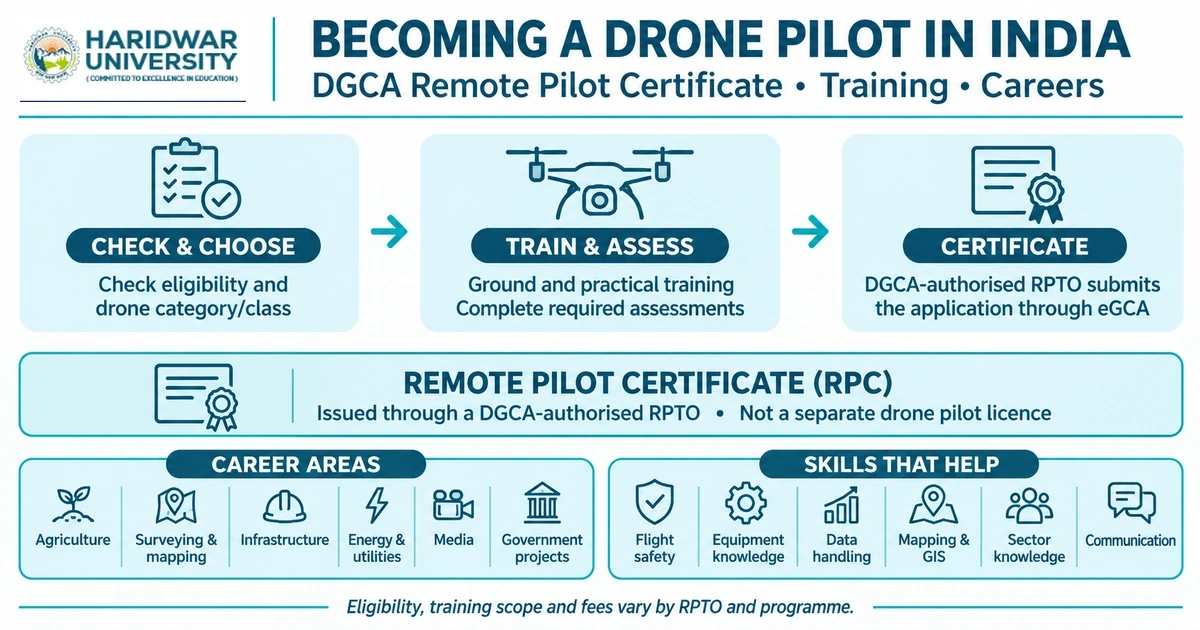
The process begins with selecting the right training organisation, not simply enrolling in the first drone course advertised online. A typical route involves the following structured steps:
Review the age, educational and documentation requirements for the course and drone category you intend to pursue.
Training must match the intended scope of operation (e.g., Small, Medium, or Large category). Ask the RPTO which categories and classes its authorisation covers.
Verify the organisation's current authorisation certificate and approved training scope directly through official regulatory channels.
Training includes theoretical instruction (aviation rules, aerodynamics, meteorology) and practical flight exercises under the prescribed syllabus.
Candidates must successfully pass the theory exams, simulator tests, and practical flight skill evaluation specified for the programme.
The RPTO submits the relevant application through the DGCA's eGCA portal after successful training, issuing the official Remote Pilot Certificate.
The DGCA Drone Training Circular 01 of 2026, effective from 13 May 2026, sets out the current minimum criteria for RPTO authorisation. It also makes clear that training organisations must operate strictly within their approved scope.
A certificate should not be confused with unrestricted permission to fly anywhere. Commercial and non-commercial drone operators must adhere to operational rules and check the official DigitalSky airspace map (Green, Yellow, and Red zones) before every flight.
3. Eligibility and Training Duration for Drone Pilots
Eligibility criteria should be confirmed directly with the authorised RPTO before paying any registration or training fee. Requirements depend on the specific course, payload capacity, and drone category involved.
For example, Indira Gandhi Rashtriya Uran Akademi (IGRUA)’s published Remote Pilot Certificate training prerequisites include:
- Age: At least 18 years of age.
- Education: Minimum Class 10 qualification from a recognised board of education.
- Identity proof: Aadhaar card and secondary identity documentation.
- Medical fitness: A valid medical fitness certificate issued by an authorised medical practitioner.
IGRUA currently lists a five-day training duration for its advertised standard programme. While this is representative of many foundational RPC courses, duration can vary across providers depending on the depth of flight hours, simulator modules, and specialised payload training. Its official drone-training portal outlines published prerequisites, regional training centres, and curriculum details.
4. DGCA Drone Pilot Training Cost and Fees in India
There is no uniform or government-fixed training fee that applies to every drone pilot course across India. Total cost depends on the RPTO, drone category (Micro, Small, Medium), training syllabus, location, simulator access, and accommodation options included.
It is crucial to distinguish between the base tuition fee and any separate certificate-issuance, exam, or administrative charges. Prospective candidates should review the official Ministry of Civil Aviation RPTO listings and request an itemised fee schedule.
| Cost Component | What to Confirm |
|---|---|
| Training fee | Ground classes, practical flying sessions, flight briefing, and study materials |
| Assessment charges | Whether required skill tests and theory examinations are included in the tuition |
| Certificate-related charges | Any applicable government eGCA application or processing fee |
| Equipment and flight practice | Whether flight simulator hours and live dual-control flying sessions are fully covered |
| Additional expenses | Travel, lodging/boarding near the airfield, medical exam charges, and GST |
My advice to students and parents is straightforward: compare what each institute provides rather than merely looking at the headline price. A lower advertised fee often excludes practical flying hours, simulator time, or re-test charges.
5. Choosing a DGCA-Authorised Drone Training Institute
A training provider’s marketing banner or social media claim of being “DGCA-approved” is insufficient. Verification before enrolment protects your time and capital.
RPTO Evaluation Checklist
- Verify current DGCA authorisation: Inspect the official DGCA approval document and validity dates.
- Check category & class scope: Confirm whether the authorisation covers Small (2kg–25kg) or Medium (25kg–150kg) drones.
- Verify physical training site: Ensure the specific airfield or training campus is listed on the DGCA authorisation schedule.
- Instructor credentials: Verify that instructors hold valid DGCA remote pilot instructor authorisations.
- Supervised flight hours: Confirm the minimum guaranteed solo and dual-control flight minutes per candidate.
- Simulator infrastructure: Ensure access to certified flight simulators for emergency procedures and failsafe training.
- Written fee transparency: Request a complete fee breakup including examination and eGCA certification charges.
- Post-training support: Ask how the institute coordinates final certificate processing through the eGCA system.
6. Career Opportunities After Drone Pilot Certification
A Remote Pilot Certificate serves as the legal operating foundation, but industry career paths depend heavily on practical handling skills, technical troubleshooting, and industry-specific software domain knowledge.
| Industry Sector | Core Work & Operations |
|---|---|
| Agriculture | Precision crop spraying, multispectral crop health monitoring, soil analysis, and yield estimation. |
| Surveying & Mapping | Photogrammetry, LiDAR scanning, cadastral mapping, 3D terrain modeling, and GIS boundary surveys. |
| Infrastructure & Construction | Highway and railway alignment surveys, bridge inspections, construction progress tracking, and volumetric earthwork analysis. |
| Energy & Utilities | Thermal inspection of solar panels, wind turbine blade checks, and high-voltage power transmission line monitoring. |
| Cinematography & Media | Aerial cinematography, advertising productions, real estate showcases, and live broadcast events. |
| Public Schemes & Governance | Surveying and spatial asset creation under large-scale central initiatives such as SVAMITVA, Namo Drone Didi, NAKSHA, and AMRUT. |
Agriculture is experiencing particularly rapid adoption because unmanned aerial vehicles dramatically accelerate spraying and multispectral field analysis. Students interested in this specialization can read our comprehensive guide to agri-tech careers in India and examine how AI and precision farming are applied in modern agriculture.
However, an RPC alone does not automatically make someone an agricultural agronomist, land surveyor, or structural inspection expert. Those roles require foundational engineering or domain training alongside drone operations.
7. Skills That Improve Drone Pilot Employability
Certification establishes regulatory compliance, but employers and service contracting enterprises seek pilots who demonstrate operational maturity, safety discipline, and technical acumen. Key competencies include:
- Flight planning and safety protocol: Executing comprehensive pre-flight checklists, airspace clearances on DigitalSky, fail-safe contingency planning, and emergency procedures.
- Hardware and battery maintenance: Understanding LiPo battery charging cycles, avionics, motor telemetry, sensor calibration, and routine field maintenance.
- Data handling and processing: Efficiently cataloging high-resolution aerial imagery, thermal datasets, and coordinate logs for engineering teams.
- Mapping and GIS tool proficiency: Familiarity with photogrammetry software (e.g., Pix4D, Agisoft Metashape) and GIS tools (QGIS, ArcGIS) elevates pilots from mere operators into high-value technical analysts.
- Sector-specific workflows: Tailoring flight profiles for agricultural spraying, volumetric stockpile measurement, or structural inspection.
- Communication and team coordination: Coordinating with air traffic visual observers, project managers, and enterprise clients on active job sites.
For students seeking an integrated academic qualification rather than a short standalone vocational certificate, our in-depth B.Sc. Aviation & Drone Technology programme guide explains how foundational aerodynamics, aviation management, UAV electronics, and regulatory training come together into a comprehensive multi-year degree.
8. Frequently Asked Questions (FAQs)
1. How much does it cost to get a DGCA Remote Pilot Certificate in India?
The total cost varies depending on the RPTO, drone category (Micro, Small, or Medium), curriculum depth, simulator access, and accommodation. Candidates should request a complete written fee breakdown from authorised RPTOs that clearly distinguishes training fees from DGCA application and examination charges.
2. How do I get a DGCA drone pilot certificate?
Enrol with a DGCA-authorised Remote Pilot Training Organisation (RPTO) offering training for your intended drone category. Complete the prescribed ground school theoretical classes, simulator hours, and supervised practical flight training. Upon clearing internal and regulatory assessments, the RPTO processes your certificate via the DGCA’s eGCA portal.
3. Who can become a drone pilot in India?
Under prevailing DGCA guidelines, candidates must be at least 18 years of age, have completed a minimum of Class 10 education from a recognised board, hold a valid Aadhaar card, and obtain a medical fitness certificate. Always verify course-specific requirements directly with your chosen RPTO.
4. How many days does drone pilot training take?
Foundational Remote Pilot Certificate training typically takes around 5 days across most DGCA-authorised institutes (such as IGRUA). Specialised courses covering agricultural spraying, advanced mapping, thermal thermography, or medium-category aircraft may extend over several weeks.
5. How can I verify a DGCA-authorised RPTO?
Cross-check the organisation on the official Ministry of Civil Aviation or DGCA website. Confirm its official RPTO authorisation number, approved drone categories and classes, validity dates, and certified training airfield location before remitting fees.
6. Is drone piloting a good career in India?
Drone piloting offers strong potential across agriculture, aerial surveying, infrastructure inspection, defense, and public governance schemes. However, commercial success depends on practical flight precision, analytical software skills, and safety adherence. A certificate is the prerequisite license, but specialized domain knowledge drives career growth.
7. What jobs can I get after drone pilot certification?
Graduates can work as commercial drone pilots, agricultural spraying operators, GIS survey technicians, construction inspection specialists, aerial cinematographers, or drone operations technicians. Combining the pilot credential with degree-level education unlocks roles in UAV system assembly, maintenance, and flight operations management.
9. Building a Career in India's Drone Industry
Drone technology is creating dynamic career tracks that merge engineering concepts with field operations. For students, the primary choice is not choosing the cheapest available crash course, but deciding which sector of drone operations aligns with their career aspirations and selecting the right educational path.
I encourage prospective candidates to rigorously check an RPTO’s DGCA approval status, assess the actual hands-on flight minutes provided, and recognize the serious safety responsibilities involved in piloting unmanned aircraft. The Remote Pilot Certificate is an essential launching pad; domain specialization, GIS proficiency, and rigorous operational standards are what build long-term career longevity.
For students interested in exploring UAV technology and aviation management as part of an undergraduate education, Haridwar University’s technical programmes and academic guides provide an excellent foundation. Always review the latest DGCA circulars before undertaking regulated commercial flight operations.
Build Your Future in Drone Technology & New-Age Engineering at Haridwar University
Explore modern programmes in Aviation, Drone Technology, Computing, and Advanced Engineering. Learn with state-of-the-art lab infrastructure, industry internships, career mentorship, and merit scholarships up to 80%. Admissions open for the 2027-28 academic session.