

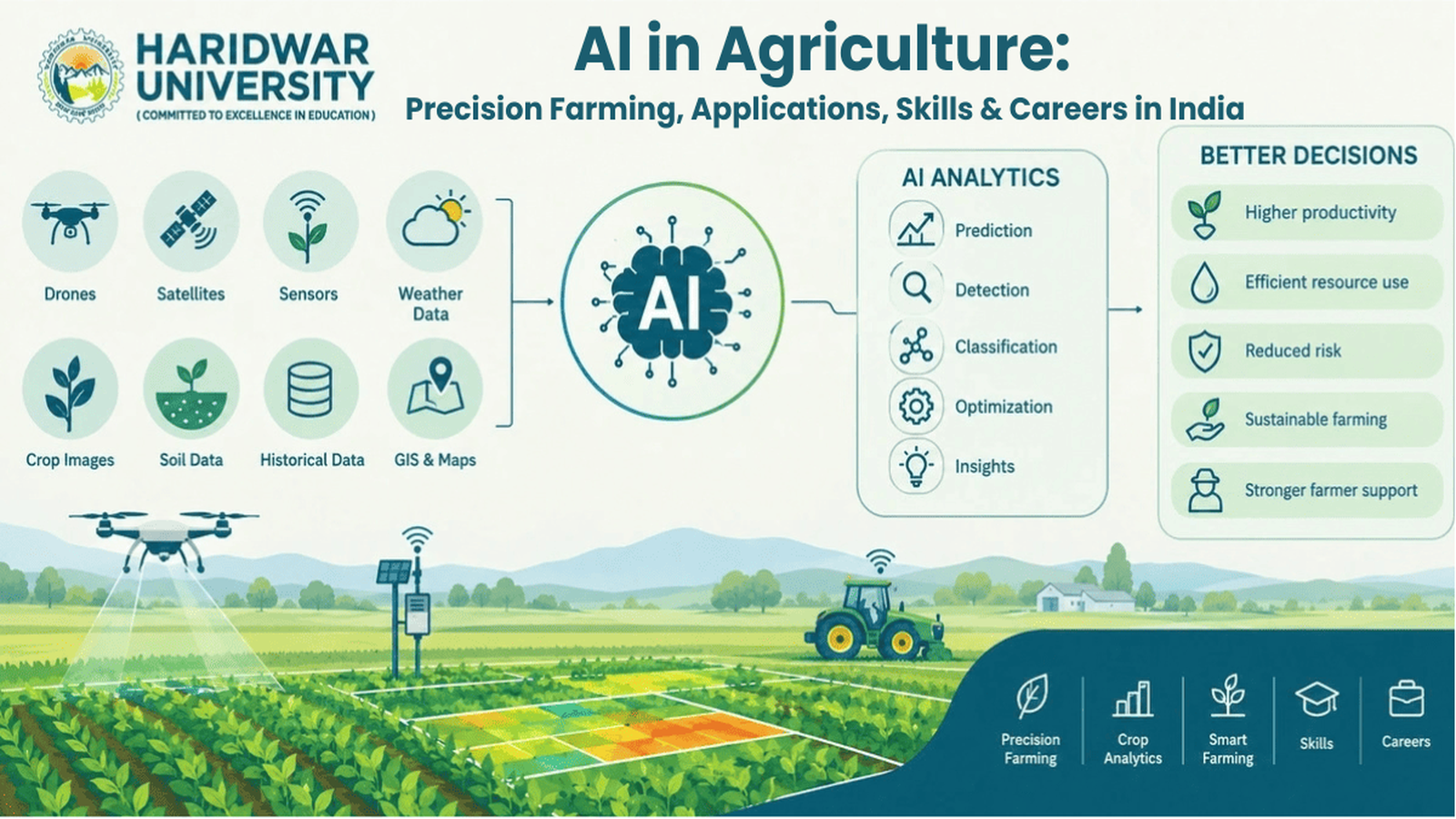
AI in Agriculture: Precision Farming, Applications, Skills & Careers in India
Dr. Roshan Kumar Thakur
Head, Roorkee College of Agricultural Sciences, Haridwar University
Table of Contents
- How AI Is Changing Agriculture in India
- How AI, Smart Farming and Precision Agriculture Work Together
- Where AI Is Being Applied Across Agriculture
- How Crop Analytics Turns Agricultural Data Into Decisions
- How Drones, Sensors, GIS and Remote Sensing Support Precision Farming
- Which AI Techniques Fit Different Agricultural Problems
- How India Is Applying AI Across the Agricultural Ecosystem
- What Limits AI Adoption in Indian Agriculture
- What Students Should Learn for AI-Enabled Agriculture
- Practical AI Projects for Agriculture Students
- Career Pathways at the Intersection of Agriculture and AI
- Frequently Asked Questions (FAQs)
- From Agricultural Fundamentals to AI-Enabled Farming
How AI Is Changing Agriculture in India
Agriculture is becoming increasingly data-driven. When I look at the direction of modern farming in India, I see a growing connection between agricultural science, field data, remote sensing, sensors, artificial intelligence, and digital advisory systems.
AI is not replacing agricultural knowledge. Its true value lies in helping farmers, agronomists, and agricultural researchers interpret large amounts of information and make better-informed, timely decisions across planting, irrigation, fertilisation, and crop protection.
India is already building this essential digital infrastructure:
Created under the Government of India's Digital Agriculture Mission to anchor authenticated agronomic services.
Covered during the Rabi 2024–25 Digital Crop Survey by February 2026, mapping geo-referenced farm plots nationwide.
Governmental AI pipelines actively monitoring pest outbreaks, forecasting local weather anomalies, and dispatching hyper-local advisories.
For students pursuing degrees in agriculture, this creates an unprecedented learning opportunity. Agriculture increasingly needs professionals who understand both agricultural fundamentals and the modern computational technologies used to analyse agricultural data. Students can explore our detailed review of B.Sc. Agriculture education at Haridwar University to see how our campus grounds students in both soil and digital sciences.
How AI, Smart Farming and Precision Agriculture Work Together
AI, smart farming, and precision agriculture are closely related terms, but they are not identical. Understanding the exact role of each pillar prevents costly misconceptions:
📡 Smart Farming
Focuses on infrastructure and connectivity. It brings digital technologies such as IoT sensors, automated farm machinery, cellular connectivity, and telemetry platforms into farm management.
🎯 Precision Agriculture
Focuses on spatial and temporal management. Rather than treating an entire 10-hectare field uniformly, it manages intra-field variations and applies water, seeds, and agrochemicals precisely according to specific crop needs.
🧠 Artificial Intelligence
Provides the analytical and predictive intelligence. AI algorithms process multimodal sensor streams, historical weather, and aerial imagery to extract actionable patterns, predict crop stress, and recommend corrective interventions.
The Practical Agricultural Technology Chain:
This distinction matters because AI is only one part of the wider agricultural technology ecosystem. At Haridwar University, our B.Sc. (Hons.) Agriculture with AI programme intentionally bridges agricultural sciences with precision farming, AgriTech, AI, drone technology, GIS, and IoT-enabled applications.
Where AI Is Being Applied Across Agriculture
The strongest agricultural AI applications are those where large, complex, or multi-temporal datasets can directly support an operational decision on the farm:
| Agricultural Problem | Data Used | AI Application & Technique |
|---|---|---|
| Crop Disease Detection | RGB leaf photographs, multispectral crop images | Computer vision (CNNs, transfer learning, object detection) |
| Yield Prediction | Weather parameters, soil attributes, historical yield records | Machine learning (Random Forest, XGBoost, regression trees) |
| Pest Detection | Crop close-ups, sticky trap images, field scouting logs | AI-based image classification and bounding box localization |
| Smart Irrigation | Soil moisture telemetry, evapotranspiration, forecasted rain | Predictive analytics & automated valve scheduling |
| Soil Management | NPK levels, pH readings, organic carbon, field measurements | Data analytics, spatial interpolation, and nutrient ML |
| Crop Monitoring | Sentinel-2/Landsat satellite bands, high-res drone orthomosaics | Remote sensing indices (NDVI, NDRE) + Deep Learning segmentation |
| Market & Price Planning | Mandi arrivals, historical price indices, national supply data | Time-series forecasting (ARIMA, Prophet, LSTM) |
| Farmer Advisory Services | Agronomic package of practices, localized weather, farmer queries | AI-assisted multilingual decision support & conversational RAG |
This table illustrates why problem framing must always precede algorithm selection: we do not use AI simply because it exists, but because it solves a defined agricultural bottle-neck.
How Crop Analytics Turns Agricultural Data Into Decisions
I consider crop analytics one of the most critical competence areas for students entering technology-enabled agriculture. Raw data gathered from a farm is messy, non-linear, and heavily influenced by micro-climatic fluctuations.
Agricultural data streams typically originate from diverse sources:
To convert these heterogeneous signals into farm actions, students must master the rigorous analytics lifecycle:
For example, a crop-health monitoring system might combine daily field photographs with satellite vegetation indices, local weather records, and soil-moisture logs to identify potential water or nitrogen stress before visible wilting occurs. The Government of India has already demonstrated AI-based crop-health analytics using these datasets for major staples such as rice and wheat.
For engineering and agriculture students alike, mastering this pipeline creates an indispensable skill bridge between agricultural botany, statistics, Python programming, machine learning, computer vision, and geospatial analysis. Students can consult our repository of free AI and machine learning datasets to find open-source agronomic datasets for experimental modelling.
How Drones, Sensors, GIS and Remote Sensing Support Precision Farming
Precision farming achieves its maximum impact when direct field observations are combined with multi-layered digital sensing technologies:
- Agricultural Drones: Unmanned aerial vehicles (UAVs) capture ultra-high-resolution aerial imagery (sub-centimetre ground resolution), enabling the detection of individual weeds, micro-canopy damage, or clogged drip irrigation lines.
- In-Situ IoT Sensors: Soil moisture probes, capacitive leaf sensors, and micro-climate sensors record continuous temporal changes in root-zone hydration and humidity.
- Geographic Information Systems (GIS): GIS software maps topographical variations, drainage paths, soil nutrient zones, and historical yield maps spatially.
- Satellite Remote Sensing: Constellations provide synoptic, multi-temporal coverage across entire administrative districts, tracking regional crop vigour over full seasons.
Integrated Drone-Vision Pipeline:
Drone imagery → Image preprocessing → Computer vision model → Crop-stress detection → Field-level assessment
The same core principle empowers automated weed detection (enabling targeted spot-spraying rather than blanket chemical applications), canopy cover calculation, and pre-symptomatic blight identification. Students interested in the hardware and piloting aspect of precision agriculture can explore Haridwar University's specialized B.Sc. in Aviation and Drone Technology as well as our curated guide on IoT sensor-to-cloud project architectures.
Which AI Techniques Fit Different Agricultural Problems
Students should always learn to select AI techniques according to the specific characteristics of the agricultural challenge, rather than picking a fashionable library first and searching for a problem:
| AI / Computational Technique | Suitable Agricultural Application |
|---|---|
| Machine Learning (Tabular / Regression) | Yield prediction, mandi commodity price prediction, fertilizer dosage optimization |
| Deep Learning (CNNs / Vision Transformers) | Complex multiclass leaf disease diagnosis, fruit grading, fine-grained plant phenotyping |
| Computer Vision (Object Detection / Segmentation) | Real-time weed spot-detection, pest trap counting, fruit counting for harvest estimation |
| Time-Series Modelling (LSTM / GRU / Prophet) | Rainfall anomalies, seasonal soil drying curves, market supply-demand fluctuations |
| Remote Sensing + AI | Regional crop acreage estimation, drought impact mapping, crop insurance claim verification |
| GIS + Spatial Analytics | Soil fertility mapping, watershed management, terrain slope analysis for machinery navigation |
| IoT + Machine Learning | Automated precision drip irrigation, greenhouse climate control, frost protection alerts |
| Generative AI & Multimodal LLMs | Voice-enabled vernacular advisory bots, agricultural scheme explanations, diagnostic assistants |
| Agricultural Robotics & Autonomous Systems | Autonomous weeding rovers, robotic harvesting arms, laser-based pest eradication |
| Predictive Analytics & Optimization | Pest epidemic warning systems, cold-chain logistics routing, crop rotation planning |
National Curriculum Alignment:
The current AI for Agriculture course offered nationally through SWAYAM Plus reflects this interdisciplinary direction, covering data collection, statistical methods, computer vision, natural language processing, generative AI, agricultural ethics, and practical field deployments.
How India Is Applying AI Across the Agricultural Ecosystem
India's agricultural AI transformation is not theoretical; it is actively operating at institutional scale across millions of farmers:
🗣️ Kisan e-Mitra
A voice-enabled, AI-powered multilingual virtual assistant developed to support farmers with direct queries regarding government schemes such as PM-KISAN.
Answered >93 Lakh Queries by Dec 2025🐛 National Pest Surveillance System
An AI and machine-learning driven national platform designed to detect crop pests and diseases from uploaded field imagery, issuing early warning advisories.
Early Pest Epidemic Mitigation🌐 Bharat-VISTAAR
An advanced AI-powered multilingual agricultural advisory platform launched in 2026. Phase I integrates central schemes, personalized crop advisories, mandi rates, and soil health.
Comprehensive Agri Advisory 2026🌾 ICAR RAISE Project
Developed by the Indian Council of Agricultural Research, RAISE uses deep-learning computer vision models to diagnose biotic and abiotic rice stresses directly through a mobile app.
Mobile Rice Crop DiagnosticsThese concrete initiatives show students that agricultural AI extends far beyond automated machinery: it encompasses nationwide advisory systems, epidemiological pest tracking, parametric crop insurance, yield forecasting, and digital farm management.
What Limits AI Adoption in Indian Agriculture
AI is a transformative analytical tool, but it is not a magic wand that bypasses biological and ground realities. Responsible agricultural education requires understanding systemic constraints:
⚠️ Real-World Challenges in Indian Agriculture:
- Inconsistent or Noisy Field Data: Varying illumination in leaf photography, sensor drift, and intermittent connectivity lead to noisy datasets.
- Rural Connectivity Gaps: Remote farmland often lacks high-speed 4G/5G coverage, requiring lightweight, edge-deployable AI models on local mobile devices.
- Capital Cost of Hardware: IoT soil sensor nodes, multispectral cameras, and autonomous drones carry high initial capital expenditure for smallholder farmers.
- Digital Literacy & Language Nuances: Advisory tools must support regional dialects, vernacular speech recognition, and intuitive non-text interfaces.
- Agro-Climatic Diversity: An AI model calibrated for wheat in Punjab cannot be applied directly to paddy in coastal Odisha without substantial retraining.
- Responsible Data Governance: Protecting smallholders' farm location and financial data while ensuring transparency in automated credit/insurance scoring.
- Field Validation Difficulty: Unprecedented weather anomalies driven by climate change make historical pattern correlations less reliable.
This is why I adamantly advise students never to treat an uninspected algorithm prediction as an agricultural conclusion. The only responsible professional workflow is:
AI must always empower human agronomic judgement, never substitute for it.
What Students Should Learn for AI-Enabled Agriculture
The most valuable professionals in the next decade of AgriTech will not be pure data scientists who have never walked a furrow, nor agronomists who fear spreadsheets. They will be bilingual professionals fluent in both disciplines.
Build Agricultural Fundamentals First
Students must cultivate a solid foundational grasp of crop physiology, agronomy, soil chemistry, plant pathology, entomology, irrigation principles, and farm management. Without this knowledge, one cannot evaluate whether an AI model's output is agronomically sound or dangerously flawed.
Add Data and AI Skills
Add applied computational skills: descriptive and inferential statistics, Python for data science (NumPy, Pandas, Matplotlib), exploratory data analysis, Scikit-Learn for machine learning, PyTorch/TensorFlow for computer vision, and time-series analysis for weather and yield trends.
Master Precision Agricultural Technologies
Synthesize knowledge with industry-standard domain technologies: QGIS / ArcGIS for spatial mapping, Google Earth Engine for multispectral remote sensing, UAV flight planning for drone mapping, micro-controller programming (ESP32/Arduino) for IoT telemetry, and cloud data platforms.
This structured progression is systematically integrated into Haridwar University's Agriculture curriculum, where traditional fieldwork is paired with our high-performance computing labs, drone training centres, and university research farms.
Practical AI Projects for Agriculture Students
Students frequently ask me what projects impress employers and graduate admissions committees. The answer is simple: tackle small, verifiable, well-scoped agricultural problems rather than claiming to automate an entire farming system.
1. Leaf Disease Diagnosis
VisionTrain a MobileNet or ResNet model on benchmark plant disease datasets (e.g., PlantVillage) to classify bacterial leaf blight, rust, and powdery mildew from smartphone photographs.
2. Crop Yield Prediction
RegressionBuild a Random Forest or XGBoost regressor predicting district-level crop yield (quintals/hectare) using historical meteorological data, rainfall indices, and fertilizer usage.
3. Soil-Moisture Irrigation Scheduling
IoT + MLDeploy capacitive soil probes with an ESP32 microcontroller, logging moisture decline curves and training an algorithm to forecast irrigation trigger points 24 hours in advance.
4. Weed Detection in Field Crops
YOLOUse YOLOv8/v11 object detection to distinguish invasive broadleaf weeds from crop seedlings in inter-row video footage, providing bounding boxes for targeted spraying.
5. Satellite Crop-Health Classification
Remote SensingExtract multi-temporal Sentinel-2 surface reflectance bands on Google Earth Engine, computing NDVI/EVI time-series to classify crop health and detect drought anomalies.
6. Mandi Price Forecasting
Time-SeriesAnalyze historical Agmarknet wholesale market price datasets to forecast weekly tomato or onion prices using ARIMA or Prophet models to support harvest timing.
7. Insect Pest Trap Monitoring
VisionImplement image segmentation to count and classify trapped insect pests (e.g., fall armyworm, pink bollworm) on pheromone sticky cards, generating infestation alerts.
8. Vernacular Advisory Assistant
NLP & RAGDevelop a Retrieval-Augmented Generation (RAG) agent indexing official ICAR package of practices, answering farmer questions in Hindi and regional languages with verified citations.
At Haridwar University, our faculty-guided project mentoring explicitly supports both crop-disease detection systems and smart agriculture monitoring setups. Students looking for further project guidance can also study our guide on AI projects for engineering students.
Career Pathways at the Intersection of Agriculture and AI
The emerging opportunity in India is not simply to be an "AI engineer" or a "traditional agronomist" in isolation. Industry demand is shifting decisively towards professionals who sit comfortably at the intersection:
| Interdisciplinary Skill Combination | High-Demand Industrial Work Area |
|---|---|
| Agriculture + Data Analytics | Agricultural Data Analyst / Farm Analytics Specialist |
| GIS + Remote Sensing | Geospatial Analyst / Satellite Crop Monitoring Specialist |
| Agriculture + Computer Vision | Crop Diagnostics & Quality Inspection Specialist |
| Machine Learning + Crop Data | Yield & Crop Insurance Risk Modeller |
| IoT + Agriculture | Smart Irrigation & Precision Farming Engineer |
| Drone Operations + GIS | Agricultural Drone Pilot & Field Survey Lead |
| AI + Agricultural Research | AgriTech Research Scientist / Breeding Analytics Specialist |
| Agriculture + AI Product Development | Digital Agriculture Product Manager |
Job titles vary across AgriTech start-ups, corporate agribusinesses (seed, fertilizer, and crop protection conglomerates), geospatial firms, and government research institutes. Students should focus on building demonstrable project repositories and verifiable field competencies rather than getting attached to a particular title. For deeper guidance on career horizons, review our analysis on career paths after B.Sc. Agriculture and our advanced M.Sc. Agriculture in Agronomy opportunities.
Frequently Asked Questions (FAQs)
1. What is AI in agriculture?
AI in agriculture means using artificial intelligence and related data-driven methods to analyse agricultural information, identify patterns, make predictions, and support farming decisions across crop monitoring, protection, irrigation, and yield estimation.
2. How is AI used in precision agriculture?
AI can analyse information from soil sensors, satellite imagery, drones, meteorological stations, and field observations to support crop monitoring, disease detection, precision irrigation scheduling, yield prediction, and targeted chemical applications.
3. What is smart farming?
Smart farming uses connected digital technologies such as IoT sensors, wireless telemetry, GIS, farm automation, and data analytics platforms to monitor, automate, and manage agricultural operations more efficiently and sustainably.
4. Which AI skills should agriculture students learn?
Students should gradually build agricultural domain knowledge alongside statistical analysis, Python programming, exploratory data analysis, machine learning fundamentals, computer vision, GIS, remote sensing, and IoT sensor integration.
5. Can agriculture students learn artificial intelligence?
Yes, absolutely. Students can begin with foundational mathematics, statistics, and introductory programming before progressing to applied machine learning and agriculture-specific workflows such as crop analytics, pest detection, and precision irrigation.
6. What are some AI project ideas for agriculture students?
Top starting projects include leaf crop disease detection using computer vision, crop yield prediction with tabular machine learning, soil-moisture-based smart irrigation, weed detection using object detection, satellite crop-health analysis, insect pest detection, and mandi price forecasting.
7. What is the role of AI in the future of Indian agriculture?
AI will play an increasingly central role across farmer advisory services, regional crop monitoring, automated pest surveillance, weather anomaly prediction, precision farming, crop insurance assessment, and supply chain logistics. Its ultimate success depends on data quality, local validation, and responsible implementation.
From Agricultural Fundamentals to AI-Enabled Farming
I believe the single most important lesson for students is that AI does not replace agricultural science; it extends what agricultural professionals can accomplish with reliable information.
The future of farming will inevitably involve more sensors, more drone flights, and larger datasets. But data alone does not grow food. Students must know where that data comes from, whether the underlying biological assumptions hold, how reliable an algorithmic prediction is, and when field-level human agronomic judgement must take over.
The Complete Learning Pathway:
For students entering agriculture today, this balanced mastery provides a rock-solid foundation for active participation in India's expanding AgriTech ecosystem.
Explore Agriculture Degree Programs
Discover hands-on degree options at Roorkee College of Agricultural Sciences, including B.Sc. (Hons.) Agriculture and postgraduate M.Sc. Agriculture in Agronomy.
Explore Related Engineering Guides
See how AI is transforming other foundational engineering disciplines in our university guides on AI in Civil Engineering and AI in Mechanical Engineering.
Ready to Lead the Future of Smart Farming & Agricultural AI?
Join Haridwar University's premier agricultural programs at the Roorkee College of Agricultural Sciences. Master precision agriculture, drone diagnostics, crop analytics, and advanced farming technologies on extensive research farms with dedicated AI computing infrastructure.