

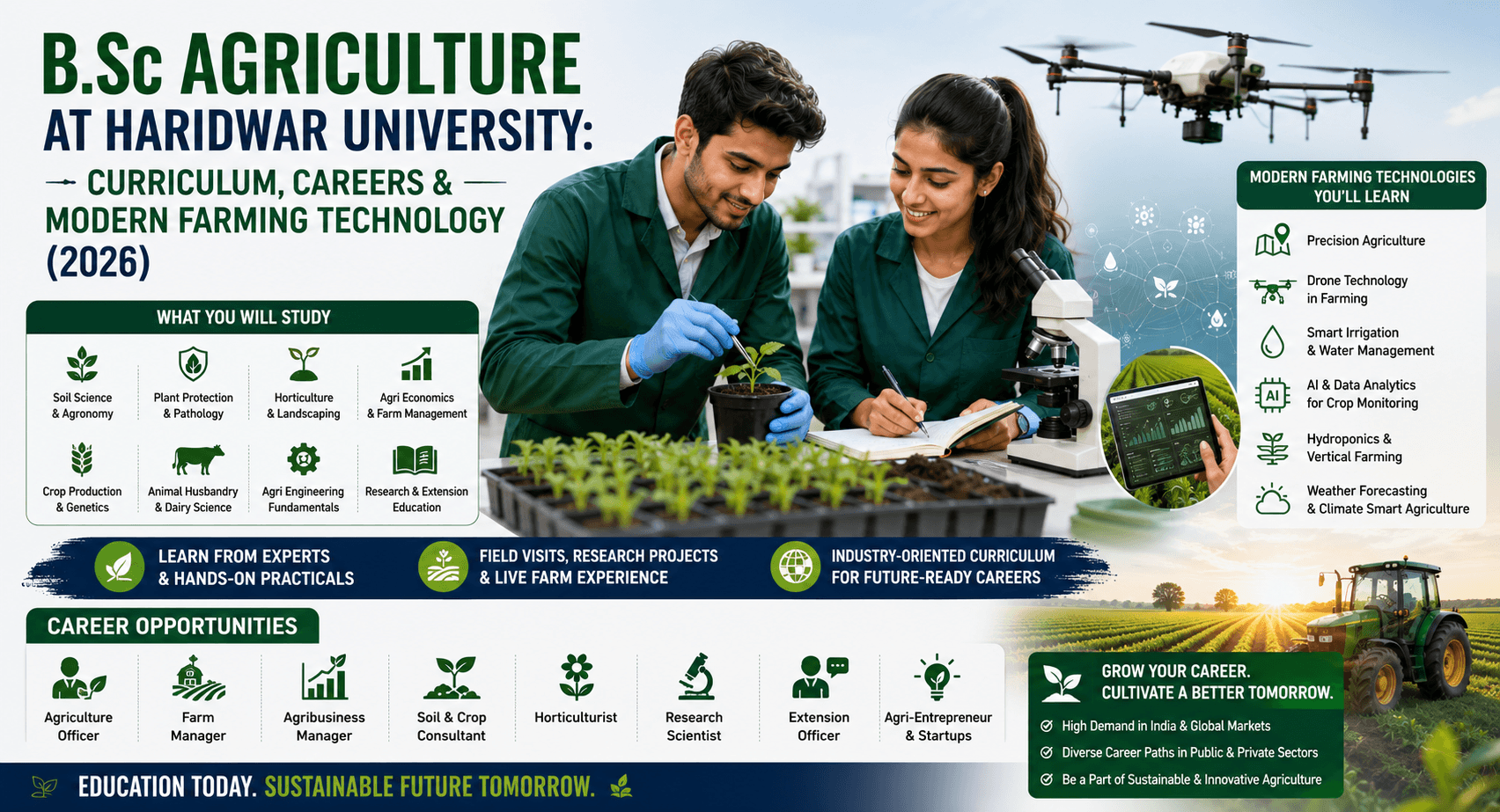
B.Sc Agriculture at Haridwar University: Curriculum, Careers & Modern Farming Technology (2026)
Dr. Roshan Kumar Thakur
Head, Roorkee College of Agricultural Sciences, Haridwar University
Table of Contents
- At a Glance: B.Sc. (Hons.) Agriculture with AI
- Eligibility & Fee Details
- Why B.Sc. Agriculture Is Relevant in 2026
- What Students Learn During Four Years of B.Sc. Agriculture
- Modern Farming Technologies Included in the Programme
- Learning Beyond the Classroom
- Career Opportunities After B.Sc. Agriculture
- Higher Studies After B.Sc. Agriculture
- Building Skills Beyond the Classroom
- Admission Process & How to Apply
- Frequently Asked Questions (FAQs)
Agriculture is becoming increasingly technology-driven. Artificial intelligence, precision farming, drone-based crop monitoring, GIS mapping, IoT-enabled sensors, and data-driven decision-making are transforming how crops are cultivated, monitored, and managed. As India's agriculture sector adopts these innovations, graduates are expected to combine strong agricultural fundamentals with the ability to work alongside modern technologies.
Choosing a B.Sc. Agriculture programme today is therefore about more than learning crop production or soil management. Students should evaluate how a programme prepares them for government services, agribusiness, research, sustainable farming, and technology-enabled agriculture while building practical skills that remain relevant as the industry evolves.
Haridwar University's B.Sc. (Hons.) Agriculture with AI is designed with this objective in mind. Along with core agricultural sciences, the programme introduces students to emerging areas such as precision farming, AgriTech applications, artificial intelligence, and practical field-based learning, helping them understand how technology is reshaping modern agriculture.
At a Glance: B.Sc. (Hons.) Agriculture with AI at Haridwar University
* Certain research and scientist positions generally require postgraduate qualifications and/or relevant competitive examinations.
Eligibility & Fee Details
Eligibility Criteria
Fee Structure
Why B.Sc. Agriculture Is Relevant in 2026
India's agriculture sector is rapidly expanding beyond traditional farming. Precision agriculture, climate-smart cultivation, digital advisory services, food processing, agricultural startups, and government initiatives promoting smart farming are creating opportunities for graduates who understand both agricultural science and modern technology.
A well-designed B.Sc. Agriculture programme should therefore prepare students not only to improve agricultural productivity but also to solve real-world challenges across agribusiness, research, sustainability, food systems, and rural development.
What Students Learn During Four Years of B.Sc. Agriculture
A strong agriculture programme should build knowledge progressively, allowing students to move from scientific fundamentals to practical farm management and technology-enabled agriculture. Rather than treating classroom learning and field experience separately, the curriculum is designed to connect theory with real agricultural practices.
At Haridwar University, the B.Sc. (Hons.) Agriculture with AI programme follows this progression through classroom instruction, laboratory work, field demonstrations, and practical exposure.
This gradual progression helps students understand not only how crops are cultivated but also how scientific research, technology, business management, and policy influence modern agriculture.
Modern Farming Technologies Included in the Programme
Agriculture is increasingly supported by digital technologies that improve productivity while reducing resource consumption. Understanding these technologies enables graduates to contribute to farms, agribusinesses, research organisations, and government initiatives promoting sustainable agriculture.
Some of the technology-driven areas introduced during the programme include:
- Precision Farming: Optimising irrigation, fertiliser application, and crop monitoring using data-driven practices.
- Artificial Intelligence Applications: Analysing crop health, predicting disease outbreaks, and supporting agricultural decision-making.
- Drone Technology: Crop surveillance, field mapping, and precision spraying in large agricultural areas.
- GIS and Digital Mapping: Understanding soil conditions, land utilisation, and farm planning.
- Sustainable Agriculture Practices: Improving productivity while supporting environmental conservation and efficient resource management.
These technologies do not replace agricultural science. Instead, they strengthen traditional farming knowledge by helping farmers make faster, more informed decisions based on accurate field data.
Related Read: Similar technology-driven changes are also transforming healthcare and pharmaceutical sciences. Students interested in understanding how artificial intelligence is being applied beyond agriculture can explore AI in Pharmacy: How Artificial Intelligence is Transforming Drug Discovery & Patient Care (2026).
Learning Beyond the Classroom
Agriculture is a practice-oriented discipline where field experience remains essential. Along with classroom teaching, students participate in practical laboratories, crop demonstrations, farm visits, and hands-on learning activities that develop observation, analytical thinking, and problem-solving skills.
This balance between scientific concepts and practical application prepares graduates to adapt to both conventional farming environments and technology-driven agricultural organisations.
Career Opportunities After B.Sc. Agriculture
A B.Sc. Agriculture graduate today can build a career across government departments, agribusiness companies, food processing industries, research organisations, financial institutions, and rapidly growing AgriTech startups. The growing adoption of precision farming, digital agriculture, and sustainable food production has further expanded opportunities beyond conventional farming roles.
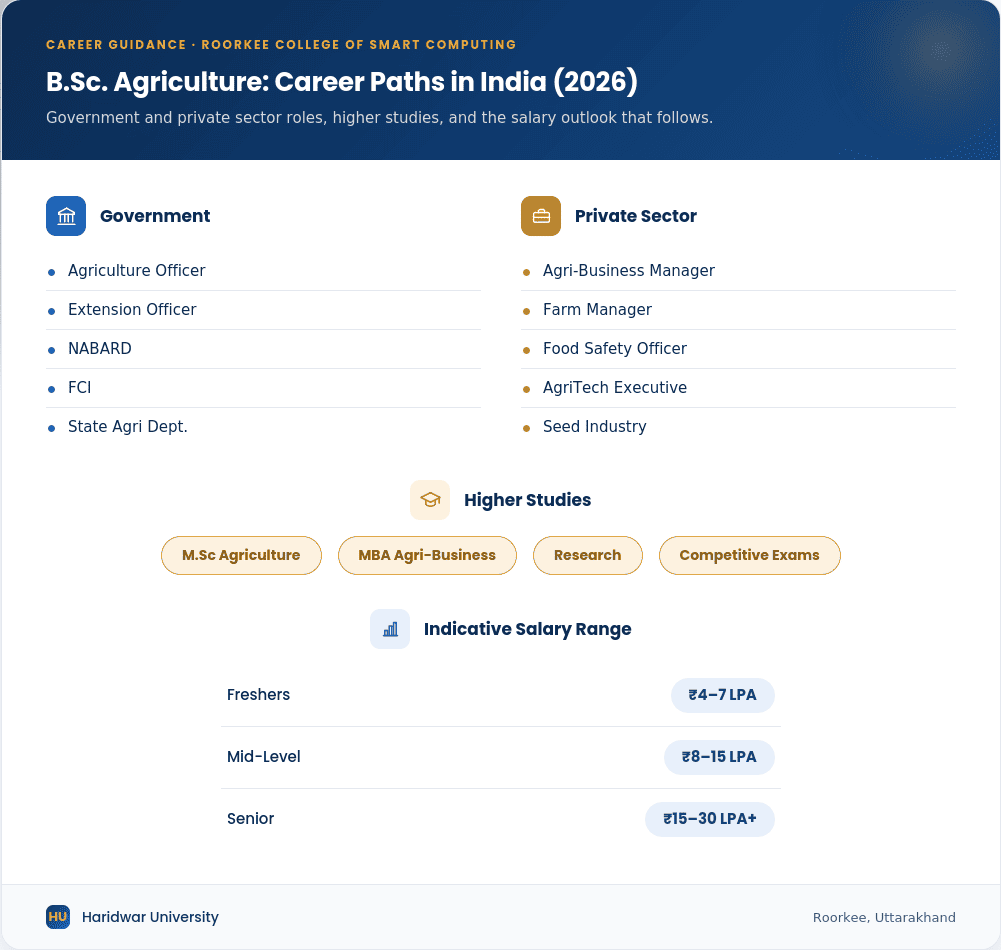
Career Opportunities After B.Sc. Agriculture: Government, AgriTech & Industry Roles (2026)
Popular Career Roles & Salary Outlook (2026)
Note: Research scientist positions generally require postgraduate qualifications and relevant competitive examinations.
Government Career Opportunities
For students interested in public service, agriculture offers a wide range of government career pathways.
Government positions often provide structured career progression, professional development, and opportunities to contribute directly to agricultural productivity and rural development.
Organisations such as NABARD (Careers & Rural Development) regularly recruit professionals for rural development, agricultural finance, and allied functions through competitive recruitment processes.
Private Sector & AgriTech Growth
Private-sector opportunities have expanded significantly over the past decade as agriculture becomes more technology-oriented. Graduates today work with seed companies, food processing organisations, AgriTech startups, precision farming firms, fertiliser manufacturers, agricultural consulting companies, and export businesses.
Professionals who combine agricultural knowledge with digital skills, data analysis, and farm management practices are increasingly valued as the industry adopts automation, artificial intelligence, and sustainable farming technologies.
Higher Studies After B.Sc. Agriculture
Graduates who wish to specialise further or pursue research can continue their education in several disciplines depending on their career goals. Some popular options include:
Students planning to continue their education after graduation can pursue programmes such as M.Sc. Agriculture (Agronomy), or research-oriented postgraduate studies depending on their career goals.
Guide Resource: Those comparing postgraduate options across different disciplines may also find Postgraduate Programmes at Haridwar University: The Complete 2026 Guide useful while planning their next academic step.
Building Skills Beyond the Classroom
Success in agriculture increasingly depends on combining scientific knowledge with practical problem-solving. Alongside academic learning, students are encouraged to develop communication, analytical thinking, digital literacy, and field-based decision-making skills through practical activities, internships, industry interaction, and project work.
Exposure to modern farming practices, emerging agricultural technologies, and real-world production challenges helps graduates adapt to changing industry requirements while preparing them for careers across government organisations, agribusiness companies, research institutions, and AgriTech enterprises.
Admission Process & How to Apply
Admission to B.Sc. Agriculture (Hons.) with AI is conducted according to the university's admission guidelines and may include HUAET (Haridwar University Admission Entrance Test) along with other applicable entrance examinations or merit-based admission criteria for the respective admission cycle.
Apply for B.Sc. Agriculture at Haridwar University
Students seeking a programme that combines agricultural sciences with practical field learning and modern farming technologies can explore B.Sc. Agriculture (Hons.) with AI at Haridwar University.
For complete information about the curriculum, admission process, fee structure, eligibility, and programme highlights, explore our resources or connect with admissions.
Frequently Asked Questions (FAQs)
1. What is the duration of B.Sc. Agriculture at Haridwar University?
The programme is a four-year undergraduate degree (eight semesters) designed to combine agricultural sciences with practical learning and emerging technologies.
2. What is the eligibility for B.Sc. Agriculture at Haridwar University?
Candidates should have completed 10+2 (Science) with Biology from a recognised board with the minimum qualifying marks prescribed by the university for the admission session (minimum 50%).
3. Does the programme include Artificial Intelligence?
Yes. The programme is offered as B.Sc. Agriculture (Hons.) with AI, introducing students to areas such as precision farming, AgriTech applications, and AI-enabled agricultural practices alongside core agricultural sciences.
4. What are the career opportunities after B.Sc. Agriculture?
Graduates can pursue careers in agribusiness, AgriTech companies, food processing, quality assurance, government departments, agricultural consulting, research, and rural development organisations.
5. Can I apply for government jobs after completing B.Sc. Agriculture?
Yes. Graduates may become eligible for various government opportunities, including positions in State Agriculture Departments, NABARD, FCI, public sector banks (IBPS SO), and other organisations, subject to recruitment notifications and eligibility requirements.
6. What is the average salary after B.Sc. Agriculture?
Fresh graduates generally begin with salaries ranging between ₹4–7 LPA, while experienced professionals can earn significantly more depending on their role, employer, qualifications, and experience.
7. Can I pursue higher studies after B.Sc. Agriculture?
Yes. Many graduates continue with M.Sc. Agriculture, MBA (Agri-Business), research programmes, or other specialised postgraduate courses depending on their career goals.
8. Is B.Sc. Agriculture a good career choice in 2026?
With increasing adoption of precision farming, AgriTech, food processing, and sustainable agriculture, graduates with strong scientific knowledge and practical skills continue to find opportunities across both government and private sectors.