

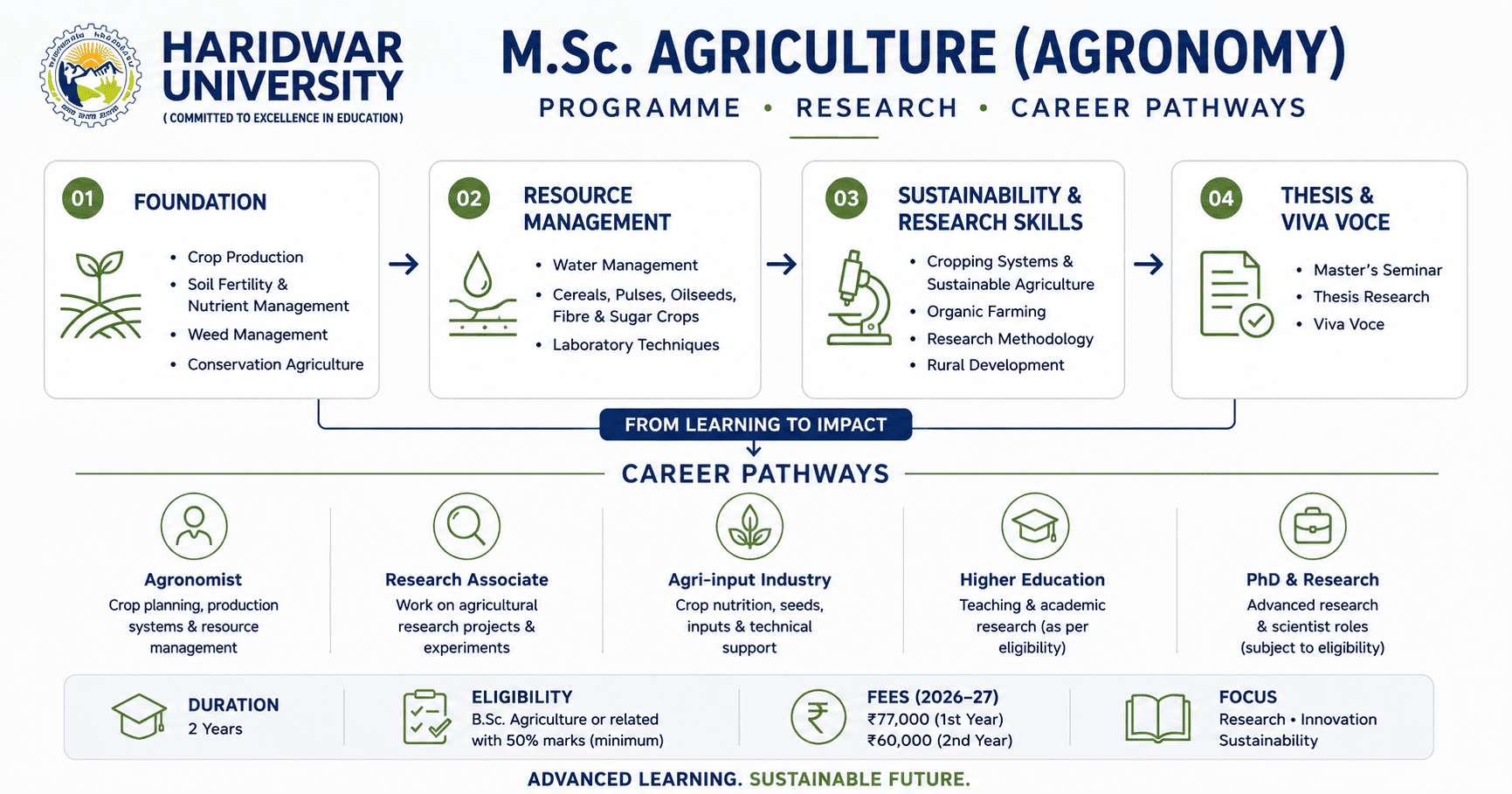
Agronomy sits at the centre of one of agriculture's most practical questions: how can crops be produced efficiently while managing soil, water and other natural resources sustainably? At Haridwar University, the M.Sc. Agriculture (Agronomy) programme approaches that question through advanced crop production, soil-plant-water management, sustainable agriculture and rigorous scientific research. The two-year postgraduate programme combines classroom learning with field experiments, practical laboratory training and thesis-based research.
For students moving from a B.Sc. Agriculture into postgraduate study, this distinction matters. An M.Sc. in Agronomy is not simply another qualification in agriculture. It is an opportunity to specialise in crop production systems and develop the research skills needed to study and solve real agricultural challenges.
Table of Contents
1. What Is Agronomy and Why Does It Matter?
2. M.Sc. Agriculture (Agronomy) Curriculum at HU
3. How Research and Field Learning Fit Into the Programme
4. What Research Areas Can Students Explore?
5. Career Options After M.Sc. Agriculture (Agronomy)
6. Salary Outlook for Agronomy Careers
7. Eligibility and Fees for M.Sc. Agriculture (Agronomy) at HU
8. How M.Sc. Agronomy Builds on B.Sc. Agriculture
9. Why Choose M.Sc. Agriculture (Agronomy) at HU?
1. What Is Agronomy and Why Does It Matter?
Agronomy focuses on the scientific management of crops, soils and production systems. At the postgraduate level, this involves questions around crop productivity, nutrient and water management, weed control, conservation agriculture, cropping systems and sustainable production.
| Core Area | Programme Focus |
|---|---|
| Crop Production | Modern crop production techniques and yield optimization |
| Soil Science | Soil fertility, integrated nutrient management and soil microbiology |
| Water Management | Principles and practices of water conservation and precision irrigation |
| Weed Management | Weed ecology, integrated herbicide management and biological control |
| Cropping Systems | Sustainable agriculture, crop diversification and conservation farming |
| Organic Agriculture | Principles, certification standards and practices of organic farming |
| Research | Literature review, experimental design, methodology, thesis and viva voce |
| Laboratory Work | Advanced soil-plant testing and analytical laboratory techniques |
The Indian Council of Agricultural Research (ICAR)'s Agricultural Education Division works to strengthen higher agricultural education and human-resource development across agricultural sciences in India. Agronomy is represented as a core postgraduate and doctoral discipline within the ICAR research and education ecosystem. That wider context makes Agronomy relevant not only to farm production, but also to agricultural research, resource management and technology-led modern farming.
2. M.Sc. Agriculture (Agronomy) Curriculum at HU
The four-semester structure moves systematically from core crop and resource-management concepts towards independent field research.
Semester 1: Foundation (21 Credits)
Modern Concepts in Crop Production, Soil Fertility & Nutrient Management, Weed Management, Conservation Agriculture, Technical Writing & Communication Skills, and early Thesis Literature Review.
Semester 2: Management (25 Credits)
Water Management, Agronomy of Major Cereals & Pulses, Agronomy of Oilseed, Fibre & Sugar Crops, Laboratory Analytical Techniques, Genetics, and Continued Literature Review.
Semester 3: Sustainability (25 Credits)
Cropping Systems & Sustainable Agriculture, Organic Farming, Agriculture Research Ethics, Rural Development Programmes, and Thesis Research (Methodology).
Semester 4: Thesis & Viva (11 Credits)
Dedicated research completion: Master's Seminar followed by independent Thesis Research & final Viva Voce examination.
Academic Progression: Learn the production system → Understand resource management → Develop research methodology → Complete independent thesis work.
3. How Research and Field Learning Fit Into the Programme
The programme's research component begins early rather than being left entirely to the final semester. HU lists field experiments, practical training, thesis-based research, research methodology and statistical analysis among the core programme features.
HU's Roorkee College of Agricultural Sciences features dedicated experimental farms, field research stations and modern laboratories supporting continuous agricultural trials and hands-on training.
The Agronomy Thesis Research Pathway
Literature Review → Research Methodology → Thesis Fieldwork → Master's Seminar → Viva Voce
4. What Research Areas Can Students Explore?
The curriculum provides several diverse directions for academic and applied research projects:
5. Career Options After M.Sc. Agriculture (Agronomy)
An Agronomy postgraduate can build a rewarding career across farm management, agricultural inputs, scientific research and higher education:
| Career Direction | Typical Work Area |
|---|---|
| Agronomist | Crop planning, commercial farm production and resource management |
| Research Associate | Agricultural research projects, trials and experimental analysis |
| Agri-Input Specialist | Crop nutrition, seed development, farm chemicals and technical advisory |
| Agricultural Field Specialist | Field-level crop agronomy and farm advisory operations |
| Research / Technical Executive | Private and public agricultural research and development programmes |
| Higher Education / Academia | Teaching and university research, subject to required qualifications (NET) |
| PhD Researcher | Advanced doctoral research in Agronomy or related plant sciences |
The career pathway expands with further research qualifications. The Agricultural Scientists Recruitment Board (ASRB) conducts examinations including the Agricultural Research Service (ARS) and National Eligibility Test (NET), qualifying candidates for scientist and assistant professorship positions in ICAR institutes and state agricultural universities.
6. Salary Outlook for Agronomy Careers
Salary varies significantly by employer, geographic location, experience level, job profile and qualification. As an industry-wide reference, AmbitionBox's 2025 market data reports an overall ₹2 lakh – ₹10 lakh annual salary range for Agronomists in India:
| Experience Level | Indicative Agronomist Salary (AmbitionBox) |
|---|---|
| Fresher | ₹1.8 – ₹6.0 LPA |
| Around 2 Years | ₹2.0 – ₹6.5 LPA |
| Around 3 Years | ₹2.6 – ₹8.0 LPA |
| Experienced | Up to ₹10 LPA+ (depending on industry and role) |
Note:These figures are indicative occupation-level salary ranges reported by AmbitionBox, not salary brackets specifically guaranteed for M.Sc. Agronomy graduates. Actual compensation can vary according to employer, role, experience, location and qualifications.
7. Eligibility and Fees for M.Sc. Agriculture (Agronomy) at HU
HU's current programme information specifies the following admission criteria and fee schedule:
| Admission Factor | HU Requirement / Detail |
|---|---|
| Programme Duration | 2 years (4 semesters) |
| Academic Qualification | Bachelor's degree in Agriculture or related agricultural field from a recognised university |
| Minimum Marks | 50% aggregate or equivalent CGPA |
| Admission Mode | State Agricultural Entrance Examination or merit as per university guidelines |
| 1st-Year Fee | ₹77,000 |
| 2nd-Year Fee | ₹60,000 |
8. How M.Sc. Agronomy Builds on B.Sc. Agriculture
The progression from undergraduate to postgraduate study is straightforward but the academic focus changes.
Students can first build broad agricultural knowledge through a B.Sc. Agriculture programme at Haridwar University and then specialise in Agronomy at postgraduate level.
HU's related guide, B.Sc. Agriculture at Haridwar University: Curriculum, Careers & Modern Farming Technology (2026), covers the undergraduate foundation, while Career Options After B.Sc. Agriculture From Haridwar University: 10 Modern Roles (2026) explores career directions after graduation.
9. Why Choose M.Sc. Agriculture (Agronomy) at HU?
The programme brings together crop production, soil and water management, sustainability and research within a two-year postgraduate structure. Its strongest feature is the coherent research progression — students encounter literature review in Year 1, methodology in Semester 3, and dedicated thesis fieldwork and viva voce in Semester 4.
The wider Roorkee College of Agricultural Sciences ecosystem provides access to experimental agricultural lands, modern research labs, and close mentoring by experienced agricultural faculty.
10. Frequently Asked Questions (FAQs)
Q1: Is M.Sc. Agriculture (Agronomy) a two-year course?
Yes. The M.Sc. Agriculture (Agronomy) programme at HU is structured across four semesters over two academic years.
Q2: What does Agronomy cover?
Agronomy covers scientific crop production and management, including soil fertility, nutrient management, water management, weed control, cropping systems, conservation agriculture and sustainable farming practices.
Q3: What is the eligibility for M.Sc. Agriculture (Agronomy) at HU?
Applicants need a bachelor's degree in Agriculture or a related agricultural field from a recognised university, with at least 50% marks or equivalent CGPA as specified by HU.
Q4: Does the programme include thesis research?
Yes. The curriculum includes thesis literature review, research methodology, experimental fieldwork, a Master's seminar and final thesis viva voce.
Q5: Is there practical or field-based training?
Yes. HU lists field experiments and practical training among the programme features, while the agriculture college maintains experimental farms, field stations and laboratories for ongoing research.
Q6: Can M.Sc. Agronomy graduates pursue a PhD?
Yes. Agronomy is an established postgraduate and doctoral discipline in the ICAR and national agricultural research ecosystem. Graduates can apply for doctoral admissions subject to entrance norms.
Q7: Can M.Sc. Agronomy lead to ARS or NET?
Yes, it forms the core academic pathway for agricultural research and teaching examinations conducted by the Agricultural Scientists Recruitment Board (ASRB), subject to current notification criteria.
Q8: What is the salary after M.Sc. Agriculture (Agronomy)?
As an occupation-level benchmark, AmbitionBox reports ₹2–10 lakh per year for Agronomists in India based on 2025 market data. Actual remuneration depends on role, employer, experience and location.
Q9: What is the fee for M.Sc. Agriculture (Agronomy) at HU?
The current HU fee schedule lists ₹77,000 for the first year and ₹60,000 for the second year (total ₹1,37,000 for the full 2-year programme).
11. Building a Research-Oriented Career in Agronomy
Agronomy brings together crop science, soil and water management, sustainability and research. At Haridwar University, that combination is reflected directly in the curriculum, from modern crop production and conservation agriculture to thesis methodology and final research. For students seeking postgraduate agricultural education with a clear research component, the programme offers a focused route to advanced expertise.
Advance Your Agricultural Career with M.Sc. Agronomy
Join Roorkee College of Agricultural Sciences at Haridwar University. Explore experimental research, sustainable farming systems, and career pathways.