

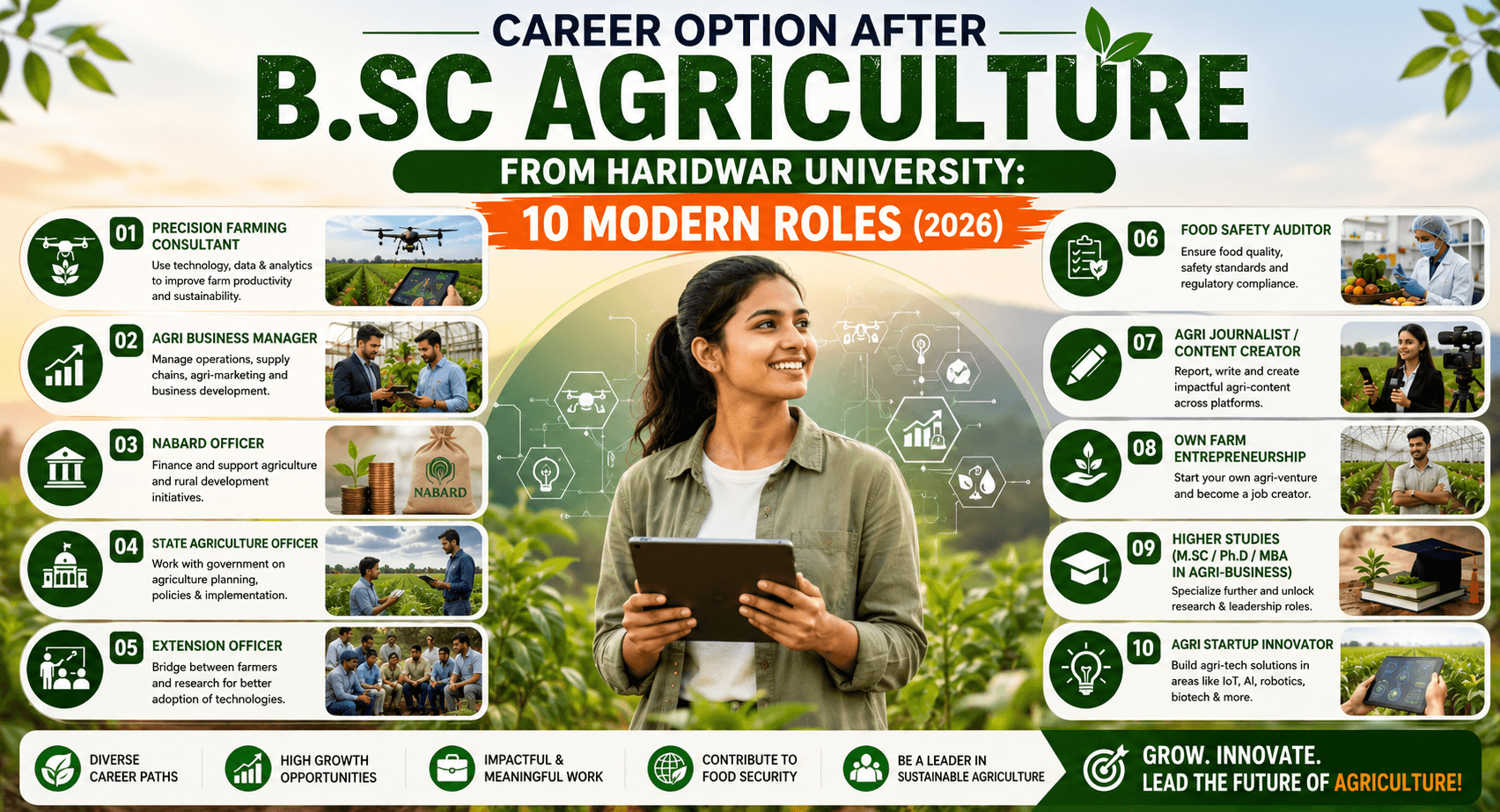
Career Option After B.Sc Agriculture From Haridwar University: 10 Modern Roles (2026)
Dr. Roshan Kumar Thakur
HOD, Agriculture Sciences, Haridwar University
Table of Contents
Every June, right after board and entrance results come out, I get more or less the same phone call in my office. A worried parent wants to know whether a B.Sc Agriculture degree is still “worth it,” and I've stopped giving them a one-line answer, because there isn't one. Fifteen years ago, if you'd asked anyone about Career After B.sc Agriculture Haridwar University options, they'd have named two paths: prepare for a state PSC exam, or teach at a local school while you kept attempting it. Both are still valid, but they're no longer the whole picture.
What's actually changed is the range of organisations willing to hire straight out of an agriculture college. Tractor and farm-equipment companies run full agronomy teams now. Supply-chain start-ups need people who can judge the quality of a tomato at four in the morning inside a collection centre. Food companies need auditors who understand microbiology as comfortably as they understand a compliance checklist. None of this existed in quite the same form when I was a student, and very little of it shows up in the generic “top 10 jobs” lists that circulate online.
This article tries to close that gap. Instead of recycling generic advice, it walks through the roles our own students at Roorkee College of Agricultural Sciences have actually gone into over recent placement cycles, roughly what each one pays, and where the traditional government route still makes sense in 2026. If you're a student weighing your options, read it end to end; if you already know what you're curious about, the contents list below will take you straight there.
10 Modern Career Paths After B.Sc Agriculture
The old choice between a school teaching post and a bank probationary officer exam doesn't hold anymore. If you're mapping out Career After B.sc Agriculture Haridwar University options seriously, here's where our graduates are genuinely landing jobs in 2026, based on placement data and what recent batches have told us after joining.
1. Agri-Tech Companies
The clearest shift over the last five years is how comfortable equipment and agri-supply-chain companies have become hiring straight out of a B.Sc Agriculture programme, instead of insisting on an MBA or an engineering degree first. Three employer names come up again and again when our final-year students discuss where they've applied, and it's worth looking at each one separately because the actual day-to-day work differs quite a bit. Our placement records from the last three cycles show a steady rise in offers from exactly this segment.
John Deere India
John Deere doesn't just want someone who can operate a tractor - it wants graduates who can sit across from a farmer, work out why yield dropped on a particular plot, and explain how a specific machine or attachment solves that exact problem. New hires usually start in territory sales or agronomy support, spend a good chunk of the first year travelling between dealer locations, and get trained internally on precision-ag tools most colleges simply don't have access to. It's demanding - long travel days, farmer meetings that run past sunset - but the technical exposure is hard to match anywhere else this early in a career.
Mahindra Agri
Mahindra's agribusiness arm spans seeds, farm equipment, and increasingly micro-irrigation and fresh-produce retail. What they look for isn't a specific skill so much as an attitude: someone who isn't precious about switching from a dealer meeting in the morning to a field demonstration by afternoon. Graduates who've done well here tend to be comfortable with a bit of chaos, since schedules shift constantly with the crop calendar, and they can hold a conversation with both a distributor and a smallholder farmer without changing their vocabulary too much.
NinjaCart
NinjaCart and similar farm-to-retail platforms are a slightly different animal. The work is mostly procurement and quality control - inspecting produce at collection centres, deciding what won't survive a long haul, coordinating with drivers and warehouse staff under real time pressure. It's less glamorous than the phrase “agri-tech” suggests, and peak-season hours can be brutal, but for a fresh graduate it's an unusually fast way to actually see how farm produce reaches a city - something the B.Sc Agriculture curriculum at Roorkee College of Agricultural Sciences tries to prepare students for through its supply-chain and post-harvest management modules, though nothing quite matches doing it live.
2. Agri Business Manager
Somewhere between the field and the boardroom sits the agri business manager - a role that seed companies, fertiliser manufacturers, and food-processing firms all need but rarely advertise clearly on campus. The job is part negotiation and part planning: estimating how much seed a district will need next season, managing dealers who've often been in the trade longer than the manager has been alive, and translating scattered farmer feedback into something a product team can actually act on. It suits graduates who did reasonably well in agricultural economics and extension courses but never wanted to be in a lab every single day. One of our recent alumni now manages a district territory for a fertiliser company and says the biggest adjustment wasn't the agriculture knowledge at all - it was learning to read a balance sheet. Pay tends to track fairly closely with sales performance in this role, which some people love and others find stressful; it's worth being honest with yourself about which camp you're in before you choose this path.
3. NABARD Officer
The National Bank for Agriculture and Rural Development recruits agriculture graduates as Assistant Managers through its Grade A examination, and it remains one of the most competitive - and most respected - government routes open to this degree. Officers end up working on rural credit planning, watershed development projects, and support for farmer-producer organisations, which means the job is far more varied than the word “bank” usually implies. The exam itself is tough; it typically draws lakhs of applicants for a few hundred seats, so most students who clear it have spent a full year or more preparing alongside their final semester. Current notifications, eligibility criteria, and exam pattern are published on the official NABARD website, and it's worth checking that page directly rather than relying on coaching-centre summaries, since eligibility details do change from one cycle to the next.
4. State Agriculture Officer
State agriculture departments recruit officers through their respective public service commissions to oversee input distribution, crop insurance enrolment, and district-level advisory work. It remains one of the steadier government routes for B.Sc Agriculture graduates, and it's particularly relevant in hill states like Uttarakhand, where extension staff are chronically in short supply and postings often come with real responsibility fairly early on. The trade-off is pace - promotions and pay revisions move on a government timetable, not a corporate one - but for graduates who want stability and a role that keeps them close to actual farming communities, this is usually the first exam they prepare for after graduation.
5. Extension Officer
Extension officers are the bridge between agricultural research and what actually happens on a farmer's field - running demonstration plots, organising training sessions, and making sure government scheme benefits reach the people they're meant for instead of getting lost in paperwork. Krishi Vigyan Kendras and state agriculture departments are the main recruiters here. It's not a desk job by any stretch; expect to spend a large share of your week travelling between villages, which some graduates find exhausting and others describe as the most satisfying part of the work, since you can see the direct effect of what you're doing.
6. Precision Farming Consultant
Precision farming consultants advise larger farm operations, farmer-producer organisations, and agri-tech companies on soil sensors, drone-based crop monitoring, and variable-rate input application - essentially helping a farm use data instead of habit to decide what, when, and how much to apply. It's a newer role and the job titles aren't always standardised yet, but demand is growing quickly as Indian farms scale up and consolidate. Students who take an early interest in this area usually pair their core agriculture coursework with short certificate programmes in GIS or remote sensing, since that combination is exactly what employers in this space are struggling to find enough of right now.
7. Food Safety Auditor
Food safety auditors inspect processing units, cold-storage facilities, and packaging lines to confirm they meet national food-safety standards, and demand for this role has grown noticeably as more food companies chase export contracts that require formal certification. Graduates typically work either with third-party certification bodies or directly inside a food company's quality team, and the standards they're auditing against are set and published by the Food Safety and Standards Authority of India (FSSAI). It's detail-heavy work - a large part of the job is documentation, not just physical inspection - so students who enjoyed the microbiology and food-processing components of their degree tend to adapt to it faster than those who were mainly drawn to fieldwork.
8. Agri Journalist / Content Creator
Farm-focused digital publications, agri-tech YouTube channels, and government outreach cells now hire agriculture graduates specifically to translate research and policy into content that farmers can actually use and act on. Subject knowledge matters more here than a formal journalism degree does, which is exactly why agriculture graduates are increasingly the ones getting picked for these roles over trained journalists who don't know the difference between a nutrient deficiency and a fungal infection. A handful of our own students write occasional explainer pieces for the university's own outreach channels while still on campus, which turns out to be genuinely useful groundwork if this is a direction that interests you - it's worth starting before you graduate rather than after.
9. Own Farm Entrepreneurship
Not every graduate wants a payslip, and a growing number are starting their own ventures instead - protected cultivation units, organic input businesses, mushroom cultivation, or small dairy enterprises, often backed by NABARD refinance schemes or state horticulture subsidies rather than personal savings alone. The degree gives you the technical grounding to make reasonable decisions about crop choice, input use, and post-harvest handling; the entrepreneurship itself comes from execution, and honestly, from tolerance for risk. I'd be doing prospective students a disservice if I didn't say this plainly: several ventures fail in the first two years, usually over cash-flow timing rather than technical mistakes, so anyone considering this route should talk to at least two or three people who've actually done it before committing their own capital.
10. Higher Studies: M.Sc, Ph.D., MBA in Agri-Business
For students who want to specialise further, or move into research, teaching, or corporate agribusiness leadership, postgraduate study is the natural next step, and it's one a meaningful share of our graduating batch chooses every year instead of jumping straight into a job.
M.Sc in Agriculture (Agronomy and Allied Fields)
An M.Sc opens doors to research positions, ICAR-linked institutes, and teaching roles at agriculture colleges. It's also the more common route for students who want to appear for the ICAR-JRF or similar research entrance exams later on.
Ph.D. in Agriculture
A doctorate is generally the entry point for university faculty positions and senior research scientist roles within India's agricultural research network. It's a longer commitment - typically three to five years - and makes the most sense for students who already know they want to end up in academia or a research institute rather than industry.
MBA in Agri-Business
An MBA with an agribusiness specialisation targets management roles in agri-input companies, food processing firms, or commodity trading desks. Compared to a general MBA, the agribusiness track tends to place graduates faster into roles that actually use their original agriculture background, instead of treating it as irrelevant background information.
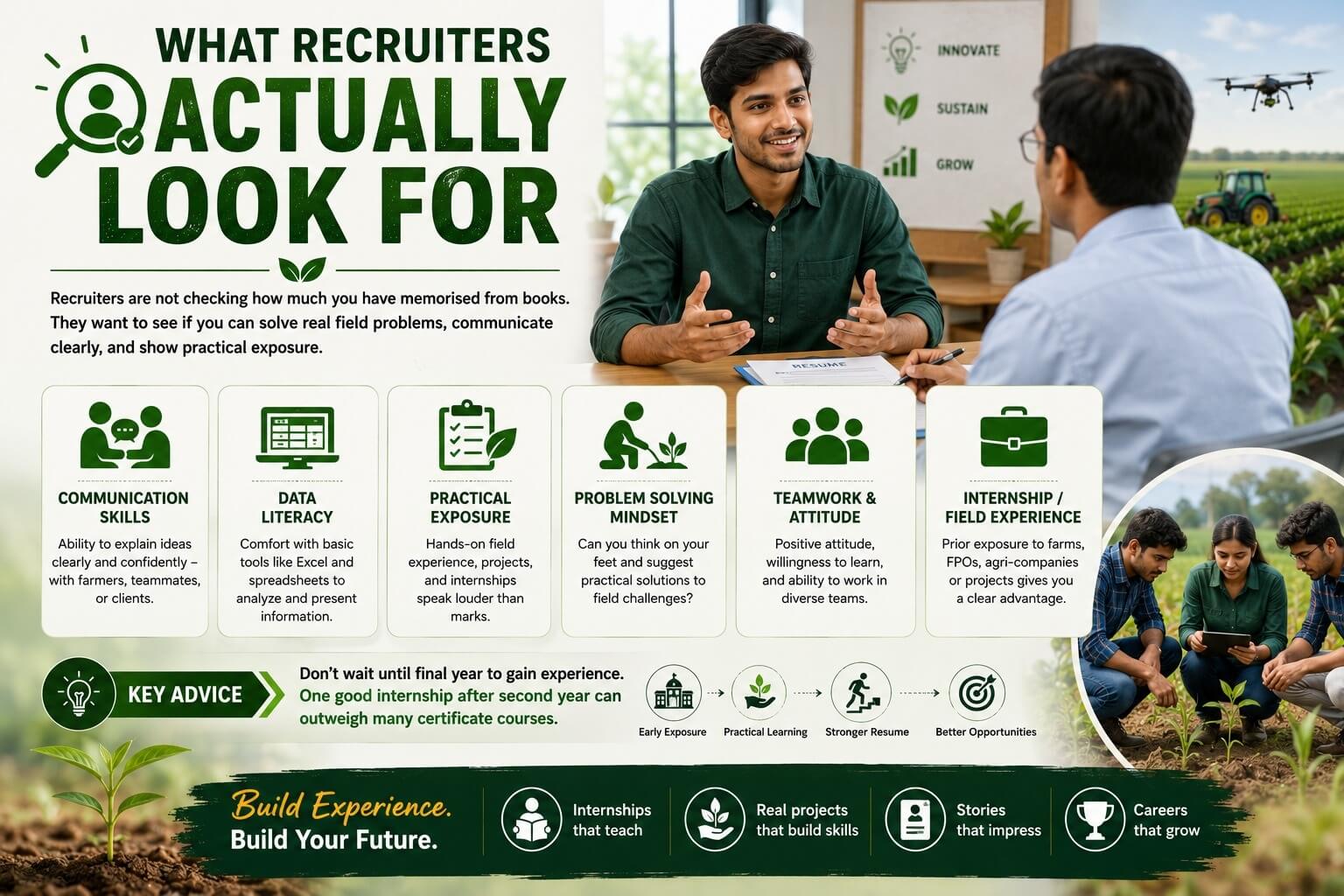
What Recruiters Actually Look For
Having sat in on placement interviews for several years now, I can say the pattern is fairly consistent across every company that visits campus - agri-tech, government-adjacent, or corporate. Recruiters are rarely testing whether a student has memorised textbook content; they're testing whether a student can hold a practical conversation about a real field problem without freezing up. Communication skills, comfort with basic data tools like spreadsheets, and any prior internship or fieldwork experience tend to matter more than the final percentage on a mark sheet. Students who've done a summer internship at an FPO, a seed company, or even a small local farm almost always interview better, simply because they have real anecdotes to draw on instead of textbook answers.
If there's one piece of advice I repeat every placement season, it's this: don't wait until final year to build that experience. A single well-chosen internship after second year does more for a resume than another certificate course ever will.
Salary Ranges Per Role
One question I get almost as often as “which job should I take” is “what will it actually pay,” so here's a straight answer. Pay varies by location, company size, and whether a role sits inside government or private industry, but the ranges below reflect what recent graduates and mid-career professionals in these Career After B.sc Agriculture Haridwar University roles are broadly earning in 2026, based on offer letters our placement cell has tracked and inputs from alumni currently working in each field.
These figures are indicative industry estimates and will vary by state, employer, and individual negotiation - treat them as a starting reference point, not a guarantee.
Government Job Options Explained
For a lot of families I speak with, Career After B.sc Agriculture Haridwar University still means one thing above all - a government post. That instinct isn't wrong, it's just incomplete, because the entry routes differ quite a bit from one another and it helps to understand them separately rather than lumping them together as “govt job.” NABARD Grade A and Grade B posts are filled through a national-level exam; state agriculture and horticulture departments recruit through their respective state public service commissions, with separate notifications for each state; and research-track posts inside ICAR institutes are filled through the Agricultural Scientists Recruitment Board rather than a general civil services route. Details on ICAR-affiliated research and academic opportunities are available directly on the Indian Council of Agricultural Research (ICAR) website, while recruitment notices specifically for research scientist posts are published on the Agricultural Scientists Recruitment Board (ASRB) portal.
Graduates interested in export-oriented agribusiness careers - quality certification, market development, and trade facilitation - can track relevant openings and guidelines through the Agricultural and Processed Food Products Export Development Authority (APEDA), which also publishes broader policy updates, central schemes, and subsidy programmes affecting the sector under the Ministry of Agriculture and Farmers Welfare. My honest suggestion to students preparing for any of these exams is to bookmark the relevant official page directly and check it monthly - far too many students rely on WhatsApp forwards for notification dates and end up missing application windows because of it.
Curious what the B.Sc Agriculture programme at Haridwar University actually covers - subjects, labs, and industry tie-ups?
Checked the fee structure and scholarship slabs and ready to move forward?
Frequently Asked Questions
Q1. Is B.Sc Agriculture a good career choice in 2026?
Yes, and arguably more so than it was a decade ago. Beyond the traditional government track, the sector now genuinely offers openings in agri-tech, food safety auditing, precision farming, and agribusiness management, which has widened the placement pool considerably for recent graduates.
Q2. What is the scope after B.Sc Agriculture from Haridwar University?
Graduates from the programme have gone on to agri-tech companies, state and central government departments, NABARD, food processing firms, and postgraduate study such as an M.Sc, Ph.D., or MBA in Agri-Business - the range has widened noticeably over the last few placement cycles.
Q3. Can B.Sc Agriculture graduates apply for NABARD exams?
Yes. NABARD's Grade A recruitment exam is open to agriculture graduates and remains one of the most sought-after and competitive government routes in this field, so serious preparation typically needs to start well before final year.
Q4. Is a private job or a government job better after B.Sc Agriculture?
It genuinely depends on what you value. Government roles offer stability, defined career progression, and pension benefits, while private agri-tech roles often move faster on salary growth but come with less job security - there's no universally correct answer here.
Q5. Do I need an M.Sc to get a good agriculture job?
Not necessarily. Many agri-tech, food safety, and agribusiness roles hire directly after a B.Sc, though an M.Sc or MBA does help meaningfully if your goal is research, teaching, or a senior management position down the line.
Q6. What is the starting salary after B.Sc Agriculture?
Entry-level salaries generally fall between roughly Rs 3 to Rs 6 lakh per annum depending on the specific role, employer, and location, with agri-tech field roles and NABARD positions typically sitting at the higher end of that range.
Q7. Which companies hire B.Sc Agriculture graduates?
Companies such as John Deere India, Mahindra Agri, and NinjaCart regularly hire agriculture graduates for field, sales, and supply-chain roles, and all three have visited our campus for placements in recent cycles.
Q8. Is Haridwar University's B.Sc Agriculture programme ICAR-aligned?
Yes. The programme at Roorkee College of Agricultural Sciences is designed with ICAR-aligned curriculum elements and includes practical farm training as a core, non-optional component rather than an add-on.
Q9. How can I apply for B.Sc Agriculture at Haridwar University?
Interested students can review eligibility criteria and the current fee structure on the university's admissions page, and submit an application directly through the official apply-now portal linked in this article.
A Closing Note
If you're still weighing your Career After B.sc Agriculture Haridwar University options, my honest advice is to talk to someone who's actually walked one of these paths rather than relying only on articles like this one - including this one. General career openings and internship postings from the university are listed on the HU Careers page, and more admissions and career-planning articles like this one are published regularly on the Haridwar University blog. Whichever path you lean towards, the decision is far easier once you've spoken to two or three people already living it.