

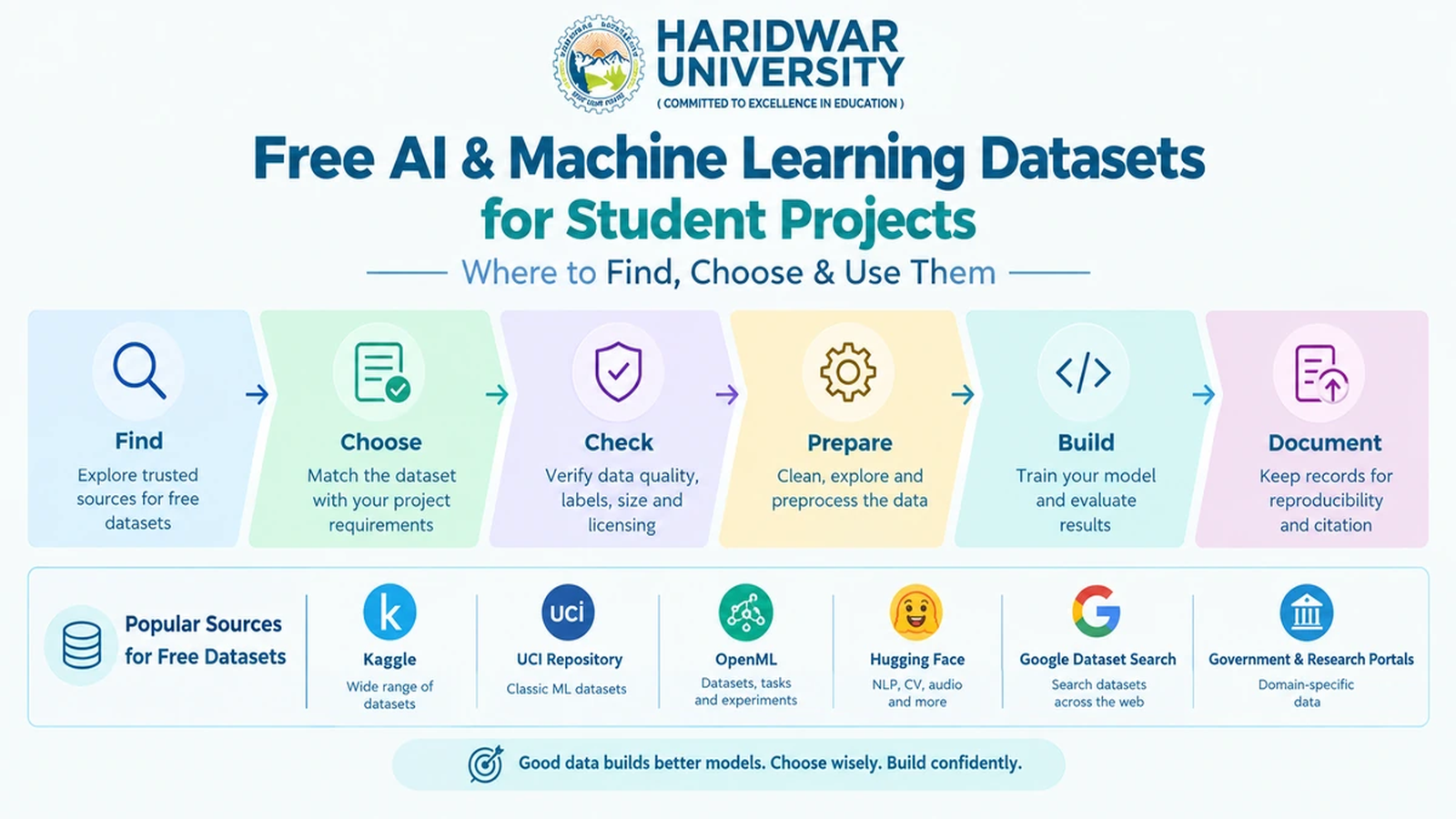
Free AI & Machine Learning Datasets for Student Projects: Where to Find, Choose & Use Them
Dr. Himanshu Verma
Head of CSE, Haridwar University
Roorkee College of Smart Computing | Dataset Selection & Curation Guide
How to find authenticated datasets, match data types to AI tasks, verify licensing, and build leak-free machine learning pipelines.
Finding a dataset is rarely the most difficult part of an artificial intelligence or machine learning project. The truly difficult part is deciding whether the dataset is scientifically valid, ethically licensed, and appropriate for the problem you want to solve.
In my experience reviewing capstone projects in our Department of Computer Science & Engineering, students frequently begin with a dataset simply because it is popular, massive, or easy to download. The problems emerge later: the target variable does not match the proposed model, the data size overwhelms available GPU/RAM memory, labels are noisy and poorly annotated, or the final project report contains no verifiable provenance of where the records originated.
- Problem: What specific, measurable engineering problem does this data support?
- Documentation: Is the schema, unit of measurement, and target definition clearly documented?
- Licensing: Can I legally and academically use, modify, and publish with it under its stated terms?
- Compute Feasibility: Can I train, validate, and evaluate it with my available hardware resources?
- Explainability: Can I transparently explain every transformation, split, and baseline decision?
This comprehensive guide focuses on that decision framework rather than providing another uncurated directory of links. We examine where students can discover authenticated, free AI/ML datasets, how to select between them, what to audit before downloading, and how to execute a leak-free, reproducible machine learning workflow.
Table of Contents
1. Where Students Can Find Free AI and Machine Learning Datasets
2. Choose the Dataset After Defining the Project Problem
3. Match Dataset Type to the AI or ML Task
4. Check Data Quality, Labels, Size and Computing Requirements
5. Verify Dataset Licensing and Record Its Provenance
6. Use a Dataset Through a Reproducible Machine Learning Workflow
7. Turn Dataset Work Into Evidence for a Student Project
8. Common Dataset Mistakes Students Should Avoid
9. Build a Dataset Selection Checklist Before You Start
10. Frequently Asked Questions (FAQs)
11. Make the Dataset Part of the Project & Academic Pathways at HU
1. Where Students Can Find Free AI and Machine Learning Datasets
I strongly urge students to begin with established, authenticated repositories rather than downloading an unexplained CSV file from a random tutorial blog. The right source depends on the project domain:
Kaggle Datasets
Outstanding for exploratory search and community benchmarks. Features robust filtering by task (classification, NLP, vision), file format, license type, and size, with instant in-browser column previews and metadata summaries.
UCI Machine Learning Repository
The gold standard for academic benchmark rigor. Maintains over 689 carefully documented tabular datasets (Iris, Heart Disease, Wine Quality, Bank Marketing) with complete attribute characteristics and academic citations.
OpenML Platform
Essential when reproducibility and benchmarking matter. Provides versioned, meta-tagged datasets with Python/R/Java APIs, exact target variable distributions, and recorded scientific experiment runs.
Hugging Face Datasets
The premier ecosystem for modern NLP, speech/audio, and computer vision. Offers instant programmatic loading, memory-mapped streaming for massive corpora, and direct integration with PyTorch and Transformers.
Google Dataset Search
A specialized search engine across thousands of institutional, government, and university repositories worldwide. Allows filtering by update date, download format, and usage rights.
Government & Research Portals
Open data portals (such as data.gov.in, NASA, WHO, and NIH) provide authoritative, real-world domain data where public policy, environmental telemetry, and healthcare provenance are paramount.
For students exploring project formulation across these data sources, our 20 Machine Learning Projects for Beginners illustrates how datasets connect directly to specific modeling tasks and evaluation protocols.
2. Choose the Dataset After Defining the Project Problem
The single most common mistake in student projects is inverting the engineering workflow:
The dataset must serve the problem statement, not the other way around:
| Project Objective | Machine Learning Task | Specific Dataset Requirement |
|---|---|---|
| Predict whether a bank customer churns | Binary Classification | Tabular customer records with clean ground-truth exit labels. |
| Predict residential property valuation | Regression | Continuous numerical target with physical & geographic features. |
| Group e-commerce shoppers by habits | Clustering (Unsupervised) | RFM transaction features without requiring artificial labels. |
| Detect crop and leaf diseases | Image Classification | High-resolution plant images with verified agronomic class annotations. |
| Classify review sentiment (positive/negative) | NLP Text Classification | Text strings with validated polar or fine-grained sentiment annotations. |
| Forecast energy grid consumption | Time Series Forecasting | Consecutive timestamped observations with non-leaking chronological splits. |
| Detect vehicles in traffic video feeds | Object Detection | Images with bounding-box coordinates (YOLO/COCO format). |
| Answer inquiries from institutional policies | Retrieval / RAG | Approved source text documents and ground-truth QA evaluation pairs. |
This problem-first methodology aligns with the standards outlined in our 25 Final-Year Project Ideas for CSE & AI/ML Students, ensuring student capstone submissions are academically defensible and technically focused.
3. Match Dataset Type to the AI or ML Task
Once the core problem is articulated, categorize your data requirements by sensory modality and algorithmic structure:
Tabular Data
The best starting point for ML foundations using pandas, scikit-learn, and XGBoost. Prioritize UCI and OpenML benchmarks where feature descriptions and missingness are fully documented.
Image & Visual Data
Requires precise annotation format verification: class labels for ResNet/ViT, bounding boxes for YOLO detection, or pixel masks for U-Net segmentation. See our Computer Vision Project Guide.
Text & NLP Corpora
Distinguish between unlabelled pretraining text and supervised task corpora (sentiment, NER BIO-tags, SQuAD QA pairs). Explore our NLP Project Guide.
Time Series & Audio
Temporal alignment is critical. Shuffling observations breaks time dependency and causes catastrophic future-data leakage into training splits.
Students working on neural modeling can also review HU's 15 Deep Learning Project Ideas for Final-Year Students to see how dataset choice directly dictates neural backbone and loss function selection.
4. Check Data Quality, Labels, Size and Computing Requirements
A dataset can be open and freely accessible, yet still completely inappropriate for a student capstone. Before hitting download, audit these six foundational parameters:
| Parameter to Inspect | Critical Engineering Questions to Ask |
|---|---|
| 1. Documentation & Dictionary | Do I understand what every individual column, unit of measurement, and missingness flag signifies? |
| 2. Target Variable Clarity | Is the dependent variable unambiguous, or is it a proxy that introduces hidden label noise? |
| 3. Annotation Credibility | Who labelled the data (domain experts, crowdworkers, or an automated heuristic)? What is the inter-annotator agreement? |
| 4. Missing Data & Noise | What proportion of values are null or corrupt? Are values Missing Completely at Random (MCAR) or Missing Not at Random (MNAR)? |
| 5. Dataset Size vs. Compute | Can my local workstation or student GPU environment load, preprocess, and train this without out-of-memory (OOM) crashes? |
| 6. Class Distribution & Skew | Are classes severely imbalanced (e.g. 99:1 fraud ratio)? If so, accuracy metrics become meaningless and require PR-AUC / F1-Macro. |
A vital academic reminder: A smaller, well-understood dataset (such as 10,000 clean records) where you perform rigorous cross-validation, baseline comparisons, and honest error analysis will consistently earn higher grades during evaluation than an unmanageable 100GB dataset that cannot be trained properly within university deadlines.
5. Verify Dataset Licensing and Record Its Provenance
"Free to download" and "free for every possible application" are not equivalent. Plagiarism, copyright infringement, and ethical violations in dataset usage can invalidate a capstone project.
Before writing your first import statement, document these 8 provenance attributes:
Recommended GitHub README "Data Source & License" Snippet:
- **Dataset Name:** [Official Title, e.g. Statlog Heart Disease]
- **Original Publisher / Source:** [UCI Machine Learning Repository]
- **Repository URL:** [https://archive.ics.uci.edu/dataset/45/heart+disease]
- **Version & Access Date:** [v1.0 • Accessed Sept 2026]
- **License Category:** [Creative Commons Attribution 4.0 International (CC BY 4.0)]
- **Attribution / Citation:** [Detrano, R., et al. (1989)...]
- **Commercial / Academic Restrictions:** [Academic non-commercial use permitted with attribution]
- **Applied Preprocessing:** [Median imputation on column 'thal', min-max scaling on 'chol']
Adding this concise section to your repository immediately communicates academic integrity and scientific reproducibility.
6. Use a Dataset Through a Reproducible Machine Learning Workflow
Downloading the file is merely step zero. A professional machine learning workflow follows a strict 9-step progression:
- Find: Search specifically by problem context and data type rather than searching generic keywords.
- Inspect: Audit column dictionaries, units, sample values, and missingness before loading.
- Clean: Address duplicate records, structural anomalies, trailing whitespaces, and corrupted records.
- Split: Enforce strict train/validation/test splits before any scaling or imputation to prevent data leakage.
- Preprocess: Apply transformers (StandardScaler, OneHotEncoder) fitted only on the training partition.
- Baseline: Establish a simple heuristic or linear baseline (e.g. majority-class or Linear Regression).
- Train: Train candidate models (Random Forest, XGBoost, or Neural Networks) using cross-validation.
- Evaluate: Benchmark performance using multi-metric rubrics (F1-Macro, ROC-AUC, RMSE) on held-out test data.
- Document: Record hyperparameters, metric comparisons, confusion matrices, and known edge-case limitations.
7. Turn Dataset Work Into Evidence for a Student Project
In technical interviews and final-year vivas, never stop at a hollow statement like "The model achieved 95% accuracy." That assertion tells the evaluator nothing about data leakage, majority class cheating, or real generalization.
Instead, turn your data preparation into structured technical evidence:
Unsatisfactory Viva Claim:
“I found a Kaggle dataset with 50,000 rows and trained a deep neural network that got 96.2% accuracy.”
Engineered Evidence Presentation:
• Dataset: 12,400 curated records with an 85:15 negative-to-positive class skew.
• Leakage Prevention: Stratified 80/20 train-test split applied prior to all preprocessing.
• Baseline: Logistic regression yielded 0.62 F1-Score on minority class.
• Improvement: Tuned XGBoost with SMOTE balanced F1-Score to 0.84 with 0.89 ROC-AUC.
• Failure Mode: Analysis revealed high false positives when customer tenure < 3 months.
For more on packaging machine learning code into professional evidence, see our comprehensive guide on How to Build an AI Portfolio for Job Applications: From GitHub to Deployment.
For students working on language models and retrieval systems, our Generative AI Project Ideas for Students 2026 details how to curate institutional document corpora for grounded RAG and autonomous agents.
8. Common Dataset Mistakes Students Should Avoid
A famous benchmark is not automatically suited to your specific problem formulation.
Skipping documentation leads to discovering fatal label flaws weeks into development.
Using unverified datasets that violate copyright or academic attribution standards.
Downloading 50GB when 2GB provides identical statistical signal with 10x faster iteration.
Failing to identify skewed classes and reporting deceptive high-accuracy metrics.
Fitting scalers or imputers across the entire dataset before splitting train and test sets.
9. Build a Dataset Selection Checklist Before You Start
Before approving any capstone project proposal, faculty evaluators examine this 14-point audit:
10. Frequently Asked Questions (FAQs)
1. Where can students find free machine learning datasets?
Kaggle, UCI Machine Learning Repository, OpenML and Hugging Face are useful starting points, with the most suitable source depending on the project type and data format.
2. Which dataset is suitable for a beginner machine learning project?
A small, well-documented dataset is generally easier to understand and reproduce than a very large dataset. UCI provides several classic datasets that can be used to learn fundamental classification, regression and related workflows.
3. Are Kaggle datasets free to use?
Kaggle hosts public datasets with different licensing arrangements, so students should check the individual dataset's stated licence rather than assuming that every dataset has identical usage rights.
4. How do I know whether a dataset is good for my project?
Check whether its data type, target or labels, size, documentation, quality and licence match the project you have defined. The dataset should support a measurable task that you can evaluate with your available resources.
5. Should students use Kaggle or UCI datasets?
The choice depends on the project. Kaggle provides a broad searchable ecosystem with filters and community resources, while UCI is particularly useful for documented machine learning datasets and established academic examples.
6. Do I need to cite a dataset in my project report?
Yes. Students should record the original dataset source, relevant citation information, licence and any important preprocessing or transformation performed on the data.
7. Can I use a large dataset for a final-year AI project?
You can, but size should follow the research or engineering requirement. A dataset that exceeds your available storage, memory or processing capacity can make the project unnecessarily difficult. A smaller, well-understood dataset with rigorous evaluation can be more defensible.
11. Make the Dataset Part of the Project & Academic Pathways at HU
When students ask me where to find a machine learning dataset, my answer is always followed by another question: what are you planning to prove with it?
A free dataset is genuinely valuable when it empowers you to investigate a well-scoped hypothesis, build a leak-free pipeline, compare established baselines, evaluate results with multi-metric rigor, and document operational limitations.
At Haridwar University, this connection between data science and real-world engineering is woven directly into our computing curricula. Students explore these pipelines through the B.Tech Hons. AI & ML and B.Tech CSE programmes at the Roorkee College of Smart Computing, supported by high-performance GPU clusters in our AI & Innovation Laboratories.
Related Technical Project Guides at Haridwar University:
- HU's 20 Machine Learning Projects for Beginners – Curated datasets, code structures, and learning paths.
- HU's 25 Final-Year Project Ideas for CSE & AI/ML Students – Comprehensive project themes and scoring.
- HU's 15 Deep Learning Project Ideas for Final-Year Students – Neural networks, CNNs, and evaluation workflows.
- HU's Generative AI Project Ideas 2026 – RAG, AI agents, and parameter-efficient fine-tuning (PEFT).
- HU's Natural Language Processing Project Ideas – Text classification, NER, and Transformers.
- Computer Vision Projects for Students – OpenCV, YOLO, and visual perception pipelines.
- HU's 25 AI Projects for Engineering Students – Traditional AI, heuristics, and predictive models.
- HU's B.Tech AI & ML vs CSE Guide – Comprehensive curriculum comparison.
- HU's B.Tech AI & ML Programme Guide 2026 – Honors degree pathways and GPU lab infrastructure.
- Cloud Computing Projects for Students – Deploying containerized AI microservices on AWS, Azure, and GCP.
- Cybersecurity Project Ideas for Students – Threat detection, SIEM, and vulnerability analysis.
- Blockchain Project Ideas for Students – Smart contracts, dApps, and decentralized consensus.
- Robotics Projects for Engineering Students – Hardware integration and ROS robotics pipelines.
- IoT Project Ideas: Sensor-to-Cloud – MQTT telemetry and smart connected devices.
Build Advanced Machine Learning & AI Systems at Haridwar University
Work with authenticated datasets, cutting-edge GPU laboratory infrastructure, and expert faculty mentorship across B.Tech and BCA programmes at Haridwar University.