

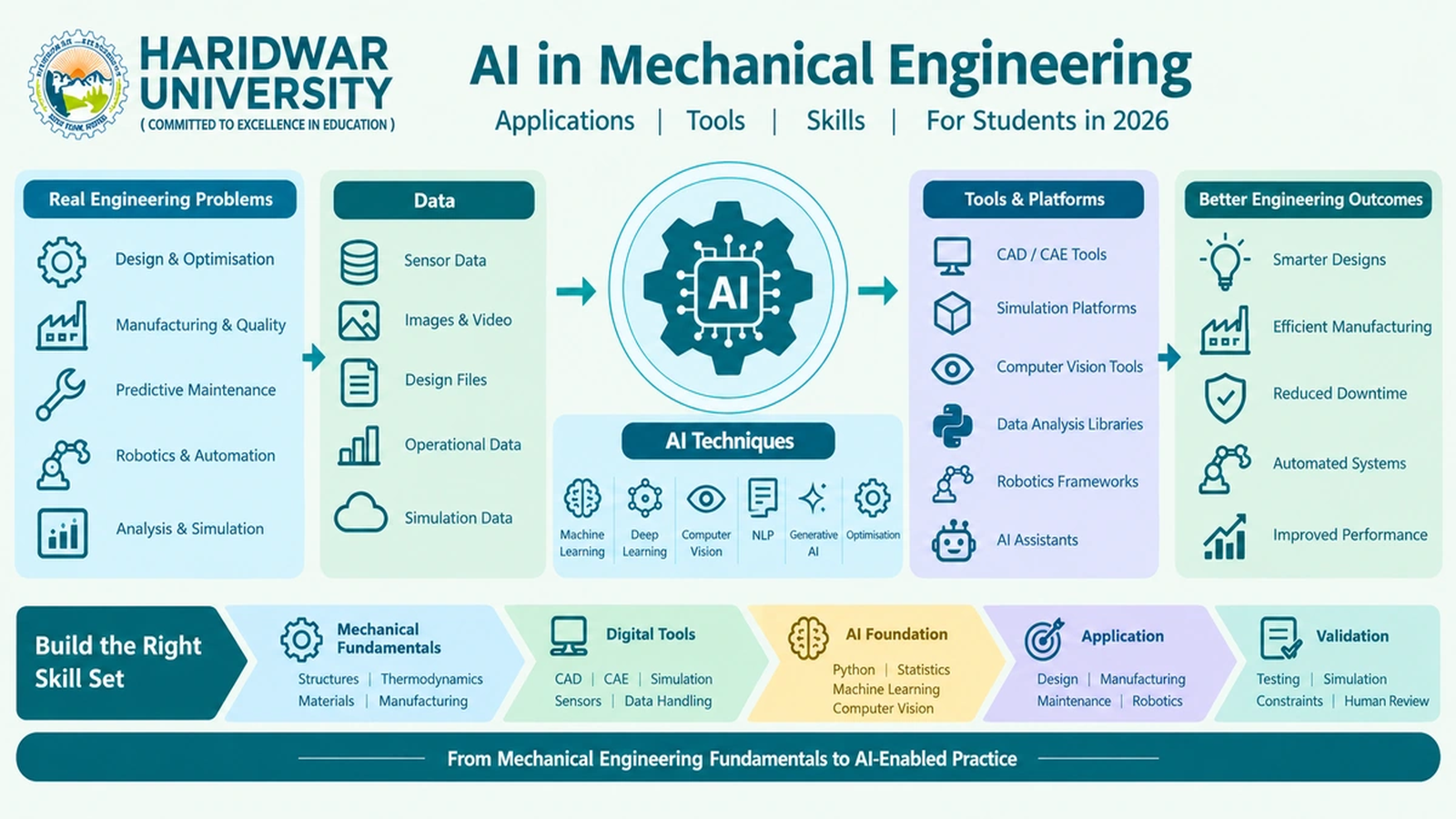
AI in Mechanical Engineering: Applications, Tools & Skills for Students in 2026
Mr. Abhinav Bhatnagar
Head, Mechanical Engineering, Haridwar University
Guide Table of Contents
- How AI Is Changing Mechanical Engineering Work
- Where AI Is Being Applied Across Mechanical Engineering
- Match AI Techniques to Mechanical Engineering Problems
- Use AI for Mechanical Design and Design Optimisation
- Apply AI to Manufacturing, Quality Control and Robotics
- Use AI for Predictive Maintenance and Machine Health
- Explore AI Tools for Mechanical Engineering Workflows
- Build AI Skills Alongside Mechanical Engineering Fundamentals
- Start With Practical AI Projects for Mechanical Engineering Students
- Verify AI Outputs Before Using Them in Engineering Decisions
- Build a Practical AI Learning Path for Mechanical Students
- Frequently Asked Questions (FAQs)
Mechanical engineering is no longer defined solely by physical machinery, production shop floors, and conventional hand calculations. In 2026, Artificial Intelligence (AI) has become an integral layer embedded directly into design optimisation, finite element simulation, automated manufacturing, autonomous robotics, predictive maintenance, and structural reliability analysis.
From my perspective as Head of Mechanical Engineering at Haridwar University, the decisive question facing aspiring engineers is not whether AI will enter our discipline—it is already here. The true differentiator is understanding exactly where AI can systematically enhance engineering workflows, which tools solve tangible problems, and how to build the interdisciplinary technical skills required to validate every single computational output.
Recent systematic reviews of AI in engineering education highlight rapid adoption across engineering drafting, automated simulation assessment, intelligent tutoring, and generative CAD. At the same time, academic and industrial research spans topology optimisation, computer numerical control (CNC) telemetry, acoustic emissions, and computer-vision-guided robotics. To navigate this evolving landscape, students must anchor their learning in a reliable engineering framework:
How AI Is Changing Mechanical Engineering Work
AI functions as an empowering analytical layer within established engineering workflows rather than a substitute for first-principles physics. In industrial practice:
- Design engineers deploy generative algorithms to rapidly iterate through hundreds of lightweight, high-stiffness geometries within finite element boundary conditions.
- Manufacturing engineers harvest high-frequency machine telemetry to prevent chatter, optimize tool feeds and speeds, and identify microscopic surface defects on production lines.
- Reliability and maintenance teams rely on machine learning models trained on vibration, acoustic, and thermal telemetry to forecast machinery breakdown weeks before catastrophic failure occurs.
| Engineering Area | AI Application & Workflow Transformation |
|---|---|
| Mechanical Design | Generative design, topology optimisation, and physics-informed surrogate geometry synthesis. |
| Simulation (FEA/CFD) | Surrogate neural network models delivering near real-time field approximations and parametric sweeps. |
| Manufacturing | Process parameter optimisation, cutting-tool wear estimation, and automated in-line surface defect detection. |
| Maintenance & Reliability | Vibration failure prediction, acoustic anomaly detection, and remaining useful life (RUL) estimation. |
| Robotics & Automation | Perception-driven path planning, visual servoing, kinematics reinforcement learning, and collaborative robotics. |
| Materials Engineering | Alloy property prediction, microstructural phase analysis, and fatigue-life regression modeling. |
| Technical Documentation | Information extraction from ASME/ISO technical codes, Bill of Materials (BOM) parsing, and technical assistance. |
For students enrolled in our B.Tech Mechanical Engineering program at Haridwar University, this shift underscores why mastering digital engineering tools alongside physical mechanics is essential for high-value industrial placements.
Where AI Is Being Applied Across Mechanical Engineering
AI applications now span the entire product and machinery lifecycle, from conceptual ideation to end-of-life recycling:
Design and Simulation
Machine learning models uncover complex non-linear relationships between 3D geometry, boundary conditions, and stress/thermal distributions. Surrogate models trained on high-fidelity computational fluid dynamics (CFD) and finite element analysis (FEA) datasets evaluate aerodynamic drag or thermal resistance in fractions of a second, accelerating design space exploration.
Manufacturing and Inspection
Modern machine vision systems deployed on industrial assembly lines inspect machined components, welds, and additive manufacturing layers at conveyor speeds, surpassing human capability in defect classification and dimensional verification.
Maintenance and Reliability
Continuous vibration spectra, thermal imaging, pressure transducers, and acoustic sensors feed time-series models that diagnose bearing wear, gear pitting, cavitation in pumps, and shaft misalignment before physical damage halts production.
Robotics and Intelligent Systems
Vision-guided robotic arms, automated guided vehicles (AGVs), and autonomous mobile robots (AMRs) integrate computer vision and reinforcement learning to navigate dynamic factory floors, handle fragile payloads, and safely collaborate alongside human technicians.
Match AI Techniques to Mechanical Engineering Problems
A common trap for students is learning a generic AI tool or library without understanding its engineering context. Mechanical engineers must adopt a problem-first approach: identify the physical challenge first, determine what data is accessible, and then select the appropriate mathematical or AI model.
| Engineering Problem | Data Source | Targeted AI Direction | Essential Student Skills |
|---|---|---|---|
| Design Optimisation | CAD geometries, FEA stress tensors, load cases | Topology optimisation & Generative Design | 3D CAD, solid mechanics, boundary constraint definition |
| Machine Failure | Accelerometers, vibration spectra, motor current | Supervised Machine Learning / Classification | Python ML libraries (Scikit-Learn), signal processing (FFT) |
| Defect Inspection | RGB cameras, thermal infrared, optical profilometry | Computer Vision (CNNs, YOLO, OpenCV) | Image preprocessing, feature segmentation, convolutional networks |
| Sensor Forecasting | Temperature sensors, pressure logs, strain gauges | Time-Series ML (LSTM, GRU, ARIMA) | Statistical data handling, Pandas, temporal anomaly detection |
| Simulation Acceleration | Mesh coordinates, CFD flow fields, FEA matrices | Surrogate Modelling & PINNs | FEA/CFD fundamentals, neural network regressors |
| Robot Control | Depth cameras, LiDAR, joint encoders, IMUs | Reinforcement Learning & Kinematic ML | Kinematics, dynamics, ROS (Robot Operating System), Python |
| Technical Information | Engineering codes (ASME, ISO, ASTM), spec sheets | NLP & Retrieval-Augmented Generation | Prompt engineering, source verification, documentation review |
Use AI for Mechanical Design and Design Optimisation
Generative design represents one of the most visible AI-related developments in mechanical engineering. Rather than manually sketching individual rib thicknesses and bracket geometries, the engineer defines the functional envelope:
- Structural Load Cases: Static forces, dynamic torques, cyclic pressures, and thermal gradients.
- Material Specifications: Young's modulus, yield strength, density, and fatigue limits.
- Manufacturing Constraints: 3-axis CNC milling access, additive manufacturing build direction, casting draft angles, or sheet metal bending limits.
- Performance Objectives: Maximize stiffness-to-weight ratio, minimize mass, or optimize heat dissipation.
⚠️ Critical Engineering Caveat: AI Geometries Are Not Production-Ready Designs
An AI-generated shape is merely a mathematical optimization candidate. Students must never assume an uninspected algorithm output can be directly dispatched to fabrication. Always run independent FEA stress analyses, check for stress concentrations, verify machining clearance, and confirm compliance with industrial safety factors.
The disciplined student design sequence is:
Apply AI to Manufacturing, Quality Control and Robotics
Manufacturing provides another strong application area for AI. Modern production environments generate extensive telemetry across CNC spindles, injection molding machines, and robotic assembly stations:
- Optical Quality Inspection: High-resolution industrial cameras analyze stamped parts or 3D-printed layers in real time, detecting micro-cracks, porosity, warping, or dimensional drift.
- Process Parameter Optimisation: Algorithms analyze tool wear curves, cutting forces, and motor power to optimize feed rates dynamically, minimizing tool breakage and cycle times.
- Vision-Guided Robotic Automation: Robots equipped with depth sensors dynamically pick randomly oriented workpieces from bins, adjust weld paths based on seam gaps, and assemble complex sub-assemblies.
Students looking to build interdisciplinary capstone projects can explore our specialized university guides on robotics projects for engineering students and IoT sensor-to-cloud projects.
Use AI for Predictive Maintenance and Machine Health
Predictive maintenance is particularly relevant to mechanical engineering because machines generate continuous physical data throughout their operation. Unplanned downtime costs industrial facilities billions annually, making vibration analysis and anomaly detection high-demand industrial skills.
A sensible student workflow collects or accesses historical vibration, temperature, or motor-current data to classify machine states, identify anomalies, and estimate potential failures. The model should support maintenance decisions, never become the sole basis for a safety-critical decision.
Explore AI Tools for Mechanical Engineering Workflows
The current AI-tool landscape is moving beyond general chatbots into specialized, physics-aware engineering software suites. Students should think in tool categories rather than isolated brand names:
| Workflow Area | Tool Category to Explore | Key Student Considerations |
|---|---|---|
| CAD and Design | Generative-design and AI-assisted CAD | Check educational licensing; verify export to solid formats (STEP/SAT), not just meshes. |
| FEA / CFD Simulation | AI-assisted simulation and surrogate models | Surrogates deliver rapid estimation, but non-linear phenomena require traditional verification. |
| Manufacturing & CAM | AI-enabled CAM and process optimisation | Ensure toolpaths respect machine axis limits, spindle torque, and tool rigidity. |
| Inspection & Metrology | Computer vision and defect classification | Master image thresholding, contour detection, and transfer learning with OpenCV/PyTorch. |
| Maintenance & Reliability | ML and vibration sensor analytics | Understand Fast Fourier Transforms (FFT) and bearing pass frequencies before training classifiers. |
| Research & Documentation | AI research and document assistants | Use for literature synthesis and drafting, but cross-check all equations and citations. |
| Programming & Scripting | AI coding assistants | Utilize for debugging Python automation, but maintain firm comprehension of script logic. |
Build AI Skills Alongside Mechanical Engineering Fundamentals
Attempting to master advanced machine learning without firm grounding in mechanical engineering creates fragile skill sets. At Roorkee College of Engineering, Haridwar University, we mentor students through a balanced, layered pyramid of competencies:
Tier 1: Mechanical Foundation
Mechanics, thermodynamics, fluid dynamics, materials science, machine design, and manufacturing processes. The irreplaceable physical core.
Tier 2: Digital Engineering
Parametric 3D CAD modeling, FEA stress analysis, CFD flow simulation, CNC toolpaths, and sensor telemetry acquisition.
Tier 3: AI & Data Foundation
Python programming, NumPy, Pandas, descriptive statistics, basic machine learning algorithms, and computer vision libraries.
Tier 4: Mechanical AI Applications
Generative structural design, bearing fault classification, acoustic anomaly detection, and vision-guided robotics.
Tier 5: Engineering Validation
Physical experimental verification, high-fidelity FEA validation, safety factor enforcement, and professional engineering ethics.
Start With Practical AI Projects for Mechanical Engineering Students
Students can begin with manageable, empirically bounded problems rather than attempting an overly ambitious autonomous smart factory. A strong portfolio project demonstrates clear evaluation metrics and engineering interpretation:
| Project Concept | Targeted AI Approach | Evidence to Demonstrate in Portfolio |
|---|---|---|
| Machine-Failure Prediction | Classification / Time-Series ML | Precision, recall, confusion matrix, and FFT waterfall spectral plots. |
| Predictive Maintenance | Anomaly Detection (Autoencoders/SVM) | Detection performance, false positive rate, and remaining useful life (RUL) curve. |
| Manufacturing Defect Detection | Computer Vision (YOLO/CNNs) | Accuracy, F1-score, annotated test samples, and inference speed (FPS). |
| Design Optimisation Study | Generative Design & Topology Optimisation | Mass reduction vs stiffness trade-offs, Von Mises stress contours, and manufacturability review. |
| Machine-Condition Classifier | Multi-Class Supervised ML | Model comparison (Random Forest vs XGBoost) and validation across speed/load regimes. |
| Production-Quality Prediction | Regression & Gradient Boosting | RMSE, MAE, R-squared error metrics, and physical feature importance interpretation. |
For broader project-selection guidance and capstone frameworks, students can refer to Haridwar University's guide to final-year engineering project ideas and AI projects for engineering students.
Verify AI Outputs Before Using Them in Engineering Decisions
This is the critical step students should never skip. AI can produce plausible calculations, design geometries, Python code, or explanations that nonetheless contain subtle flaws. The risk is magnified when an output appears technically polished but has not been checked against governing physics.
Core Engineering Principle
AI can assist engineering judgement; it should never replace engineering verification.
Enforce this strict review sequence across every project:
- For Mechanical Design: Verify dimensions, load distributions, and boundary constraints; then perform independent FEA simulation and physical coupon testing.
- For Predictive Maintenance: Evaluate model performance against known machinery baseline behaviour; thoroughly investigate both false positives and false negatives.
- For Generative AI Answers: Cross-check equations, mechanical standards (ASME, ISO, ASTM), material constants, and claims against authoritative engineering textbooks.
Build a Practical AI Learning Path for Mechanical Students
Students can build capability progressively without compromising their foundational coursework:
Strengthen mechanics, machine design, CAD, and conventional simulation packages.
Learn Python, NumPy, Pandas, descriptive statistics, and basic sensor data handling.
Build a supervised classifier using open engineering datasets (e.g., CWRU bearing vibration).
Choose an applied vertical: predictive maintenance, computer vision, generative CAD, or robotics.
Integrate AI models with commercial CAD/CAE tools, IoT microcontrollers, or CAM workflows.
Document project methodology, baseline comparisons, error metrics, and physical limitations.
To plan your career trajectory and explore professional prospects, review our detailed guide on career paths after B.Tech Mechanical Engineering and postgraduate studies in M.Tech Mechanical Engineering.
Frequently Asked Questions (FAQs)
1. What is AI in mechanical engineering?
AI in mechanical engineering means applying machine learning, computer vision, optimisation, generative AI and related computational methods to engineering problems such as design, manufacturing, simulation, inspection, and maintenance.
2. What are the main applications of AI in mechanical engineering?
Major applications include generative design optimisation, surrogate simulation assistance, manufacturing process optimisation, automated quality inspection, predictive maintenance of rotating machinery, robotics control, and engineering data analysis.
3. Which AI tools are useful for mechanical engineering students?
The useful category depends on the engineering problem. Students can explore generative CAD (Autodesk Fusion 360, PTC Creo), simulation surrogates (Altair physicsAI, Ansys Discovery), computer vision (OpenCV, YOLO), Python data-analysis libraries (NumPy, SciPy, Scikit-learn), and MATLAB Predictive Maintenance Toolbox while observing licensing and validation limits.
4. Do mechanical engineering students need to learn Python for AI?
Yes, Python is highly useful for machine learning, sensor data analysis, and computer vision projects, although the required programming depth depends on the student's chosen application. Basic scripting, data manipulation with Pandas, and model training with Scikit-learn are sufficient for most engineering capstones.
5. Can AI replace mechanical engineers?
No. AI can automate or assist parts of engineering work, but mechanical engineering still fundamentally requires physical understanding, boundary constraints, safety validation, experimental testing, and professional judgement. Current industrial consensus presents AI as an analytical multiplier in the workflow rather than a universal replacement for engineering analysis.
6. What AI project should a mechanical engineering student build first?
Start with a project where the engineering problem and evaluation method are clear, such as machine-condition classification using vibration sensor telemetry (e.g., CWRU Bearing Dataset), predictive maintenance anomaly detection, or manufacturing-defect detection using OpenCV.
7. How should students verify AI-generated engineering results?
Check the assumptions, input telemetry, calculations, and boundary constraints, then validate results through appropriate numerical simulation (FEA/CFD), physical testing, authoritative technical standards (ASME, ISO), or experienced faculty review.
From Mechanical Engineering Fundamentals to AI-Enabled Practice
The strongest mechanical engineering students in an AI-enabled environment will not simply be those who know the most AI tools. They will be those who can identify an engineering problem, understand the underlying mechanics, select an appropriate AI method, work with the necessary data, and rigorously verify the resulting output.
AI is becoming part of mechanical engineering, but the engineering fundamentals remain the foundation. The opportunity lies in combining both intelligently.
Shape the Future of Intelligent Engineering at Haridwar University
Experience cutting-edge mechanical laboratories, robotics workshops, and advanced computing facilities at Roorkee College of Engineering, Haridwar University. Master core mechanics alongside applied artificial intelligence.