

Agri-Tech Careers in India: 10 Jobs in Drones, Data & Precision Farming
Dr. Roshan Kumar Thakur
Associate Professor & HOD, Agricultural Sciences, Haridwar University
The next generation of agricultural professionals will need more than an understanding of crops, soil and farm management. They will also need to interpret data, work with digital tools and understand how technologies such as drones, satellite imagery, sensors and artificial intelligence are changing farm operations. This shift is creating new agriculture technology careers across data analysis, precision farming, field operations, engineering and agribusiness.
The opportunity is not limited to computer science graduates. Agriculture students can bring essential knowledge of crops and farming systems to technology-led roles, while engineers and data specialists can contribute their technical expertise. The important question is how these skills come together in the workplace. Here are ten agri-tech career paths, the work they involve and the preparation students should consider.
Table of Contents
- 1. What Agri-Tech Means for Modern Agriculture
- 2. 10 Agri-Tech Careers in India
- 3. Skills and Tools Used in Agri-Tech Jobs
- 4. Degrees and Qualifications for Agri-Tech Careers
- 5. How Freshers Can Build an Entry Route into Agri-Tech
- 6. Frequently Asked Questions (FAQs)
- 7. Building a Career at the Intersection of Agriculture and Technology
1. What Agri-Tech Means for Modern Agriculture
Agri-tech, or agricultural technology, refers to the use of scientific and digital tools to improve how farms are monitored, managed and supplied. It includes technologies such as artificial intelligence, the Internet of Things (IoT), drones, robotics, sensors, satellite applications and Geographic Information Systems (GIS).
Consider a practical example. A farmer may traditionally inspect a field to identify signs of water stress or crop damage. With soil-moisture sensors, satellite images and drone-based surveys, a specialist can gather more detailed information and help identify where attention is needed. The technology supports the decision; agricultural knowledge helps interpret it.
The Government of India identifies drones, AI, IoT, robotics, sensors, remote sensing and GIS among the technologies increasingly integrated into agricultural operations. The Indian Council of Agricultural Research’s Network Programme on Precision Agriculture also works on sensor-based crop and soil monitoring, drone and satellite platforms, and IoT-enabled farming systems.
For students, this means agri-tech careers are not confined to one department or job title. They connect agricultural science with engineering, data, field services and business.
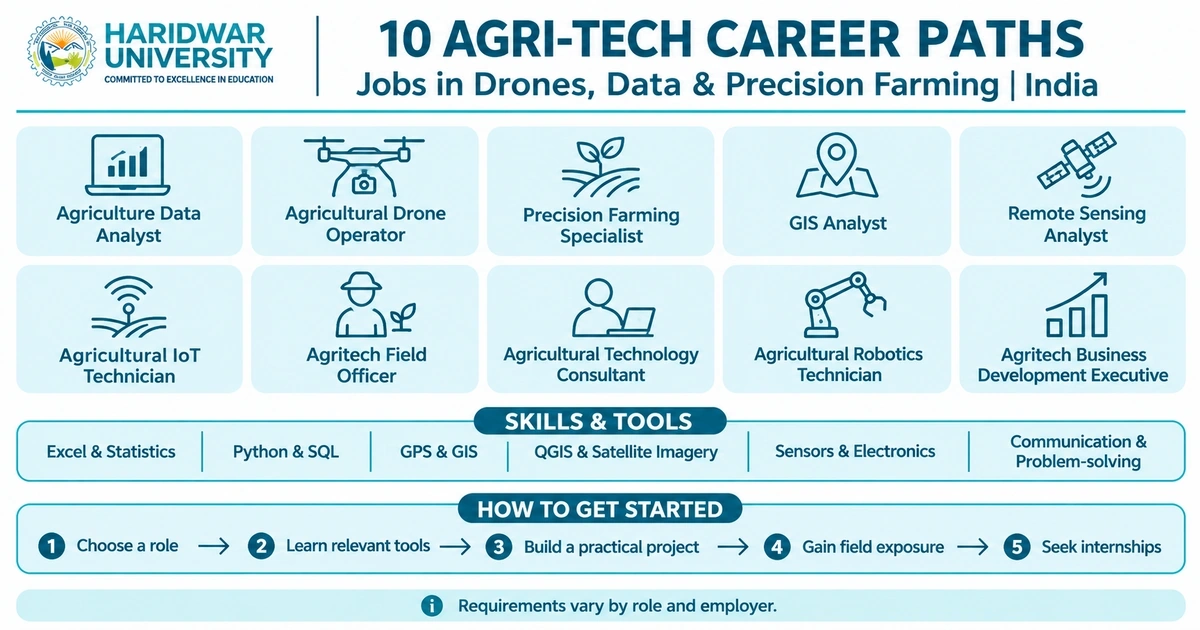
2. 10 Agri-Tech Careers in India
The following roles represent different pathways within the sector. Employers may use different job titles, and entry requirements vary according to the work involved.
1. Agriculture Data Analyst
Agriculture data analysts work with information such as crop records, soil readings, weather patterns, yield reports and field observations. Their task is to identify patterns that can support decisions on crop performance, resource use and farm planning. Useful skills include spreadsheets, statistics, data visualisation and, for more technical positions, Python or SQL. An agriculture graduate with additional data-analysis training can build towards this role; employers may also recruit graduates from statistics, computer science and data science backgrounds.
2. Agricultural Drone Operator
Agricultural drone operators prepare and operate drones for tasks such as crop spraying, field surveys and aerial data collection. Their responsibilities can include pre-flight checks, flight planning, safe operation, equipment maintenance and maintaining operational records. The National Qualification Register’s Kisan Drone Operator occupational profile describes work involving drone operation, agricultural spraying, data collection and equipment maintenance. For commercial remote-pilot work, students should check applicable DGCA requirements and train through an authorised Remote Pilot Training Organisation.
3. Precision Farming Specialist
A precision farming specialist uses field information and technology to help improve the timing and application of agricultural inputs. The work may involve GPS-guided equipment, soil sensors, field mapping, crop monitoring and analysis of location-specific data. The National Qualification Register’s Precision Farming Technician profile identifies GIS, GPS, drones, sensors and software as tools used to collect and analyse agricultural field data. This is a useful pathway for students interested in combining crop science with practical technology.
4. GIS Analyst
A Geographic Information Systems (GIS) analyst works with location-based data. In agriculture, this can mean preparing maps of farm boundaries, soil characteristics, irrigation networks, crop distribution or field conditions. The role suits students who enjoy mapping and spatial analysis. Familiarity with GIS software, GPS data and map interpretation is valuable. Agriculture graduates can build domain knowledge, while geography, geoinformatics and related technical graduates may enter through spatial-data skills.
5. Remote Sensing Analyst
Remote sensing analysts interpret information collected by satellites, aircraft or drones. Agricultural applications include monitoring vegetation, observing changes in crop conditions and supporting estimates of crop area or production. This role requires an understanding of imagery, spatial data and analytical methods. Students may develop relevant skills through remote-sensing coursework, GIS projects and practice with satellite datasets.
6. Agricultural IoT Technician
IoT technicians install, test and maintain connected devices used in agricultural settings. These may include soil-moisture sensors, weather stations, irrigation controllers and other monitoring equipment. The work is practical as well as technical. It can involve checking sensor readings, troubleshooting connectivity, maintaining devices and helping users understand the information they produce. Electronics, instrumentation, computer science and agricultural technology backgrounds can be relevant.
7. Agritech Field Officer
An agritech field officer helps introduce digital tools and services to farmers, producer groups or agricultural businesses. The role may involve demonstrating equipment, collecting field feedback, supporting onboarding and explaining how a platform or device is used. Communication matters as much as technical familiarity. A person in this role must understand the farming context and explain technology in language that users can apply.
8. Agricultural Technology Consultant
Agricultural technology consultants help farms, agribusinesses and institutions assess which technologies may suit their operations. They may review existing practices, identify operational problems and recommend solutions involving irrigation systems, sensors, farm software or precision agriculture. This is generally a knowledge-led role. Agricultural experience, technical understanding and the ability to evaluate costs and practical benefits are important; some consulting positions require prior industry experience.
9. Agricultural Robotics Technician
Agricultural robotics technicians work with automated or semi-automated equipment used in activities such as planting, weeding, harvesting and crop monitoring. Their work can include installation, testing, maintenance and troubleshooting. Mechanical, electrical, electronics and mechatronics knowledge is useful. Students from agriculture backgrounds can also contribute by understanding field conditions and the practical requirements of farm operations.
10. Agritech Business Development Executive
Not every agri-tech career involves programming or operating equipment. Business development professionals help companies introduce agricultural products and services to farmers, cooperatives, distributors and agribusinesses. They may explain product features, identify customer requirements, coordinate demonstrations and develop business relationships. Communication, market understanding and familiarity with agricultural products are useful foundations.
A look at active agri-tech business hiring shows recruitment across engineering, AI and data science, agronomy, product and enterprise sales. It is a useful reminder that the sector needs people with different specialisations, not only software developers.
3. Skills and Tools Used in Agri-Tech Jobs
Students often assume they must learn every new technology to enter agri-tech. That is neither practical nor necessary. The right skills depend on the role.
| Career Area | Useful Skills and Tools |
|---|---|
| Data Analysis | Excel, statistics, Python, SQL, data visualisation |
| Drone Operations | Flight planning, safe operation, equipment checks, field knowledge |
| Precision Farming | GPS, GIS, sensors, field mapping, crop management |
| GIS and Remote Sensing | QGIS, satellite imagery, spatial analysis |
| IoT and Robotics | Electronics, sensors, connectivity, equipment maintenance |
| Field and Business Roles | Farmer communication, product demonstrations, problem-solving, market knowledge |
One distinction deserves attention: collecting data and interpreting it are different skills. A drone can capture field images, but understanding what those images indicate about crop health requires suitable analytical and agricultural knowledge.
The ICAR precision agriculture programme offers examples of how sensors, remote sensing, AI and ICT are applied to crop and soil monitoring. Students can use such applications to decide which technical skills are relevant to their preferred career path.
4. Degrees and Qualifications for Agri-Tech Careers
There is no single degree that qualifies someone for every agri-tech job. The academic route should match the work a student wants to pursue.
- B.Sc. Agriculture: Builds knowledge of crops, soil, agronomy and agricultural systems. Additional training in GIS, data analysis or precision farming can help students explore technology-focused roles. Explore our comprehensive guide to B.Sc. Agriculture at Haridwar University: Curriculum, Careers and Modern Farming Technology.
- B.Tech Agricultural Engineering: Can provide a foundation for careers involving farm machinery, irrigation, automation and agricultural equipment.
- Engineering and Computer Science Degrees: Can lead towards IoT, robotics, software, data science and AI roles when supported by relevant projects and agricultural context.
- Geography, Geoinformatics and Remote-Sensing Qualifications: Can support pathways in GIS mapping, satellite-image analysis and spatial data.
- Specialised Drone Training: Is relevant for students seeking professional drone-pilot work. Learn more about drone operations in our overview of B.Sc. Aviation & Drone Technology.
Students interested in the agricultural route can explore Haridwar University’s Roorkee College of Agriculture Sciences and its B.Sc. Agriculture Hons. with AI programme. The programme combines agricultural science with areas such as AI, machine learning, precision farming and smart agriculture. The University’s related guide, AI in Agriculture: Precision Farming, Applications and Skills in India, provides further context on the relationship between agricultural fundamentals and emerging technologies. For broader opportunities across the sector, read careers in agriculture beyond farming.
5. How Freshers Can Build an Entry Route into Agri-Tech
A degree provides the foundation, but practical evidence of skills can make a fresher’s profile more relevant. I would encourage students to build a small portfolio around a real agricultural problem rather than collecting certificates without applying what they learn.
- Choose a Role to Explore: Decide whether your interest lies in data, drones, precision farming, GIS, equipment or farmer-facing work.
- Learn the Relevant Tools: Start with spreadsheets and data visualisation for analytics, or GIS software for mapping. Drone aspirants should investigate recognised training requirements.
- Build a Practical Project: For example, map a small farm plot, analyse sample crop or weather data, or prepare a basic soil-moisture monitoring exercise.
- Gain Field Exposure: Understand how technology performs outside a classroom. Field visits can reveal practical issues involving connectivity, equipment, crop conditions and user needs.
- Look for Relevant Internships: Explore opportunities with agri-tech companies, agricultural research organisations, equipment providers, agribusinesses and farm-service businesses.
Do not assume that every role is a remote or desk-based job. Data and software positions may offer some remote-working options, while drone operations, equipment support and field advisory work commonly require on-site activity. Entry-level opportunities also vary by employer, location and season.
6. Frequently Asked Questions (FAQs)
1. Can a B.Sc. Agriculture graduate work in agri-tech?
Yes. Agriculture graduates can explore roles in agronomy support, precision farming, agricultural data analysis and field operations. Learning relevant tools such as GIS, spreadsheets, remote sensing or agricultural sensors can strengthen their preparation.
2. Is agricultural engineering a good career option?
It can be a suitable choice for students interested in machinery, irrigation, automation, farm equipment and technology-led agricultural systems. Career options depend on specialisation, practical skills and employer requirements.
3. Do agricultural drone pilots need certification in India?
Professional drone operations must follow applicable DGCA rules. Students should check the requirements for the relevant drone category and obtain training through an authorised Remote Pilot Training Organisation where required.
4. What qualifications are needed for precision farming jobs?
Requirements vary by employer and role. Agriculture, agricultural engineering and related technical qualifications can be relevant. Skills in GPS, GIS, sensors, field-data collection and analysis are particularly useful.
5. Can students enter agri-tech without an agriculture degree?
Yes. Graduates in computer science, data science, electronics, mechanical engineering, geography and related fields can contribute to software, analytics, IoT, robotics and geospatial roles. Agricultural knowledge becomes especially valuable when working directly with crops and farm operations.
6. What is the difference between precision farming and smart farming?
Precision farming uses location-specific information and technology to manage field activities more accurately, such as applying water or fertiliser according to local requirements. Smart farming is a broader term that can include connected devices, automation, AI and digital farm-management systems. The two approaches often overlap.
7. What is the salary of an agriculture data analyst in India?
There is no single reliable salary figure for this job title across India. Pay varies with experience, location, employer, analytical skills and whether the role involves basic reporting, GIS, remote sensing or advanced data science. Students should compare current vacancies with similar responsibilities rather than rely on one broad salary estimate.
7. Building a Career at the Intersection of Agriculture and Technology
Agri-tech is changing the range of work available to people who understand agriculture and those who build the technologies used in it. Data analysts, drone operators, GIS specialists, precision farming professionals, IoT technicians and agribusiness teams all contribute to this ecosystem.
My advice to students is to begin with a clear understanding of agricultural problems and then develop the technical skills needed to address them. A student who can interpret field conditions, work with reliable data and explain a practical solution has a stronger foundation than someone who knows a tool without understanding where it fits.
The most useful preparation is therefore a combination of subject knowledge, relevant technical training and practical exposure. That is where agriculture education can connect meaningfully with the opportunities emerging across India’s agri-tech sector.
Shape the Future of Agriculture at Haridwar University
Empower your career with cutting-edge programmes in agricultural sciences, precision farming, AI integration, and modern agribusiness. Benefit from state-of-the-art agricultural research farms, industry internships, and merit scholarships up to 80%. Applications open for the 2027-28 session.