

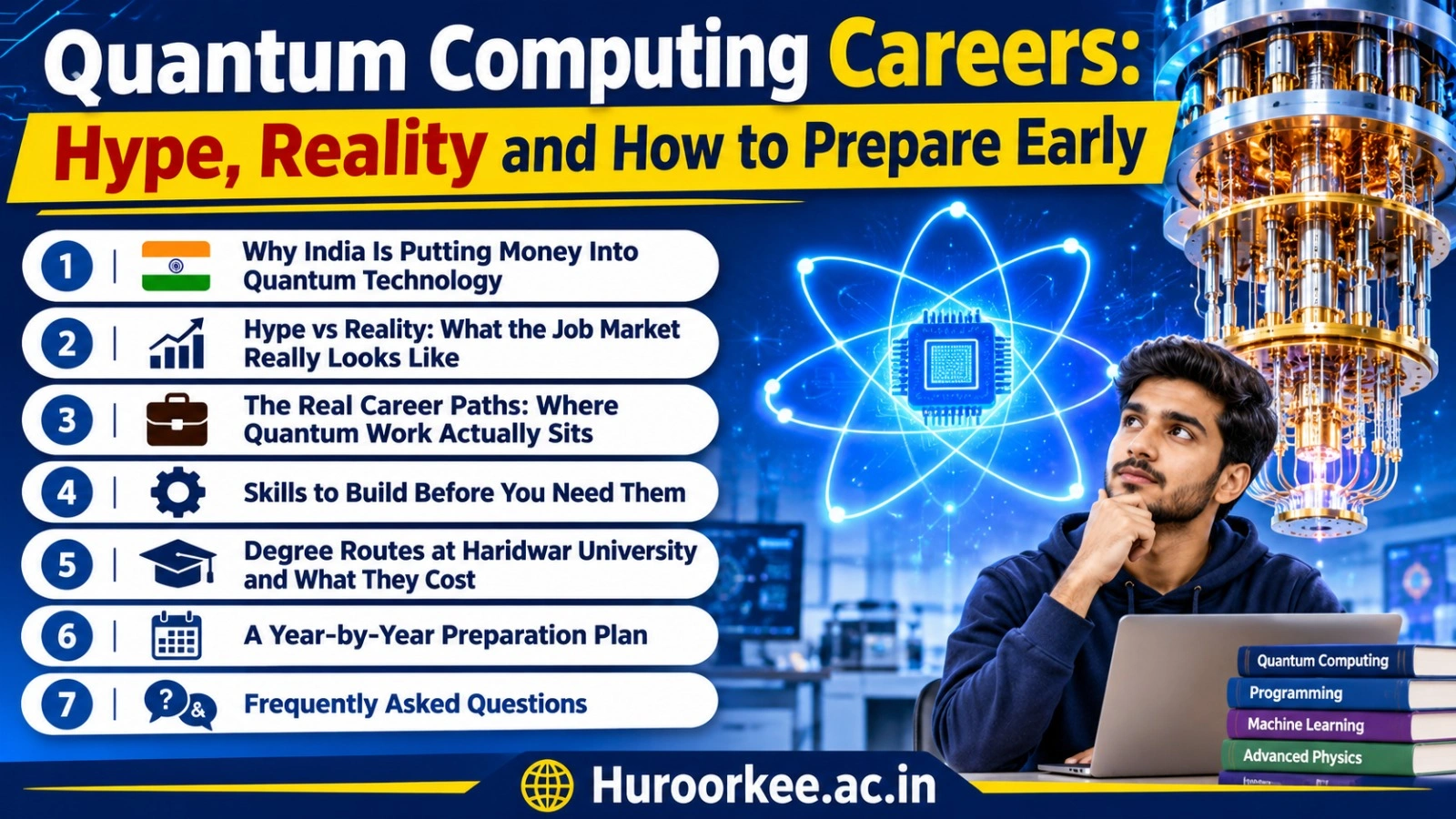
Quantum Computing Careers: Hype, Reality and How to Prepare Early
Dr. Rohit Kumar
Associate Professor & HOD, Computer Applications, Haridwar University
Quantum Computing Careers: Hype, Reality and How to Prepare Early is really three questions rolled into one. How much of the excitement is earned? Which jobs exist today? And what should a first-year student actually do about it? This guide leans on official sources for all three, and it ends with a plan you can start this semester.
Start with the table below. It’s the short version; everything after it is the evidence.
| What You Hear | What the Official Record Shows |
|---|---|
| Quantum computers will replace ordinary computers soon. | India’s National Quantum Mission targets intermediate-scale machines of 50 to 1,000 physical qubits within eight years (DST). |
| Quantum jobs are only for physics PhDs. | The Mission funds four areas: computing, communication, sensing and metrology, and materials and devices (DST). That’s a wider mix of work than one discipline. |
| Quantum security is a problem for the distant future. | NIST released its first three post-quantum encryption standards in August 2024 and urged early adoption (NIST). |
| Every university already runs a quantum degree. | DST invited institutions in July 2025 to set up undergraduate teaching labs supporting a UG minor in quantum technologies (DST). |
Table of Contents
- 1. Why India Is Putting Money Into Quantum Technology
- 2. Hype vs Reality: What the Job Market Really Looks Like
- 3. The Real Career Paths: Where Quantum Work Actually Sits
- 4. Skills to Build Before You Need Them
- 5. Degree Routes at Haridwar University and What They Cost
- 6. A Year-by-Year Preparation Plan
- 7. Frequently Asked Questions (FAQs)
1. Why India Is Putting Money Into Quantum Technology
The Union Cabinet approved the National Quantum Mission (NQM) in April 2023, with a total cost of ₹6,003.65 crore from 2023-24 to 2030-31, according to the Department of Science & Technology (DST). The idea is to build research and industry capacity in quantum technology from a standing start, then scale it.
What the Money Is Meant to Deliver
The goals are specific. They include quantum computers of intermediate scale, a multi-node quantum network with quantum memories, and sensitive magnetometers and atomic clocks for timing and navigation. All of it needs people.
Why the Timeline Matters to You
Join a four-year degree in 2027 and you graduate in 2031, just as the Mission’s funding window closes. Whatever follows it, today’s first-years are the ones who’ll meet it.
2. Hype vs Reality: What the Job Market Really Looks Like
Where the Hype Runs Ahead
Read the Mission’s target again: 50 to 1,000 physical qubits, on platforms such as superconducting and photonic systems, within eight years. That’s a research machine, not a stand-in for the laptop on your desk. And the community building it is small. DST’s 2025 call for proposals says the four hubs bring together 152 researchers from 43 institutes. That’s a research circle, not a mass-hiring sector, at least not yet.
Where the Reality Is Already Here
Security is the clearest case. In August 2024 NIST finalised its first three post-quantum encryption standards and told system administrators to start integrating them at once, because full integration takes time. NIST adds that some experts expect a code-breaking quantum device within a decade. Nobody can promise that date. Still, the migration work (finding where encryption is used, swapping algorithms, testing) runs on ordinary computers and needs ordinary engineers.
That’s the honest core of Quantum Computing Careers: Hype, Reality and How to Prepare Early. The field is real, the timeline is long, and the nearest jobs sit next to quantum rather than inside it. One more note: this article quotes no quantum salary figures, because no official, dated pay benchmark was available when it was written. For context on other emerging deep-tech areas, compare our analyses of space sector careers in India and semiconductor and VLSI careers.
3. The Real Career Paths: Where Quantum Work Actually Sits
DST splits the Mission into four hubs, which makes a handy map of the career territory. Computing sits at IISc Bengaluru, communication at IIT Madras with the Centre for Development of Telematics (C-DOT), sensing and metrology at IIT Bombay, and materials and devices at IIT Delhi. Together they form 14 technical groups, as DST’s hub announcement lists. IIT Roorkee appears among the institutions involved in the computing, communication and materials hubs. HU’s own pages mention no tie-up with the Mission, so read that as geography, not an admission pitch.
- Hardware and Sensing: This is lab work: qubits, atomic clocks, magnetometers. It leans on physics and electronics, and realistically on postgraduate study.
- Algorithms and Software: Here the toolkit is linear algebra plus code. NPTEL’s course from IIT Madras and IBM Research, for example, teaches quantum algorithms using Qiskit.
- Communication and Security: Quantum networks are a stated Mission deliverable, but the nearest entry point for a networking or cybersecurity student is post-quantum cryptography, the classical-computer kind of defence NIST has standardised.
4. Skills to Build Before You Need Them
You don’t need to have studied a single qubit to begin. You need the vocabulary underneath it.
- Maths Comes First: Linear algebra and probability do most of the heavy lifting. NPTEL describes its IIT Kanpur course on quantum computing through the query model as mainly about the mathematical and computer-science side.
- Code Second: Python is the usual entry language for tools such as Qiskit. Write small programs that multiply matrices, then work through a two-qubit circuit by hand.
- Just Enough Physics: A first-year physics course covers the vocabulary you need to follow a seminar. Deeper quantum mechanics can wait for later years or a postgraduate programme.
Still choosing a degree? HU’s admission overview sets out eligibility and the application process, so read it next to your own maths marks.
5. Degree Routes at Haridwar University and What They Cost
HU’s programme and fee pages, checked on 18 November 2026, list no standalone quantum computing degree. They do list the computing degrees that build the base the field draws on, all under Roorkee College of Smart Computing. The table shows the main routes, using the fee structure on HU’s official fees and scholarships page (headed 2027-28 when checked).
| Programme | Year 1 | Later Years |
|---|---|---|
| B.Tech. Hons. CSE (4 years) | ₹1,32,000 | ₹1,15,000 a year (Years 2–4) |
| B.Tech. Hons. AI & ML (4 years) | ₹1,62,000 | ₹1,45,000 a year (Years 2–4) |
| BCA (3 years) | ₹82,000 | ₹65,000 a year (Years 2–3) |
| MCA with AI (2 years) | ₹92,000 | ₹75,000 (Year 2) |
| M.Tech. CSE (2 years) | ₹78,000 | ₹70,000 (Year 2) |
Charges include tuition, enrolment, admission, examination and uniform fees; transport costs extra. Fees can be revised, so confirm on the official page before you pay anything.
On scholarships, the same page lists merit slabs on first-year tuition, from 10% to 80% by JEE rank, Class 12 aggregate or CUET percentile, plus 25% for girls (first year only) and an AICTE scholarship for M.Tech students who qualify through GATE-2027. A student can claim only one scholarship, and private candidates get no merit scholarship.
Explore Computing Programmes at HU →
6. A Year-by-Year Preparation Plan
Nothing here needs a quantum computer. It needs consistency.
- Year 1: Calculus, linear algebra and Python. By the end of the year, matrices and complex numbers should feel ordinary.
- Year 2: Add probability, data structures and algorithms. Take one NPTEL quantum course, such as the IIT Madras and IBM Research offering, and finish it rather than sampling three.
- Year 3: Build a mini project that mixes classical and quantum ideas, like a small circuit simulator in Python. Add a cryptography or security elective if your programme offers one, and read about NIST’s FIPS 203, 204 and 205.
- Final Year and Beyond: Decide between a software or security job and a postgraduate step. At HU, MCA with AI and M.Tech CSE are the routes on the fee page above.
A long learning curve is easier with backup. HU’s Student Welfare Service page describes a Student Care Centre in each academic block with a stated 24-hour response time, and it covers education-loan support for tuition, hostel and laptop costs.
In the end, Quantum Computing Careers: Hype, Reality and How to Prepare Early comes down to one habit. Build the maths and code foundations now, and let the field show you where it’s heading. Facts and fees here were checked on 18 November 2026; check the official pages again before you decide.
7. Frequently Asked Questions (FAQs)
Do I need a physics degree to work in quantum computing?
Not for every role. Hardware work leans on physics and electronics, algorithm and software roles draw on maths and computer science, and security work comes from cryptography. Pick the side that matches your degree.
Is quantum computing a safe career bet today?
It’s a long-horizon bet. The Mission’s funded period runs to 2030-31 and targets intermediate-scale machines, so pair quantum interest with a solid classical skill like software or security.
Can a BCA or B.Tech CSE student enter the field?
Yes, mostly through software, algorithms and security work, often followed by a postgraduate degree. HU lists B.Tech CSE, BCA, MCA with AI and M.Tech CSE, though none is quantum-specific.
Which maths should I learn first?
Linear algebra and probability, then discrete mathematics. NPTEL’s IIT Kanpur course on the query model focuses mainly on the mathematical side.
Are there free ways to start learning?
NPTEL lists quantum computing courses from IIT Madras (with IBM Research) and IIT Kanpur. Check each course page for current enrolment details.
What is post-quantum cryptography, and is it a quantum job?
It’s encryption designed to resist quantum attacks, and it runs on ordinary computers. NIST published its first three standards, FIPS 203, 204 and 205, in August 2024, so it’s an accessible entry point.
How much do quantum jobs pay?
This article gives no figure because no official, dated benchmark was available. Ask for the source and date before trusting any salary number you see online.
What do HU’s computing degrees cost in Year 1?
Among the programmes in the table, Year 1 runs from ₹82,000 for BCA to ₹1,62,000 for B.Tech. Hons. AI & ML on the fee page checked on 18 November 2026. The official page is the only source to trust.
Does HU offer a quantum computing degree?
Not on the programme and fee pages checked on 18 November 2026. The computing degrees build the base; the admissions team can answer questions about electives.
Master Next-Gen Computing at Haridwar University
Build deep computational foundations in algorithms, AI, machine learning, and cybersecurity. Explore industry-aligned B.Tech, BCA, MCA, and M.Tech programmes with advanced labs, expert faculty, and merit scholarships up to 80%. Admissions are open for the 2027-28 session.