

Space Sector Careers in India: ISRO, Private Launch Firms and What They Hire For
Dr. Rajiv Mahajan
Vice-Chancellor, Haridwar University
Space Sector Careers in India once meant one employer, ISRO. Not any more. In a written Rajya Sabha reply on 13 August 2026, the government said around 440 space-technology start-ups are registered, and IN-SPACe has authorised 18 of them for space activities. An engineering graduate now has two doors, one government and one private, and each asks for something different. This guide sets out who is hiring, what they want, and which degree routes are worth planning for.
| Dimension | ISRO (Department of Space) | Private Launch Firms (Skyroot as the example) |
|---|---|---|
| How Engineers Enter | Scientist/Engineer ‘SC’ through ICRB: GATE score, then interview | Direct application to the company; Kalpana Fellowship for freshers |
| Pay Information | Level 10, minimum basic ₹56,100 a month plus allowances | Not published on the careers page |
| Experience Asked | No experience requirement stated; age limit 28 in the 2026 notice | 2 to 12+ years for every listed role |
| Disciplines Named | Electronics, Mechanical, Computer Science, Civil, Electrical, Refrigeration & AC, Architecture | Avionics, composites, welding, valves, propulsion testing, procurement, HR |
| Where the Work Is | Centres from Thiruvananthapuram and Bengaluru to Sriharikota, Hyderabad and Ahmedabad | Hyderabad |
Table of Contents
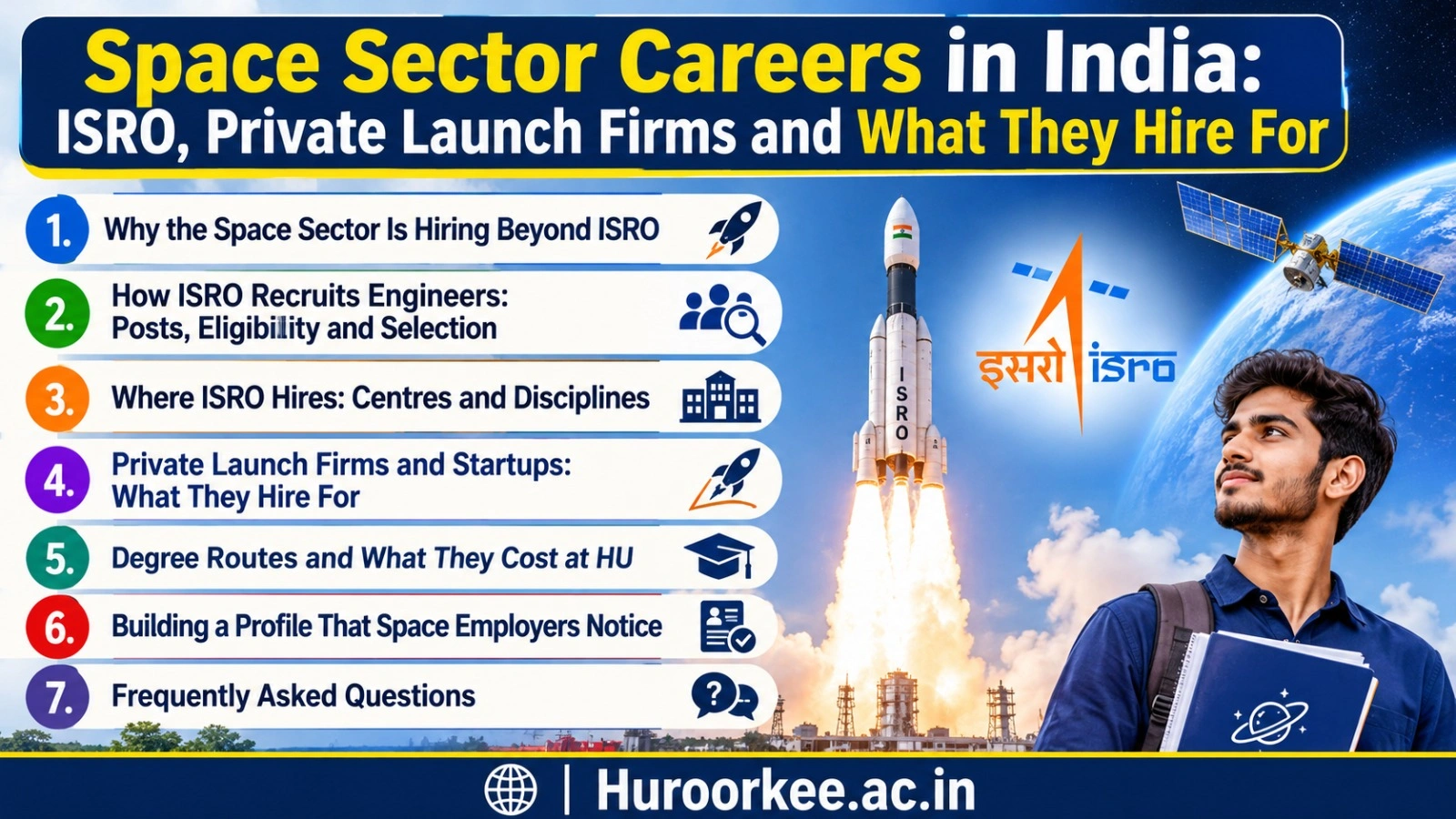
- 1. Why the Space Sector Is Hiring Beyond ISRO
- 2. How ISRO Recruits Engineers: Posts, Eligibility and Selection
- 3. Where ISRO Hires: Centres and Disciplines
- 4. Private Launch Firms and Startups: What They Hire For
- 5. Degree Routes and What They Cost at HU
- 6. Building a Profile That Space Employers Notice
- 7. Frequently Asked Questions
1. Why the Space Sector Is Hiring Beyond ISRO
Read that reply carefully before getting excited. The 440 counts registrations, not employees. IN-SPACe has granted 113 authorisations to 52 non-government entities, and 18 of those entities are start-ups, including Agnikul Cosmos, Bellatrix Aerospace and Skyroot Aerospace. The reply also says Indian private companies propose two commercial launches in FY 2026-27 and, once IN-SPACe approves the manifest, more than six in FY 2027-28.
Access matters too. Applications to use ISRO infrastructure, including the launch pads at Sriharikota, go through IN-SPACe’s digital platform and are reviewed by an expert committee. A private rocket still flies from a public spaceport.
Hiring follows launches: more rockets and satellites mean more people to build, test and fly them. But the reply gives no job numbers, so this guide quotes none. Anyone weighing space sector careers in India should expect steady growth with uneven demand, not a sudden flood of vacancies.
2. How ISRO Recruits Engineers: Posts, Eligibility and Selection
The main engineering entry point is the Scientist/Engineer ‘SC’ post, advertised by the ISRO Centralised Recruitment Board. The latest advertisement on ISRO’s site is No. ISRO:ICRB:02(EMC-CEPO):2026, dated 28 July 2026. Its window ran from 28 July to 17 August 2026 and has closed. Future notices will differ in dates, vacancies and age limits, and ICRB can publish more than one a year, so read the live one on isro.gov.in before you plan anything.
Eligibility in That Advertisement
The post is Group ‘A’ at Level 10 of the Pay Matrix. It asked for a B.E. or B.Tech in the matching discipline with at least 65% aggregate across all semesters, or a CGPA of 6.84 on 10, completed within the course duration. A valid GATE 2025 or 2026 score in the matching paper was compulsory, and the age limit was 28 on 17 August 2026, with government relaxations. Starting basic pay is ₹56,100 a month, plus dearness, house rent and transport allowances. For comprehensive preparation insights, consult our GATE preparation guide.
How the Interview Is Scored
Candidates were shortlisted for interview at 1:7 on GATE score. The final panel weighs GATE and interview 50:50, and the interview is marked out of 100:
| Attribute Assessed | Marks |
|---|---|
| Technical (academic) knowledge | 40 |
| General awareness in the area of specialisation | 20 |
| Presentation and communication skill | 20 |
| Comprehension | 10 |
| Academic achievements | 10 |
There are qualifying cut-offs as well. Unreserved and EWS candidates needed at least 50% in GATE score, 50% in the interview and 60% in aggregate; reserved candidates needed 40%, 40% and 50%. Only 10 marks reward academic achievements, and three of those depend on institute type (IITs, IISc, IIST, NITs and NIRF top-20 institutes). Students elsewhere, HU included, can’t earn that slice. The other 97 marks are open to everyone, and they reward what you know, what you’ve built and how clearly you explain it.
3. Where ISRO Hires: Centres and Disciplines
The same advertisement shows where the work sits. It listed 92 tentative vacancies across seven disciplines, a number ISRO itself calls provisional.
| Discipline | Tentative Vacancies |
|---|---|
| Electronics | 34 |
| Mechanical | 26 |
| Computer Science | 13 |
| Civil (10 at ISRO centres, 1 at PRL) | 11 |
| Electrical | 4 |
| Refrigeration and Air Conditioning | 2 |
| Architecture | 2 |
Not every post is about rockets directly. ISRO says its civil engineering programme office and construction and maintenance divisions plan, design, build and maintain the ground structures, buildings and facilities the space programme depends on. That’s where civil engineers fit.
Electronics, Mechanical and Computer Science account for 73 of the 92. Postings ran from Thiruvananthapuram and Valiamala to Sriharikota, Hyderabad, Ahmedabad, Bengaluru, Hassan and Mahendragiri. Appointees can also be posted to any centre and transferred as needed, which families should know before a student applies.
4. Private Launch Firms and Startups: What They Hire For
Private firms run no common exam. You apply to each company for whatever it needs that month. Skyroot Aerospace in Hyderabad is the clearest example because it publishes openings. On its careers page, checked on 17 November 2026, the open roles were:
| Role | Experience Asked |
|---|---|
| Lead – HR Operations | 12+ years |
| Procurement Engineer – Avionics | 5–8 years |
| Methods Engineer – Composites | 3–7 years |
| Lead Methods Engineer | 12+ years |
| Welding Engineer – Aerospace | 2–5 years |
| Cryogenic Propulsion Test Engineer | 3–5 years |
| Hardware Design Engineer – Avionics | 4–7 years |
| Valve Design Engineer | 2–4 years |
Two things stand out. The work isn’t only rocket science in the film sense: composites, welding, valves, avionics hardware, sourcing and HR all appear. And not one listed role asks for under two years’ experience. In space sector careers in India, then, the government route is published and predictable, while the private route moves faster but asks for experience first.
Treat that table as a snapshot, because openings change from week to week. The PIB list also names other authorised start-ups, such as Dhruva Space, Digantara, GalaxEye and PixxelSpace India, so it’s worth reading each company’s own careers page for roles beyond launch.
The Fresher Route: Kalpana Fellowship
Skyroot’s Kalpana Fellowship is the way in for freshers. The page describes a 12-month programme across departments with mentorship, a stipend and a fast track to full-time roles. It’s open to final-year B.Tech, M.Tech or PhD students and to graduates with no professional experience within two years of finishing, in aerospace, aeronautical, mechanical, electronics, chemical and electrical streams, for Indian nationals only. Neither the stipend nor any private-sector salary is published there, so we quote none.
5. Degree Routes and What They Cost at HU
ISRO’s advertisement names Electronics, Mechanical, Computer Science, Civil and Electrical among its disciplines. HU’s Roorkee College of Engineering and smart computing offer B.Tech Hons programmes in ECE, ME, CSE, CE and EEE, which sit in the same families. Whether a specific degree title is accepted is for ISRO’s own FAQ to confirm. HU’s pages used here publish no ISRO or launch-firm hiring figures, so none are claimed.
One caution: B.Sc. Aviation & Drone Technology is a three-year B.Sc., and the advertisement asked for a B.E./B.Tech or equivalent. Treat it as a drone-and-aviation route, not an ISRO one.
Fees Structure (2027-28)
Fee structure 2027-28 from HU’s fees and scholarships page, checked on 17 November 2026. Totals add the listed years.
| Programme | Year 1 | Each Later Year | Total |
|---|---|---|---|
| B.Tech. Hons. ECE with AI (VLSI Certification from IIT/NIT) | ₹1,32,000 | ₹1,15,000 | ₹4,77,000 |
| B.Tech. Hons. CSE | ₹1,32,000 | ₹1,15,000 | ₹4,77,000 |
| B.Tech. Hons. ME with AI | ₹1,27,000 | ₹1,10,000 | ₹4,57,000 |
| B.Tech. Hons. EEE with AI | ₹1,27,000 | ₹1,10,000 | ₹4,57,000 |
| B.Tech. Hons. CE with AI | ₹1,27,000 | ₹1,10,000 | ₹4,57,000 |
| B.Sc. Aviation & Drone Technology (3 years) | ₹1,05,000 | ₹1,00,000 | ₹3,05,000 |
Charges include tuition, enrolment, admission, examination and uniform fees; transport is extra. Hostel is ₹85,000, ₹95,000 or ₹1,05,000 a year (normal, semi-deluxe, deluxe AC), covering lodging, mess and laundry.
Scholarships
First-year tuition scholarships are one per student. Merit slabs (JEE rank, Class 12 aggregate or CUET percentile) give 80% above 90%, 50% above 80% up to 90%, 20% above 70% up to 80% and 10% above 60% up to 70%. Sports certificates earn 50%, 30%, 20% or 10% at national, state, district or school level. A 25% award applies for girls’ education, UK domicile and specified categories. Scoring 85% or more in any semester brings a ₹5,000 academic award, provided every subject is cleared at the first attempt. M.Tech students who qualify in GATE-2027 can get a scholarship through AICTE, which matters because GATE is also ISRO’s screening tool. Private candidates aren’t eligible for merit scholarships.
Explore Engineering Programmes at HU →
6. Building a Profile That Space Employers Notice
Use ISRO’s marking as a map. Protect your aggregate: the 65% or 6.84 rule averages every semester, so a weak first year costs later. Take the GATE paper that matches your degree (EC, ME, CS, CE or EE) and check the official GATE site for dates, which change each cycle. Then build something. Technical knowledge carries 40 marks and communication 20, and Skyroot lists ‘Build Fast, Test Faster’ among its values. Test a project in avionics, embedded systems, structures or propulsion, break it, and practise explaining why. When a semester gets heavy, HU’s student welfare services are a place to take the problem. Space sector careers in India reward people who read the entry rules early and work backwards from them.
Parents can help most with two small habits: ask in first year which GATE paper matches the branch, and keep an eye on semester marks rather than waiting for the final CGPA. Neither costs anything, and both protect options that are hard to recover later.
7. Frequently Asked Questions
Do I need a GATE score to join ISRO as a scientist?
For the 28 July 2026 Scientist/Engineer ‘SC’ advertisement, yes. Shortlisting used a valid GATE 2025 or 2026 score in the paper matching the degree. Other ISRO notices can differ, so read the live advertisement.
What academic marks does ISRO ask for?
That advertisement required a B.E. or B.Tech with at least 65% aggregate across all semesters, or CGPA 6.84 on 10, completed within the course duration. CGPA could not be converted into a percentage.
What is the starting pay for an ISRO Scientist/Engineer ‘SC’?
The minimum basic pay is ₹56,100 per month at Level 10 of the Pay Matrix. Dearness, house rent and transport allowances are added as per the rules on the subject.
Is there an age limit?
The 2026 advertisement set 28 years as on 17 August 2026. Government of India relaxations applied to eligible categories, such as serving government employees and SC, ST and OBC candidates.
Can a fresher get into a private launch company?
On 17 November 2026 every open Skyroot role asked for two years of experience or more. Its Kalpana Fellowship, for final-year students and recent graduates, is the fresher route.
Do private space firms hire only aerospace engineers?
No. Skyroot’s listing included avionics, composites, welding, valves, procurement and HR roles. The fellowship also accepts mechanical, electronics, chemical and electrical streams.
Can a B.Sc. graduate apply for ISRO’s Scientist/Engineer ‘SC’ post?
Not under the 2026 advertisement, which asked for a B.E./B.Tech or equivalent (or an architecture degree for one post). A B.Sc. doesn’t meet that, so check each notice’s wording.
Which HU programmes match ISRO’s disciplines?
HU offers B.Tech Hons in ECE, ME, CSE, CE and EEE, which sit in the disciplines ISRO named. Confirm degree-title acceptance in ISRO’s FAQ, as HU publishes no ISRO hiring figures.
What do HU’s B.Tech programmes cost, and can scholarships reduce it?
For 2027-28 the listed four-year totals run from ₹4,57,000 to ₹4,77,000 across the five programmes above. Merit scholarships of 10% to 80% of first-year tuition exist, one per student.
Launch Your Engineering Career at Haridwar University
Prepare for cutting-edge careers in aerospace systems, electronics, mechanical design, computer science, and core engineering. Explore industry-aligned B.Tech programmes featuring advanced labs, GATE mentoring, and up to 80% merit scholarships. Admissions are open for the 2027-28 session.