

Sustainability Jobs in India: 10 ESG Roles, Salaries & How to Start
Mr. Javed Ali
Head, Business Studies, Haridwar University
Sustainability is no longer discussed only in terms of reducing pollution or planting trees. Indian businesses are increasingly expected to measure their environmental impact, examine workplace and supply-chain practices, manage governance risks, and explain their performance to investors and other stakeholders. This shift has created opportunities in sustainability jobs in India, particularly in environmental, social, and governance (ESG) reporting, analysis, consulting, and compliance.
One important development is SEBI’s Business Responsibility and Sustainability Report (BRSR). The regulator requires the top 1,000 listed entities, by market capitalisation, to include BRSR disclosures in their annual reports. Its BRSR Core framework also introduces phased assessment or assurance requirements. These obligations create practical work around collecting, checking, and reporting non-financial information. They do not, however, mean every company must employ a dedicated ESG team.
For students, the useful question is not simply whether ESG is a growing field. It is what the work involves, which qualifications are relevant, and how to prepare for an entry-level role.
Table of Contents
- 1. What ESG Means in a Business and Career Context
- 2. ESG, Sustainability and Green Jobs: Understanding the Difference
- 3. Why ESG Careers Are Becoming Relevant in India
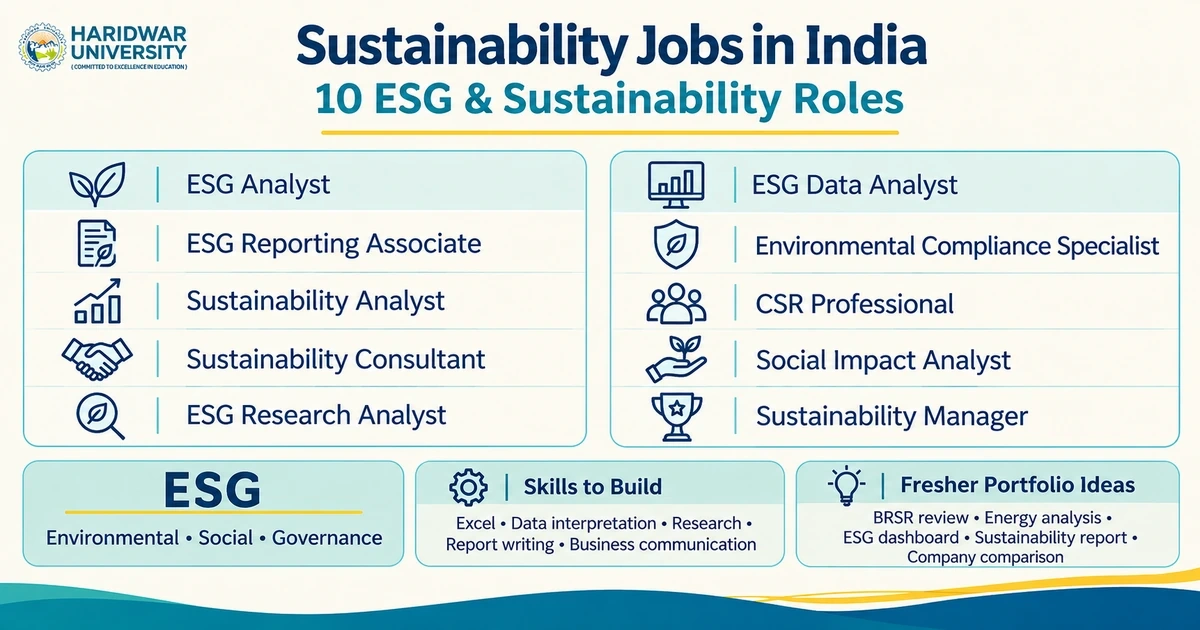
- 4. 10 ESG and Sustainability Jobs in India
- 5. What ESG Professionals Actually Do at Work
- 6. Degrees and Skills That Can Lead to an ESG Career
- 7. How Freshers Can Start a Career in ESG
- 8. ESG Salary in India: What Candidates Should Expect
- 9. Industries That Hire ESG Professionals
- 10. Frequently Asked Questions (FAQs)
- 11. Building a Career in ESG and Sustainability
1. What ESG Means in a Business and Career Context
ESG stands for Environmental, Social, and Governance. It is a comprehensive analytical framework used to evaluate how an organisation manages its operational footprint, ethical responsibilities, and systemic risks beyond traditional balance-sheet financials.
- Environmental: Energy consumption, greenhouse-gas (GHG) Scope 1, 2, and 3 emissions, water stewardship, industrial waste segregation, circular recycling, and pollution prevention.
- Social: Occupational health and safety, fair labour practices, workforce diversity, human rights compliance, customer privacy, and community welfare.
- Governance: Board oversight and independence, anti-bribery policies, executive compensation alignment, shareholder transparency, and regulatory compliance.
An ESG analyst evaluates a company’s real-world energy audit numbers, audits contractor safety metrics, and verifies whether published sustainability disclosures are corroborated by primary audit evidence. The discipline merges rigorous quantitative research, regulatory documentation, and strategic business comprehension.
2. ESG, Sustainability and Green Jobs: Understanding the Difference
While frequently used interchangeably, these terms define distinct operational and professional domains:
| Career Domain | Primary Operational Focus | Representative Roles |
|---|---|---|
| ESG | Measuring, analyzing, assuring, and reporting corporate non-financial disclosures, investor data, and regulatory risks. | ESG Analyst, ESG Reporting Associate, ESG Research Analyst |
| Sustainability | Optimizing organizational resource use, designing circular packaging, and implementing operational decarbonization plans. | Sustainability Analyst, Sustainability Consultant, Sustainability Manager |
| Green Careers | Technical and engineering execution of clean technologies, clean energy, and pollution-control infrastructure. | Solar PV Design Engineer, Wind Turbine Engineer, Environmental Specialist |
For example, a renewable energy engineer designs solar PV plants without drafting annual ESG filings. Conversely, an ESG analyst measures a corporation’s overall renewable power adoption without building electrical substations. For students interested in the engineering side of clean technologies, explore our dedicated guides to renewable energy jobs in India and EV careers in India.
3. Why ESG Careers Are Becoming Relevant in India
The demand for verifiable sustainability data is fundamentally reshaping how Indian businesses operate. Under SEBI guidelines, the top 1,000 listed entities must file Business Responsibility and Sustainability Reports (BRSR). The phased introduction of the BRSR Core framework mandates formal third-party assurance for key environmental and social indicators, making data governance critical.
Furthermore, global supply chain dynamics amplify this requirement. Micro, Small, and Medium Enterprises (MSMEs) supplying multinational corporations or European markets (under EU carbon border adjustment mechanisms) must now document their carbon intensity, water usage, and shop-floor safety. Institutional investors, sovereign wealth funds, commercial banks, and credit rating agencies increasingly tie debt terms and equity valuations to ESG risk ratings.
A March 2026 report by People Matters, citing leadership from Green Business Certification Inc. (GBCI), notes surging demand for sustainability professionals in India alongside a visible scarcity of candidates possessing hands-on capabilities in carbon accounting, BRSR documentation, and lifecycle assessments.
4. 10 ESG and Sustainability Jobs in India
The following roles represent established entry and growth trajectories within the corporate sustainability and ESG ecosystem:
- ESG Analyst: Audits corporate sustainability data, benchmark industry peers, identifies compliance gaps, and prepares analytical dossiers for management or financial rating agencies.
- ESG Reporting Associate: Interfaces with internal business units to aggregate bills, meter readings, and safety logs, compiling formal annual disclosures aligned with BRSR, GRI, or CDP standards.
- Sustainability Analyst: Tracks operational efficiency metrics across energy, water, raw materials, and factory waste streams, formulating conservation roadmaps.
- Sustainability Consultant: Advises multiple corporate clients on materiality assessments, decarbonization roadmaps, circular product lifecycles, and net-zero strategy.
- ESG Research Analyst: Works with equity brokerages, asset management companies, or rating firms (MSCI, Sustainalytics, CRISIL) to evaluate corporate ESG risks for portfolio allocation.
- ESG Data Analyst: Cleans, structures, and automates massive non-financial datasets, building interactive Power BI or Tableau monitoring dashboards.
- Environmental Compliance Specialist: Oversees environmental clearances, State Pollution Control Board (SPCB) consent-to-operate mandates, hazardous waste disposal, and effluent treatment compliance.
- Corporate Social Responsibility (CSR) Professional: Directs Section 135 Companies Act mandated CSR budgets, coordinates NGO partnerships, oversees rural healthcare/education initiatives, and verifies social impact metrics.
- Social Impact Analyst: Evaluates human capital metrics, supply-chain fair wages, POSH compliance, diversity ratios, and community stakeholder sentiment.
- Sustainability Manager: Orchestrates enterprise-wide ESG strategy, leads internal audit readiness, interfaces with board-level ESG committees, and drives investor roadshows (an advanced leadership role).
5. What ESG Professionals Actually Do at Work
To demystify the discipline, consider an industrial enterprise preparing its annual disclosures. The ESG department does not write vague mission statements; it conducts forensic operational accounting:
- Data Collation: Collecting utility bills, diesel generator logs, refrigerant top-ups, raw water extraction meters, industrial wastewater discharge tests, and lost-time injury frequency rates (LTIFR).
- Verification & Calculation: Validating that emission factors match Central Electricity Authority (CEA) grid averages, ensuring Scope 1 and Scope 2 calculations adhere to the GHG Protocol.
- Assurance Readiness: Preparing audit trails and supporting evidence for independent statutory assurance partners.
- Strategic Gap Resolution: Helping procurement teams replace high-carbon packaging materials or transition fleet logistics toward electric mobility.
6. Degrees and Skills That Can Lead to an ESG Career
Because corporate sustainability touches finance, regulation, operations, and science, diverse academic backgrounds provide viable launchpads:
- BBA & MBA: Ideal for strategic corporate coordination, stakeholder management, supply-chain oversight, and ESG consultancy. Explore HU’s guides to career options after BBA and career options after MBA, as well as programmes at Roorkee College of Business Studies.
- B.Com & Finance Qualifications: Excellent for ESG ratings research, sustainable debt underwriting, green bond validation, and statutory non-financial auditing.
- Environmental Science & Agriculture: Critical for biodiversity impact studies, soil carbon metrics, wastewater testing, and circular farming practices.
- Engineering (Mechanical, Chemical, Electrical, Civil): Perfectly suited for factory energy audits, thermodynamic efficiency modeling, industrial emissions scrubbers, and green building certifications (LEED/GRIHA).
- Data Science & Computer Applications: Vital for ESG telemetry platforms, ERP integration (SAP S/4HANA Sustainability), and automated emissions tracking. Explore options on the Haridwar University courses page.
7. How Freshers Can Start a Career in ESG
While theoretical online certifications introduce basic terminology, employers hire candidates who can demonstrate practical analytical rigor. Building a concrete portfolio before graduation establishes credibility:
- Deconstruct a Published BRSR Filing: Download the annual BRSR filing of a Nifty 50 corporation from the NSE/BSE portal. Analyze its Scope 1 and Scope 2 GHG emissions, gender diversity statistics, and water recycling ratios.
- Execute an Energy & Carbon Audit: Model the annual electrical consumption of an academic department or apartment complex, applying official CEA carbon emission factors to compute total metric tonnes of CO2 equivalent (tCO2e).
- Build an ESG Performance Dashboard: Create an interactive dashboard in Microsoft Excel or Power BI visualizing quarterly water intensity, hazardous waste diversion, and workplace safety incidents.
- Draft a Peer Benchmarking Report: Compare the sustainability disclosures of two major FMCG or automotive competitors, identifying reporting strengths and omitted disclosures.
Target early internships in ESG consulting, environmental compliance auditing, or CSR reporting. Consult our practical guide to preparing for and securing meaningful internships.
8. ESG Salary in India: What Candidates Should Expect
Compensation across corporate sustainability reflects your specific functional track (analytical, consultative, technical, or compliance) and the employer’s market stature:
As an indicative reference, compensation benchmarking by Salary.com reported an average annual package of approximately ₹4.14 lakh for an entry-level ESG Analyst I in India, with the 25th-to-75th percentile bracket spanning ₹3.23 lakh to ₹6.88 lakh per year. Specialized consultants in global advisory firms (Big 4, ERM) and quantitative analysts in credit rating agencies command significantly higher salary trajectories as domain expertise and assurance credentials mature.
9. Industries That Hire ESG Professionals
| Industry Sector | Core ESG & Sustainability Responsibilities |
|---|---|
| Banking, Financial Services & Insurance (BFSI) | Climate risk stress-testing, sustainable debt origination, green bond assurance, and portfolio ESG screening. |
| Manufacturing & Automotive | Scope 1 and 2 emissions accounting, worker safety audits, industrial wastewater recycling, and energy management. |
| Information Technology & Services | Data center Power Usage Effectiveness (PUE) tracking, e-waste certification, and digital ESG dashboard solutions. |
| FMCG & Retail | Sustainable agricultural raw material sourcing, Extended Producer Responsibility (EPR) plastic recovery, and supply-chain labour audits. |
| Consulting & Assurance Advisory | BRSR statutory audits, third-party assurance verification, lifecycle assessments (LCA), and net-zero strategy formulation. |
10. Frequently Asked Questions (FAQs)
1. Is ESG a good career option in India?
Yes. Regulatory mandates (such as SEBI BRSR) and global supply-chain compliance have turned ESG into an essential corporate function across finance, manufacturing, IT, consulting, and retail.
2. Can freshers get ESG jobs in India?
Yes. Freshers can enter as ESG reporting assistants, junior research analysts, sustainability interns, environmental compliance trainees, and data analysts—particularly if they demonstrate practical spreadsheet modeling and BRSR knowledge.
3. Which degree is best for an ESG career?
There is no single best degree. BBA/MBA graduates excel in operations and consultancy; B.Com/finance majors lead rating research; environmental scientists manage field audits; and engineers drive technical energy audits.
4. What does an ESG analyst do?
An ESG analyst gathers, audits, and verifies corporate environmental data (energy, emissions, water, waste), evaluates social metrics (workforce safety, diversity), analyzes governance disclosures, and compiles reports for management or rating agencies.
5. Is ESG the same as CSR?
No. CSR focuses on social and community welfare initiatives funded under Section 135 mandates. ESG is a wider business framework evaluating environmental footprints, workforce rights, internal governance, and financial resilience.
6. Do ESG professionals need coding skills?
Coding is not mandatory for general reporting or compliance roles. Advanced Excel is essential across all positions, while SQL, Python, and Power BI are valuable for data-intensive analyst roles.
7. Which industries offer ESG career opportunities?
Opportunities exist across banking, consulting advisory, manufacturing, pharmaceuticals, IT services, renewable energy, infrastructure, and consumer goods.
11. Building a Career in ESG and Sustainability
ESG is not a buzzword or a superficial shortcut to a clean-tech career. It is an exacting professional domain combining commercial judgment, data integrity, environmental stewardship, and accountability.
My advice to students is to start with a strong foundational degree, learn how organizations account for their environmental and social footprint, and gain hands-on experience working with real corporate disclosures. In this evolving landscape, the ability to question data sources, verify methodology, and communicate findings clearly is your most valuable career asset.
Ready to Advance Your Education at Haridwar University?
Prepare for high-growth careers in modern management, business analytics, sustainability, and corporate leadership. Explore our industry-aligned BBA, MBA, Commerce, and Engineering degree programmes with generous merit scholarships and dedicated career support. Applications are open for the 2027-28 session.