

AI in Finance & Accounting: What B.Com and MBA Students Need to Learn in 2026
Mr. Javed Ali
Head, Business Studies, Haridwar University
Artificial intelligence is moving from a technology discussion into everyday finance and accounting work. Financial institutions already use AI for forecasting, anomaly detection, risk and fraud analysis, document processing, customer service and data-driven decision-making.
For students, I think the more useful question is not whether AI will enter finance. It already has. The question is what a B.Com or MBA student should learn so that AI becomes a working capability rather than another tool they have merely heard about. That means keeping the accounting and finance fundamentals intact while adding data analysis, AI literacy, practical tool use, critical evaluation and professional judgement.
At Haridwar University, this direction is already reflected in our business education ecosystem. The Roorkee College of Business Studies currently lists B.Com with AI and MBA with AI, with Finance, HR and Marketing options for the MBA.
Table of Contents
- How AI Is Changing Finance and Accounting Work
- Where AI Is Being Applied Across Finance and Accounting
- How AI Supports Financial Analysis, Forecasting and Risk Management
- How AI Is Changing Accounting, Audit and Financial Reporting
- What B.Com Students Should Learn About AI, Data and Accounting
- What MBA Finance Students Should Learn About AI and Analytics
- Which AI Tools Finance and Accounting Students Should Learn First
- How Students Can Build Practical Finance and Accounting AI Projects
- How Students Should Verify AI-Generated Financial Information
- How AI Is Changing Finance and Accounting Career Skills
- Frequently Asked Questions (FAQs)
- From Commerce Fundamentals to AI-Enabled Finance Practice
How AI Is Changing Finance and Accounting Work
AI is not one technology doing one job. In finance, different AI capabilities address different problems.
| Finance or Accounting Task | AI Capability | Practical Use |
|---|---|---|
| Financial analysis | Pattern recognition and summarisation | Identify trends across financial data |
| Forecasting | Predictive modelling | Support revenue, demand or cash-flow forecasts |
| Fraud detection | Anomaly detection | Flag unusual transactions or behaviour |
| Risk management | Predictive analytics | Identify patterns associated with risk |
| Document processing | AI-assisted extraction | Process financial documents and information |
| Research | NLP and generative AI | Search, classify and summarise large volumes of text |
| Customer service | Conversational AI | Handle routine financial queries |
| Reporting | Generative AI | Assist with summaries and draft reporting |
Google Cloud identifies predictive modelling, anomaly detection, sentiment analysis, document processing and generative AI among the capabilities being applied across financial services.
But there is an important distinction here: AI capability is not the same thing as financial judgement. A model can identify an unusual transaction. It does not automatically establish why that transaction is unusual or what action a professional should take.
That distinction should shape how students learn AI.
Where AI Is Being Applied Across Finance and Accounting
The applications are broad enough that students should stop thinking of AI in finance as synonymous with high-frequency trading or basic chatbots.
In banking and financial services, AI can support personalised services, risk and fraud management, compliance, operations and customer engagement.
In accounting, the applications move closer to the daily workflow: document processing, transaction analysis, reconciliation support, reporting, audit analysis and identifying unusual entries.
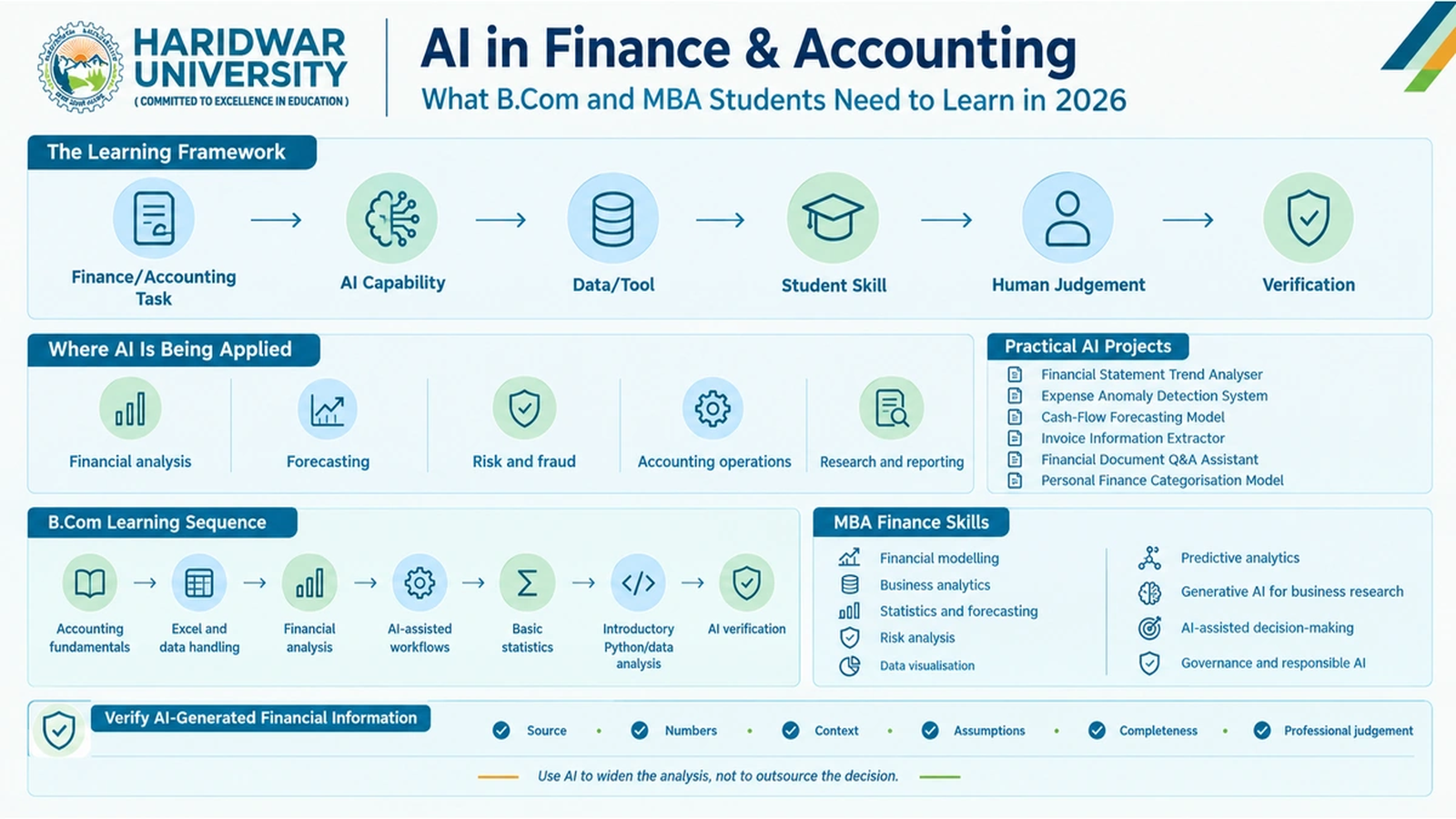
I would organise the landscape into five areas:
Five Critical Functional Domains:
- Financial analysis: Processing multi-period statements to detect growth trajectories and operational inefficiencies.
- Forecasting: Leveraging historical business records for predictive cash-flow modelling and sensitivity analysis.
- Risk and fraud: Real-time anomaly detection flagging suspicious ledger entries and credit patterns.
- Accounting operations: Eliminating manual journal data entry to redirect accountant hours to strategic interpretation.
- Research and reporting: Synthesising market filings, regulatory updates and management commentaries.
How AI Supports Financial Analysis, Forecasting and Risk Management
Financial analysis has traditionally required students to understand balance sheets, ratio analyses, industry trends, capital structures and macroeconomic context. AI does not eliminate those foundations; it changes how much data a student can process and how rapidly trends can be surfaced.
For example, a student analysing five years of corporate annual reports can use AI-assisted analytics to pinpoint margin compressions or prepare comparative variance summaries. In risk management, machine-learning algorithms surface statistical outliers across millions of transactions. The model output is a signal for thorough investigation, not a final verdict.
How AI Is Changing Accounting, Audit and Financial Reporting
Accounting is particularly interesting because it contains many structured and repetitive processes alongside work that requires interpretation.
AI can assist with extracting information from documents, processing large transaction datasets, identifying anomalies and preparing summaries. Current accounting education is beginning to reflect this shift. The SWAYAM Plus AI for Accounting course, for example, is specifically designed for commerce and management students and combines accounting concepts with AI, Python, real-world datasets and interactive laboratory work.
For audit and reporting, however, speed cannot be the only measure of success.
A generated summary may omit an important qualification. An automated classification may be wrong. A financial figure may have been interpreted without sufficient context.
The accounting student of 2026 therefore needs two abilities at the same time:
understand the numbers and question the technology handling them.
What B.Com Students Should Learn About AI, Data and Accounting
For an undergraduate commerce student, jumping into complex neural network mathematics is counterproductive. Start with tangible business and financial problems.
The emphasis should remain on applying technology to familiar commerce problems.
A student should be able to analyse a financial statement, clean a dataset, create meaningful comparisons, use an AI system to explore the information and then independently check whether the output makes financial sense.
HU's B.Com with AI is positioned within the Roorkee College of Business Studies alongside other business and management programmes. Students can also read our related B.Com curriculum and CA/CS/CMA pathways guide for broader commerce-study context.
What MBA Finance Students Should Learn About AI and Analytics
MBA Finance students should go one level deeper.
Their foundation should include:
- Financial modelling
- Business analytics
- Statistics and forecasting
- Risk analysis
- Data visualisation
- Financial research
- Predictive analytics
- Generative AI for business research
- AI-assisted decision-making
- Governance and responsible AI
The reason is simple. An MBA Finance graduate is more likely to use AI to support a business decision than to build the underlying model from scratch.
The World Economic Forum's Future of Jobs Report 2025 places AI and big data among the fastest-growing skills and also highlights analytical thinking, leadership and other human capabilities.
That combination matters. Finance professionals need technology fluency without losing the ability to interpret business consequences.
HU's current MBA with AI combines management education with AI-enabled business learning and offers Finance, HR and Marketing options.
Which AI Tools Finance and Accounting Students Should Learn First
Avoid chasing every new software launch. Focus on tool categories that solve core commercial workflows:
| Capability | What to Practise |
|---|---|
| Generative AI | Research, summarisation and structured analytical drafting |
| Spreadsheet AI | Formula assistance, cohort analysis, and macro generation |
| Data analytics | Interactive BI dashboards, trend visualisations, and variance tracking |
| Document AI | Automated invoice data extraction and balance sheet parsing |
| Forecasting tools | Time-series forecasting, scenario testing, and budget simulations |
| Research tools | Retrieving, filtering, and comparing company disclosures |
| Python | Pandas data manipulation, statistical cleaning, and automated reporting |
How Students Can Build Practical Finance and Accounting AI Projects
Tangible capstone projects provide credible proof of competence for recruiter interviews:
1. Financial Statement Trend Analyser
Automate multi-year ratio analysis and margin decomposition across Indian corporate disclosures.
2. Expense Anomaly Detection System
Deploy clustering and outlier identification algorithms to highlight irregular expense items in transaction ledgers.
3. Cash-Flow Forecasting Model
Build predictive cash-burn models incorporating seasonal revenue fluctuations and working capital requirements.
4. Invoice Information Extractor
Use OCR and document AI to parse vendor invoices, validate GST numbers, and cross-check total calculations.
5. Financial Document Q&A Assistant
Construct a local retrieval-augmented system to query quarterly earnings transcripts and risk disclosures.
6. Personal Finance Categorisation Model
Classify bank statements into distinct spending buckets and benchmark prediction precision.
A good project should show the problem, dataset, method, evaluation and limitations, rather than simply presenting a screenshot of an AI tool.
Students looking for broader project-building guidance can also refer to HU's AI portfolio guide and AI project ideas for engineering students, adapting the documentation principles to finance and accounting problems.
How Students Should Verify AI-Generated Financial Information
In corporate finance, a plausible-sounding hallucination can lead to catastrophic capital mistakes. Before adopting any AI-generated figure or narrative, follow this 6-point verification standard:
- Source Verification: Where did the underlying data originate, and does the primary filing exist?
- Mathematical Reconciliation: Do all generated totals, percentages, and formulas tie back to original ledgers?
- Accounting Context: Has the model misconstrued the reporting period, currency denomination, or tax standard?
- Underlying Assumptions: Are growth rates, discount factors, and terminal multiples realistic?
- Completeness: Have audit qualifications, notes to accounts, or contingent liabilities been skipped?
- Professional Judgement: What qualitative governance factors require human sign-off?
How AI Is Changing Finance and Accounting Career Skills
I do not see the future of finance as a simple contest between accountants and machines.
The more useful way to look at it is task by task.
The World Economic Forum projects substantial labour-market disruption by 2030 and reports that 39% of workers' core skills are expected to change. It also identifies AI and big data as the fastest-growing skill category.
For finance and accounting students, this means the valuable combination is increasingly:
ACCA's 2026 research, based on a global survey of 1,600 finance professionals, also identifies skills and data gaps as important issues for finance teams becoming AI-enabled.
That is why I would not advise students to abandon accounting fundamentals in favour of AI tools. The better strategy is to make those fundamentals more powerful with technology.
Frequently Asked Questions (FAQs)
1. How is AI used in finance and accounting?
AI is used for financial analysis, forecasting, anomaly detection, fraud and risk analysis, document processing, customer service, research and reporting support.
2. Should B.Com students learn AI?
Yes. They should begin with AI literacy, data handling, financial analysis and practical AI-assisted workflows rather than jumping directly into advanced machine learning.
3. What AI skills should MBA Finance students learn?
MBA Finance students should develop skills in financial analytics, forecasting, data visualisation, predictive modelling, generative AI, research and AI-assisted decision-making.
4. Can AI do accounting?
AI can automate or assist with specific accounting tasks, but accounting work also involves interpretation, controls, professional judgement and accountability. Those responsibilities cannot simply be handed to an AI system.
5. Which AI tools should finance students learn?
Students should prioritise tools for generative AI, spreadsheets, data analysis, document processing, forecasting and research. The exact product matters less than understanding the underlying capability.
6. Can students use ChatGPT for accounting work?
Yes, for tasks such as explaining concepts, structuring research, summarising supplied information or assisting with analysis. Financial figures, calculations and source-based claims should always be independently checked.
7. Will AI replace finance and accounting jobs?
AI is likely to automate some tasks and change many workflows, but the evidence points towards changing skill requirements rather than a simple one-for-one replacement of entire professions. Human judgement, analytical thinking, communication and oversight remain important.
From Commerce Fundamentals to AI-Enabled Finance Practice
I encourage students to resist both extremes: dismissing AI as a temporary gimmick or assuming it replaces core commerce acumen. The true path to professional distinction lies in synthesis:
Master core commerce principles. Work with real financial data. Understand what AI models can and cannot do. Select the right tool for the right analytical problem. Verify every output against fundamental principles. And articulate your conclusions with confidence and professional clarity.
Accelerate Your Career with AI-Enabled Business Programmes at HU
Step into future-ready commerce education with B.Com with AI and MBA with AI at Roorkee College of Business Studies. Gain practical analytics expertise, industry mentorship, and corporate placement readiness.