

AI in Nursing: How Artificial Intelligence Is Changing Nursing Practice
Dr. Jiya Sajeev
Head, Nursing Department, Haridwar University
Artificial intelligence is no longer a distant technology discussed only in computer science departments. AI in nursing is becoming directly relevant to clinical documentation, patient monitoring, clinical decision support, care planning, communication and healthcare workflows. The important question for nurses, however, is not simply where AI can be used. It is what changes when an AI-generated alert, risk score, summary or recommendation becomes part of everyday clinical practice.
This represents a shift in responsibility rather than a transfer of responsibility. While AI algorithms process vast volumes of clinical telemetry and physiological data rapidly, nurses still have to interpret that information in the context of an individual patient, recognise anomalies that do not fit mathematical patterns, communicate with patients and families, and act decisively within professional and clinical boundaries.
A 2026 qualitative systematic review synthesising 26 studies involving 678 nurses and nursing professionals across 11 countries identified five recurring themes: clinical efficiency and decision-making, implementation barriers, ethical concerns, evolving nursing roles, and communication. That evidence provides a grounded starting point for understanding artificial intelligence in nursing—without overstating its capabilities or dismissing its transformative clinical potential.
Table of Contents
- How AI Is Changing Nursing Practice and Healthcare Delivery
- Where AI Fits Into Everyday Nursing Workflows
- How AI Supports Clinical Decision-Making and Patient Monitoring
- How AI Is Changing Nursing Documentation and Handover
- What AI Can and Cannot Do for Patient Safety
- How Nurses Should Evaluate AI Outputs in Practice
- What AI Adoption Means for Nursing Skills and Professional Roles
- How Healthcare Teams Can Integrate AI Responsibly
- Frequently Asked Questions (FAQs)
- Keeping Nursing Judgement at the Centre of AI-Enabled Care
How AI Is Changing Nursing Practice and Healthcare Delivery
The most practical way to understand AI in nursing is to examine concrete clinical tasks rather than generic technology labels. A bedside nurse may encounter artificial intelligence through a continuous predictive monitoring platform, a clinical decision-support tool, an automated documentation workflow, a patient-facing conversational chatbot, or an algorithm identifying subtle patterns across hospital records.
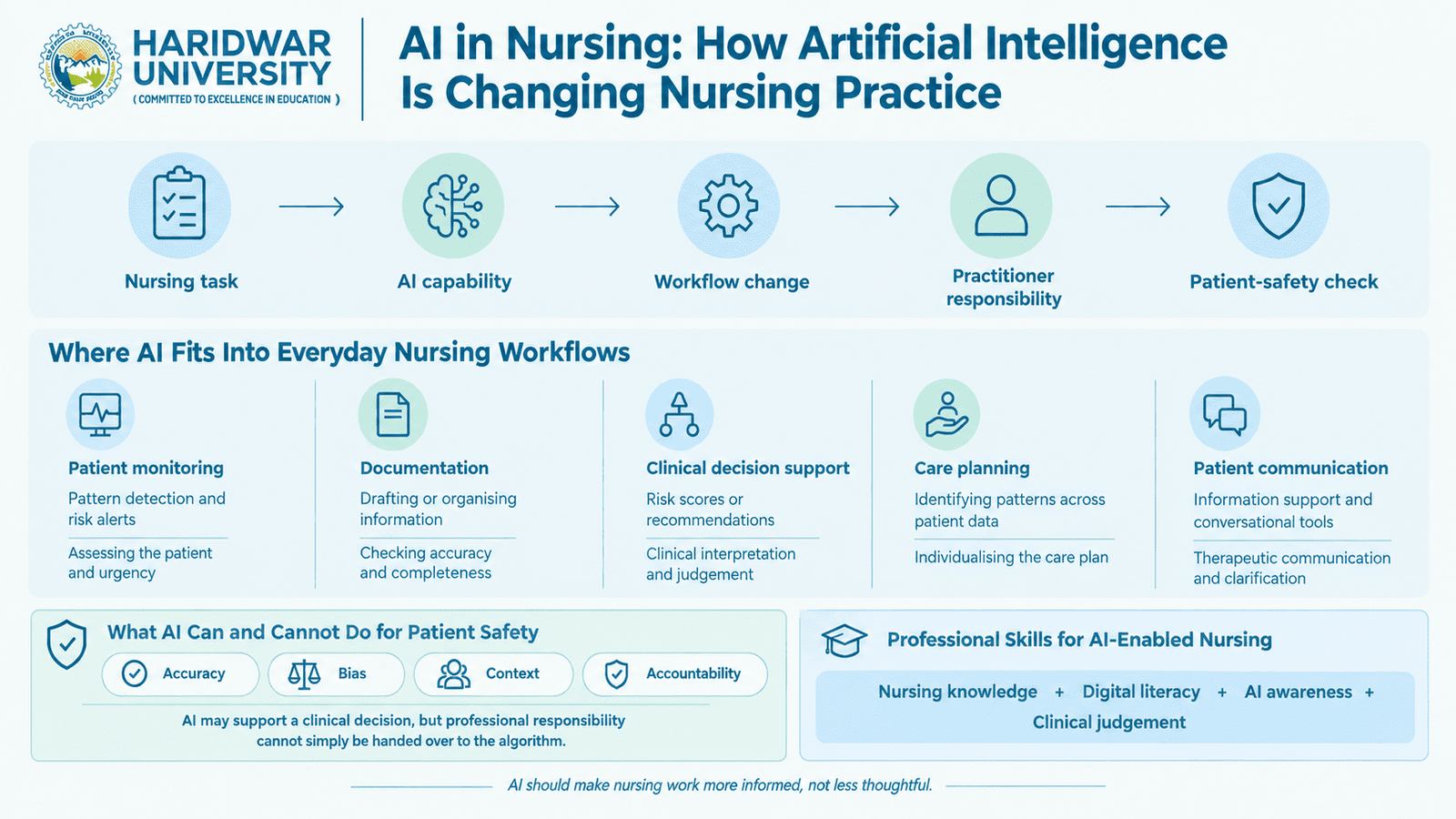
While these tools perform distinct computational tasks, their operational clinical sequence remains consistent:
The table below maps primary nursing functional areas to their corresponding AI capabilities and the enduring human responsibilities that must remain with qualified nursing professionals:
| Nursing Area | Possible AI Contribution | What Remains with the Practitioner |
|---|---|---|
| Patient Monitoring | Multi-parameter pattern detection, trend analysis and proactive risk alerts | Bedside patient assessment, verifying vital signs and determining clinical urgency |
| Documentation | Drafting clinical notes, structuring unstructured notes, and summarising EHR data | Checking factual accuracy, clinical completeness, context, and legal sign-off |
| Clinical Decision Support | Generating evidence-based risk scores, triage prioritisation, and recommendations | Holistic clinical interpretation, contextual evaluation, and expert judgement |
| Care Planning | Identifying health patterns, historical trajectories, and standard guideline matching | Individualising care plans based on patient values, family dynamics, and lived context |
| Patient Communication | Patient education chatbots, multilingual support, and routine discharge reminders | Therapeutic empathy, addressing anxiety, de-escalation, and complex clarification |
| Research & Education | Medical literature synthesis, rapid evidence extraction, and case simulations | Critical appraisal of evidence, continuing education, and professional development |
| Workforce Management | Forecasting patient acuity, unit workload surges, and staffing requirements | Final staffing allocation, team safety oversight, and ethical accountability |
This functional distinction is crucial. Faster data processing does not automatically equate to better nursing care. The 2026 meta-synthesis highlighted that while nurses appreciate AI's capacity to streamline repetitive tasks and improve diagnostic accuracy, they encounter significant technical friction, organisational hurdles, ethical dilemmas, and communication barriers during deployment. True progress means making nursing work more informed, not less thoughtful.
Where AI Fits Into Everyday Nursing Workflows
AI provides the greatest utility when a clinical workflow generates more simultaneous information than an individual practitioner can process manually in real time.
Consider inpatient hemodynamic monitoring in critical care or surgical wards. Rather than waiting for an isolated vital sign to breach an acute threshold, modern machine-learning models continuously analyze longitudinal telemetry—such as subtle shifts in heart rate variability, mean arterial pressure, respiration rates, and pulse oximetry. The software identifies non-linear deterioration signatures hours before an overt clinical emergency like septic shock occurs.
In this workflow, the nurse's role evolves from manual metric collection to synthesising algorithmic alerts with hands-on physical assessment, patient history, medication changes, and direct bedside observations.
The same principle governs care planning. While an algorithm can aggregate electronic medical records (EMR) to suggest standard post-operative protocols, a patient's real-world care plan cannot be reduced to automated output. Nursing practice relies on observing physical mobility, understanding family support structures, respecting personal patient preferences, and exercising professional intuition—dimensions that structured hospital databases rarely capture.
This is why implementing artificial intelligence in nursing differs fundamentally from introducing routine administrative software. AI directly influences the clinical information flow, fundamentally altering what healthcare practitioners must notice, prioritise, and cross-examine.
How AI Supports Clinical Decision-Making and Patient Monitoring
Clinical decision support systems (CDSS) powered by machine learning represent one of the highest-impact applications of artificial intelligence in nursing practice. These systems evaluate complex patient data points to produce early risk estimates, fall risk scores, pressure ulcer predictions, and automated triage classifications.
Crucial Clinical Principle: An alert is not a diagnosis.
Rigorous clinical practice demands an unbroken assessment chain:
The fourth step—hands-on nursing assessment—can never be bypassed.
When an AI system flags a patient as high-risk for deterioration, the attending nurse must verify whether the alert corresponds with actual physical symptoms, laboratory findings, and patient responsiveness. Conversely, a reassuring "low risk" score must never instill a false sense of security when clinical observations indicate that the patient is decompensating.
Algorithms are inherently vulnerable to statistical artifacts, false positives, false negatives, and sensor miscalibrations that fail to reflect unique patient complexities. The World Health Organization (WHO) has underscored that AI applications in health require rigorous governance frameworks, ethical oversight, and clear lines of professional accountability for frontline healthcare workers.
How AI Is Changing Nursing Documentation and Handover
Clinical documentation represents another domain undergoing profound workflow transformations through Generative AI and natural language processing (NLP).
AI-driven ambient documentation tools can transcribe nurse-patient interactions, structure unstructured clinical notes, summarise voluminous progress charts, and generate draft handover reports between nursing shifts. While these capabilities alleviate burdensome administrative overhead, they introduce an indispensable verification responsibility.
Practice Rule: A draft note is always a draft.
Nurses must systematically verify that machine-generated documentation accurately reflects what occurred at the bedside, ensure that subtle clinical details are not omitted, confirm that terminology conforms to regulatory standards, and verify that the final record cannot mislead downstream healthcare providers.
This standard applies equally to shift handover summaries. A concise, AI-condensed summary is advantageous only if it preserves critical safety information and continuity of care.
Success should not be evaluated simply by asking, "How many minutes did AI save?" The decisive metric is: Did the automated workflow save administrative time without sacrificing accuracy, clinical depth, or patient safety? As multi-modal models enter healthcare environments, WHO's guidance on Large Multi-Modal Models (LMMs) highlights both their clinical potential and the necessity of mitigating algorithmic hallucinations and inaccuracies.
What AI Can and Cannot Do for Patient Safety
Artificial intelligence enhances patient safety by flagging subtle deteriorating trends and reducing documentation delays. Simultaneously, poor implementation introduces serious clinical risks.
The American Nurses Association (ANA) 2026 AI in Nursing Practice Think Tank identified significant concerns, including automation bias (overreliance on machine recommendations), ambiguous accountability, algorithmic bias across diverse patient demographics, and cognitive overload caused by alert fatigue.
To safeguard patient well-being, nurses must apply four essential checks before acting upon automated outputs:
| Safety Check Dimension | Essential Nursing Question |
|---|---|
| Accuracy Check | Does the output accurately mirror all verified bedside observations, vital records, and diagnostic results? |
| Bias & Fairness Check | Could the underlying training data or algorithm perform unequally across different age groups, genders, ethnicities, or comorbidities? |
| Clinical Context Check | Does the algorithmic suggestion make therapeutic sense given this specific patient's current goals of care, comorbidities, and acute changes? |
| Accountability Check | Who holds the legal and professional responsibility for the final medical decision? (It is always the licensed healthcare practitioner). |
WHO guidance firmly places ethics and human rights at the heart of health AI design and deployment. In bedside nursing, this establishes a clear rule: AI may inform clinical decisions, but professional responsibility can never be outsourced to an algorithm.
How Nurses Should Evaluate AI Outputs in Practice
Developing AI literacy does not require turning nursing practitioners into software programmers or data scientists. Instead, it equips nurses with the critical thinking skills needed to question computational results intelligently.
When interacting with any clinical AI output, practitioners should execute a disciplined six-stage evaluation sequence:
For instance, if a predictive monitoring system generates a high sepsis risk score, the nurse must identify what inputs drove the score (such as elevated heart rate or white blood cell count), understand its statistical limitations, and check whether localized factors (like an acute anxiety episode or post-exercise tachycardia) explain the anomaly. If generative AI generates draft discharge instructions, the nurse must review every line for pharmacological accuracy.
This evolving paradigm is reshaping healthcare education. A 2026 scoping review of AI literacy among nursing professionals highlighted technical comprehension and critical evaluation as indispensable core competencies. At Haridwar University, this forward-looking integration is embodied in the progressive B.Sc. Nursing with AI programme delivered through the Roorkee College of Allied Health Sciences.
What AI Adoption Means for Nursing Skills and Professional Roles
The rapid growth of AI does not diminish the human core of nursing; it amplifies the qualities machines cannot replicate. As computational tools assume mechanical data tasks, distinctly human clinical faculties become even more valuable.
Future-ready nursing professionals require a synergistic blend of skills:
- Robust Clinical Fundamentals: Deep mastery of human anatomy, physiology, pharmacology, and hands-on physical assessment.
- Digital Health & Informatics Literacy: Comfortable navigation of electronic health records, connected health sensors, and data pipelines.
- Foundational AI Literacy: Comprehension of how algorithms process inputs, generate probabilistic scores, and where limitations lie.
- Critical Analytical Evaluation: The intellectual discipline to interrogate algorithmic outputs rather than adopting them passively.
- Data Privacy & Cybersecurity Awareness: Safeguarding protected health information (PHI) across automated digital platforms.
- Therapeutic Communication: Explaining automated processes and clinical diagnoses clearly and compassionately to patients and relatives.
- Ethical Reasoning & Advocacy: Protecting vulnerable patients from biased algorithms or automated misclassifications.
- Interdisciplinary Collaboration: Working fluently alongside data analysts, hospital IT teams, physicians, and clinical ethicists.
The 2026 systematic review of nurses' experiences documented expanding professional roles, requiring supervisory competencies and technical confidence alongside patient-centred care and clinical empathy.
For aspiring students, the strategic balance is clear: learning AI must never displace foundational nursing science. The winning formula is:
Students exploring this academic journey can review our in-depth B.Sc. Nursing Guide 2026, which outlines the comprehensive four-year curriculum, clinical hospital rotations, and state-of-the-art training laboratories. Students can also investigate diverse career pathways in our guide to career options after B.Sc. Nursing, as well as cross-disciplinary innovations in AI in pharmacy and healthcare.
How Healthcare Teams Can Integrate AI Responsibly
Successful clinical integration is never simply about purchasing software licenses and providing cursory user tutorials. Hospital workflows must be designed collaboratively around frontline nurses who use the systems at the point of care.
Healthcare leadership must evaluate six essential organizational pillars:
- Clinical Relevance: Is the AI model addressing a real, clearly defined clinical pain point or diagnostic bottleneck?
- Workflow Fit: Does the technology eliminate unnecessary steps, or does it impose an extra layer of burdensome screen time?
- Targeted Training: Do nurses understand not only how to click through software, but how the underlying models function and where their failure modes occur?
- Clear Governance: Are institutional protocols established regarding clinical accountability, documentation standards, and overrides?
- Continuous Performance Evaluation: Are algorithmic accuracy, diagnostic false positives, and patient outcomes routinely audited in real clinical settings?
- Frontline Feedback Channels: Can bedside nurses rapidly flag misleading alerts, report algorithmic hallucinations, and guide software updates?
The 2026 nursing systematic review explicitly advocates for user-centred design, frontline nurse participation in algorithm co-creation, explainable outputs, alert threshold customisation, and continuous professional training. Furthermore, the American Nurses Association has called for nurse-led guardrails to ensure patient protection.
This marks a pivotal shift: nurses must not be treated as passive end-users of healthcare AI. Their deep observational knowledge and bedside clinical insight make them indispensable contributors to how clinical AI systems are evaluated, refined, and governed.
Frequently Asked Questions (FAQs)
1. How is AI currently used in nursing?
AI is currently deployed and actively investigated across clinical decision support, predictive analytics for patient deterioration, continuous physiological monitoring, documentation streamlining, individualised care planning, conversational communication tools, and hospital workload management.
2. How does AI support nursing documentation?
AI assists by transcribing bedside speech, organising clinical data points, preparing concise handover notes, and producing draft summaries. However, licensed nurses must always verify and sign off on all documentation to ensure legal and clinical accuracy.
3. How is AI used in patient monitoring?
AI continuously examines multi-parameter data streams to detect subtle non-linear physiological deterioration signatures hours before vital signs cross critical limits. Alerts indicate a need for prompt clinical evaluation rather than automated action.
4. Which types of AI are used in clinical decision support?
Clinical decision support tools deploy machine learning algorithms, deep predictive analytics, natural language processing (NLP), and rule-based expert systems to produce risk scores, detect drug-drug interactions, and aid triage prioritization.
5. Can AI replace nurses' clinical judgement?
No. While AI processes complex data streams efficiently, essential elements of nursing—including clinical judgment, bedside physical evaluation, empathetic communication, ethical accountability, and patient advocacy—remain strictly human responsibilities.
6. What risks should nurses consider when using AI?
Key clinical hazards include algorithmic inaccuracies, training biases, overreliance on automated alerts, patient privacy infringements, unclear clinical accountability, alert fatigue, and poor alignment with bedside nursing workflows.
7. What AI skills should nursing practitioners develop?
Nurses should cultivate practical AI literacy, health informatics fluency, critical appraisal skills to challenge automated outputs, data privacy competencies, and the ability to combine data insights with physical patient assessment.
Keeping Nursing Judgement at the Centre of AI-Enabled Care
The most lasting transformation brought by artificial intelligence in nursing may not be a particular diagnostic algorithm, mobile app, or robotic device. Rather, it is a transformation in how nurses interact with complex health data.
AI excels at recognizing patterns across voluminous datasets at speeds impossible for manual human calculation. Nursing practice contributes the essential complementary elements: holistic context, clinical observation, compassionate communication, ethical reasoning, and ultimate accountability. The intersection of both disciplines is where modern healthcare excellence emerges.
As AI systems proliferate across modern hospitals and clinics, the most effective nursing leaders will not simply be those who operate the largest number of technological tools. They will be the clinicians who understand when to leverage automated tools, when to challenge machine outputs, and when professional human judgment must take absolute precedence.
For nursing students, the educational directive is clear: establish rock-solid clinical fundamentals, master digital health and AI literacies, cultivate critical evaluation habits, and place patient safety at the heart of every technology-assisted workflow.
Advance Your Nursing Career with Healthcare AI at Haridwar University
Learn in advanced clinical simulation laboratories and gain real-world hospital experience where cutting-edge digital health tools and patient-centred empathy converge. Discover our specialized B.Sc. Nursing programmes today.