

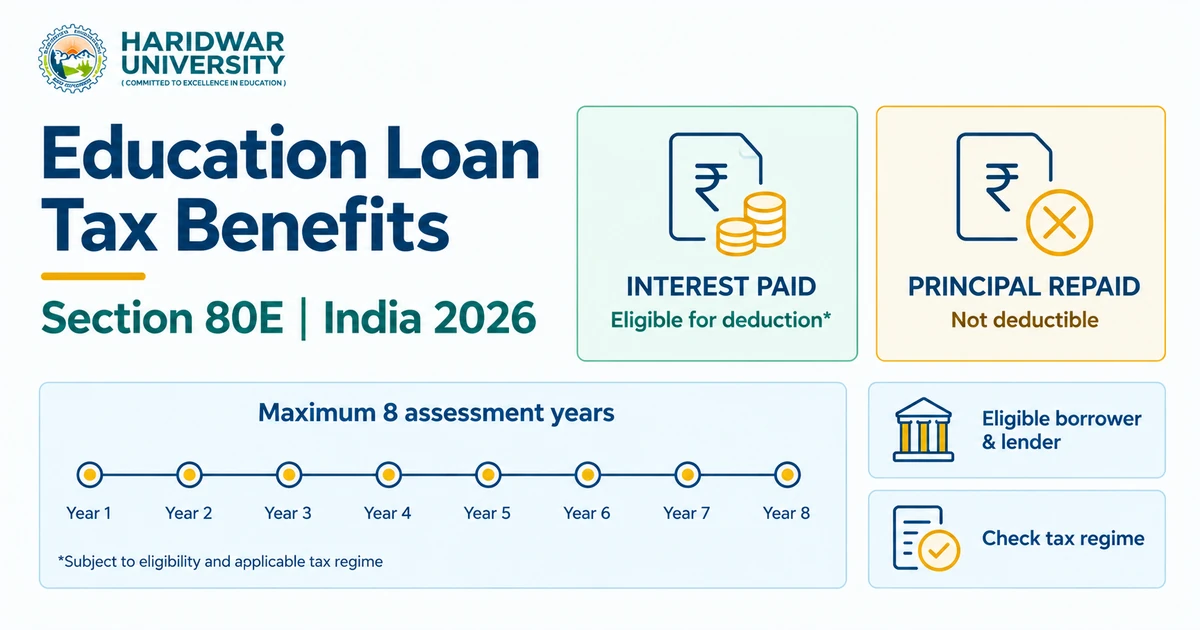
Paying for higher education is a major financial commitment, and the cost does not end when the admission fee is paid. For families using an education loan, interest can add substantially to the amount eventually repaid. However, eligible borrowers may be able to reduce their taxable income through education loan tax benefits under Section 80E of the Income-tax Act, 1961.
The provision is useful, but it is often misunderstood. Section 80E covers qualifying interest payments, not the principal amount repaid. Eligibility also depends on who borrowed the money, the purpose of the loan, the lender, and the tax regime selected. Crucially, the deduction is not available under every tax regime.
At Haridwar University, we encourage students and parents to evaluate these financial details while planning their degree funding. A tax deduction can provide meaningful relief, but it should be calculated as part of a wider funding strategy rather than treated as a substitute for comparing transparent course fees, scholarships, and lender terms.
Table of Contents
- 1. Understanding Section 80E and Its Tax Benefits
- 2. Eligibility Rules for Claiming the Deduction
- 3. Interest Deduction Limits and the Eight-Year Rule
- 4. Education Loan Tax Benefits Under the Old and New Regimes
- 5. A Worked Example of the Tax Deduction
- 6. Documents and Steps for Claiming Section 80E
- 7. Education Funding Decisions Beyond Tax Savings
- 8. Frequently Asked Questions (FAQs)
- 9. Plan Your Education Finances with Clear Numbers
1. Understanding Section 80E and Its Tax Benefits
Section 80E provides an income-tax deduction for qualifying interest paid on a loan taken from a recognized financial institution or an approved charitable institution to fund higher education. The deduction applies when the loan is utilized for the taxpayer's own higher education or that of a qualifying relative.
Section 80E can apply to eligible higher education pursued either in India or abroad, provided the borrower and loan structure meet statutory conditions. Under the provision, higher education means any course of study pursued after passing the Senior Secondary Examination (Class 12) or its equivalent from a recognized board or university. This covers undergraduate and postgraduate degree programmes.
| Loan Component | Section 80E Treatment |
|---|---|
| Qualifying interest actually paid | Eligible for deduction, subject to statutory rules |
| Principal repaid | Not deductible under Section 80E |
| Interest merely charged but not yet paid | Not deductible merely because it has accrued |
| Loan repayment after the permitted deduction period | No Section 80E deduction once the 8-year period concludes |
The official Section 80E provision published by the Income Tax Department outlines the exact statutory wording on qualifying interest, eligible relationships, and allowable deduction timelines. While there is no upper monetary rupee ceiling on qualifying interest under Section 80E itself, eligibility hinges strictly on borrower status, lending institution, purpose, and tax regime selection.
2. Eligibility Rules for Claiming the Deduction
Section 80E is available exclusively to an individual taxpayer, not automatically to everyone associated with a student. The statutory rules mandate five key eligibility criteria:
- Eligible Borrower: The individual claiming the tax deduction must be the primary applicant who formally contracted the education loan.
- Eligible Purpose: The borrowed capital must directly fund full-time higher education for the borrower or their qualifying relative.
- Eligible Relationship: A relative, under this section, is defined strictly as the taxpayer's spouse, children, or a student for whom the individual serves as legal guardian.
- Eligible Lender: The loan must originate from a scheduled commercial bank, a financial institution governed by the Banking Regulation Act, or an approved charitable institution. Private loans from employers, friends, or family do not qualify.
- Actual Interest Outflow: The deduction is permitted only against interest actually paid out of income chargeable to tax during the corresponding previous financial year.
Borrower Identity Matters: Consider a parent who signs as the primary borrower for their child's engineering degree. The parent may claim the interest deduction against their personal taxable income. Conversely, if an adult student signs the loan in their own name, a parent cannot claim the deduction simply because they contribute toward monthly EMIs. Confirm borrower documentation before finalizing tax filings.
3. Interest Deduction Limits and the Eight-Year Rule
Unlike Section 80C (capped at ₹1.5 lakh) or Section 80D, Section 80E does not impose a maximum monetary cap on qualifying interest. Instead, the law restricts the time duration over which deductions can be availed.
The Eight-Year Window Rule
The deduction is available for the initial assessment year (the year you begin servicing loan interest) plus the seven succeeding assessment years immediately following, or until the qualifying interest is repaid in full, whichever occurs earlier. This creates an absolute maximum span of 8 assessment years.
Two critical operational realities deserve close attention:
- The period is a cap, not an automatic guarantee: If a family repays their education loan in five years, the deduction terminates once interest liability ceases.
- The clock does not reset: Changing jobs, shifting employers, or refinancing the loan through another financial institution does not restart the eight-year deduction counter. Maintain meticulous records from the very first month interest repayment commences.
4. Education Loan Tax Benefits Under the Old and New Regimes
Tax regime selection is one of the most critical considerations for education loan borrowers. A deduction allowed under one regime is not universally available across both.
Under the statutory framework applicable to Assessment Year 2026–27, the Income Tax Department distinguishes deductions allowable under the normal (old) regime from the simplified new regime under Section 115BAC. Section 80E is omitted from the permissible deduction schedule under the new tax regime.
| Tax Consideration | Old / Normal Regime | New Regime (Sec. 115BAC) |
|---|---|---|
| Section 80E Deduction | Available (subject to conditions) | Not available |
| Qualifying Interest | Deduction on eligible interest paid | No Section 80E deduction |
| Principal Repayment | Not deductible under 80E | Not deductible under 80E |
| Strategic Comparison | Compute total tax after Chapter VI-A deductions | Compute tax under concessional slab rates |
For detailed verification, taxpayers should review the official Income Tax Department overview of deductions allowable to taxpayers. Do not select a tax regime solely to claim Section 80E; calculate your net tax liability under both regimes taking into account salary slabs, HRA, Section 80C, and standard deductions.
5. A Worked Example of the Tax Deduction
To illustrate how Section 80E impacts taxable income, consider an eligible borrower under the old tax regime who pays ₹1,20,000 in qualifying interest during a financial year:
| Calculation Step | Amount (₹) |
|---|---|
| Taxable income before Section 80E deduction | ₹9,00,000 |
| Less: Qualifying education loan interest paid during the year | ₹1,20,000 |
| Illustrative taxable income after deduction | ₹7,80,000 |
Important Clarification: The deduction reduces taxable income by ₹1,20,000; it does not mean the borrower receives a ₹1,20,000 direct cash refund. The actual cash savings depend on the individual's marginal tax bracket plus applicable health and education cess. Borrowers should never opt for a higher-interest loan under the mistaken premise that tax savings make the excess interest free.
6. Documents and Steps for Claiming Section 80E
Maintaining organized loan documentation ensures seamless ITR filing and simplifies verification if tax authorities query the deduction:
| Document / Record | Why It Matters |
|---|---|
| Loan Sanction Letter & Agreement | Establishes the borrowing terms and identifies the primary borrower. |
| Annual Interest Certificate from Bank | Proves exact interest accrued and paid during the relevant financial year. |
| Bank Statement & Repayment Records | Reconciles monthly EMI deductions between interest and principal chunks. |
| University Admission Letter & Fee Receipts | Validates the legitimate higher-education purpose of the loan. |
| Previous ITRs & Working Papers | Tracks the initial assessment year and remaining eligibility within the 8-year span. |
Practical Step-by-Step Filing Checklist
- Confirm Eligibility: Verify the borrower name, student relationship, eligible lender status, and higher-education course level.
- Procure Bank Interest Certificate: Request your bank's formal education loan interest certificate reflecting actual amounts debited.
- Evaluate Tax Regimes: Compare your tax liability across both old and new regimes before choosing which return form to submit.
- Track Deduction Horizon: Record which assessment year you are currently in to ensure you do not exceed the eight-year cap.
- File Under Chapter VI-A: Enter the certified interest figure in Schedule Chapter VI-A under Section 80E and archive your receipts.
7. Education Funding Decisions Beyond Tax Savings
Tax optimization is only one element of a sound higher-education funding plan. Before taking on formal debt, families should determine their net borrowing requirement after taking into account institutional scholarships, upfront fee waivers, and savings.
At Haridwar University, students can explore published course fee structures and merit scholarship slabs directly on our official Fees & Scholarships Portal. Our comprehensive Education Loan Guide for HU Students walks through approved lender options, documentation, and campus facilitation, while our analysis on Scholarship vs Education Loan: How to Fund Your HU Degree assists parents in structuring balanced financing.
Three Questions to Ask Before Signing a Loan Agreement
- What is the net funding requirement after applying confirmed merit scholarships or domicile concessions?
- What will the cumulative repayment total be, including simple or compound interest accrued during the study moratorium period?
- Will the expected tax deduction actually deliver financial savings given the borrower’s income bracket and regime selection?
Prospective students exploring undergraduate or postgraduate studies across engineering, management, pharmacy, allied sciences, or computing can review our Haridwar University Academic Programmes to confirm curriculum specializations and exact fee timelines before planning loan sanctions.
8. Frequently Asked Questions (FAQs)
Is there a maximum deduction limit under Section 80E?
No. Section 80E does not impose a fixed rupee cap on qualifying interest. The entire eligible interest paid during the financial year can be deducted, subject to statutory borrower conditions and the maximum eight-assessment-year window.
Can I claim a deduction on education-loan principal repayment?
No. Section 80E exclusively covers qualifying interest paid. Principal repayments do not qualify for deductions under Section 80E or Section 80C.
Can parents claim education-loan tax benefits?
Yes. A parent who is the designated primary borrower on the loan agreement can claim the Section 80E deduction when funding the higher education of their children, provided they pay the interest out of taxable income.
Is Section 80E available under the new tax regime?
No. Under Section 115BAC for Assessment Year 2026–27, Section 80E is not included among allowable Chapter VI-A deductions. Taxpayers must choose the old/normal regime to avail of Section 80E.
When does the eight-year deduction period begin?
It starts with the initial assessment year corresponding to the financial year in which the borrower first pays interest, and continues for seven subsequent assessment years or until the full interest is settled, whichever is earlier.
Can I claim a deduction if my education loan is from a friend or relative?
No. Loans obtained from friends, relatives, personal lenders, or non-approved trusts do not satisfy the statutory lender criteria under Section 80E. Borrowing must originate from a recognized financial or charitable institution.
Do I need an interest certificate to claim Section 80E?
Yes. While you do not need to attach physical copies when e-filing your ITR, an annual interest certificate issued by your lending bank is essential supporting evidence that establishes the exact interest component paid during the year.
9. Plan Your Education Finances with Clear Numbers
Education loan tax benefits under Section 80E provide valuable relief for eligible borrowers seeking higher degrees, but the legal framework requires careful attention. The deduction applies solely to qualifying interest payments, remains limited to a strict eight-assessment-year window, and requires filing under the old tax regime.
For students and families, the most prudent approach is to first determine the total cost of your degree, maximize institutional and state scholarships, evaluate transparent bank credit terms, and only then factor in eligible tax deductions.
Fund Your Degree with Confidence at Haridwar University
Explore transparent fee schedules, check your merit scholarship eligibility, and access dedicated education loan support from our admissions counseling team today.