

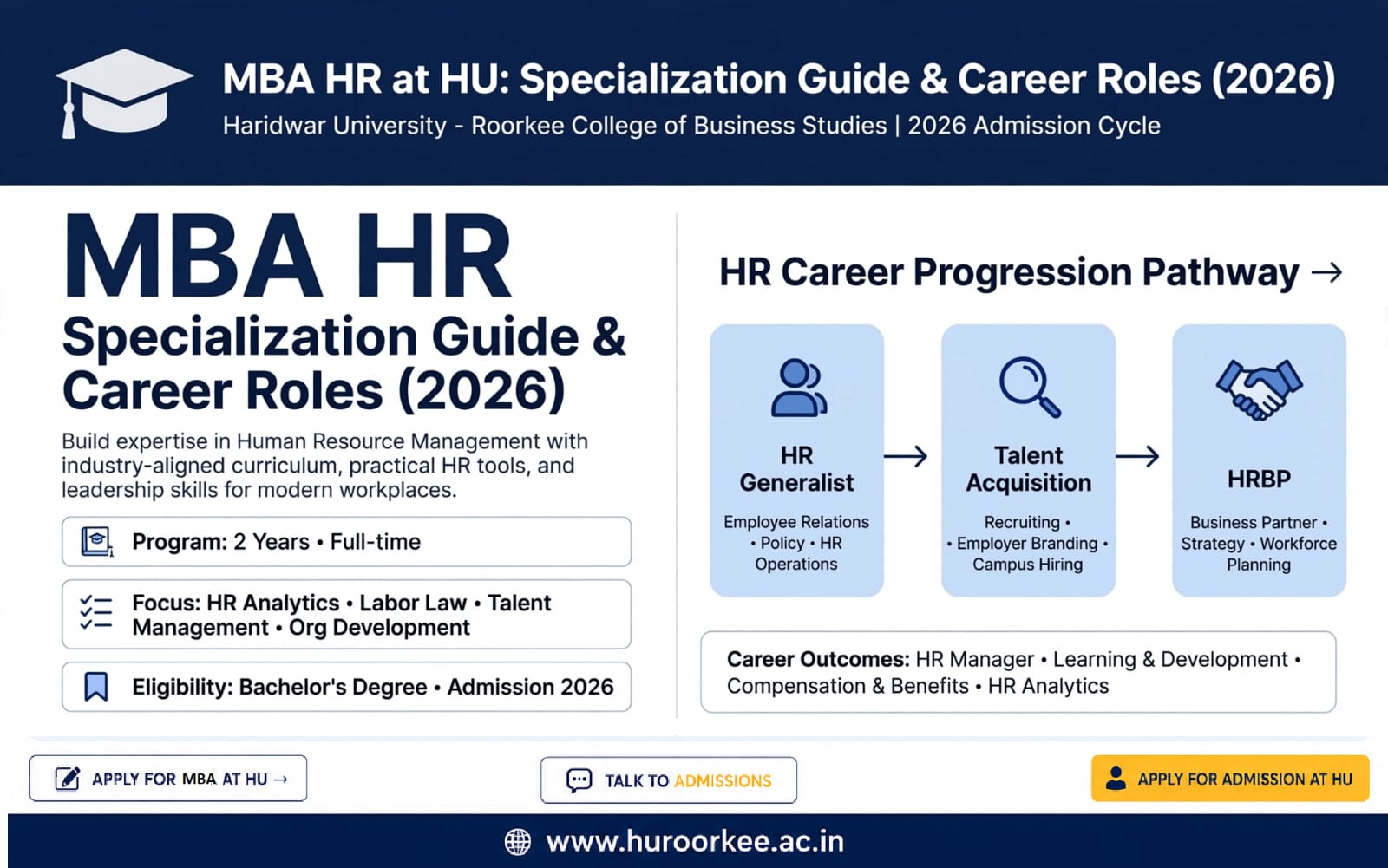
If you are weighing a general MBA against a specialised, people-first degree, MBA HR Haridwar University is probably one of the phrases you have already searched while comparing options for the 2026 admission cycle. The human resources function has changed more in the last five years than in the previous two decades — recruitment is now data-led, performance reviews run through HR software, and even policy drafting leans on AI tools. A specialisation built around this shift, rather than a generic people-management syllabus, is what actually prepares you for the roles companies are hiring for right now.
One naming note worth flagging up front: on HU's own admissions pages, this track is listed as “MBA with AI (HR specialisation)”, not as a standalone “MBA HR” degree. The content is the same HR curriculum described below — just be sure to search for that exact program name on HU's site when checking fees or applying, so you land on the right page.
Haridwar University runs its MBA in HR under the Roorkee College of Business Studies, alongside Finance and Marketing specialisations, and pairs the core curriculum with an IIM/IIT/NIT-affiliated certification add-on described on the MBA programme page. That combination — a postgraduate degree plus an external certification layer — is meant to narrow the gap between classroom HR theory and what recruiters actually screen for at interview stage.
Table of Contents
- Why MBA HR at Haridwar University Makes Sense in 2026
- Track Subjects: What the MBA HR Curriculum Covers
- Career Roles After MBA HR: Generalist, Talent Acquisition & the HRBP Path
- HR-Tech Skills You Will Need in 2026
- Who Should Choose MBA HR?
- Fees & Scholarships at Haridwar University (2026-27)
- Frequently Asked Questions
1. Why MBA HR at Haridwar University Makes Sense in 2026
If you are weighing a general MBA against a specialised, people-first degree, MBA HR Haridwar University is probably one of the phrases you have already searched while comparing options for the 2026 admission cycle. The human resources function has changed more in the last five years than in the previous two decades — recruitment is now data-led, performance reviews run through HR software, and even policy drafting leans on AI tools. A specialisation built around this shift, rather than a generic people-management syllabus, is what actually prepares you for the roles companies are hiring for right now.
One naming note worth flagging up front: on HU's own admissions pages, this track is listed as “MBA with AI (HR specialisation)”, not as a standalone “MBA HR” degree. The content is the same HR curriculum described below — just be sure to search for that exact program name on HU's site when checking fees or applying, so you land on the right page.
Haridwar University runs its MBA in HR under the Roorkee College of Business Studies, alongside Finance and Marketing specialisations, and pairs the core curriculum with an IIM/IIT/NIT-affiliated certification add-on described on the MBA programme page. That combination — a postgraduate degree plus an external certification layer — is meant to narrow the gap between classroom HR theory and what recruiters actually screen for at interview stage.
2. Track Subjects: What the MBA HR Curriculum Covers
The first year of the MBA at HU covers the usual management core — accounting, economics, organisational behaviour, marketing and operations — shared across the Finance, HR and Marketing tracks. HR specialisation subjects take over from the second year onward (semesters 3 and 4).
Core HR Subjects You Will Study
- Strategic Human Resource Management
- Labour Laws & Industrial Relations
- Compensation & Benefits Design
- Talent Acquisition & Workforce Planning
- Performance Management Systems
- HR Analytics & People Metrics
- Training, Learning & Development
- AI Tools in HR (bundled with the IIM/IIT/NIT certification track)
This mix is what separates a real specialisation from a generic elective basket: labour law and compensation design give you compliance depth, and India's central Ministry of Labour & Employment portal is a useful reference point for how these laws are actually administered, while HR analytics and AI tools are what recruiters now expect a fresher to at least be conversant in.
3. Career Roles After MBA HR: Generalist, Talent Acquisition & the HRBP Path
An MBA in HR doesn't lead to one job title — it opens three fairly distinct tracks, and most graduates end up choosing based on temperament as much as pay.
Note on salary figures: The salary numbers in this section come from PayScale's India-wide compensation data, not from Haridwar University's own placement records. They give a realistic sense of market pay by role, but they are not HU-specific outcomes. For actual HU placement statistics (average package, top recruiters), check the university's placement overview page directly, since that data is program- and cohort-specific and updates every admission cycle.
HR Generalist
This is the most common first posting for freshers — a mix of onboarding, employee records, policy execution and light recruitment support. According to PayScale India's 2026 compensation data, the average base salary for an HR Generalist in India is around ₹4.56 lakh a year, with the range running from roughly ₹2.31 lakh at entry level to about ₹9.93 lakh for senior generalists.
Talent Acquisition (TA) Specialist
TA specialists own the hiring funnel — sourcing, screening, interview coordination and employer branding. PayScale's India data puts the average TA specialist salary at close to ₹6.09 lakh annually, with a spread from about ₹2.98 lakh to roughly ₹10 lakh depending on city and industry.
HR Business Partner (HRBP)
HRBP is the role most MBA HR graduates aim for by mid-career — it sits closer to the business side, working directly with department heads on workforce planning, attrition and organisational design rather than transactional HR. Pay reflects that shift: PayScale's 2026 India figures show an average HRBP base salary of roughly ₹9.77 lakh, climbing well past ₹15–20 lakh at the experienced end in metro markets.
The realistic progression most MBA HR graduates follow is Generalist or TA Executive for the first two to three years, a move into a Senior Generalist or TA Lead role, and then HRBP or HR Manager once they've handled a business unit's people decisions independently. HU's placement overview page and its Our Programs listing are both worth checking to see how this maps onto the university's own MBA cohorts.
4. HR-Tech Skills You Will Need in 2026
HR hasn't been spared the AI shift reshaping every business function. Recruiters increasingly expect MBA HR graduates to be comfortable with applicant tracking systems (ATS), HRIS platforms, and basic people-analytics dashboards — reading attrition trends and headcount data, not just producing reports.
- HRIS & payroll platforms (e.g., SAP SuccessFactors, Workday, Keka)
- Applicant Tracking Systems (ATS) and structured interview scorecards
- People analytics and attrition dashboards
- Generative AI for policy drafting, JD writing and onboarding content
- HR chatbots and employee self-service tools
This is also why HU bundles an AI-linked certification with the MBA HR track instead of leaving it as an optional elective, as noted on its alumni page and programme listings — the working assumption is that HR-tech fluency is now a baseline expectation, not a differentiator.
5. Who Should Choose MBA HR?
- You'd rather manage people and process than build financial models or run marketing campaigns.
- You're comfortable with labour law, documentation and compliance detail.
- You want a generalist path into mid-management rather than a narrow technical specialism.
- You're drawn to organisational design, culture and workforce-strategy conversations.
If most of that sounds like you, HR is the tech-vs-tech-adjacent choice that rewards people skills over spreadsheet skills — though, as the HR-tech section above shows, spreadsheets and dashboards haven't disappeared.
6. Fees & Scholarships at Haridwar University (2026-27)
Fee accuracy matters more than most other details in this decision, so here are the figures listed on HU's official Fees & Scholarships page at the time of writing, not third-party aggregator estimates. Fee structures are revised annually, so confirm the current figures directly with HU admissions before you budget or apply.
MBA with AI (Finance / HR / Marketing) carries a tuition fee of ₹62,000, with total first-year charges (tuition, enrolment, admission, examination and uniform combined) of ₹1,77,000 across two semesters, and ₹1,60,000 for the second year — bringing the total two-year programme cost to ₹3,37,000, before hostel and transport.
The same page lists several scholarship categories: a 25% first-year tuition waiver for candidates who score above 60% in their qualifying exam and meet specific eligibility categories (defence/freedom-fighter families, HU alumni siblings, orphans, or children of university employees), a separate 25% waiver for female candidates to promote women's education, and additional merit-based waivers of up to 50% tied to qualifying-exam percentile or aggregate score.
Hostel fees, listed separately on the same page, start at ₹85,000 a year for a standard room; this covers accommodation only — mess/food charges and transport are billed separately, so factor those in when budgeting total cost of attendance.
Take the Next Step Towards Your MBA at Haridwar University
7. Frequently Asked Questions
1. Is the MBA programme at Haridwar University UGC-recognised?
Haridwar University is listed with the University Grants Commission, and its MBA programmes fall under this recognition, in line with UGC's regulatory framework for Indian universities.
2. What is the total MBA HR fee at Haridwar University for 2026-27?
The MBA with AI (HR specialisation) carries a tuition fee of ₹62,000, with total first-year charges of ₹1,77,000 and second-year charges of ₹1,60,000 — a two-year total of ₹3,37,000 — as listed on HU's official fees and scholarships page. Confirm current figures directly with HU, as fee structures are revised each admission cycle.
3. Does HU offer scholarships for MBA HR students?
Yes. Depending on your qualifying score and eligibility category, you can get a 25% to 50% waiver on first-year tuition, including a dedicated scholarship for female candidates, under HU's published scholarship policy.
4. What makes HU's MBA HR different from a regular HR specialisation?
HU bundles the MBA with an IIM/IIT/NIT-affiliated certification module, aimed at adding an external, recognisable credential on top of the core HR curriculum.
5. What is the difference between an HR Generalist and an HRBP?
A Generalist handles day-to-day, transactional HR work such as onboarding, records and policy execution, while an HRBP works closely with business leaders on workforce strategy, attrition and organisational decisions, usually a few years into an HR career.
6. What salary can I expect right after MBA HR?
Fresh HR Generalists in India average around ₹4.56 lakh a year per PayScale's 2026 India data, with typical entry-level offers starting closer to ₹2.3–2.5 lakh. This is industry-wide data, not an HU-specific placement figure, and it varies with city, industry and employer — see the placement note in the career-roles section above.
7. Is coding or an analytics background required for MBA HR?
There's no formal coding requirement, but comfort with basic dashboards, HRIS tools and spreadsheet-level data reading is expected, given how far HR-tech has moved.
8. What is the eligibility criteria for MBA admission at HU?
A recognised bachelor's degree is the baseline requirement, and admission is assessed via HU's own entrance process alongside qualifying-exam scores. Specific percentage cut-offs, entrance-test details and application deadlines are listed on the HU admission portal, and are worth confirming directly before you apply.
9. How do I apply for the MBA HR programme at Haridwar University?
You can apply directly through HU's official admission portal, or reach out to the admissions team to get your questions on fees, scholarships and eligibility answered before you submit your application: Apply for MBA →
Ready to Start Your Management Career?
Explore admissions, fee details, and application guidance for Haridwar University.