

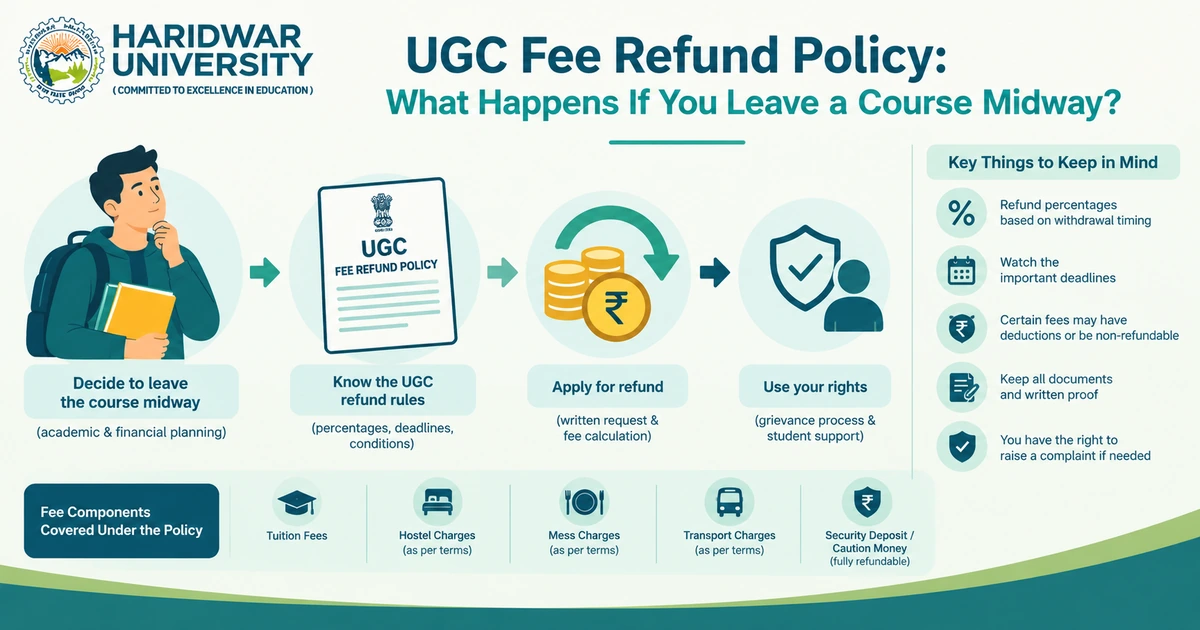
Leaving a college course midway creates two complex problems at once: determining your next academic direction and finding out how much of your paid fee can be recovered. The UGC fee refund policy provides a structured regulatory framework for fee refunds when students cancel admissions or withdraw from programmes, but the exact timing of withdrawal is decisive. It is equally important to distinguish cancelling admission prior to course commencement from discontinuing studies after attending classes for several weeks or months.
A refund is not calculated simply from the day a student stops attending lectures, and the total sum remitted is not automatically refundable in every situation. Official university policies operate on formal written notice dates and statutory timelines.
The University Grants Commission (UGC) issued a formal notification stating that its established fee-refund policy continues in force across subsequent academic cycles until updated directives are published. Furthermore, the UGC issued a strict communication (UGC Letter to all Higher Educational Institutions) mandating immediate compliance and warning against non-compliance with its Fee Refund Policy. Students should review the latest official guidelines and understand their legal rights before initiating withdrawal.
Table of Contents
- 1. Understanding the UGC Fee Refund Policy
- 2. Fee Refund Percentages and Important Deadlines
- 3. Admission Cancellation and Mid-Course Withdrawal
- 4. The Fee Refund Application Process
- 5. Student Rights and Refund Complaints
- 6. Fee Components That Need Separate Verification
- 7. Frequently Asked Questions (FAQs)
- 8. Making an Informed Decision Before Withdrawing
1. Understanding the UGC Fee Refund Policy
The UGC fee refund policy defines a graded percentage scale based on precisely when an institution receives a student’s formal written withdrawal notice relative to its officially notified last date of admission. It is not an arbitrary rule that permits every departing student to claim an identical percentage regardless of timing.
The official UGC Fee Refund Policy Document sets out the statutory timeline. The timing calculation revolves around the formally notified last date of admission, rather than when the student paid fees, attended the first lecture, or informally decided to withdraw.
Three Crucial Dates to Document in Writing
- Formally Notified Last Date of Admission: The cutoff declared publicly by the university or state admission council.
- Receipt Date of Withdrawal Notice: The official date-stamped receipt or email acknowledgment confirming the university received your withdrawal request.
- Refund Application Date: The date on which formal bank account details and cancellation documents were verified.
Retain verifiable documentary proof of all interactions. While verbal discussions with academic counsellors are helpful, they hold zero legal standing without an acknowledged written withdrawal letter.
2. Fee Refund Percentages and Important Deadlines
The statutory refund schedule published by the University Grants Commission uses a five-tier refund slab system:
| When the Institution Receives the Withdrawal Notice | Refund Percentage |
|---|---|
| 15 days or more before the formally notified last date of admission | 100% * |
| Less than 15 days before the formally notified last date of admission | 90% |
| Within 15 days after the formally notified last date of admission | 80% |
| More than 15 days but within 30 days after the last date of admission | 50% |
| More than 30 days after the formally notified last date of admission | 0% (under this schedule) |
* Permissible Processing Deduction: In the 100% refund slab, institutions may deduct a processing charge not exceeding 5% of the fees paid, subject to a maximum cap of ₹5,000. Furthermore, caution money or security deposits, which do not form part of tuition fees, must be returned in full.
Statutory Disbursement Window: The UGC regulation mandates that all eligible refunds must be processed and credited within 15 calendar days of receiving the written cancellation request.
3. Admission Cancellation and Mid-Course Withdrawal
Understanding the operational boundary between admission cancellation and mid-course withdrawal is vital:
- Admission Cancellation: Occurs when a student surrenders an offered seat prior to or immediately around the official commencement of the academic semester. The UGC’s 5-tier percentage slab applies directly.
- Mid-Course Withdrawal: Occurs after a student has commenced regular coursework, attended lectures, used laboratory supplies, or resided in hostel accommodation for several months. In mid-course exits, refund treatment is governed by institutional policy, unexpired service terms, and security deposit settlements.
Under the UGC Regulations Compendium on Prospectus Disclosures, universities must explicitly publish refundable fee components, caution deposits, and refund timelines in advance.
At Haridwar University, prospective students and parents can review transparent fee disclosures on our official Fees & Scholarships Portal and explore comprehensive degree offerings on the Haridwar University Academic Programmes directory.
4. The Fee Refund Application Process
If you make the decision to withdraw, follow this structured procedural sequence to protect your financial interests:
Five-Step Refund Filing Protocol
- Review Published Terms: Examine the university prospectus, admission handbook, and course-specific rules.
- Submit Formal Written Notice: Deliver a signed withdrawal letter and email to the Registrar and Admissions Office containing your enrollment ID, branch, and submission date.
- Request Written Calculation: Ask for an itemized refund breakdown showing gross fees paid, applicable percentage slab, processing deductions, and caution money.
- Retain All Acknowledgments: Maintain physical and digital copies of fee deposit receipts, bank statements, and the university’s written acknowledgment.
- Track the 15-Day Timeline: If the refund is not credited within 15 days, send a formal follow-up requesting an immediate status report.
If withdrawal is being contemplated due to financial strain, explore institutional funding alternatives before making an irreversible exit. Consult our guides on Haridwar University Scholarship Eligibility and Education Loan Support for Students.
5. Student Rights and Refund Complaints
When an institution improperly withholds eligible refunds or ignores statutory timelines, students have legal recourse under the UGC Redressal of Grievances of Students Regulations (2023).
Three-Tier Grievance Escalation Hierarchy
- Tier 1 — Institutional Level: Submit a written representation to the Registrar and Finance Officer requesting formal clarification.
- Tier 2 — Student Grievance Redressal Committee (SGRC): File an official complaint with the university’s internal SGRC, which is mandated by UGC regulations to hear student disputes.
- Tier 3 — UGC Central Fee Nivaran Portal: If the university fails to resolve the matter, lodge a formal grievance on the central UGC Portal under the Fee Nivaran cell.
Critical Student Right: Prohibition of Certificate Retention
UGC regulations strictly prohibit higher educational institutions from retaining original academic marksheets, migration certificates, or degree certificates as leverage for fee recovery. Institutions are authorized solely to verify original documents and must return them to students immediately.
6. Fee Components That Need Separate Verification
University fee receipts typically bundle several heads that receive distinct treatment upon withdrawal:
- Tuition and Academic Charges: Governed directly by UGC percentage slabs.
- Caution Money and Institutional Deposits: Refundable 100% in full, subject to clearance of campus property or library dues.
- Hostel and Mess Charges: Billed for living accommodation; unutilized months are typically refunded on a pro-rata basis under published residential rules.
- Transportation Charges: Charged on bus route operations; unexpired terms can be settled according to transport department guidelines.
7. Frequently Asked Questions (FAQs)
What is the UGC fee refund policy?
It is the statutory framework issued by the University Grants Commission governing refunds when students withdraw from higher education institutions. It defines percentage slabs linked directly to the date of withdrawal relative to the last date of admission.
Can I get my college fees back if I leave midway?
Yes, but the amount depends on the date of withdrawal relative to the admission cutoff, caution deposits, and unutilized service charges. Do not assume automatic 100% refunds once regular academic semesters have commenced.
Is there a separate UGC fee refund policy for 2026–27?
The UGC formally notified that its existing fee-refund framework remains in effect for subsequent academic sessions until a revised policy is issued. Always verify current notifications on the official UGC website.
How long does an eligible UGC fee refund take?
Under UGC regulations, eligible refunds must be processed and credited within 15 days of the institution receiving the formal written withdrawal application.
Can a college keep my original certificates because I owe fees?
No. UGC guidelines strictly prohibit institutions from retaining original academic or personal documents. Original documents may only be inspected during admission and must be handed back immediately.
What should I do if my college rejects my refund request?
Request an itemized written calculation citing the specific rule applied. If unresolved, escalate through the university's Student Grievance Redressal Committee (SGRC) and the UGC Fee Nivaran portal.
Is the application or registration fee refundable?
Application processing fees are generally non-refundable across higher educational institutions. However, inside the 100% refund window, the maximum retention allowed for processing charges is strictly capped at ₹5,000.
8. Making an Informed Decision Before Withdrawing
When evaluating a course change or withdrawal, establishing the applicable statutory rule before making assumptions about financial recovery is paramount. The UGC fee refund policy provides a balanced framework, but written documentation, timely communication, and prompt filing are what safeguard your rights.
Do not rely on verbal assurances or unverified social media summaries. Submit all correspondence in writing, demand itemized calculations, and verify official directives to make informed, confident educational decisions.
Explore Transparent Admissions at Haridwar University
Learn about our student-first admission standards, transparent fee schedules, and scholarship support. Connect directly with our admissions and student welfare counselors today.