

4-Year UG Degree Explained: Certificate, Diploma, Honours & PhD Options (2026)
Mr. Sumit Chauhan
Registrar, Haridwar University
A student who leaves university after one year, returns after an unexpected career break, or completes an intensive four-year undergraduate programme should never have to navigate an ambiguous qualification framework. That principle underpins the University Grants Commission’s (UGC) multiple entry and exit model. It empowers students with greater academic mobility while systematically tying each milestone to verifiable credit and skill criteria.
The four-year undergraduate degree has attracted significant attention because it introduces pathways to an Honours or Honours with Research degree and opens a direct route to PhD admission for eligible scholars without a prior master’s degree. However, online commentary frequently presents these outcomes as automatic. They are not. Exact UGC credit benchmarks, institutional adoption, and departmental evaluation criteria remain decisive. As Registrar, I believe students and parents must understand the statutory regulations before committing to an academic pathway.
Table of Contents
- Understanding the 4-Year Undergraduate Degree in India
- Four Exit Options Under the Undergraduate Framework
- Honours and Honours with Research: The Difference
- Multiple Entry, Exit and Re-entry Through Academic Bank of Credits
- PhD Eligibility After a Four-Year Undergraduate Degree
- Other Important UGC Provisions Students Should Know
- What the Framework Means for Students and Parents
- Frequently Asked Questions
- Choosing the Right Undergraduate Pathway
1. Understanding the 4-Year Undergraduate Degree in India
The Four-Year Undergraduate Programme (FYUGP) forms a cornerstone of the shift toward flexible, multidisciplinary learning outlined in the National Education Policy (NEP 2020). Through the University Grants Commission (UGC) Curriculum and Credit Framework for Undergraduate Programmes, students gain credit-based curriculum options, opportunities to combine majors with vocational minors, and flexible exit credentials.
A key regulatory milestone is the UGC Minimum Standards of Instruction for the Grant of UG Degree and PG Degree Regulations, 2025. These notified regulations provide statutory sanction for undergraduate programmes spanning either three or four years, complete with multiple entry and exit mechanisms.
Crucially, the policy does not mean every university or department automatically offers identical four-year exit awards. Higher education institutions must update their statutes, design semester curricula, and secure statutory Academic Council sanctions. A traditional 3-year bachelor’s degree remains fully valid, while completing the optional fourth year unlocks specialised Honours or Honours with Research credentials.
2. Four Exit Options Under the Undergraduate Framework
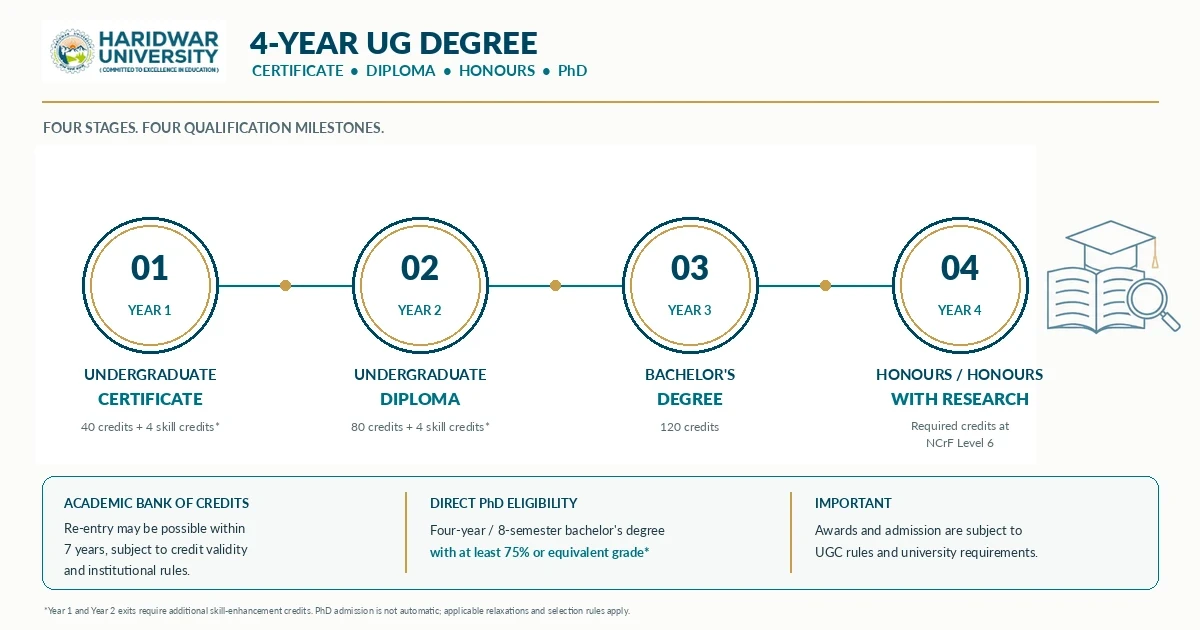
The UGC framework aligns progressive stages of undergraduate study with distinct academic qualifications. The 2025 Regulations specify the required credit thresholds and mandatory skill-enhancement components:
| Stage of Study | Mandatory Academic Credit Requirement | Conferred Qualification |
|---|---|---|
| After Year 1 (Sem 1–2) | 40 credits + at least 4 additional skill-enhancement course credits | Undergraduate Certificate |
| After Year 2 (Sem 3–4) | 80 credits + at least 4 additional skill-enhancement course credits | Undergraduate Diploma |
| After Year 3 (Sem 5–6) | 120 credits at the prescribed curricular level | Bachelor’s Degree |
| After Year 4 (Sem 7–8) | 160 credits total, including NCrF Level 6 advanced credits | Bachelor’s Degree with Honours / Honours with Research |
Critical Credit Caveat: The additional 4 skill-enhancement credits required for the Year 1 Certificate and Year 2 Diploma are mandatory. Completing 40 or 80 classroom credits alone does not qualify a student for exit. Students must complete summer internships or approved practical skill modules before exit papers are awarded.
Year 1: Undergraduate Certificate
Certifies foundational learning across core disciplines plus 4 vocational skill credits. It validates completed coursework on official transcripts but should not be mistaken for a standalone professional qualification or full bachelor’s degree.
Year 2: Undergraduate Diploma
Recognises two full years of undergraduate training (80 credits + 4 skill credits). While it supports junior technical roles, candidates should check employer and licensing norms to ensure diploma equivalence for specific posts.
Year 3: Bachelor’s Degree
Awards a complete, standard bachelor’s degree after 120 credits. Graduates can immediately enter the corporate workforce, sit for UPSC/SSC civil service exams, or proceed to standard 2-year master’s degree programs.
Year 4: Honours or Honours with Research
Completes 160 credits with advanced Level 6 coursework. Graduates gain eligibility for accelerated 1-year master’s programs and direct doctoral entry subject to qualifying conditions.
3. Honours and Honours with Research: The Difference
Many students assume that every fourth-year student automatically receives an Honours with Research credential. In reality, the UGC framework divides the fourth year into two distinct curricular avenues:
● Bachelor’s Degree with Honours
Focuses on advanced disciplinary coursework, specialized electives, professional seminars, and applied industry modules. It is tailored for students aiming for corporate leadership, senior technical roles, or rapid entry into specialized professional sectors.
● Bachelor’s Degree with Honours with Research
Reserved for students who undertake rigorous research methodology training, execute an independent investigation under faculty mentorship, author a supervised dissertation, and defend their research findings before an evaluation committee.
Under UGC provisions, universities may restrict entry into the Honours with Research track to students who achieve a minimum CGPA (often 7.5 or above across the first six semesters). Students targeting academic or research careers must inspect the university’s published laboratory infrastructure and faculty publications rather than relying on title labels alone.
4. Multiple Entry, Exit and Re-entry Through Academic Bank of Credits
Unforeseen family responsibilities, financial hurdles, or health challenges previously forced students to drop out and forfeit completed academic years. The multiple entry and exit architecture, powered by the Academic Bank of Credits (ABC), transforms earned credits into persistent digital assets.
Key operational rules governing credit retention and re-entry include:
- Seven-Year Shelf Life: Under the 2025 Regulations, students are permitted to re-enter at the appropriate subsequent academic level within a maximum period of seven years.
- Institutional Admission Discretion: Credit transfer is not an automatic right of admission into any university. The receiving institution evaluates credit equivalence, course syllabus matching, seat vacancy, and admission prerequisites.
- National Portability: Credits logged on the DigiLocker-linked ABC portal transfer seamlessly between participating central, state, and private universities.
For a comprehensive walkthrough on digital credit redemption, read our in-depth guide on credit transfer via Academic Bank of Credits.
5. PhD Eligibility After a Four-Year Undergraduate Degree
One of the most consequential policy changes introduced under the UGC (Minimum Standards and Procedure for Award of Ph.D. Degree) Regulations, 2022 is permitting graduates of 4-year/8-semester bachelor’s degrees to seek direct admission into doctoral research.
Statutory Criteria for Direct Doctoral Entry
- Minimum Academic Score: Candidates must score at least 75% aggregate marks or equivalent cumulative grade points in their four-year bachelor’s degree.
- Statutory Category Relaxations: A 5% mark relaxation (lowering the threshold to 70%) is provided for SC, ST, OBC (non-creamy layer), differently-abled, and Economically Weaker Section (EWS) applicants.
- Selection Mechanisms: Eligibility is not a guarantee of a PhD seat. Candidates must clear national examinations (such as UGC-NET / CSIR-NET) or institution-specific entrance tests and viva-voce interviews.
Prospective scholars can explore advanced research infrastructure and doctoral guidelines on Haridwar University’s official doctorate programmes portal.
Explore NEP-Aligned Undergraduate Programmes at Haridwar University
Discover future-ready B.Tech Honours, BCA, BBA, B.Com, and Allied Healthcare degrees with credit mobility.
Explore All HU Academic Programmes →6. Other Important UGC Provisions Students Should Know
The 2025 Regulations introduce several crucial modernisations that transform academic access:
1. Twice-Yearly Admission Cycles
Universities with adequate infrastructure may admit students twice a year: July/August and January/February cycles. This prevents students who missed summer rounds or completed winter board re-evaluations from forfeiting an entire academic year.
2. Dual Undergraduate Degrees Simultaneously
Students can pursue two academic degrees concurrently—either one full-time on-campus programme combined with an online/ODL degree, or two online/ODL degrees—provided lecture timetables and examination sessions do not overlap.
3. Open-School Qualifications & Cross-Discipline Admissions
Senior secondary qualifications from recognized state open schools or NIOS are recognized for university admission. Furthermore, students can transition into new disciplines if they qualify via entrance examinations, with universities offering bridge courses to fill foundational knowledge gaps.
4. Mandatory DEB-ID for ODL & Online Degrees
Learners enrolling in distance and online courses must generate a mandatory DEB-ID via the UGC Distance Education Bureau using their ABC ID. This rule does not apply to regular on-campus undergraduate admissions.
7. What the Framework Means for Students and Parents
While policy flexibility is immensely beneficial, flexibility should never replace thorough due diligence during university admissions. Before finalizing enrolment, parents and students should examine five vital checkpoints:
- 1. Conferred Award Structure: Verify whether the programme is structured as a 3-year or 4-year degree, and which specific exit credentials are formally approved.
- 2. Credit Curriculum Details: Request the published semester credit matrix, including vocational and skill-enhancement course allocations.
- 3. Re-entry Regulations: Confirm university policies regarding credit validity and maximum allowable hiatus durations.
- 4. Postgraduate Progression: Inspect whether future target institutions (in India or abroad) recognise 3-year or 4-year credentials for master’s and doctoral admissions.
- 5. Formal Statutory Approvals: Confirm the university’s listing under the UGC Act and state enactments by reviewing its recognitions and statutory approvals.
For school leavers evaluating academic directions after Class 12, review our comprehensive guides on courses after 12th Science and guidance on how to switch careers after choosing the wrong degree.
8. Frequently Asked Questions
1. Is a four-year undergraduate degree compulsory in India?
No. Under the UGC Regulations, 2025, universities may offer both three-year and four-year undergraduate programmes. The three-year bachelor’s degree remains a completely valid degree for employment, competitive exams, and postgraduate study.
2. Can I leave college after one year and receive a certificate?
Yes, provided you complete 40 core credits plus at least 4 additional skill-enhancement course credits (often completed through vocational training or a summer internship) and the university has formally implemented the exit option.
3. Is an undergraduate diploma after two years equivalent to a traditional diploma?
Not automatically. The undergraduate diploma reflects two years of university degree coursework (80 credits + 4 skill credits). Its recognition for specific technical posts or lateral diploma entry must be verified against individual recruiting bodies.
4. Can I return to my degree after leaving college?
Yes. Under UGC rules, earned credits stored digitally in your Academic Bank of Credits account remain valid for re-entry within a maximum period of seven years, subject to seat availability and institutional equivalence norms.
5. Can a student with a four-year bachelor’s degree apply directly for a PhD?
Yes. Under the UGC PhD Regulations, 2022, candidates completing a 4-year bachelor’s degree with at least 75% aggregate marks (70% for reserved categories) are eligible to apply directly for PhD programmes without a master’s degree.
6. Is Honours with Research necessary for direct PhD eligibility?
The UGC PhD Regulations refer specifically to a qualifying 4-year/8-semester bachelor’s degree and the 75% marks threshold. While an Honours with Research background provides valuable dissertation preparation, candidates must fulfill the university’s entrance tests and interview criteria.
7. Is DEB-ID compulsory for regular university admission?
No. A DEB-ID is compulsory exclusively for open, distance learning (ODL), and online degree programs. Regular, full-time on-campus admissions do not require a DEB-ID.
8. Can I pursue two undergraduate degrees at the same time?
Yes. UGC guidelines permit pursuing two undergraduate degrees simultaneously, such as one regular on-campus program and one online/ODL program, provided class timetables and exam schedules do not conflict.
9. Choosing the Right Undergraduate Pathway
A four-year undergraduate degree opens valuable horizons for academic specialization, substantial research preparation, and seamless entry into doctoral research. Equally, a focused three-year bachelor’s degree remains a pragmatic, highly effective route for students aiming to start professional employment or write competitive civil service examinations.
My fundamental advice as Registrar is simple: do not select a programme solely on the theoretical promise of exit options or PhD eligibility. Thoroughly inspect the curriculum, verified credit requirements, laboratory ecosystem, and institutional implementation. Making a conscious, well-informed choice during admission is infinitely more beneficial than discovering regulatory constraints at the point of exit.
Build Your Future with NEP-Aligned Degrees at Haridwar University
Explore flexible undergraduate and postgraduate programmes featuring credit mobility, industry certifications, merit scholarships up to 80%, and transparent academic pathways.