

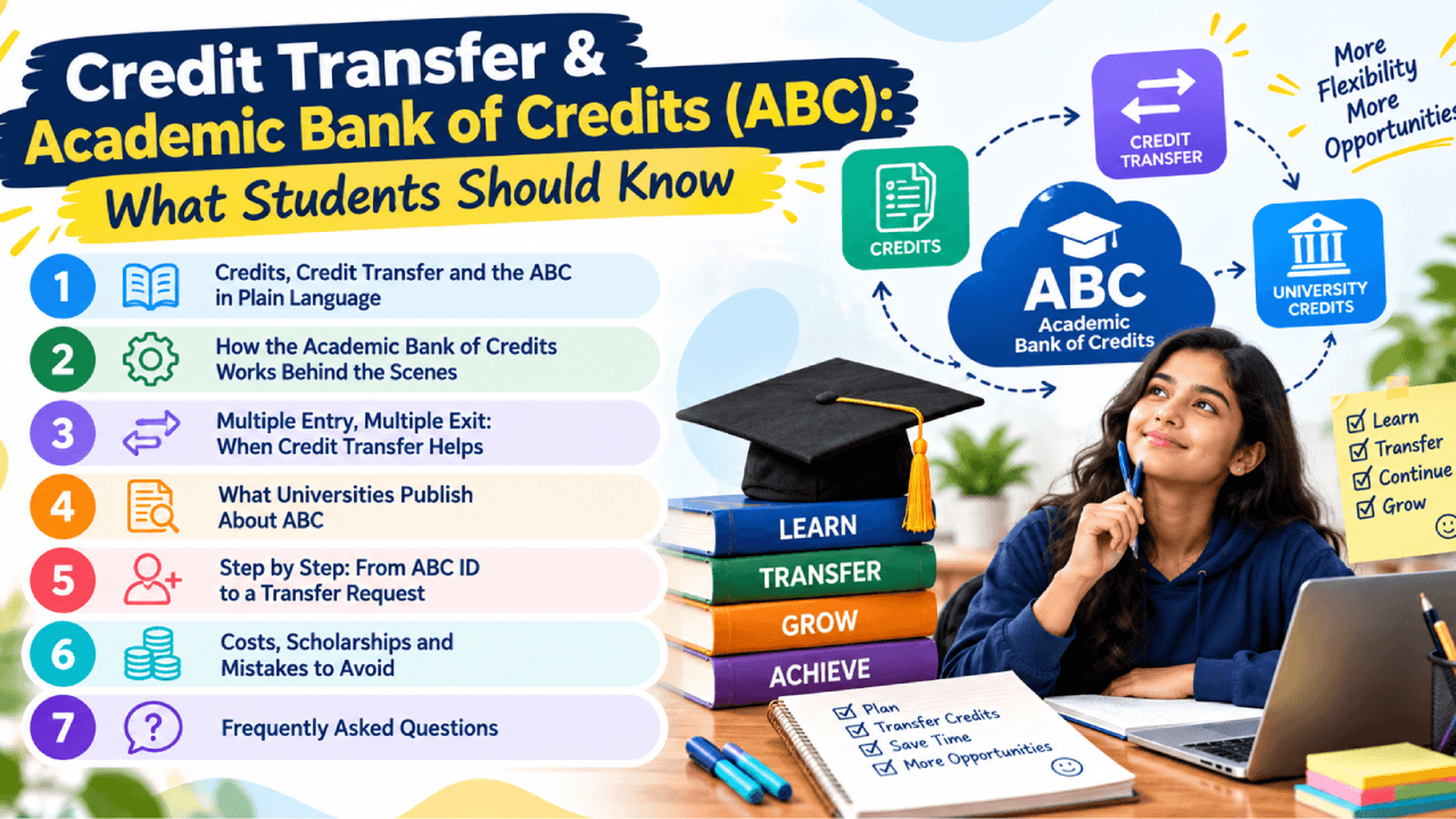
Picture a second-year student whose family moves cities halfway through a degree. Or a diploma holder who wants to join a bachelor’s programme without sitting through everything again. Both ask the same question: what happens to the credits I’ve already earned? Credit Transfer & Academic Bank of Credits (ABC) exists precisely to answer that. The core concept is straightforward: your university coursework turns into academic credits, those credits sit in a secure digital account in your name, and another recognised institution can inspect, verify, and redeem them when you move.
A July 2026 factsheet from the Press Information Bureau describes the ABC as a Ministry of Education platform, regulated by the University Grants Commission (UGC), for storing, transferring, and redeeming credits earned at recognised higher education institutions. However, real academic life introduces strict rules, validity caps, and procedural nuances. This comprehensive guide covers how the system functions behind the scenes, how to generate your 12-digit student ID, what Haridwar University publishes regarding credit mobility, and the practical mistakes students make most often.
Table of Contents
- 1. Credits, Credit Transfer and the ABC in Plain Language
- 2. How the Academic Bank of Credits Works Behind the Scenes
- 3. Multiple Entry, Multiple Exit: When Credit Transfer Helps
- 4. What Haridwar University Publishes About ABC
- 5. Step by Step: From ABC ID to a Transfer Request
- 6. Costs, Scholarships and Mistakes to Avoid
- 7. Frequently Asked Questions
1. Credits, Credit Transfer and the ABC in Plain Language
To navigate credit mobility, you must start with the fundamental academic unit itself: the credit. A credit measures academic workload and student engagement. Under the UGC’s 2021 regulations, one hour of theory lecture or tutorial per week, or two hours of laboratory practical work across a semester, equals one academic credit. Mandatory internship weeks also earn credits, capped under UGC guidelines at six credits.
Credit transfer simply means that one recognised higher education institution accepts and validates academic credits earned by a student at another institution, either in whole or in part, toward the fulfilment of an accredited qualification.
Where the Idea Came From
The National Education Policy (NEP) 2020 envisioned an Academic Bank of Credits that digitally stores academic credits earned from accredited institutions, enabling degrees to be awarded based on cumulative credits earned across different colleges and modalities. Following NEP 2020 mandates, the University Grants Commission formally notified the ABC Regulations in the Gazette of India on 28 July 2021.
How Haridwar University Counts and Structures Credits
At Haridwar University, every academic course carries pre-approved credit values under university board schemes. Mandatory practical internships, industry projects, and lab components carry dedicated credits reflected on the semester grade sheet. HU’s formal UG and PG programme guidelines define the operational structure:
- Semester Cadence: Two semesters per academic year — odd semester (August to December) and even semester (January to May).
- Undergraduate Framework: Eight semesters for 4-year undergraduate honours/technical programmes; six semesters for standard 3-year degree programmes.
- Postgraduate Framework: Four semesters for standard 2-year postgraduate courses.
| Workload Category | Weekly Commitment | Credits Awarded | Standard Regulatory Cap |
|---|---|---|---|
| Theory / Tutorial | 1 hour per week per semester | 1 Credit | Course syllabus specific |
| Practical / Laboratory | 2 hours per week per semester | 1 Credit | Course syllabus specific |
| Internship / Field Project | Structured industrial training | Variable by duration | Max 6 Credits (UGC guidelines) |
2. How the Academic Bank of Credits Works Behind the Scenes
The easiest way to understand the ABC is to think of it as a specialized financial bank account where only authorized educational institutions can make deposits. You create your student account and receive a unique ID, but you cannot upload a marksheet or self-declare credit values.
Your awarding university or examination board securely pushes verified credit records directly to the National Academic Depository (NAD) against your student ID. The ABC framework considers course-credit entries valid only when they originate directly from the accredited institution. This institutional verification layer prevents tampering and guarantees absolute record authenticity.
ABC ID and APAAR: The Unified Student Identity
You create your ABC ID via DigiLocker. Government guidelines unify the ABC ID and the APAAR ID (Automated Permanent Academic Account Registry) into a single 12-digit permanent number linked to your Aadhaar and DigiLocker account under India's "One Nation, One Student ID" initiative. As of July 2026, the Press Information Bureau reports over 26.35 crore verified APAAR IDs generated across the country.
Credit Shelf Life and Key Constraints
Banked credits do not remain valid indefinitely:
- 7-Year Shelf Life: Academic credits remain valid for a maximum of seven years, or the specific validity duration stipulated by university statutory councils for specialised disciplines.
- Single Redemption: Once banked credits are redeemed toward the award of a formal degree or diploma, they are permanently marked as redeemed and cannot be reused toward another degree.
- Eligible Cohorts: Only academic credits earned during or after the 2021-22 academic year are eligible for digital deposit in the ABC portal.
- Institutional Network: The July 2026 PIB report records 2,899 registered higher education institutions on the ABC portal, including 521 private universities.
3. Multiple Entry, Multiple Exit: When Credit Transfer Helps
The Academic Bank of Credits is the operational infrastructure supporting the Multiple Entry and Multiple Exit (MEME) model introduced by NEP 2020. Under this flexible framework:
- Completing Year 1 allows exit with an Undergraduate Certificate.
- Completing Year 2 allows exit with an Undergraduate Diploma.
- Completing Year 3 or 4 leads to a Bachelor’s Degree or Bachelor’s Degree with Honours / Research.
Over 700 universities and 6,600 colleges across India offer these options. Pausing studies due to personal, financial, or geographic reasons is no longer an academic dead end. Your earned credits remain banked in your digital repository, ready to be transferred back into an accredited university when you re-enter.
SWAYAM Digital Course Integration
UGC’s digital learning regulations allow students to earn up to 40 percent of course credits per semester through the Government of India’s SWAYAM online portal. Verified SWAYAM credits flow directly into your ABC account and can be mapped into your college curriculum in coordination with your university examination cell.
The 50 Percent Institutional Minimum Rule
You cannot assemble a degree purely from external or borrowed credits. UGC regulations require that a student earn at least 50% of total programme credits from the institution actually awarding the terminal degree. Furthermore, the awarding university’s mandatory core and prerequisite subjects must be cleared directly under its academic board.
4. What Haridwar University Publishes About ABC
Dedicated DigiLocker and ABC Integration
Haridwar University has established direct portal integration between its student information management system and the Academic Bank of Credits. On HU’s official DigiLocker and ABC examination page, the university outlines a simple five-step onboarding procedure:
- Create a personal DigiLocker account using your Aadhaar-linked mobile number.
- Log into the National ABC portal (abc.gov.in) using DigiLocker credentials.
- Generate your unique 12-digit ABC / APAAR ID.
- Link your ABC ID to your Haridwar University student examination profile.
- Track, verify, and manage semester credits as they are deposited after each examination cycle.
HU also assigns a dedicated ABC Nodal Officer to address credit mismatches, mapping discrepancies, or upload delays. When evaluating universities, having a dedicated institutional officer and clear published workflows is critical for peace of mind.
Lateral Entry and Mid-Programme Transfer Evaluations
For students looking to join mid-course or transfer from another college, Haridwar University offers formal lateral entry pathways in engineering, pharmacy, and computer applications (including B.Tech Hons. in CSE, AI & ML, ECE, and B.Pharm). While the general fee schedule outlines lateral tuition slabs, the credit equivalency mapping is conducted case-by-case by the academic equivalency committee.
Students planning mid-course transfer should consult the admission overview and request a formal credit mapping evaluation in writing prior to finalizing enrollment.
Explore Haridwar University’s DigiLocker Portal
Review the official step-by-step procedure and access the Ministry student guide on HU's portal.
Open HU’s ABC & DigiLocker Page →5. Step by Step: From ABC ID to a Transfer Request
Executing an academic credit transfer requires three sequential stages following official ministry procedures:
1 Account Registration and ID Generation
Navigate to DigiLocker or abc.gov.in. Sign in with your mobile number linked to Aadhaar, authenticate via OTP, and establish your 6-digit security PIN. Your 12-digit ABC ID / APAAR ID is generated immediately. Record this number and share it with your university registrar during semester enrollment.
2 Initiating the Credit Transfer Request
Once your parent institution deposits semester credits, log into your ABC student dashboard. Click on Transfer Credits, accept the terms, choose your destination receiving university, program name, and stream. Check the specific subject credits you wish to transfer and click Submit. The portal generates a Transfer Request ID with status set to Pending.
3 Institutional Evaluation and Decision
The receiving university reviews the digital request against its internal syllabus equivalency and UGC guidelines. The institution can approve in full, approve in part, or reject the transfer, recording formal remarks explaining the decision. You can monitor status and read institutional feedback directly on your portal dashboard.
Crucial Reminder on Physical Documentation: Do not treat the digital ABC ID as a total replacement for official institutional documentation. When enrolling at Haridwar University, students must still submit original migration certificates, character certificates, and 10+2 marksheets as mandated by the admission overview.
6. Costs, Scholarships and Mistakes to Avoid
What the University Fee Structure States
According to the published 2026-27 fees and scholarships structure, university fees cover comprehensive tuition, enrollment, admission, examination, and uniform charges. Haridwar University levies no separate surcharge for ABC registration or digital credit transfer.
For academic scale:
- BCA Programme: ₹82,000 in Year 1; ₹65,000 per year in subsequent years.
- B.Tech Hons. Computer Science Engineering: ₹1,32,000 in Year 1; ₹1,15,000 per year in subsequent years.
- Academic Excellence Award: A ₹5,000 cash award is granted to students achieving 85% or above in a semester with all subjects cleared in the first attempt.
Four Common Slip-Ups Students Must Avoid
1. Delayed ABC ID Submission
If you fail to provide your 12-digit ABC/APAAR ID to your college during registration, your semester examination credits cannot be deposited to NAD.
2. Assuming 100% Automatic Transfer
Receiving universities review syllabus alignment. Credits for courses that do not match the destination degree syllabus will be rejected.
3. Exceeding the 7-Year Shelf Life
Credits expire after 7 years. If you pause your degree, you must resume and redeem credits within this regulatory window.
4. Stretching Beyond Max Duration
HU regulations cap 4-year undergraduate programmes at a maximum duration of 8 years. Any further extension requires special Vice Chancellor approval and penal fees.
For general student support or administrative guidance, visit the Student Welfare Service, which operates a dedicated Student Care Centre in every academic block providing 24-hour query turnaround.
7. Frequently Asked Questions
What is the Academic Bank of Credits in simple words?
A secure government digital repository that stores the academic credits you earn at recognised colleges and universities, enabling you to transfer or redeem them toward a recognised certificate, diploma, or degree.
Are an ABC ID and an APAAR ID the same thing?
Yes. Under the Ministry of Education's "One Nation, One Student ID" initiative, the ABC ID has been integrated as the APAAR ID (Automated Permanent Academic Account Registry), a unique 12-digit number linked to your Aadhaar and DigiLocker account.
How long do academic credits remain valid?
Credits remain valid for a maximum shelf life of seven years, or the specific timeframe stipulated for your discipline by statutory councils. Once redeemed for a qualification, they cannot be reused.
Can I upload my own marksheet or certificates to the ABC?
No. To maintain security and academic authenticity, the ABC portal accepts course and credit records exclusively from verified awarding educational institutions. If credits are missing, contact your college examination cell.
Can I complete a degree using only credits earned from other institutions?
No. UGC regulations require that at least 50% of the total degree credits be completed directly with the institution conferring the terminal degree, including all core prerequisite subjects.
Do SWAYAM online courses count towards my credits?
Yes. Under UGC guidelines, students may complete up to 40% of their course credits in any given semester via approved SWAYAM online courses, subject to university examination board mapping.
Who can I contact at Haridwar University regarding ABC questions?
Haridwar University's DigiLocker examination portal lists the designated institutional ABC Nodal Officer. You can also consult the Student Care Centre or the office of the Registrar for credit inquiries.
Does Haridwar University charge extra fees for credit transfer?
No. HU’s published 2026-27 fee schedule includes all standard academic, examination, and enrollment fees without levying additional surcharges for ABC account management or credit transfers.
What should I do if my credit transfer request is rejected?
The receiving institution provides written remarks detailing the reason for rejection (such as syllabus mismatch or lack of lab equivalence). Review the feedback, compare your course outline with the destination syllabus, and consult academic counsellors before submitting an amended request.
Plan Your Higher Education with Complete Credit Mobility
Whether you are entering your first year or seeking lateral entry transfer with verified credits, Haridwar University offers career-focused degrees, transparent academic policies, and state-of-the-art laboratory infrastructure.