

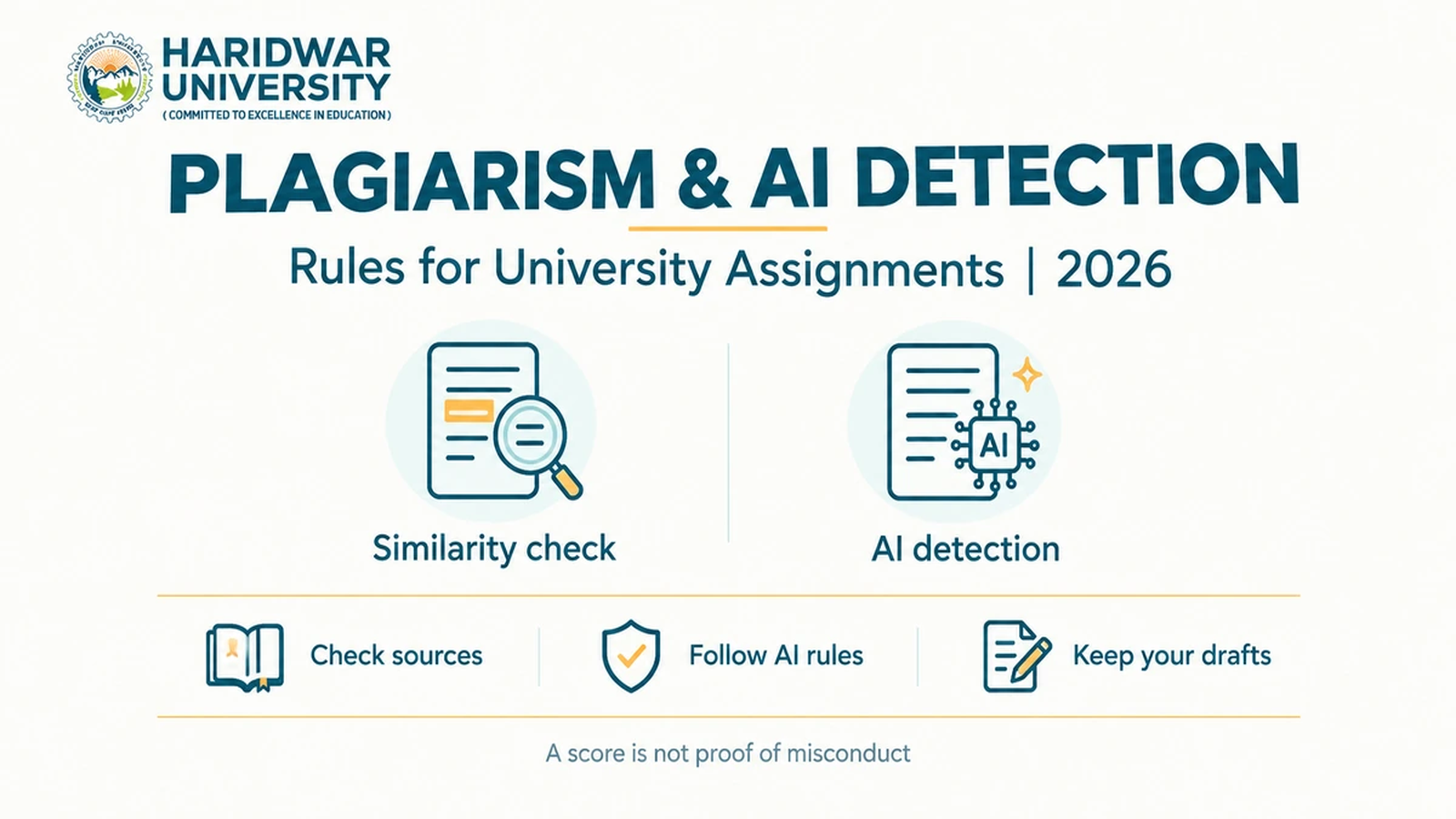
Submitting an academic assignment in 2026 involves far more than running a spell-check and meeting a submission deadline. University students must navigate rigorous plagiarism thresholds, citation standards, and emerging institutional policies governing generative AI. A plagiarism checker for an assignment scans for matching text across indexed repositories, while an AI detector estimates whether syntax and perplexity resemble machine generation. Neither software metric automatically proves or disproves academic misconduct.
In my view from the Registrar’s office at Haridwar University, the most effective strategy is to understand evaluation rules before writing, maintain contemporaneous evidence of your research process, and transparently acknowledge all sources and permitted AI assistance. Cultivating these scholarly habits protects your degree and academic reputation far more reliably than attempting to game a software detection percentage.
Table of Contents
- • 1. What Plagiarism and AI Detection Actually Mean
- • 2. Why a Similarity Score Is Not the Same as Plagiarism
- • 3. How AI Detectors Work and Why They Can Be Wrong
- • 4. UGC Plagiarism Regulations and University Assignment Rules
- • 5. How to Use AI Without Breaching Academic Integrity
- • 6. What to Do If Your Assignment Is Flagged
- • 7. How to Check an Assignment Before Submission
- • 8. An Academic Integrity Checklist for Students
- • 9. Frequently Asked Questions (FAQs)
1. What Plagiarism and AI Detection Actually Mean
Plagiarism occurs whenever a student presents another person’s words, conceptual frameworks, experimental data, or intellectual output as their own without explicit attribution. It spans copying text from digital websites, sharing coursework with classmates, paraphrasing published literature without citations, or passing off synthetic AI output as self-authored reasoning.
AI detection investigates a fundamentally different premise: whether linguistic patterns, burstiness, and structural predictability in a manuscript match patterns typical of machine-learning models like ChatGPT.
Plagiarism Checking vs. AI Detection vs. Academic Review
Understanding the distinct mechanisms powering university evaluation systems.
| Evaluation Tool | What It Examines | What the Output Signifies |
|---|---|---|
| Similarity Checker | Direct text matching against indexed academic databases, journals, and the open web | Flags overlapping text strings for human contextual review |
| AI Detector | Statistical text predictability, word perplexity, and variation in sentence lengths | Generates an algorithmic probability score estimating synthetic generation |
| Academic Review | Primary sources, draft version histories, student defense, and assignment compliance | Authoritatively determines whether academic dishonesty occurred |
These mechanisms are not interchangeable. A fully credited, verbatim quote from an academic textbook will trigger a software similarity match without violating any ethics rules. Conversely, an uncited, heavily disguised paraphrase may slip past a similarity scanner despite being academically dishonest.
2. Why a Similarity Score Is Not the Same as Plagiarism
A software similarity score simply quantifies the percentage of your submission that matches external text across the software vendor's indexed corpus. It cannot judge intent, legitimate quotation, or context.
A routine similarity report includes course assignment prompts, laboratory apparatus lists, technical jargon, standard definitions, and comprehensive bibliography entries. There is no universal "safe" percentage: a 4% similarity score containing an uncredited paragraph from another student's submission represents a violation, whereas an 18% score comprised entirely of formatted bibliographic references and properly cited case law is entirely acceptable.
Three Crucial Self-Audit Questions:
- Quotation Marks: Have I enclosed verbatim language within quotation marks and provided page-specific citations?
- Conceptual Attribution: Have I credited the original researcher whose framework, dataset, or finding I am discussing?
- Authentic Expression: Does my writing reflect genuine synthesis and critical evaluation, or am I merely rearranging someone else's sentence structures?
3. How AI Detectors Work and Why They Can Be Wrong
AI detection algorithms measure text characteristics—primarily perplexity (how statistically unpredictable words are) and burstiness (the variation in sentence structure and rhythm). Because Large Language Models select statistically probable words, their outputs exhibit uniform predictability.
However, these outputs are mathematical approximations, not forensic proof. Global higher education quality watchdogs (such as TEQSA) and major educational technology providers (including Turnitin) explicitly emphasize that AI detectors can produce false positives, erroneously flagging human-authored work—especially from non-native English speakers or technical writing with rigid jargon.
Turnitin’s official AI Writing Report guidelines state that an AI percentage should never serve as the sole justification for disciplinary action. A detection flag indicates an area for faculty dialogue and contextual review, not an automatic finding of guilt.
Students should also recognize that so-called "AI humanizers" or text-spinning software do not make unauthorized AI use acceptable. If an assessment brief prohibits synthetic text generation, altering grammar to evade detector algorithms does not remove the academic violation.
4. UGC Plagiarism Regulations and University Assignment Rules
In India, the governing statutory benchmark is the University Grants Commission (Promotion of Academic Integrity and Prevention of Plagiarism in Higher Educational Institutions) Regulations, 2018. These statutory regulations establish tiered penalty slabs for academic dissertations, theses, and publications:
- Level 0 (Similarities up to 10%): Permissible minor overlap with no penal consequence.
- Level 1 (Similarities 10% to 40%): Requires manuscript revision within a specified window.
- Level 2 (Similarities 40% to 60%): Severe academic penalties, including suspension from submission for a year.
- Level 3 (Similarities above 60%): Serious institutional action, including cancellation of degree registration.
Importantly, research thesis regulations should not be conflated with routine classroom coursework rules. For semester assignments, evaluation parameters are governed by university ordinances and specific course rubrics. Under Haridwar University’s official examination rules and regulations and institutional research promotion policy, each department issues explicit guidelines detailing permitted collaboration and formatting criteria.
5. How to Use AI Without Breaching Academic Integrity
Generative AI can enrich your academic journey when used as an educational coach rather than an unauthorized ghostwriter. As discussed in Haridwar University’s guide on learning to code with AI assistance, maintaining intellectual independence is crucial to developing durable engineering and critical thinking skills.
Ethical, Constructive Uses of AI (Where Permitted):
- Generating Socratic practice questions to test your conceptual recall before exams.
- Explaining dense mathematical concepts or programming algorithms in alternate terms.
- Assisting with grammar polish and structural flow without altering your original argument.
- Organizing brainstormed notes into logical study outlines.
High-Risk Practices That Violate Academic Integrity:
- Copying AI-generated text directly into submitted assignment papers.
- Citing hallucinated, non-existent references fabricated by language models.
- Using paraphrasing or spinning bots to deliberately disguise borrowed material.
- Failing to provide mandatory written disclosure regarding AI tool usage.
6. What to Do If Your Assignment Is Flagged
Receiving an unexpected similarity alert or an AI detection flag on an independently authored paper can cause acute anxiety. Panicking or impulsively modifying the document is counterproductive. Follow these structured, methodical steps:
- Review the Specific Report: Identify the exact highlighted sentences and review whether they correspond to cited quotations, technical formulas, or assignment templates.
- Verify Citations & References: Confirm that all quotations and borrowed concepts are properly credited in the required style sheet.
- Compile Your Document Version History: Maintain version timestamps in Google Docs, Microsoft Word, or Overleaf. A detailed revision timeline demonstrating incremental drafting over days is the single most convincing evidence of original human authorship.
- Present Research Artifacts: Gather preliminary notes, hand-drawn architecture sketches, referenced PDFs, and browser history.
- Request a Faculty Review: Schedule a professional consultation with your course instructor. Explain your investigative methodology and defend your reasoning calmly.
- Engage Student Welfare Support: If a formal academic dispute arises, access guidance through Haridwar University’s student welfare office or the Student Care Centre in your academic block for transparent grievance redressal.
7. How to Check an Assignment Before Submission
A software checker is merely one component of comprehensive pre-submission auditing. Avoid uploading unpublished work to shady, unverified free websites, as many commercial portals store or resell student submissions to third-party databases.
Adopt this pre-submission audit protocol:
- Review Originality: Ensure no phrase or data point has been incorporated without explicit citation.
- Verify Every Source: Confirm that every bibliographic entry actually exists in peer-reviewed indices.
- Inspect Matched Phrases: Differentiate harmless boilerplate text (such as lab safety notices) from genuine attribution oversights.
- Read Your Paper Aloud: An auditory check highlights awkward syntax shifts, repetitive filler, and unsupported assertions.
- Archive Working Drafts: Safely archive your initial outlines and version backups until official grades are published.
To explore how Haridwar University fosters research ethics and patent innovations, visit the official Research and Innovation ecosystem guide.
8. An Academic Integrity Checklist for Students
Before clicking "Submit" on your course portal, ensure you can tick every single item on this academic integrity checklist:
- ✓ Independent Authorship: The analysis and primary arguments represent my independent intellectual labor.
- ✓ Proper Attribution: All borrowed ideas, quotes, statistics, and figures are properly cited in the required style.
- ✓ Verified References: Every entry in my bibliography corresponds to an authentic, verified publication.
- ✓ Contextual Similarity Review: Checked highlighted matching passages rather than relying blindly on software percentages.
- ✓ Permitted AI Scope: Employed AI tools exclusively for permissible tasks (e.g., brainstorming or grammar check).
- ✓ Full Disclosure: Included explicit written acknowledgment of any software tools used during preparation.
- ✓ Preserved Draft Trail: Saved version-history logs, research notes, and primary sources to defend my findings.
Academic integrity is not merely about evading a red warning on software. It is about taking pride in your scholarship, honoring intellectual forebears, and acquiring the rigorous professional ethics demanded by modern industry. In 2026, students who understand both the mechanics of plagiarism checking and the limitations of AI detectors submit their work with calm, justified confidence.
9. Frequently Asked Questions (FAQs)
How much plagiarism is allowed in a university assignment?
There is no universal percentage that automatically makes an assignment acceptable. Requirements depend on the applicable regulations, assignment guidelines, and subject domain. Review matching passages and their attribution rather than relying on a numerical score alone.
Can ChatGPT make an assignment plagiarised?
Using ChatGPT does not automatically make every assignment plagiarised. However, submitting AI-generated text without permitted authorization, violating assignment guidelines, or presenting borrowed ideas without citation breaches academic integrity rules.
Can AI detectors detect ChatGPT accurately?
AI detectors identify statistical patterns associated with machine-generated text, but they are not infallible. False positives can occur where human writing is flagged, while edited or mixed-authorship text can be difficult to classify reliably. A detector score is an estimate, not definitive proof.
Is a 2% similarity score safe?
Not necessarily. A low similarity score may still contain an unattributed passage, an uncredited diagram, or a fabricated finding. Review the highlighted matches and ensure full attribution rather than treating 2% as an unconditional guarantee.
What is the difference between a plagiarism checker and an AI detector?
A plagiarism checker matches submitted text against indexed databases of published books, articles, and websites. An AI detector evaluates statistical perplexity and burstiness to estimate whether text resembles machine generation. They answer completely different questions.
What should I do if my original assignment is flagged as AI-generated?
Keep your research notes, outlines, reference records, and document version history. Review the flagged passages calmly, explain your writing methodology to your professor, and request a contextual academic review. A software flag alone does not prove misconduct.
Do students have to disclose AI use in assignments?
Yes, whenever required by your university policy or assignment brief. Some coursework may prohibit AI entirely, while other assignments permit brainstorming or code-debugging with explicit disclosure. Always verify specific course rules before submitting.
Upholding Academic Integrity & Educational Excellence at Haridwar University
Haridwar University provides supportive faculty mentorship, transparent evaluation regulations, comprehensive student welfare services, and industry-aligned undergraduate and postgraduate degree programmes.