

Failing a semester can make a student question their ability, worry about graduation timelines, and dread explaining the result to family. I would encourage students to pause before drawing hasty conclusions. A failed subject, several backlogs, and failure across an entire semester are not necessarily the same academic situation, and each carries different consequences under university regulations.
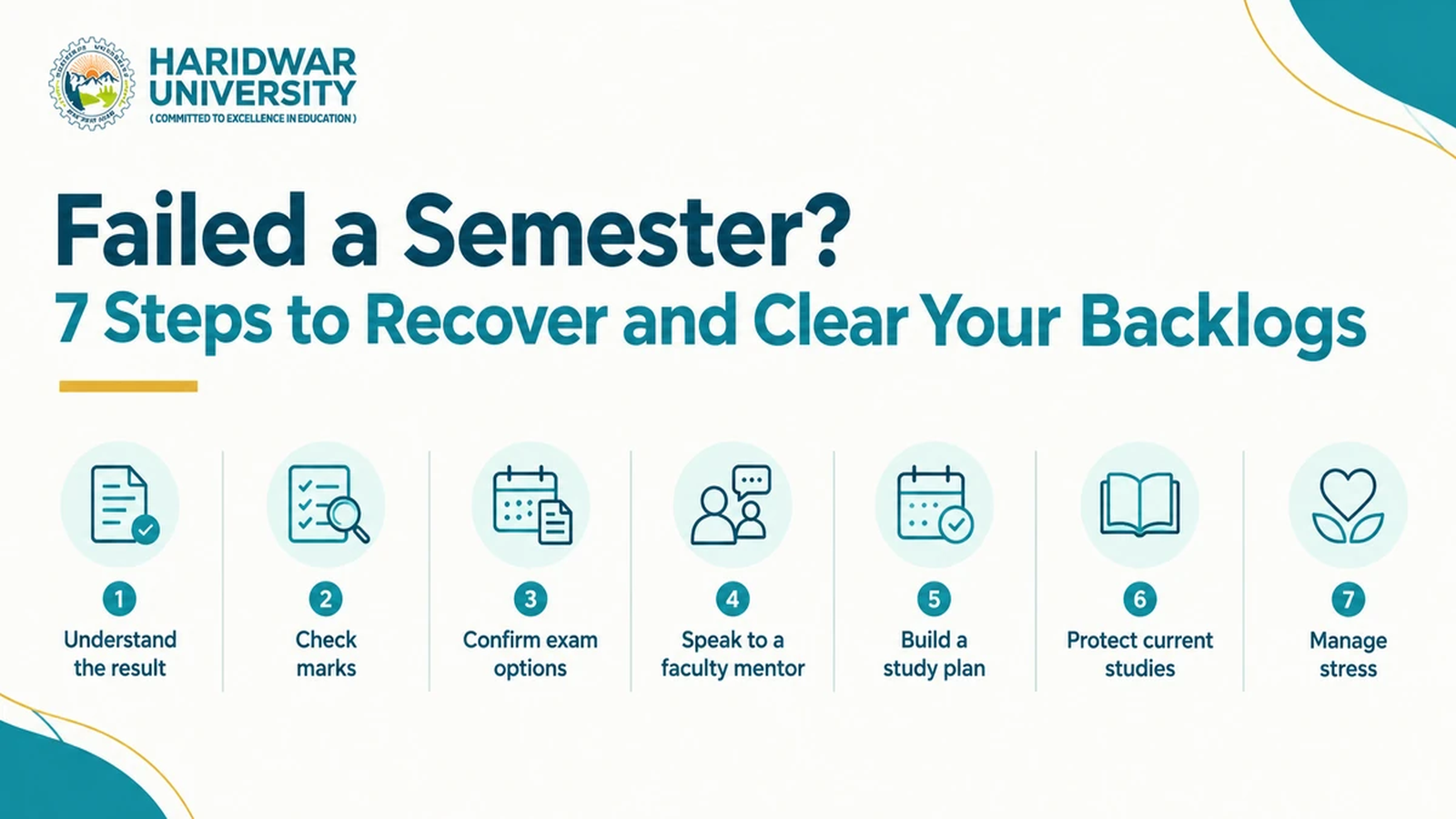
The first priority is to understand what the result actually means, identify the available examination options, and build a realistic recovery plan. If you are wondering what happens if you fail a semester, the answer depends on your university, programme, examination rules, and the number of subjects you have not cleared. Some students may be able to take supplementary or back-paper examinations; others may need to repeat particular requirements or seek formal academic advice. The important thing is not to ignore the result. Here are seven practical steps to help you recover, clear your backlogs, and protect your progress towards graduation.
Table of Contents
- • 1. Understand What Failing a Semester Actually Means
- • 2. Check Your Result and Identify the Immediate Problem
- • 3. Confirm Your Examination and Re-evaluation Options
- • 4. Speak to Your Faculty Mentor Before Making Decisions
- • 5. Build a Study Plan to Clear Your Backlogs
- • 6. Protect Your Current Semester While Recovering
- • 7. Manage Stress and Rebuild Confidence Through Action
- • 8. Your Academic Recovery Checklist
- • 9. Frequently Asked Questions (FAQs)
1. Understand What Failing a Semester Actually Means
Before deciding what to do after failing a semester, establish precisely what has gone wrong. Students often use "semester failure" as a blanket term to describe several distinctly different academic situations:
- One failed subject: You have passed most courses but have not met the passing criteria for a single paper.
- Multiple failed subjects: You have two or more courses to clear, potentially involving different examination formats (theory vs. practical).
- Failure across most or all subjects: Your overall academic progression may require closer scrutiny under the university’s promotion, minimum credit, and year-back policies.
- A failed internal assessment or missed examination: The available remedy (such as an internal re-test or medical leave review) often differs substantially from the process for failing an end-semester theory paper.
These distinctions matter tremendously. A backlog does not automatically mean that you must repeat an entire academic year, just as passing most subjects does not automatically guarantee promotion to the next semester. The outcome depends strictly on the applicable regulatory framework.
At Haridwar University (HU), students can consult the official Examination Rules and Regulations for published examination provisions. Students should check the specific rules applicable to their programme and batch rather than relying on hearsay from peers or social media posts.
2. Check Your Result and Identify the Immediate Problem
My primary advice is to replace emotional assumptions with a clear, factual record of your result. Download your official marksheet or scorecard and catalogue every single subject that needs attention.
Key Details to Record for Each Subject:
- The exact result status (e.g., Backlog, Re-appear, Incomplete) and numerical marks shown.
- Whether the deficit concerns continuous internal evaluation, practical coursework, end-term theory, or attendance shortage.
- Any discrepancy between the published result and your personal examination records (e.g., admit card endorsement or signed attendance sheet).
- The next relevant application deadline or supplementary examination notification window.
If a result is missing, an entry appears erroneous, or a paper is marked absent despite your presence, never assume that the result will correct itself automatically. Contact the examination branch immediately and follow the university's prescribed administrative grievance process.
At HU, students can access scorecards directly through the official Examination Results portal.
Keep a copy of your result and any correspondence about a discrepancy.
This first review also helps separate a knowledge gap from an administrative problem. The remedy for a subject you genuinely need to retake may be different from the process for correcting an error in the published result.
3. Confirm Your Examination and Re-evaluation Options
Once you know which subjects you have failed, confirm what options are available. Depending on the university's regulations, these may include a supplementary examination, a back-paper examination, re-evaluation, or a formal request to address an examination-related discrepancy.
These routes are not interchangeable.
- Supplementary or back-paper examination: An opportunity to attempt a paper again, where permitted under the applicable rules.
- Re-evaluation: A formal request for reassessment of an answer script, subject to the university's procedure and deadlines.
- Result correction or examination grievance: A route to report a suspected administrative or examination-related error.
Do not register for the wrong process or assume that applying for re-evaluation automatically removes the need to prepare for a re-examination.
HU publishes examination information through its Examination Schedule and provides relevant forms through its Examination Forms page. Check the latest notification for your course, the eligible papers, the prescribed fee, and the closing date.
For a detailed explanation of HU-specific back-paper procedures, see the university's existing guide to backlog rules, re-examinations, and academic recovery. Use official notices to confirm current requirements before acting.
4. Speak to Your Faculty Mentor Before Making Decisions
A failed result tells you the outcome; it does not always explain why you reached it. A conversation with the relevant faculty member can help identify whether the difficulty involved conceptual understanding, incomplete syllabus coverage, poor answer structure, calculation errors, insufficient practice or examination anxiety.
Go into the discussion with specific questions. For example:
- Which topics should I prioritise before my next attempt?
- Where did my answers fall short of the expected standard?
- Which concepts do I need to understand before moving to advanced topics?
- What academic requirements must I complete before I can progress?
If you have failed several subjects, ask for help prioritising them instead of trying to fix everything simultaneously. A faculty mentor or department representative can also direct you towards the correct academic or examination contact.
For additional revision methods, the HU semester examination preparation guide explains approaches such as syllabus mapping, practice with previous-year questions and structured revision.
The aim is to leave the conversation with a specific plan, not merely the instruction to study harder.
5. Build a Study Plan to Clear Your Backlogs
A recovery plan should reflect the time available, the number of subjects, and the difficulty of each paper. An unrealistic timetable may look impressive on the first day but is unlikely to survive a demanding week.
Start by dividing each backlog syllabus into topics. Mark them as understood, partly understood, or not understood. Allocate more time to difficult, high-priority topics while reserving regular sessions for revision and practise.
A sample weekly plan might look like this:
Illustrative Weekly Backlog Study Allocation (12-Hour Model)
A balanced framework designed to fit alongside full-time semester classes without triggering cognitive fatigue.
| Study Activity | Focus & Methodology | Weekly Time Allocation |
|---|---|---|
| Relearn Difficult Concepts | Active recall, textbook derivation, video lectures for complex units | 4 Hours |
| Practise Questions & Numericals | Unassisted problem-solving, formula application, circuit/code practice | 4 Hours |
| Attempt Timed Past Papers | Simulate examination conditions using previous 3-year university question papers. | 2 Hours |
| Review Errors & Revise Weak Topics | Error-log analysis, formula sheet memorization, targeted re-testing | 2 Hours |
| Total Dedicated Backlog Preparation | 12 Hours / Week | |
This is an illustrative starting point, not a guaranteed formula. A student preparing for several backlogs may need more time, while a student with one familiar subject may need less. Adjust the schedule around classes, practical work, and the official examination date.
Use each study session actively. Close your notes and explain a concept from memory, solve questions without looking at worked examples, then check your errors. Reading the same chapter repeatedly can create familiarity without proving that you can answer an examination question independently.
Keep an error log, too. If you repeatedly lose marks because of incomplete steps, incorrect formulas, or weak explanations, record the pattern and practise correcting it. Progress becomes easier to measure when you can see which errors are disappearing.
6. Protect Your Current Semester While Recovering
Clearing an old backlog matters, but neglecting current subjects can create another one. This is particularly challenging when students must prepare for back papers alongside regular lectures, assignments, practicals and internal assessments.
I recommend treating current coursework and backlog preparation as two connected responsibilities. Put fixed sessions for both into your weekly timetable, and review the plan every weekend.
A practical approach is to:
- Attend current classes and keep up with assignments.
- Reserve specific periods for backlog subjects instead of relying on spare time.
- Begin revision early when an examination notification is published.
- Ask for clarification as soon as a current topic becomes difficult.
- Review your progress weekly and adjust the timetable before you fall behind.
If you are unsure whether you can move to the next semester, whether a backlog affects your progression or whether a particular paper can be attempted again, obtain confirmation from the department or examination office. Do not base an important academic decision on an assumption.
The objective is to clear failed subjects without allowing the same study habits to undermine the semester you are currently attending.
7. Manage Stress and Rebuild Confidence Through Action
Academic setbacks can trigger deep feelings of shame, anxiety, and fear of disappointing family members. Those emotions are completely natural, but they do not define your intelligence, potential, or future career.
Rebuild your confidence through small, measurable victories: master a single difficult theorem, solve five complex numerical problems, or book a consultation with your course professor. Tangible micro-progress dispels chronic worry far more effectively than self-criticism. For evidence-based coping techniques, review our guide on managing exam anxiety and academic burnout.
How to Talk to Your Parents About a Failed Semester
When discussing your result with parents, focus on three clear facts: (1) what the result precisely shows without obfuscation, (2) the specific recovery steps you have initiated, and (3) when your next evaluation milestone takes place. Avoid making unrealistic promises about marks; instead, commit firmly to your structured study routine.
Protect foundational wellness: maintain 7-8 hours of sleep, take regular screen breaks, and eat balanced meals. Physical exhaustion severely degrades memory consolidation and cognitive recall.
If anxiety, insomnia, or emotional distress begins interfering with daily functioning, reach out to supportive campus resources. At Haridwar University, students can access free, confidential psychological guidance through the counselling assistance cell or connect with our student welfare office. Seeking guidance is a proactive strategy for academic success, never an admission of weakness.
8. Your Academic Recovery Checklist
Before moving forward with your semester, ensure you have ticked every item on this actionable recovery checklist:
- ✓ Downloaded official result: Obtained official marksheets and verified subject-wise breakdown.
- ✓ Catalogued failed subjects: Differentiated between theory, practical, and internal assessment deficits.
- ✓ Confirmed examination rules & cutoffs: Checked back-paper registration dates and application fee schedules.
- ✓ Assessed re-evaluation vs. re-exam: Identified the correct institutional avenue without relying on false assumptions.
- ✓ Consulted faculty mentor: Gained subject-specific guidance on priority chapters and evaluation rubrics.
- ✓ Created a structured study timetable: Reserved 10-12 weekly hours strictly for backlog mastery.
- ✓ Protected current semester classes: Maintained attendance, lab performance, and continuous internal evaluations.
- ✓ Scheduled weekly progress reviews: Established a fixed time to evaluate concept retention and refine study blocks.
A failed semester is undoubtedly a serious academic obstacle, but it is an obstacle that can be conquered systematically. The most effective response is neither paralysis nor avoidance. Understand the regulations, ask for targeted academic guidance, study consistently, and protect your current coursework. Your subsequent actions matter far more than the temporary setback behind you.
9. Frequently Asked Questions (FAQs)
What happens if you fail a semester in college?
The consequences depend on your university's academic regulations, your degree programme, and the number of subjects not cleared. You may be permitted to clear failed papers via scheduled back-paper or supplementary examinations while continuing your coursework, or your progression to the subsequent academic year may require formal review under minimum credit thresholds.
Can I go to the next semester if I fail one subject?
In most technical and degree programmes, failing a single subject does not prevent semester progression. You can typically carry the backlog forward and sit for a re-examination in the next examination cycle. However, you must verify the specific credit and prerequisite requirements of your particular programme.
What should I do first after failing a semester?
First, download your official scorecard, identify all failed courses, verify marks breakdowns, and check for clerical discrepancies. Second, confirm examination circulars and submission deadlines for back-paper sittings. Third, consult your faculty mentor to diagnose root causes and structure a targeted recovery plan.
Is re-evaluation the same as a supplementary examination?
No, they are distinct processes. Re-evaluation involves an independent reassessment or retotalling of your existing answer sheet to correct scoring errors. A supplementary or back-paper exam is a fresh attempt at writing the examination during the subsequent testing window. Applying for re-evaluation does not exempt you from preparing for re-examinations.
How can I clear backlogs while attending regular classes?
Create a balanced weekly schedule dedicating 10 to 12 hours specifically to backlog topics. Prioritize weak syllabus areas, practice past-year university question papers under timed conditions, and maintain an error log. Never skip regular semester classes, as doing so leads to cumulative academic backlogs.
Can failing a semester delay graduation?
It can if backlogs remain uncleared prior to the final semester or if year-back progression criteria apply. However, students who promptly clear their failed papers during odd/even supplementary cycles regularly complete all degree requirements and graduate on schedule.
Should I tell my parents that I failed?
Yes. An honest, transparent conversation relieves emotional pressure and establishes practical support. Clearly present the result, explain the specific back-paper and study plan you have implemented, and avoid making defensive promises about marks.
Empowering Academic Success & Student Mentorship at Haridwar University
Haridwar University provides structured academic grievance redressal, dedicated faculty mentorship, transparent examination processes, and student welfare counselling to guide you through every stage of your degree.