

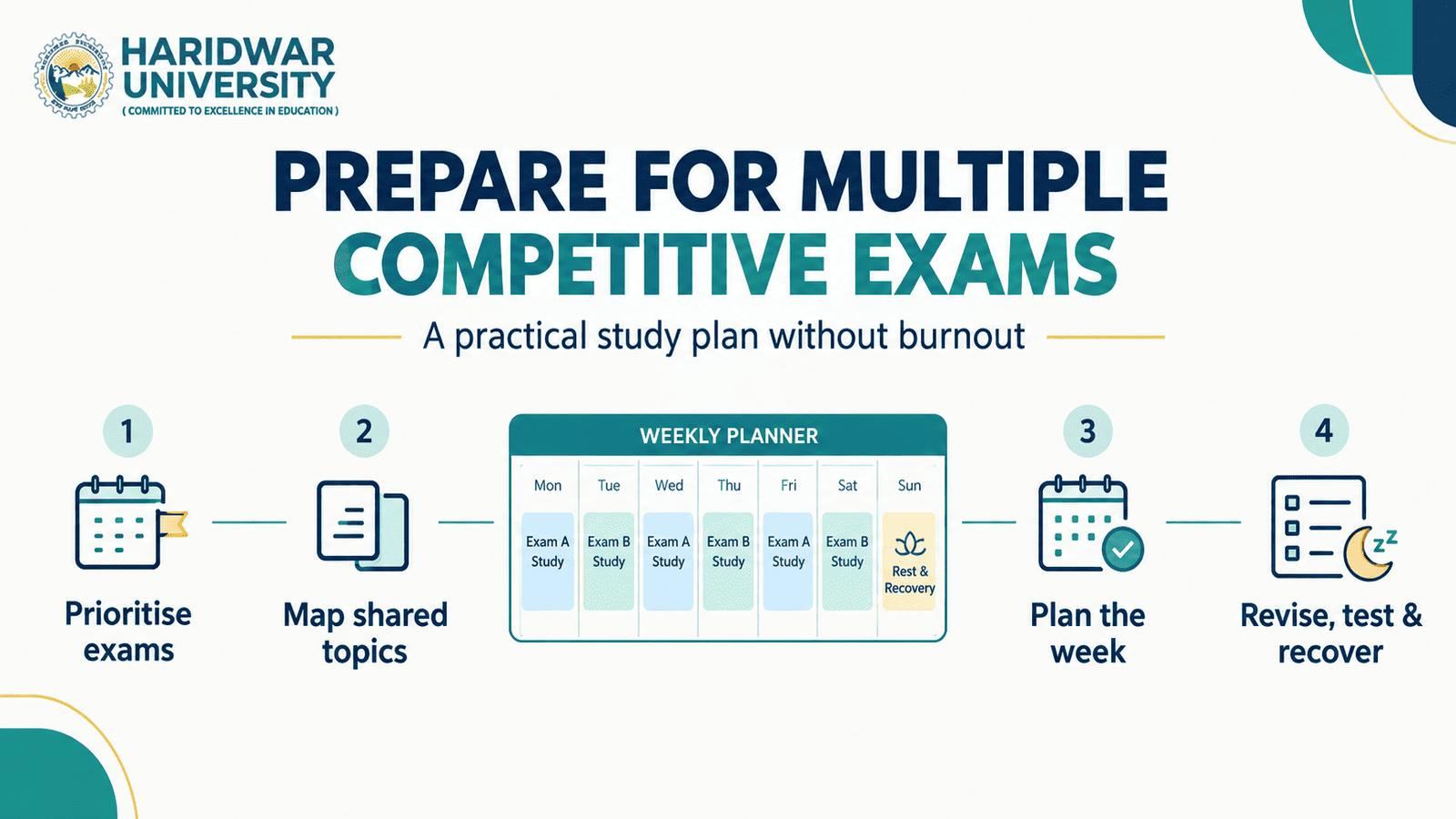
Preparing for one competitive examination requires a clear syllabus, regular practice, and a workable study schedule. Preparing for two or three at the same time adds another serious challenge: deciding what deserves attention today without neglecting the next examination or sacrificing your physical and mental health.
If you want to learn how to prepare for multiple competitive exams, the answer is not simply to increase your daily study hours. It is to organise your preparation systematically around shared subjects, exam-specific requirements, and realistic priorities. Start with one diagnostic question: Are you preparing for several exams with a common academic foundation, or are you trying to pursue unrelated targets simultaneously? That distinction determines how much study can be consolidated and how much must remain strictly separate.
Competitive preparation should be an organized, structured process, not an endless race against the clock. Below is a strategic framework designed to keep your progress measurable without making burnout an inevitable part of your preparation routine.
Table of Contents
- • 1. Understand the Demands of Each Examination
- • 2. Prioritise Exams According to Your Goals and Deadlines
- • 3. Identify Overlapping Syllabuses Without Missing Important Topics
- • 4. Build a Realistic Weekly Study Timetable
- • 5. Balance Revision, Mock Tests and Exam-Specific Practice
- • 6. Avoid Burnout While Preparing for Multiple Exams
- • 7. Manage Weeks When Two Exams Fall Close Together
- • 8. Avoid Common Mistakes in Multiple-Exam Preparation
- • 9. Frequently Asked Questions (FAQs)
- • 10. Build a Study Plan You Can Sustain
1. Understand the Demands of Each Examination
The most frequent mistake in multiple-exam planning is assuming that exams covering similar subjects require identical preparation. Two examinations may test mathematics or reasoning, yet differ dramatically in question formats, depth of difficulty, negative marking weights, and sectional time limits.
Before assembling a study routine, download the official syllabus, test structure, eligibility norms, and latest bulletins for each target test. The official UPSC portal serves as the primary reference point for civil services aspirants, while NTA, banking, or state commission websites anchor other specific targets.
| Planning Factor | What to Record and Audit |
|---|---|
| Exam Date | Distinguish confirmed statutory dates from tentative notification windows. |
| Syllabus Scope | Map common foundational subjects versus unique, exam-specific topics. |
| Question Pattern | Note sectional time limits, total duration, question types, and negative marking rules. |
| Current Preparation Level | Classify chapters into three buckets: Mastered, Shaky, or Untouched. |
| Practice Requirements | List required previous-year question sets, sectional speed drills, and full-length mocks. |
This comparative audit clarifies the genuine workload. An applicant targeting SSC CGL alongside banking recruitment can comfortably consolidate quantitative aptitude, reasoning, and English fundamentals. By contrast, a candidate preparing for an engineering entrance like JEE alongside an administrative test requires distinct, non-overlapping preparation tracks.
2. Prioritise Exams According to Your Goals and Deadlines
Treating all examinations with equal daily weight sounds democratic, but it is practically inefficient. One test may be three weeks away, while another is scheduled six months later. A third might demand major remedial work in a challenging discipline.
Evaluate each examination target across three pragmatic parameters:
- Urgency: How close is the examination date?
- Readiness: What percentage of the syllabus can you solve with high accuracy under timed conditions?
- Strategic Importance: How closely does the qualification align with your core long-term career goals?
| Current Situation | Recommended Strategic Action |
|---|---|
| Exam is imminent, preparation is weak | Focus strictly on high-yield core topics, speed drills, and error elimination. |
| Exam is imminent, preparation is strong | Shift into full mock simulation mode, error log revision, and time refinement. |
| Exam is distant, but syllabus is vast | Establish fundamental concepts and daily problem-solving routines without rushing. |
| Exam represents a secondary alternative | Maintain essential touchpoints without allowing it to cannibalize your primary target. |
Designate one Primary Examination and, where practical, one or two compatible secondary targets. This hierarchy establishes clarity: whenever two urgent academic priorities compete for the same study block, your primary target claims precedence.
3. Identify Overlapping Syllabuses Without Missing Important Topics
Shared subjects eliminate duplicate study, but conceptual overlap must be proven through syllabus line items rather than assumed from broad subject titles. Quantitative aptitude, for example, appears in both SSC and banking examinations, but banking tests emphasize rapid data interpretation and speed calculation, whereas SSC emphasizes advanced algebra, geometry, and trigonometry.
| Topic Category | Exam A | Exam B | Strategic Action Plan |
|---|---|---|---|
| Common Topic | Required | Required | Master theoretical fundamentals once; solve past papers for both formats. |
| Unique to Exam A | Required | Not Required | Dedicate distinct, isolated study sessions exclusively to Exam A. |
| Unique to Exam B | Not Required | Required | Allocate isolated study sessions strictly scheduled for Exam B. |
| Shared Topic, Different Style | Required | Required | Consolidate concept learning; separate speed drills into distinct papers. |
Always keep separate Error Notebooks for each distinct examination. A mistake triggered by conceptual misunderstanding demands theoretical review, whereas an error caused by a calculation blunder under a tight sectional countdown demands timed drill conditioning.
4. Build a Realistic Weekly Study Timetable
A practical study timetable reflects the hours you genuinely have, not an aspirational schedule that crumbles by mid-week. Daily university lectures, practical laboratory sessions, commute times, family responsibilities, and restful sleep all consume real hours.
| Day of Week | Primary Study Focus | Secondary Focus / Review |
|---|---|---|
| Monday | Shared Quantitative / Technical Concepts | Active recall & formula revision |
| Tuesday | Logical Reasoning / Core Subject Analytical Units | Exam A sectional practice questions |
| Wednesday | Exam A Unique Syllabus Modules | Error log analysis from previous tests |
| Thursday | General Awareness / Language & Comprehension | Exam B sectional practice questions |
| Friday | Remedial Focus on Weekly Weak Concepts | Consolidated flashcard / notes revision |
| Saturday | Full-Length Timed Mock Test (Simulated Timing) | Detailed diagnosis of lost marks & mistakes |
| Sunday | Weekly Audit, Backlog Buffer & Next Week Plan | Rest, physical recovery & family time |
For undergraduate students balancing competitive preparation with university degrees, our comprehensive guide on government exam preparation during college offers additional context on balancing academic credit requirements with competitive aspirations.
5. Balance Revision, Mock Tests and Exam-Specific Practice
Passively reading notes creates a false sensation of competence known as the familiarity trap. True readiness requires three distinct cognitive exercises every single week:
- Learn: Master fundamental concepts and complete planned textbook units.
- Retrieve: Test your memory by reproducing formulas, diagrams, and rules on a blank sheet without referencing materials.
- Test: Execute timed mock papers under strict exam conditions and ruthlessly analyze every dropped mark.
Never take mock tests simply to generate an arbitrary score. If you consistently lose marks on a concept shared across multiple exams, resolving that weakness benefits all targets simultaneously. If mistakes occur only during rapid-fire sectional time limits, introduce targeted sectional speed drills. To organize semester study alongside competitive prep, consult our guide to semester exam preparation.
6. Avoid Burnout While Preparing for Multiple Exams
Burnout prevention is not an afterthought or an emergency remedy; it must be engineered into your study plan from day one. When schedules demand 100% maximum capacity every day, any unexpected disruption—such as college assignments or illness—causes the schedule to collapse, triggering stress and late-night cramming.
Watch for practical warning signs of cognitive fatigue:
- Declining concentration and repeated rereading of the same sentence.
- Persistent physical fatigue despite prolonged hours in bed.
- Increased irritability and feelings of cynicism toward your preparation.
- Diminishing test accuracy despite longer daily study hours.
“A timetable is useful only when you can follow it consistently over months. More hours do not automatically mean better preparation; sustainable consistency always outperforms erratic intensity.”
Protect 7 to 8 hours of quality sleep daily. Physical movement, balanced meals, and scheduled rest periods restore neurocognitive focus. If academic pressure begins impairing daily well-being, consult campus counselors or mental health professionals immediately.
7. Manage Weeks When Two Exams Fall Close Together
When two examination dates sit only days apart, the strategic objective changes: protect preparation already mastered while dedicating final touches to the imminent test.
For instance, if Exam A occurs on a Saturday and Exam B follows on Tuesday:
- During the final 5 days before Saturday, dedicate 80% of your daily study to Exam A, maintaining only a brief 1-to-2 hour maintenance block for Exam B.
- Once Exam A concludes on Saturday afternoon, immediately pivot 100% of available hours toward Exam B's highest-yield weak topics.
- On the evening preceding any major test, avoid all-night cramming. Verify hall tickets, travel routes, and permitted stationery, and prioritize restful sleep.
8. Avoid Common Mistakes in Multiple-Exam Preparation
Many well-intentioned study habits create the illusion of hard work while actively impeding retention and test performance:
| Common Preparation Mistake | Recommended Corrective Approach |
|---|---|
| Preparing for too many unrelated exams | Select 2 to 3 compatible targets with shared core syllabuses and clear career value. |
| Treating all exams as identical | Audit each examination's distinct marking rules, timing, and question patterns. |
| Collecting too many reference books | Stick to standard NCERT/primary texts and master past question papers thoroughly. |
| Measuring progress solely by hours sat | Track syllabus units mastered, question accuracy percentage, and mistake reduction. |
| Skipping revision to start new topics | Schedule recurring active retrieval sessions; unrevised topics vanish from memory. |
| Rebuilding the timetable after one bad day | Incorporate weekly buffer sessions and conduct structured weekly reviews. |
| Sacrificing sleep to catch up on backlog | Drop low-priority peripheral tasks and protect restorative sleep cycles. |
9. Frequently Asked Questions (FAQs)
1. How do I prepare for multiple competitive exams at the same time?
Compare official syllabuses, identify genuine conceptual overlap, designate one primary target examination, and build a weekly schedule that includes exam-specific practice alongside shared topics. Review progress weekly.
2. How many hours should I study daily for multiple exams?
There is no universal number. Available hours, prior preparation, syllabus breadth, and degree coursework determine a workable schedule. Start with a sustainable daily block (4 to 6 focused hours) and adjust using completed tasks and mock accuracy as your guide.
3. Can I prepare for two exams in one day?
Yes, if your schedule allows it. You might study a shared foundational subject in one morning block and practise an exam-specific section in an evening session. When syllabuses are unrelated, keep sessions clearly segregated.
4. Is it better to study common subjects first?
Generally yes, provided the syllabuses genuinely overlap and the topic serves both targets. However, do not postpone essential exam-specific sections indefinitely simply because shared subjects feel more convenient.
5. How can I avoid burnout during competitive exam preparation?
Set achievable daily targets, protect sleep, take micro-breaks between sessions, and leave unscheduled recovery periods every week. If persistent fatigue or stress begins affecting daily functioning, reassess the workload immediately.
6. How should I manage two exams scheduled close together?
Verify dates, prioritize the nearer test according to your current readiness, and maintain a smaller daily revision block for the subsequent one. Once the first exam concludes, redirect all study hours toward the second exam's weak areas.
7. Should I prepare for several exams or focus on one?
This depends on career alignment, eligibility, and syllabus compatibility. A small group of compatible exams makes strategic sense, whereas pursuing unrelated exams divides attention and increases burnout risks.
10. Build a Study Plan You Can Sustain
Preparing for multiple competitive exams is fundamentally a test of judgment as much as discipline. The most successful aspirants understand the nuanced demands of each target, combine only the study blocks that genuinely share conceptual DNA, and preserve dedicated room for exam-specific question drills.
Every week, conduct a three-point audit:
- What syllabus chapters were genuinely completed and retained?
- Where did you lose marks in timed mock practice (concepts, calculation, or timing)?
- Does your weekly workload remain physically and mentally sustainable?
For students completing their undergraduate degrees, your core academic programme remains an essential stepping stone. Review the comprehensive Haridwar University academic programmes overview to align your degree with competitive career milestones, or read our strategic guide on how to prepare for UPSC during college.
Excel in Academics & National Competitive Exams at Haridwar University
Haridwar University integrates industry-aligned curricula, flexible academic mentoring, comprehensive placement training, and supportive campus environments designed to help you balance degree excellence with competitive examination success.