

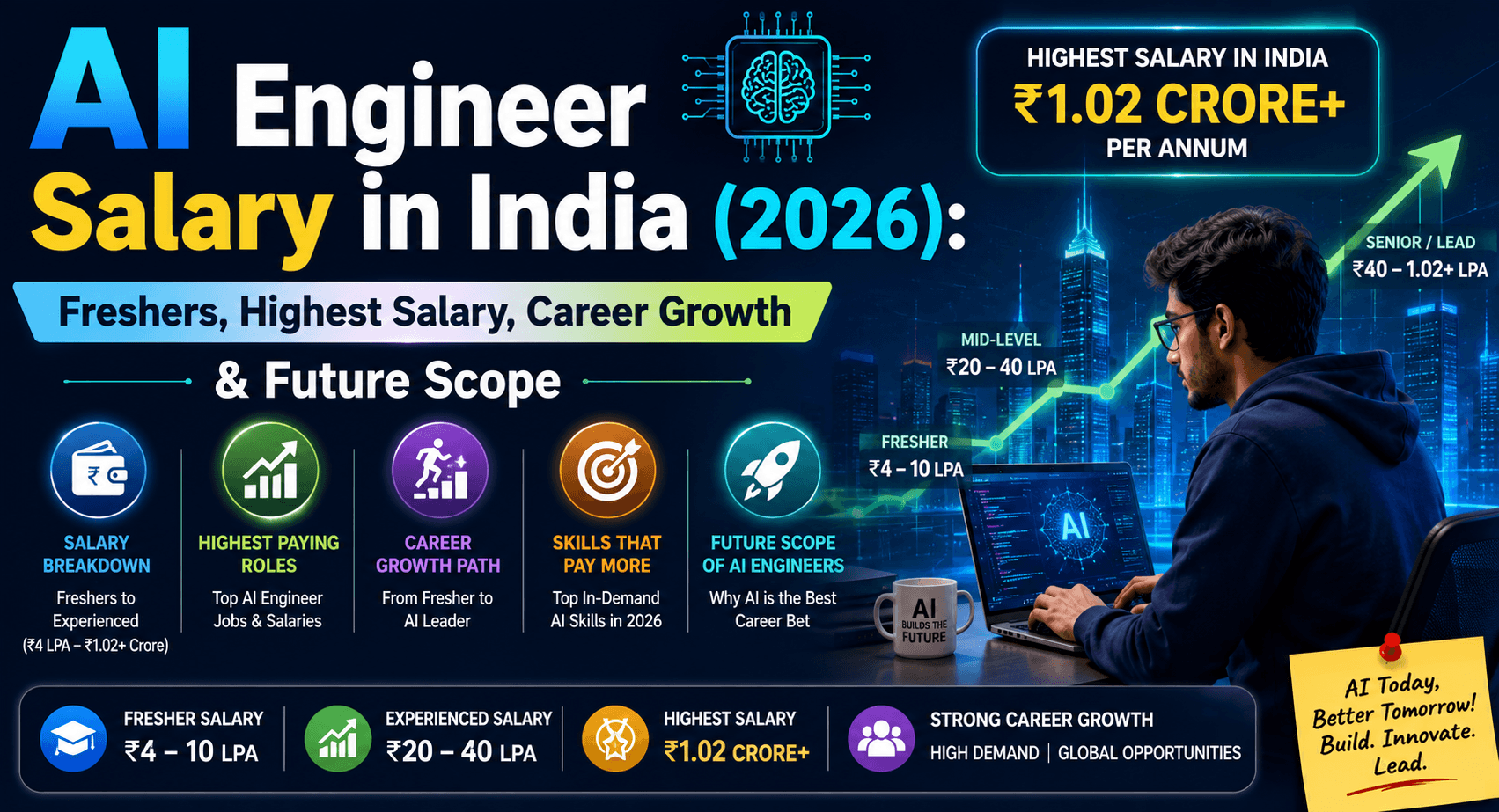
AI Engineer Salary in India (2026): Freshers, Highest Salary, Career Growth & Future Scope
Haridwar University
Understanding AI Engineer Salary in India
Artificial Intelligence has moved beyond research labs and is now shaping industries across healthcare, finance, manufacturing, retail, education, cybersecurity, logistics, and software development. As organizations continue adopting AI-driven solutions, the demand for skilled professionals has increased significantly. One of the most common questions students ask today is, "What is the AI Engineer salary in India?"
If you are planning to pursue engineering after Class 12, understanding the AI Engineer salary in India can help you make an informed career decision. While salary is an important factor, it is equally important to understand the skills, education, industry demand, and long-term growth opportunities that influence earning potential.
This guide explains the AI Engineer salary in India for freshers and experienced professionals, factors that affect compensation, top recruiters, career progression, and practical steps to build a successful AI career. Whether you are a Class 12 student, an engineering aspirant, or someone planning a career transition, this article will help you understand what to expect from one of India's fastest-growing technology careers.
If you are still deciding between Computer Science and Artificial Intelligence, read our AI vs CSE: Which Engineering Branch Should You Choose After 12th? before exploring salary expectations.
Why Is AI Engineer Salary in India Increasing?
The increasing AI Engineer salary in India is driven by one simple reason. Businesses are investing heavily in Artificial Intelligence to improve productivity, automate repetitive tasks, analyze large volumes of data, and deliver better customer experiences.
Unlike many traditional software roles, AI Engineers solve complex business problems by combining programming, mathematics, machine learning, and data analysis. Their work directly contributes to business growth, making these professionals highly valuable across industries.
According to the Stanford AI Index Report, investment in Artificial Intelligence and enterprise adoption continue to grow globally, creating sustained demand for AI talent across multiple sectors.
Similarly, the World Economic Forum Future of Jobs Report identifies Artificial Intelligence and Machine Learning specialists among the fastest-growing occupations over the coming years.
These reports indicate that organizations are not only hiring more AI professionals but are also investing in specialized talent capable of building intelligent products and services.
What Does an AI Engineer Do?
Before discussing the AI Engineer salary in India, it is important to understand the responsibilities associated with this role.
An AI Engineer designs, develops, tests, and deploys intelligent systems capable of learning from data and making predictions or decisions.
Typical responsibilities include:
- Building machine learning models
- Developing deep learning applications
- Training AI algorithms
- Processing structured and unstructured data
- Developing computer vision systems
- Creating Natural Language Processing applications
- Deploying AI models on cloud platforms
- Optimizing model performance
- Collaborating with software developers and data scientists
- Monitoring AI systems after deployment
These responsibilities require expertise in programming, mathematics, statistics, and cloud computing. Because of this specialized skill set, the AI Engineer salary in India is generally higher than many traditional entry-level software roles.
Which Industries Hire AI Engineers?
One common misconception is that AI Engineers only work in technology companies. In reality, almost every major industry is adopting Artificial Intelligence.
Today, AI Engineers are recruited by organizations in:
- Information Technology
- Banking and Financial Services
- Healthcare
- Pharmaceutical Research
- Manufacturing
- Automotive
- Retail and E-commerce
- Telecommunications
- Cybersecurity
- Education Technology
- Agriculture Technology
- Logistics and Supply Chain
- Government Digital Initiatives
As AI adoption expands across industries, employers continue searching for professionals who can design intelligent solutions for real-world business challenges. This widespread adoption contributes significantly to the increasing AI Engineer salary in India.
Why Companies Pay High Salaries to AI Engineers
Many students wonder why AI Engineers often receive higher salary packages than several other engineering roles. The answer lies in the business value they create.
Artificial Intelligence helps organizations:
- Improve operational efficiency
- Reduce manual effort
- Detect fraud
- Predict customer behavior
- Optimize inventory
- Improve medical diagnosis
- Personalize digital experiences
- Accelerate product development
- Enhance cybersecurity
- Support business decision-making
Companies are willing to invest in professionals who can build these solutions because AI directly impacts revenue, productivity, and innovation. Instead of hiring developers only to write code, businesses increasingly seek engineers capable of building intelligent systems that continue learning and improving over time. This is one of the primary reasons the AI Engineer salary in India continues to grow.
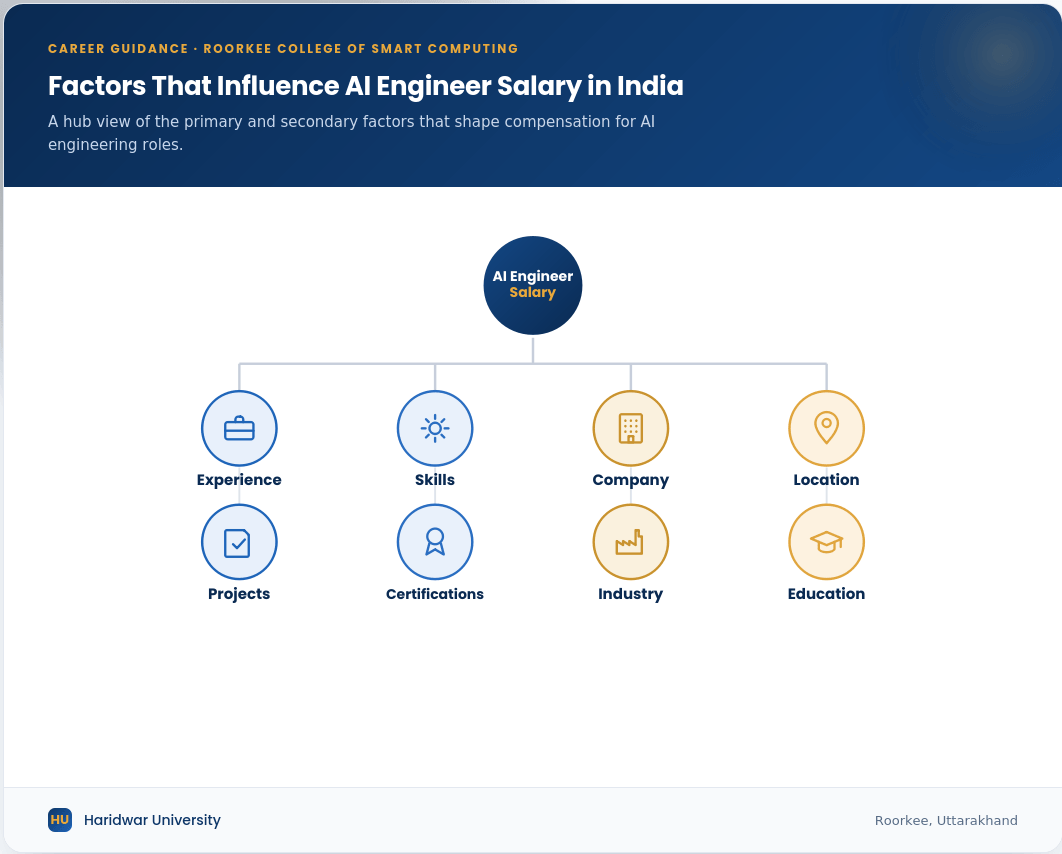
Factors That Influence AI Engineer Salary in India
Not every AI Engineer earns the same salary. Several factors influence compensation throughout a professional's career.
1. Educational Background
Graduates from institutions with strong technical education, practical projects, internships, and industry exposure often receive better placement opportunities. Students pursuing specialized Artificial Intelligence programs also gain an advantage through dedicated coursework in Machine Learning, Deep Learning, Computer Vision, Natural Language Processing, and Data Science. Explore our B.Tech Artificial Intelligence & Machine Learning Programme to understand the curriculum and career opportunities available in this specialization.
2. Technical Skills
Technical expertise plays a major role in determining the AI Engineer salary in India. Employers actively seek candidates with knowledge of:
- Python
- Machine Learning
- Deep Learning
- Neural Networks
- TensorFlow
- PyTorch
- SQL
- Data Structures
- Statistics
- Cloud Platforms
- MLOps
- Large Language Models
- Prompt Engineering
Candidates who continuously upgrade their skills generally experience faster salary growth.
3. Practical Projects
Recruiters often value practical experience as much as academic performance. Students who have completed AI-based projects, open-source contributions, Kaggle competitions, research publications, and industry internships usually have stronger resumes and better placement prospects. Practical experience demonstrates the ability to solve real-world problems, making candidates more attractive to employers.
4. Company Type
The organization you join has a major influence on your salary. Generally, compensation varies across startups, mid-sized technology companies, IT service organizations, product-based companies, global technology firms, and research organizations. While startups may offer faster learning opportunities, large product companies often provide higher compensation along with performance bonuses and stock options.
5. Location
The AI Engineer salary in India also depends on the city where you work. Technology hubs such as Bengaluru, Hyderabad, Pune, Gurgaon, Chennai, and Mumbai typically offer higher salary packages because of greater demand for AI professionals and the presence of major technology companies. However, remote work has started reducing location barriers, allowing skilled professionals from different parts of India to access opportunities with national and international employers.
6. Industry Experience
Experience remains one of the strongest factors affecting salary. As professionals gain expertise in designing AI systems, leading projects, mentoring teams, and solving complex business problems, their earning potential increases substantially. This is why experienced AI Engineers often receive significantly higher compensation than fresh graduates.
Why Students Are Choosing AI Engineering After Class 12
Artificial Intelligence has become one of the most preferred engineering specializations among students interested in future-ready careers. Several reasons contribute to this growing interest:
- High industry demand
- Strong salary potential
- Opportunities across multiple industries
- Continuous technological innovation
- Global career prospects
- Research opportunities
- Startup ecosystem
- Government support for AI initiatives
- Flexible career pathways
India's growing focus on Artificial Intelligence through initiatives such as the IndiaAI Mission also indicates long-term opportunities for students entering this field. Students interested in building intelligent software systems while working on cutting-edge technologies often find AI Engineering to be an exciting career choice.
AI Engineer Salary in India by Experience, Company, Skills & Location
AI Engineer Salary in India for Freshers
One of the first questions engineering aspirants ask is, "What is the AI Engineer salary in India for freshers?" The answer depends on several factors, including technical skills, internships, projects, college reputation, location, and the hiring company.
Fresh graduates who have strong programming skills, practical AI projects, internship experience, and a solid understanding of Machine Learning and Deep Learning often receive better salary packages than candidates with only theoretical knowledge. Rather than focusing only on academic scores, employers increasingly evaluate candidates based on their ability to solve real-world problems and build AI applications.
Based on salary benchmarks published by platforms such as AmbitionBox and Glassdoor, entry-level AI Engineers in India generally receive competitive packages, with compensation varying according to company type, skills, and experience.
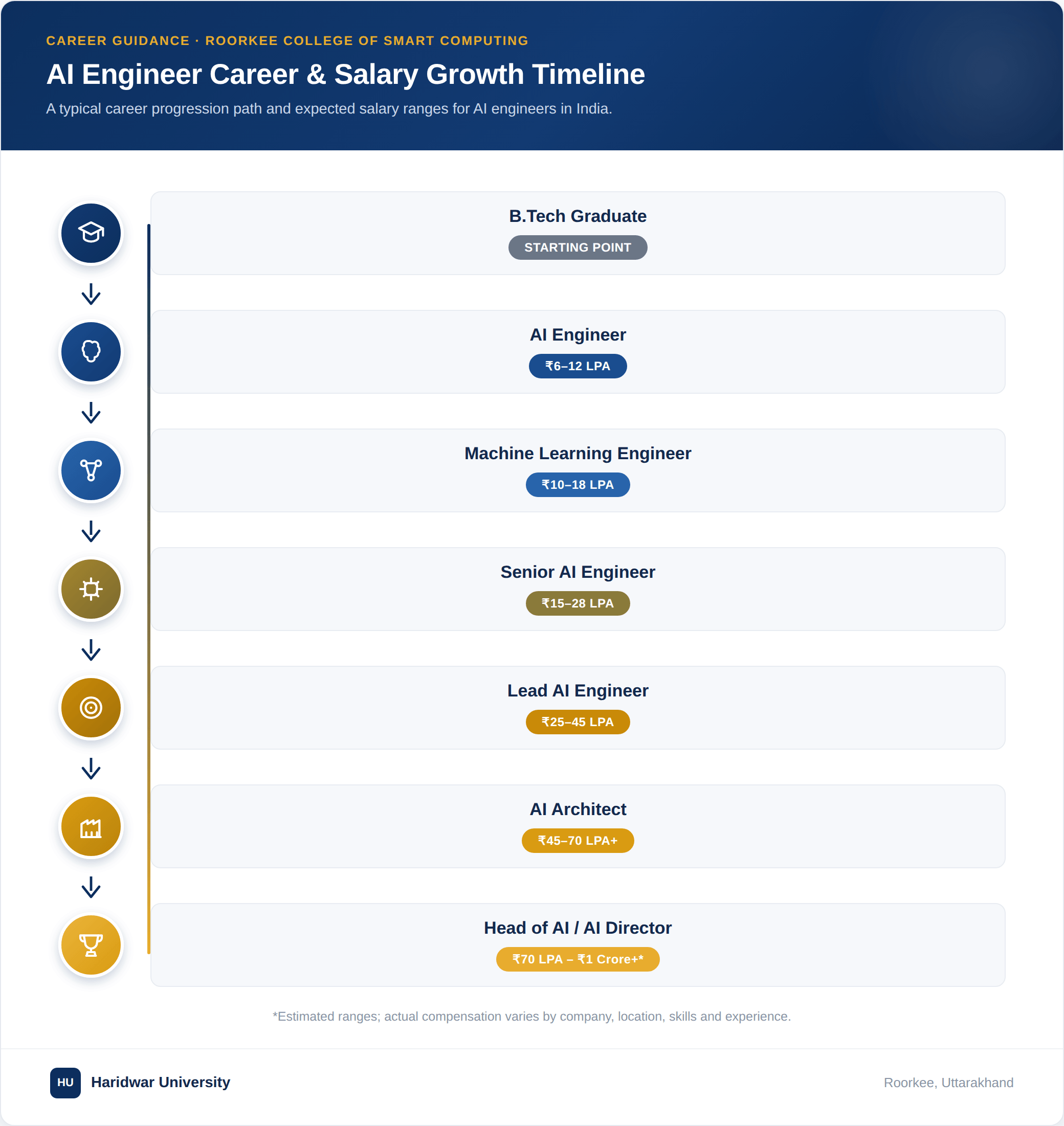
Average AI Engineer Salary in India by Experience
| Experience Level | Estimated Annual Salary (Approx.) | Career Stage |
|---|---|---|
| Fresher (0–1 Year) | ₹6 LPA – ₹12 LPA | Entry-Level AI Engineer |
| 1–3 Years | ₹10 LPA – ₹18 LPA | AI Engineer |
| 3–5 Years | ₹15 LPA – ₹28 LPA | Mid-Level AI Engineer |
| 5–8 Years | ₹25 LPA – ₹45 LPA | Senior AI Engineer |
| 8–12 Years | ₹40 LPA – ₹70 LPA+ | Lead AI Engineer |
| 12+ Years | ₹60 LPA – ₹1 Crore+* | AI Architect / Head of AI |
*Highly experienced professionals working in leading product companies, multinational organizations, or global technology firms may earn significantly more through bonuses, stock options, and international opportunities.
Instead of seeing these figures as guaranteed salaries, students should view them as potential career milestones that can be achieved through continuous learning, practical experience, and specialization.
How Does AI Engineer Salary Grow with Experience?
Unlike many traditional technology roles, AI Engineering offers strong long-term earning potential because professionals continue developing specialized expertise throughout their careers. As engineers gain experience, they typically move from writing machine learning models to designing complete AI solutions, leading technical teams, and making strategic technology decisions. Their responsibilities evolve from implementing algorithms to solving large-scale business challenges, which naturally leads to higher compensation. This progression explains why the AI Engineer salary in India often grows significantly over time for professionals who consistently upgrade their skills.
AI Engineer Salary in India by Company Type
The company you work for is one of the biggest factors influencing your salary. Different organizations have different business models, project complexity, and compensation structures. Generally, AI Engineers can expect different salary ranges depending on whether they join a startup, an IT services company, or a product-based organization.
Startup Companies
Many startups provide excellent learning opportunities and exposure to cutting-edge technologies. Although salaries vary, startups often compensate employees through rapid career growth, broader responsibilities, and in some cases, Employee Stock Ownership Plans (ESOPs). These environments are ideal for engineers who enjoy solving diverse technical challenges.
IT Service Companies
Large IT service organizations recruit AI Engineers for enterprise projects across industries. These companies provide structured training, stable career progression, and opportunities to work with international clients. Fresh graduates often begin their careers here before moving into more specialized AI roles.
Product-Based Companies
Product companies generally develop their own software platforms, AI-powered applications, or cloud-based solutions. Since these organizations rely heavily on innovation and intellectual property, they often offer some of the highest compensation packages for skilled AI professionals. Recruitment standards are usually more competitive, with greater emphasis on data structures, algorithms, machine learning fundamentals, and system design.
Global Technology Companies
International technology companies invest heavily in Artificial Intelligence research and development. Professionals working in these organizations may receive attractive compensation packages that include performance bonuses, stock grants, healthcare benefits, and opportunities to collaborate on globally impactful AI projects.
Top Companies Hiring AI Engineers in India
Artificial Intelligence talent is in demand across both Indian and multinational organizations. Some of the leading recruiters include:
- Microsoft
- Amazon
- NVIDIA
- IBM
- Oracle
- Accenture
- Infosys
- Tata Consultancy Services (TCS)
- Wipro
- Capgemini
- Deloitte
- Qualcomm
- Samsung Research
- Adobe
These companies recruit professionals for roles involving Machine Learning, Generative AI, Computer Vision, Natural Language Processing, Robotics, and Intelligent Automation. Instead of targeting only well-known brands, students should focus on building strong technical foundations and practical experience, as these are the qualities that employers value most.
AI Engineer Salary in India by Location
Location also influences the AI Engineer salary in India because major technology hubs offer more AI-focused roles, larger research teams, and stronger startup ecosystems.
| City | Hiring Demand | Salary Trend |
|---|---|---|
| Bengaluru | Very High | Highest |
| Hyderabad | Very High | Very High |
| Pune | High | High |
| Gurugram | High | High |
| Chennai | High | Moderate to High |
| Mumbai | Moderate to High | High |
| Noida | Growing | Moderate to High |
Cities with a strong presence of technology companies generally provide greater career opportunities, although remote and hybrid work models are expanding access to AI jobs across India.
Which Skills Can Increase Your AI Engineer Salary?
Many students assume that completing a B.Tech degree alone is enough to secure a high-paying AI role. In reality, employers reward professionals who combine academic knowledge with practical technical skills.
Some of the most valuable skills include:
- Python Programming
- Machine Learning
- Deep Learning
- TensorFlow
- PyTorch
- Natural Language Processing (NLP)
- Computer Vision
- Large Language Models (LLMs)
- Prompt Engineering
- MLOps
- SQL
- Data Engineering
- Cloud Computing (AWS, Azure, Google Cloud)
- Git and Version Control
Professionals who continuously learn emerging technologies are generally better positioned for salary growth throughout their careers.
According to the Stack Overflow Developer Survey, AI-assisted development tools and modern programming skills are becoming increasingly important across the software industry, reinforcing the need for continuous upskilling.
How to Increase Your AI Engineer Salary in India
Knowing the average AI Engineer salary in India is useful, but the more important question is how you can increase your earning potential throughout your career.
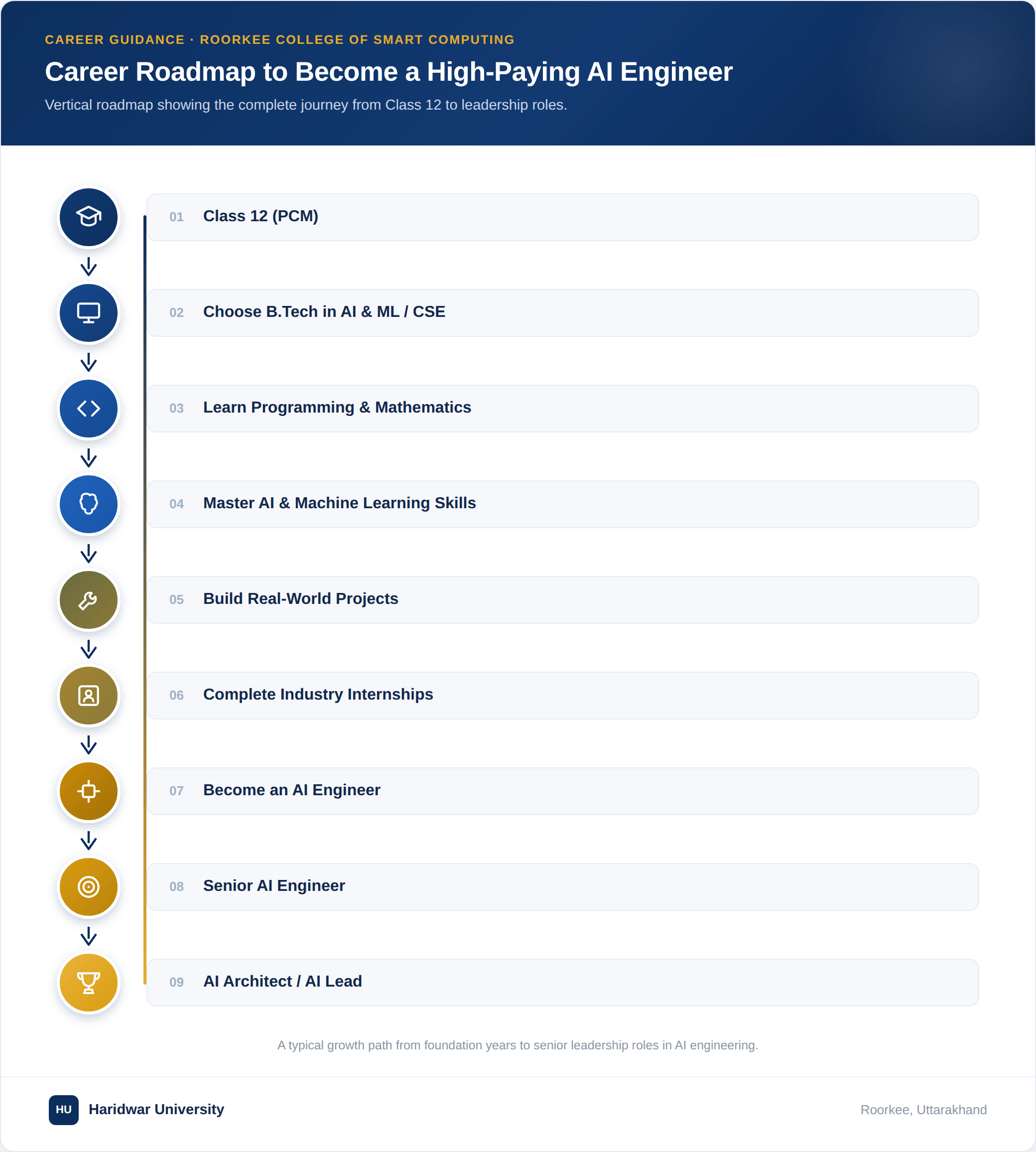
The highest-paying AI professionals are rarely those with only years of experience. Instead, they combine strong technical expertise, practical problem-solving skills, industry exposure, and continuous learning. Whether you are preparing for engineering admissions or are already pursuing a B.Tech degree, focusing on the right skills and experiences can significantly improve your long-term career growth.
Build Strong Programming Fundamentals
Programming is the foundation of every successful AI career. Before working with advanced Machine Learning models or Generative AI tools, students should develop a solid understanding of programming concepts.
The most valuable programming languages for AI Engineers include:
- Python
- SQL
- Java (for certain enterprise applications)
- C++ (used in AI research and high-performance systems)
Among these, Python remains the most widely used language because of its extensive ecosystem of AI and Machine Learning libraries. Students should also become comfortable with data structures, algorithms, object-oriented programming, database management, and version control using Git. These concepts form the technical foundation that employers expect from AI Engineers.
Learn In-Demand AI Skills
One of the biggest reasons why salaries differ between professionals with similar experience is specialization. Employers pay higher salaries to candidates who have expertise in technologies that solve real business problems.
Some of the most valuable AI skills today include:
- Machine Learning
- Deep Learning
- Neural Networks
- Natural Language Processing (NLP)
- Computer Vision
- Large Language Models (LLMs)
- Prompt Engineering
- Reinforcement Learning
- MLOps
- Cloud AI Services
- Data Engineering
As AI technologies continue to evolve, professionals who regularly update their skills remain competitive in the job market.
Gain Practical Project Experience
Recruiters increasingly prioritize practical experience over theoretical knowledge. Students should work on projects that demonstrate their ability to apply AI concepts in real-world scenarios. Examples include:
- Chatbots powered by Large Language Models
- Image recognition systems
- Recommendation engines
- Disease prediction models
- Fraud detection systems
- AI-based attendance systems
- Predictive analytics dashboards
Building projects helps students develop problem-solving skills while creating a portfolio that can be showcased during placements and interviews. Participating in hackathons, open-source projects, and coding competitions also strengthens a candidate's profile.
Complete Internships Before Graduation
Internships provide valuable industry exposure and help students understand how Artificial Intelligence is applied in real business environments. Students who complete internships often gain experience in data preprocessing, model development, model deployment, cloud computing, team collaboration, and software development workflows. Internships also improve communication skills, technical confidence, and professional networking, all of which contribute to stronger placement opportunities.
Earn Relevant Certifications
Certifications cannot replace practical experience, but they demonstrate a commitment to continuous learning. Recognized certifications in Artificial Intelligence, Machine Learning, and Cloud Computing can strengthen your resume, especially when combined with hands-on projects. Students should prioritize certifications that involve practical implementation rather than only theoretical assessments.
Develop Soft Skills Alongside Technical Skills
AI Engineers rarely work alone. They collaborate with software developers, product managers, business analysts, researchers, and clients. Strong communication, teamwork, and analytical thinking are essential for understanding business requirements and presenting technical solutions effectively. Professionals who combine technical excellence with leadership and communication skills often progress more quickly into senior roles.
AI Engineer Salary vs Software Engineer Salary
Many students compare Artificial Intelligence with traditional Software Engineering while choosing their career. Both fields offer excellent opportunities, but their responsibilities and salary growth can differ depending on specialization and experience.
| Parameter | AI Engineer | Software Engineer |
|---|---|---|
| Primary Work | AI models, Machine Learning, Intelligent Systems | Software Applications & Systems |
| Core Skills | Python, ML, Deep Learning, AI Frameworks | Programming, DSA, Software Development |
| Demand | Rapidly Growing | Consistently High |
| Learning Curve | Higher | Moderate |
| Salary Growth | High with Specialization | Stable and Strong |
| Industries | Healthcare, Finance, AI Startups, IT, Manufacturing | Almost Every Industry |
Software Engineering continues to offer excellent career opportunities. However, AI Engineering provides an additional layer of specialization that can create opportunities in emerging technologies and research-driven roles. If you are deciding between these two career paths, read our AI vs CSE: Which Engineering Branch Should You Choose After 12th?
AI Engineer vs Data Scientist: Which Career Pays More?
AI Engineers and Data Scientists often work closely together, but their responsibilities are different. A Data Scientist focuses on analyzing data, identifying patterns, and generating business insights. An AI Engineer builds intelligent systems that use those insights to automate tasks, make predictions, or improve decision-making.
Both careers offer attractive salary packages, and the better choice depends on your interests. Students who enjoy programming, software development, and building intelligent applications may find AI Engineering more suitable. Those who prefer statistical analysis, data visualization, and business analytics may prefer Data Science. Rather than choosing a career based solely on salary, students should evaluate their strengths, interests, and long-term career goals.
Is AI Engineering Worth It in 2026?
Based on current industry trends, Artificial Intelligence continues to be one of the fastest-growing technology domains worldwide. Organizations across healthcare, finance, retail, manufacturing, education, and cybersecurity are integrating AI into their operations to improve efficiency and innovation.
According to the World Economic Forum's Future of Jobs Report, AI-related roles are expected to remain among the fastest-growing professions over the coming years.
Similarly, the Stanford AI Index Report highlights continued growth in AI investment, enterprise adoption, and research, indicating sustained demand for skilled professionals. For students entering engineering today, these trends suggest that AI Engineering offers strong long-term career prospects, provided they continue learning and adapting as technology evolves.
Why Pursue AI Engineering at Haridwar University?
Choosing the right university is one of the first steps toward building a successful AI career. A quality engineering education should combine strong theoretical foundations with practical learning, industry exposure, internships, and project-based experience. Students interested in Artificial Intelligence should look for programs that include subjects such as Machine Learning, Deep Learning, Data Science, Computer Vision, Natural Language Processing, Cloud Computing, Python Programming, Industry Projects, and Internship Opportunities.
Explore our B.Tech Artificial Intelligence & Machine Learning Programme to learn about the curriculum, practical training, and career opportunities.
Learn more about our Engineering Programmes to explore other technology specializations offered at Haridwar University.
Frequently Asked Questions About AI Engineer Salary in India
FAQ 1. What is the average AI Engineer salary in India?
The AI Engineer salary in India varies depending on experience, technical skills, company, and location. Fresh graduates typically earn competitive entry-level salaries, while experienced professionals with expertise in Machine Learning, Deep Learning, Generative AI, and cloud technologies can earn significantly higher compensation. Product-based companies and multinational organizations generally offer higher salary packages than many traditional IT service companies.
FAQ 2. What is the AI Engineer salary in India for freshers?
Fresh AI Engineers usually receive salaries based on their technical skills, internships, projects, and the organization they join. Candidates with practical AI experience, strong programming skills, and industry-relevant projects generally receive better placement packages than those with only academic knowledge.
FAQ 3. Which companies offer the highest AI Engineer salary in India?
Many leading technology companies recruit AI Engineers, including Google, Microsoft, Amazon, NVIDIA, IBM, Oracle, Adobe, Accenture, Infosys, TCS, and Qualcomm. Compensation varies depending on the role, experience, and technical expertise required.
FAQ 4. Which city offers the highest AI Engineer salary in India?
Technology hubs such as Bengaluru, Hyderabad, Gurugram, Pune, Chennai, and Mumbai generally offer higher salaries because they have a larger concentration of AI companies, research organizations, and technology startups.
FAQ 5. Is AI Engineering a good career in India?
Yes. Artificial Intelligence continues to be one of the fastest-growing technology fields. As organizations increasingly adopt AI solutions, demand for skilled professionals continues to grow across industries such as healthcare, finance, manufacturing, education, cybersecurity, and retail. According to the Stanford AI Index Report, AI adoption and investment continue to increase worldwide.
FAQ 6. Which skills can increase an AI Engineer's salary?
Professionals who continuously develop skills in Python, Machine Learning, Deep Learning, Computer Vision, Natural Language Processing, Large Language Models (LLMs), MLOps, Cloud Computing, and Generative AI are generally better positioned for higher-paying roles.
FAQ 7. Can AI Engineers earn ₹1 crore per year?
Yes, but these salaries are generally achieved after several years of experience, strong technical expertise, leadership responsibilities, and employment in leading product companies or global technology organizations. Many senior professionals also receive bonuses and stock-based compensation in addition to their annual salary.
FAQ 8. Which engineering course is best for becoming an AI Engineer?
Students interested in Artificial Intelligence typically pursue B.Tech programs specializing in Artificial Intelligence & Machine Learning, Computer Science Engineering, or closely related disciplines. The ideal choice depends on career goals and personal interests. Learn more about our B.Tech Artificial Intelligence & Machine Learning Programme.
Conclusion
The AI Engineer salary in India reflects the growing importance of Artificial Intelligence across industries. However, salary should not be the only factor when choosing a career. Long-term success depends on developing strong technical foundations, continuously upgrading your skills, gaining practical experience, and solving real-world problems through innovative AI solutions. Students who begin building these skills during their engineering education are better prepared to take advantage of the expanding opportunities in Artificial Intelligence.
If you are planning your engineering journey after Class 12, choosing the right specialization and university can significantly influence your career growth. Explore our Engineering Programmes to discover future-ready B.Tech specializations offered at Haridwar University.
Ready to begin your engineering journey? Visit our Admissions 2026 to learn about eligibility, the application process, scholarships, and important admission updates.
If you're still comparing engineering branches, our detailed AI vs CSE: Which Engineering Branch Should You Choose After 12th? can help you understand the differences in curriculum, career opportunities, placement trends, and long-term growth before making your decision.