

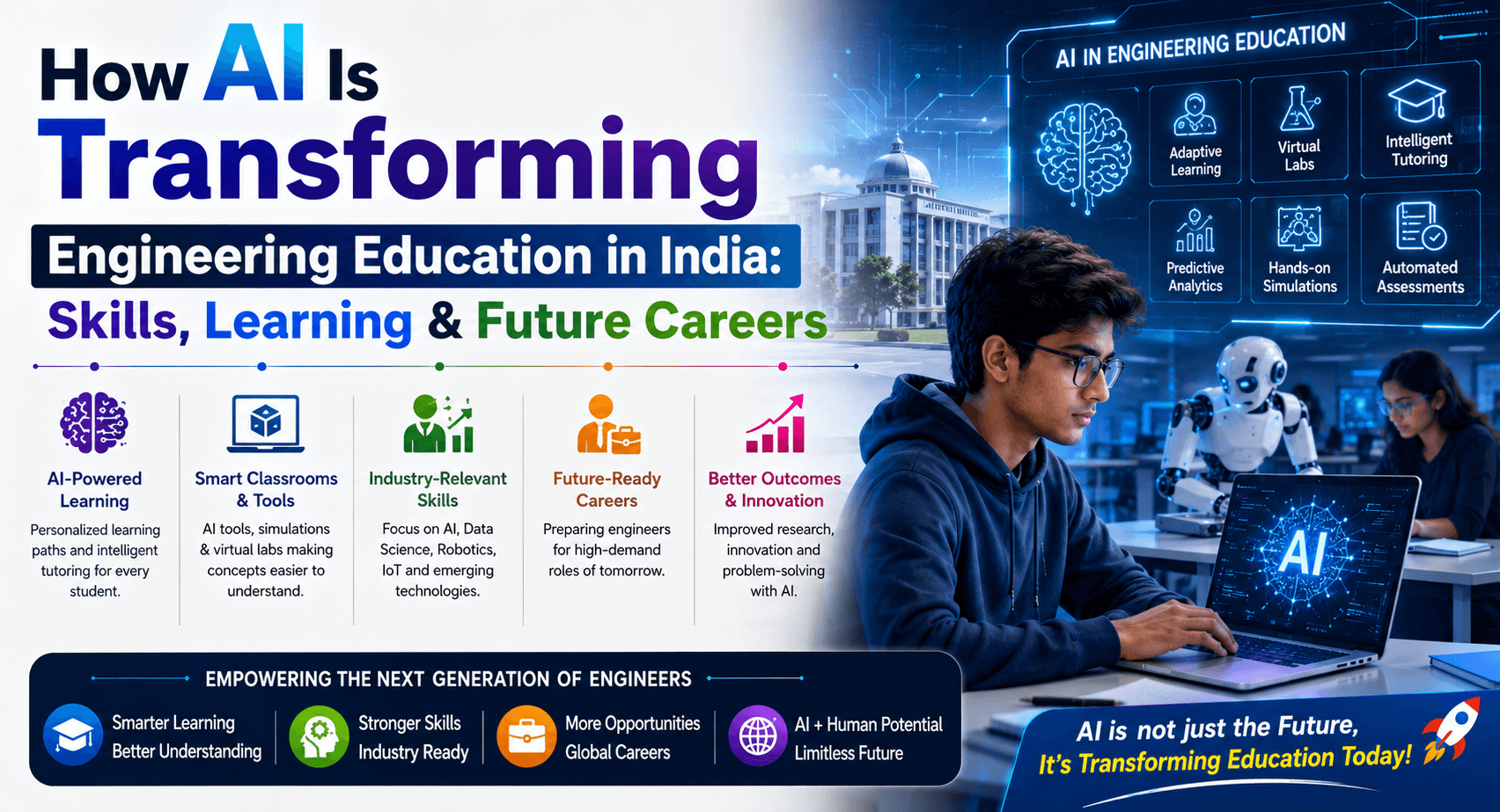
How AI Is Transforming Engineering Education in India: Skills, Learning & Future Careers
Haridwar University
Understanding the Role of AI in Engineering Education
Artificial Intelligence is changing the way industries operate, businesses make decisions, and professionals solve complex problems. This transformation is also reshaping engineering education. Today's engineering students are no longer expected to rely only on textbooks, traditional classrooms, and manual problem-solving. Instead, they are learning in an environment where AI-powered tools, virtual laboratories, intelligent tutoring systems, and data-driven learning experiences are becoming increasingly common.
This shift has created an important question among students and parents alike: How is AI transforming engineering education in India, and what does it mean for future engineers?
The answer goes beyond simply introducing new technologies into classrooms. Artificial Intelligence is changing how engineering students learn, practice, collaborate, conduct research, prepare for placements, and build future-ready careers. Universities are gradually integrating AI into teaching methodologies, while industries expect graduates to possess not only technical knowledge but also AI literacy, problem-solving abilities, and digital skills.
If you are planning to pursue engineering after Class 12, understanding how AI is transforming engineering education can help you prepare for the changing expectations of universities and employers. Rather than replacing traditional engineering concepts, AI is enhancing learning by making education more interactive, personalized, and aligned with real-world industry requirements.
If you are still deciding which engineering branch to choose, read our AI vs CSE: Which Engineering Branch Should You Choose After 12th? to understand the differences in curriculum, career opportunities, placements, and future scope.
Why Engineering Education Is Changing Faster Than Ever
Engineering has always evolved alongside technological progress. Over the last few decades, engineering education has adapted to developments such as computer programming, the internet, cloud computing, mobile technologies, and automation. Today, Artificial Intelligence represents the next major shift. Modern engineering graduates are expected to solve multidisciplinary problems that combine software, hardware, automation, analytics, and intelligent systems. As a result, engineering education is gradually moving from memorization-based learning toward project-based, application-oriented, and technology-enabled learning.
Several factors are driving this transformation:
- Rapid adoption of Artificial Intelligence across industries
- Increasing demand for digital and AI-related skills
- Greater emphasis on innovation and research
- Expansion of interdisciplinary engineering projects
- Industry expectations for job-ready graduates
- Availability of AI-powered educational platforms and tools
Organizations are no longer looking only for graduates who understand engineering theory. They also value candidates who can apply technology to solve practical challenges, collaborate effectively, and adapt to continuous technological change.
According to the World Economic Forum Future of Jobs Report, technology-driven roles, including those involving Artificial Intelligence, data, and automation, are expected to remain among the fastest-growing occupations globally. This growing demand is encouraging educational institutions to prepare students with future-ready technical and professional skills.
What Role Does Artificial Intelligence Play in Engineering Education?
Before exploring how AI is transforming engineering education, it is important to understand what Artificial Intelligence contributes to the learning process.
Artificial Intelligence refers to systems capable of performing tasks that normally require human intelligence, such as learning from data, recognizing patterns, understanding language, solving problems, and supporting decision-making.
In engineering education, AI is not replacing teachers or traditional learning methods. Instead, it acts as a powerful learning assistant that helps students understand concepts more effectively, receive personalized support, and develop practical skills.
Some of the major applications of AI in engineering education include:
- Personalized learning experiences
- Intelligent tutoring systems
- AI-assisted coding support
- Virtual laboratories and simulations
- Automated assessments and feedback
- Research assistance
- Data analysis and visualization
- Project development support
- Career guidance and skill recommendations
Rather than replacing engineering fundamentals such as mathematics, programming, mechanics, or electronics, AI enables students to learn these subjects more efficiently while spending more time on innovation, design, and problem-solving.
According to UNESCO's Guidance for Generative AI in Education and Research, Artificial Intelligence should be viewed as a tool that supports learning and responsible innovation, while educators continue to play a critical role in developing critical thinking, ethics, and human judgment.
How AI Is Changing the Way Engineering Students Learn
The biggest impact of Artificial Intelligence is not that it introduces new software. It changes the entire learning experience.
Traditional engineering education often followed a linear approach. Students attended lectures, completed assignments, performed experiments in physical laboratories, and prepared for examinations. While these methods remain important, AI is making learning more flexible, interactive, and personalized.
Today, engineering students can receive instant explanations for complex concepts, practice coding with AI-assisted tools, perform simulations without expensive laboratory equipment, and access learning resources tailored to their individual progress.
Instead of replacing traditional education, AI strengthens it by providing additional learning support whenever students need it.
| Traditional Engineering Education | AI-Enabled Engineering Education |
|---|---|
| Fixed classroom learning | Personalized learning experiences |
| Manual coding practice | AI-assisted coding guidance |
| Physical laboratories only | Virtual labs and simulations |
| Standard assignments | Adaptive learning activities |
| Delayed feedback | Instant feedback and suggestions |
| Limited learning resources | AI-powered learning assistants available anytime |
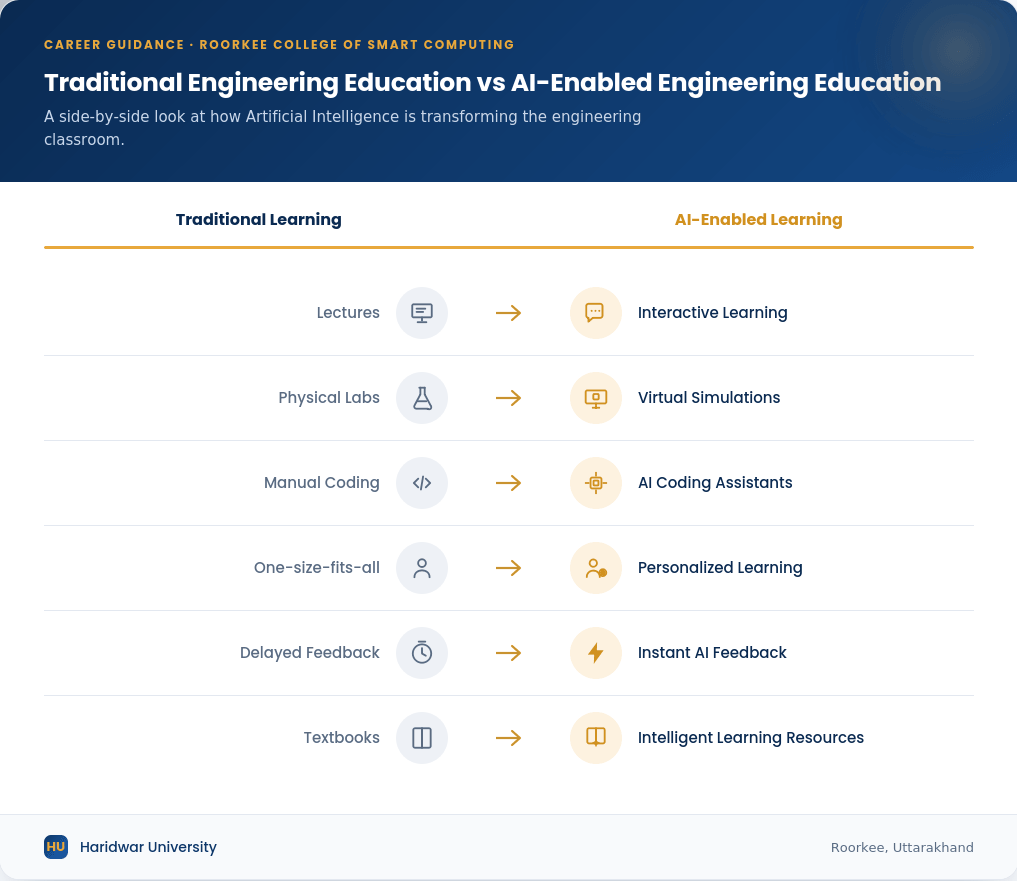
This transformation allows students to spend more time understanding engineering concepts rather than searching for information or repeating routine tasks.
However, it is important to remember that AI works best when students already possess strong engineering fundamentals. Critical thinking, mathematical reasoning, creativity, teamwork, and communication remain essential skills that cannot be replaced by AI tools.
AI Is Changing Learning, Not Replacing Engineers
A common concern among students is whether Artificial Intelligence will reduce the importance of engineering education. The reality is quite different.
AI can automate repetitive tasks, assist with coding, summarize information, and improve productivity. However, it cannot replace the creativity, analytical thinking, ethical decision-making, and engineering judgment required to solve complex real-world problems.
Successful engineers of the future will not compete against AI. Instead, they will learn how to work effectively alongside it.
This means engineering education is evolving from simply teaching technical concepts to developing professionals who can combine engineering knowledge with AI-enabled problem-solving.
According to the National Education Policy (NEP) 2020, Indian higher education is moving toward multidisciplinary learning, digital technologies, innovation, and skill-based education to prepare graduates for rapidly changing industry requirements.
Understanding how AI is transforming engineering education is only the first step. The next question most students ask is practical:
- Which AI tools should engineering students actually use?
- How can these tools improve learning without creating dependency?
- Which AI skills are becoming essential for future engineers?
AI Tools and Skills Every Engineering Student Should Learn
Top AI Tools Every Engineering Student Should Use
As AI transforms engineering education in India, students have access to tools that can simplify learning, improve productivity, and strengthen technical skills. However, these tools should be viewed as learning assistants rather than shortcuts. Their real value lies in helping students understand concepts, practice independently, and solve engineering problems more efficiently.
Using AI responsibly can help engineering students save time, explore multiple solutions, and focus more on innovation instead of repetitive tasks.
Below are some of the most useful AI tools for engineering students and their practical applications.
| AI Tool | Best Use for Engineering Students |
|---|---|
| ChatGPT | Understanding engineering concepts, coding explanations, brainstorming project ideas |
| GitHub Copilot | Writing and reviewing code more efficiently |
| Google Gemini | Research, multimodal learning, summarizing technical topics |
| Perplexity AI | Finding research-backed answers with citations |
| Claude | Reviewing lengthy technical documents and reports |
| NotebookLM | Organizing lecture notes and study materials |
| MATLAB AI Features | Engineering simulations and mathematical modeling |
| Wolfram | Solving mathematical equations and engineering calculations |
These tools should support learning, not replace it. Students who first understand engineering concepts and then use AI to enhance their learning generally develop stronger technical skills than those who rely entirely on AI-generated answers.
How Engineering Students Should Use AI Responsibly
One of the biggest misconceptions about Artificial Intelligence is that it can replace the learning process. In reality, engineering education still requires students to understand concepts, solve problems independently, and apply knowledge in practical situations. AI can accelerate learning, but it cannot replace analytical thinking, engineering judgment, or creativity.
Students should consider these best practices while using AI:
- Learn the underlying concept before asking AI for solutions.
- Verify AI-generated code before using it in projects.
- Avoid copying assignments directly from AI tools.
- Use AI to understand different approaches rather than memorizing answers.
- Cross-check technical information with textbooks, faculty guidance, and reliable references.
- Treat AI as a learning partner rather than a replacement for independent thinking.
According to UNESCO's Guidance for Generative AI in Education and Research, educational institutions should encourage the responsible and ethical use of AI while ensuring that students continue developing critical thinking, creativity, and independent problem-solving skills.
AI Skills Every Engineering Student Should Learn in 2026
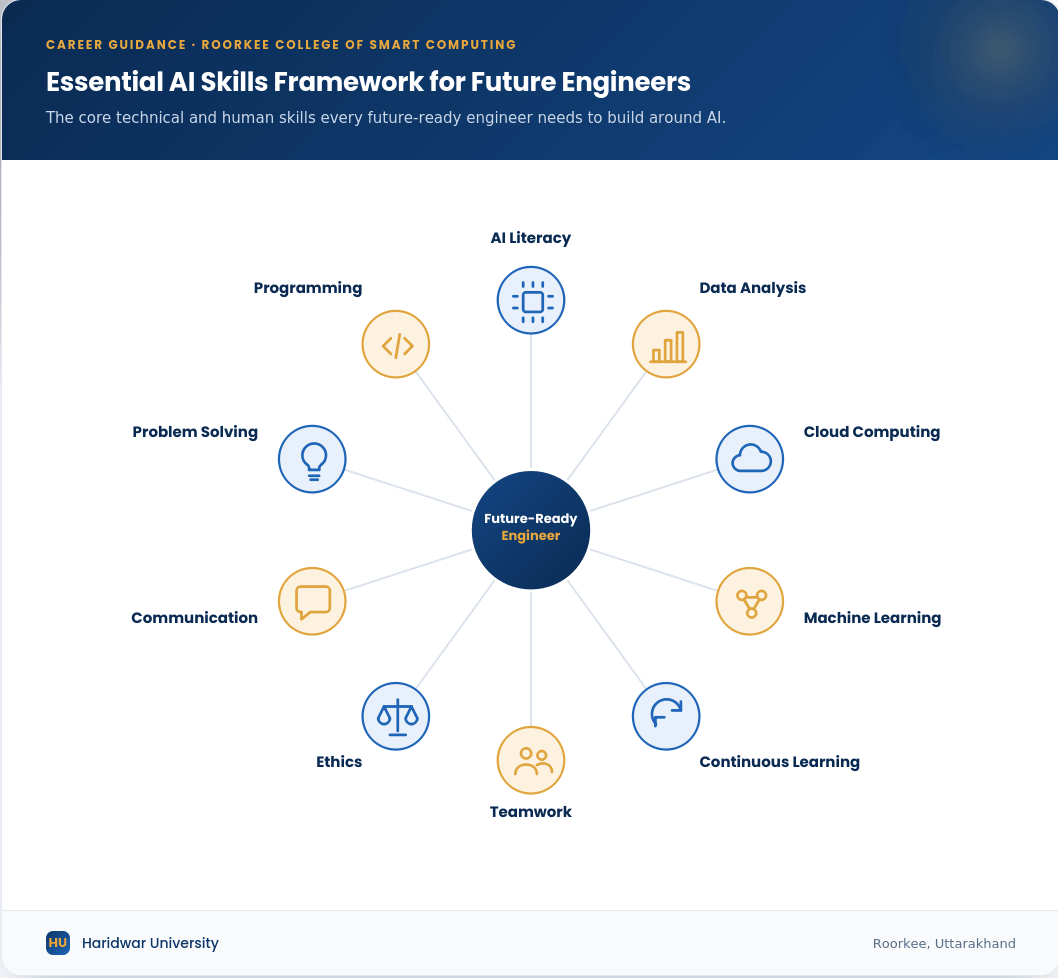
As AI becomes an integral part of engineering education, employers are increasingly looking for graduates who possess both technical expertise and AI literacy. Learning how to use AI tools is valuable, but developing the right skills is even more important. Engineering students should gradually build expertise in the following areas:
Programming Fundamentals
Programming remains the foundation of modern engineering disciplines. Students should develop proficiency in:
- Python
- C++
- Java
- SQL
Python, in particular, has become the preferred language for Artificial Intelligence and Machine Learning because of its extensive ecosystem of libraries and frameworks.
Data Analysis
Engineering projects generate large amounts of data. Students who understand how to collect, clean, analyze, and interpret data are better equipped to solve engineering problems using AI. Basic knowledge of statistics, spreadsheets, visualization tools, and databases provides a strong foundation for AI applications.
Machine Learning Fundamentals
Engineering students do not need to become AI researchers immediately. However, understanding the basics of Machine Learning helps them appreciate how intelligent systems recognize patterns, make predictions, and support decision-making. Concepts such as supervised learning, unsupervised learning, and model evaluation are becoming increasingly relevant across engineering disciplines.
Prompt Engineering
The ability to communicate effectively with AI tools is emerging as an important professional skill. Writing clear, structured prompts helps students receive more accurate explanations, better coding suggestions, and improved project guidance. Prompt engineering should be viewed as a communication skill rather than a replacement for technical knowledge.
Cloud Computing
Many AI applications are deployed using cloud platforms. Familiarity with services offered by AWS, Microsoft Azure, and Google Cloud gives engineering students exposure to modern development environments used by industry.
Version Control and Collaboration
Engineering projects often involve teamwork. Learning Git and GitHub helps students collaborate efficiently, maintain project history, and contribute to open-source software projects. These skills are widely expected during internships and campus placements.
Future-Ready Skills Beyond Artificial Intelligence
While AI is becoming increasingly important, employers continue to value a broader combination of technical and professional skills. Future engineers should focus on developing:
- Critical thinking
- Problem-solving
- Communication
- Teamwork
- Creativity
- Ethical decision-making
- Leadership
- Adaptability
- Continuous learning
Artificial Intelligence enhances these skills but does not replace them.
According to the World Economic Forum, analytical thinking, resilience, curiosity, technological literacy, and AI-related competencies are among the most important workplace skills for the coming years.
AI Skills Across Different Engineering Branches
One of the advantages of learning AI is that its applications extend far beyond Computer Science. Today, Artificial Intelligence is creating opportunities across multiple engineering disciplines.
| Engineering Branch | How AI Is Being Applied |
|---|---|
| Computer Science Engineering | Machine Learning, Software Development, Intelligent Systems |
| Artificial Intelligence & Machine Learning | Predictive Models, Deep Learning, Generative AI |
| Mechanical Engineering | Predictive Maintenance, Robotics, Smart Manufacturing |
| Civil Engineering | Smart Infrastructure, Structural Monitoring, Traffic Management |
| Electrical Engineering | Smart Grids, Energy Optimization, Fault Detection |
| Electronics & Communication Engineering | Embedded AI, IoT, Intelligent Communication Systems |
| Biotechnology & Biomedical Engineering | Medical Imaging, Drug Discovery, Healthcare Analytics |
This growing adoption highlights why understanding AI is becoming valuable for engineering students across different specializations, not only those pursuing AI-focused degrees.
Career Opportunities and the Future of AI in Engineering Education
Career Opportunities Created by AI in Engineering Education
One of the biggest advantages of AI in engineering education is that students are no longer preparing only for traditional engineering jobs. They are developing skills that can be applied across emerging industries where Artificial Intelligence is becoming an essential part of daily operations.
Today, companies are looking for engineering graduates who can combine technical knowledge with digital skills, problem-solving abilities, and AI literacy. This creates opportunities not only in software development but also in manufacturing, healthcare, construction, automotive, electronics, energy, and research.
Some of the emerging career opportunities include:
- Artificial Intelligence Engineer
- Machine Learning Engineer
- Data Scientist
- Robotics Engineer
- Computer Vision Engineer
- AI Research Associate
- Automation Engineer
- Data Engineer
- Cloud AI Engineer
- Business Intelligence Analyst
- Embedded AI Engineer
- AI Product Engineer
As Artificial Intelligence becomes part of more industries, engineering graduates who understand both engineering principles and AI applications are likely to have broader career options.
Learn more about career growth, salaries, and opportunities in our blog AI Engineer Salary in India.
Which Engineering Branch Is Best for Artificial Intelligence?
Many students preparing for engineering entrance examinations ask an important question: Which engineering branch is best for Artificial Intelligence? There is no single answer because different engineering disciplines contribute to AI in different ways. However, some branches provide a stronger foundation for students who want to build careers in Artificial Intelligence.
| Engineering Branch | Relevance to AI | Typical Career Opportunities |
|---|---|---|
| B.Tech Artificial Intelligence & Machine Learning | Very High | AI Engineer, ML Engineer, AI Research |
| Computer Science Engineering | Very High | Software Engineer, AI Developer, Data Engineer |
| Electronics & Communication Engineering | High | Embedded AI, IoT, Robotics |
| Electrical Engineering | Moderate to High | Smart Grids, Automation, Energy Systems |
| Mechanical Engineering | Moderate | Robotics, Smart Manufacturing, Predictive Maintenance |
| Civil Engineering | Moderate | Smart Cities, Structural Monitoring, Digital Infrastructure |
Students should choose a branch based on their interests, aptitude, and long-term career goals rather than salary alone.
If your primary interest lies in Machine Learning, intelligent systems, and AI applications, pursuing a specialized Artificial Intelligence programme or a Computer Science Engineering degree can provide a strong academic foundation.
Explore our B.Tech Artificial Intelligence & Machine Learning Programme to understand the curriculum, practical learning opportunities, and career pathways.
You can also compare these options in our detailed AI vs CSE: Which Engineering Branch Should You Choose After 12th?.
Can Students Pursue Artificial Intelligence After Class 12?
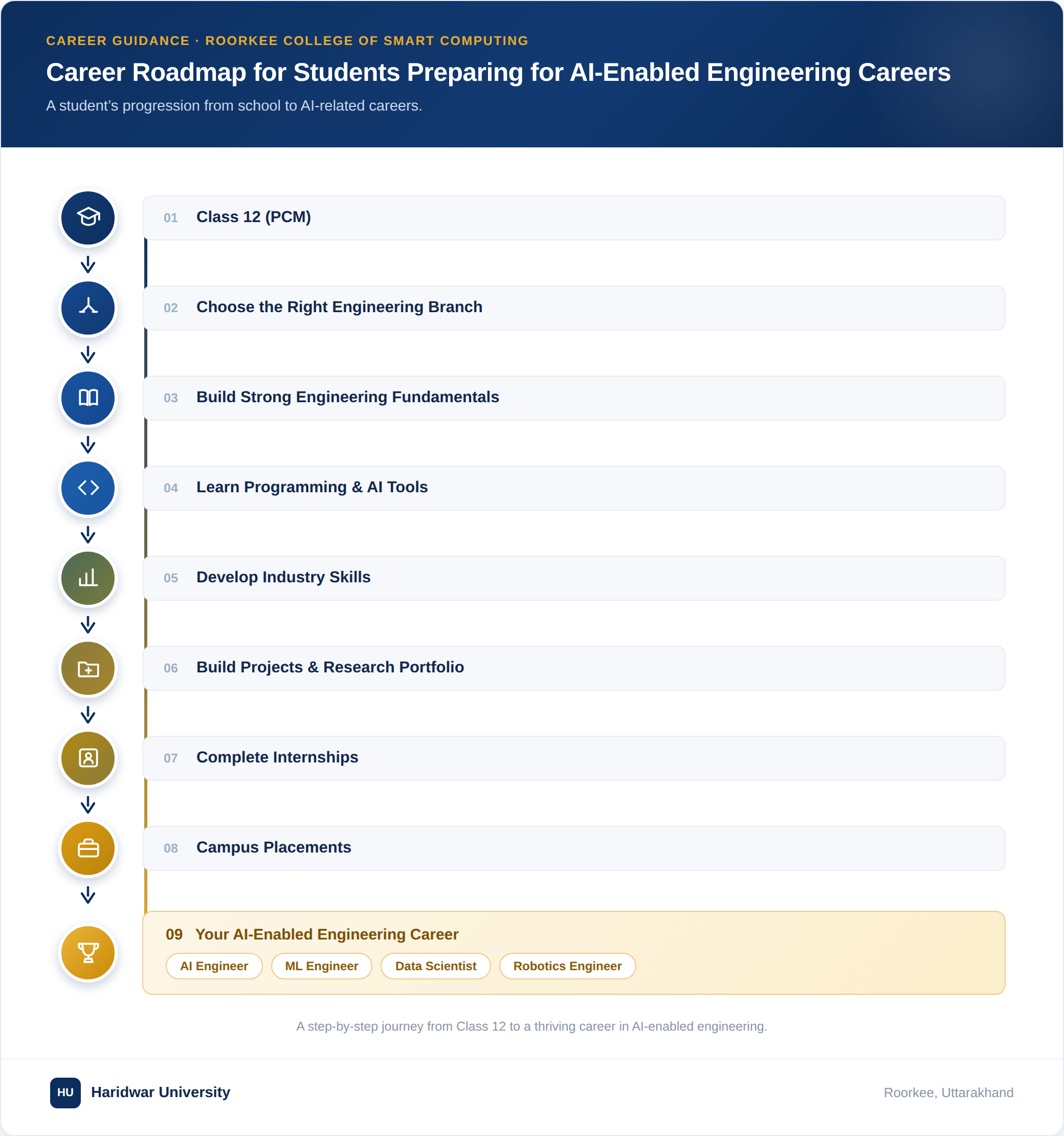
Yes. Students who have completed Class 12 with Physics, Chemistry, and Mathematics can pursue undergraduate engineering programmes related to Artificial Intelligence, depending on the eligibility requirements of the university.
Many universities now offer specialized programmes in:
- Artificial Intelligence & Machine Learning
- Computer Science Engineering with AI specialization
- Data Science
- Robotics
- Intelligent Systems
Students entering these programmes typically study subjects such as:
- Programming
- Data Structures
- Machine Learning
- Deep Learning
- Artificial Intelligence
- Database Management Systems
- Cloud Computing
- Mathematics
- Probability and Statistics
- Software Engineering
Developing a strong foundation in mathematics and logical reasoning during school can make the transition to AI-related engineering programmes smoother.
Check the Admission Process for B.Tech Programmes to learn about eligibility, application steps, scholarships, and admission timelines.
Challenges of AI in Engineering Education
While Artificial Intelligence offers significant benefits, responsible implementation is equally important. Students should understand that AI is designed to support education, not replace genuine learning.
Some of the key challenges include:
Overdependence on AI
Students who rely entirely on AI-generated solutions may miss opportunities to develop independent problem-solving skills.
Academic Integrity
Copying assignments or projects generated entirely by AI without understanding the concepts raises ethical concerns and limits genuine learning.
Accuracy of AI Responses
AI systems can occasionally produce incorrect or outdated information. Engineering students should always verify technical concepts using textbooks, faculty guidance, research papers, and trusted academic sources.
Data Privacy
Many AI tools require users to upload documents or project files. Students should avoid sharing confidential academic work, proprietary research, or sensitive personal information on public AI platforms.
Ethical Engineering Practices
Future engineers should learn to design and use AI systems responsibly while considering fairness, transparency, accountability, and societal impact.
According to UNESCO, responsible AI education should promote ethical awareness alongside technical competence, ensuring that students become responsible innovators.
The Future of AI in Indian Engineering Colleges
Artificial Intelligence is expected to become an increasingly important part of engineering education across India. Universities are gradually integrating AI into classrooms, laboratories, research activities, innovation centres, and industry collaborations.
Future engineering education is likely to place greater emphasis on:
- Interdisciplinary learning
- Industry-sponsored projects
- AI-assisted laboratories
- Digital twins and simulations
- Smart manufacturing technologies
- Research-driven innovation
- Entrepreneurship and startups
- Sustainable engineering solutions
Government initiatives such as the IndiaAI Mission are also encouraging AI adoption, skill development, research, and innovation across higher education and industry. Similarly, the AICTE has introduced initiatives encouraging engineering institutions to strengthen emerging technology education, helping students develop industry-relevant skills. These developments indicate that future engineering graduates will benefit from learning environments that combine traditional engineering principles with modern AI-enabled technologies.
Why Engineering Fundamentals Still Matter
As Artificial Intelligence becomes more accessible, some students believe AI tools can replace the need to master core engineering subjects. In reality, the opposite is true. AI is most effective when used by students who already understand engineering principles, mathematics, programming, and analytical thinking. A strong academic foundation enables students to evaluate AI-generated suggestions, identify errors, and develop innovative solutions to real-world problems. Future engineers will be distinguished not by how often they use AI, but by how effectively they combine engineering knowledge with AI-assisted problem-solving. This is why engineering education continues to emphasize fundamental concepts while integrating emerging technologies into the learning process.
Frequently Asked Questions (FAQs)
Artificial Intelligence is making engineering education more personalized, practical, and industry-oriented. AI-powered learning platforms, virtual laboratories, intelligent tutoring systems, coding assistants, and adaptive assessments help students learn more efficiently while developing skills that align with modern engineering careers.
No. AI is designed to support educators, not replace them. Teachers continue to play a vital role in mentoring students, encouraging critical thinking, conducting practical sessions, and guiding research and innovation. AI acts as a learning assistant that enhances the educational experience.
Students interested in AI careers generally choose B.Tech Artificial Intelligence & Machine Learning, Computer Science Engineering, or Computer Science with AI specialization. However, AI is also creating opportunities in Mechanical, Civil, Electrical, Electronics, and Biomedical Engineering through applications such as robotics, smart manufacturing, predictive maintenance, intelligent infrastructure, and healthcare technologies. Learn more about choosing the right engineering branch in AI vs CSE: Which Engineering Branch Should You Choose After 12th?.
Some of the most valuable skills include Python programming, Machine Learning fundamentals, Data Analytics, Prompt Engineering, Cloud Computing, Git and GitHub, problem-solving, communication, teamwork, and the ethical use of AI. Developing these skills alongside strong engineering fundamentals prepares students for future industry requirements.
Yes. Students who complete Class 12 with Physics, Chemistry, and Mathematics can pursue undergraduate engineering programmes related to Artificial Intelligence, depending on the university's eligibility criteria. Explore the B.Tech Artificial Intelligence & Machine Learning Programme to learn about eligibility, curriculum, and career opportunities.
Yes. Artificial Intelligence is increasingly being applied across Mechanical Engineering, Civil Engineering, Electrical Engineering, Electronics, Manufacturing, Robotics, Healthcare, Construction, and Smart Infrastructure. Understanding AI can improve problem-solving and create additional career opportunities regardless of the engineering discipline.
Rather than reducing opportunities, AI is changing the skills employers expect. Engineers who combine technical knowledge with AI literacy, analytical thinking, and practical problem-solving are expected to remain in strong demand across multiple industries. Read our detailed guide on AI Engineer Salary in India to understand career opportunities, salaries, and future demand.
Final Thoughts
Artificial Intelligence is not replacing engineering education. It is transforming how students learn, collaborate, innovate, and prepare for future careers.
As industries continue adopting AI-driven technologies, engineering graduates who combine strong technical fundamentals with responsible AI usage will be better positioned to solve complex problems, contribute to innovation, and succeed in an increasingly digital economy.
For students planning their engineering journey, the focus should not simply be on learning AI tools. The real goal is to develop a strong foundation in engineering principles, continuously upgrade technical skills, build practical projects, and understand how Artificial Intelligence can enhance learning and professional growth.
Engineering education in India is entering a new phase where technology and human expertise work together. Students who embrace lifelong learning, ethical practices, and innovation will be well prepared for the opportunities that lie ahead.
If you are planning to pursue engineering after Class 12, choosing an institution that combines academic excellence, practical exposure, industry collaboration, and emerging technologies can make a meaningful difference in your career.
Explore B.Tech Programmes at Haridwar University to discover engineering specializations designed to prepare students for future technologies and industry-ready careers.
Ready to begin your engineering journey? Visit our Admissions 2026 to learn about eligibility, the application process, scholarships, and important admission updates.