

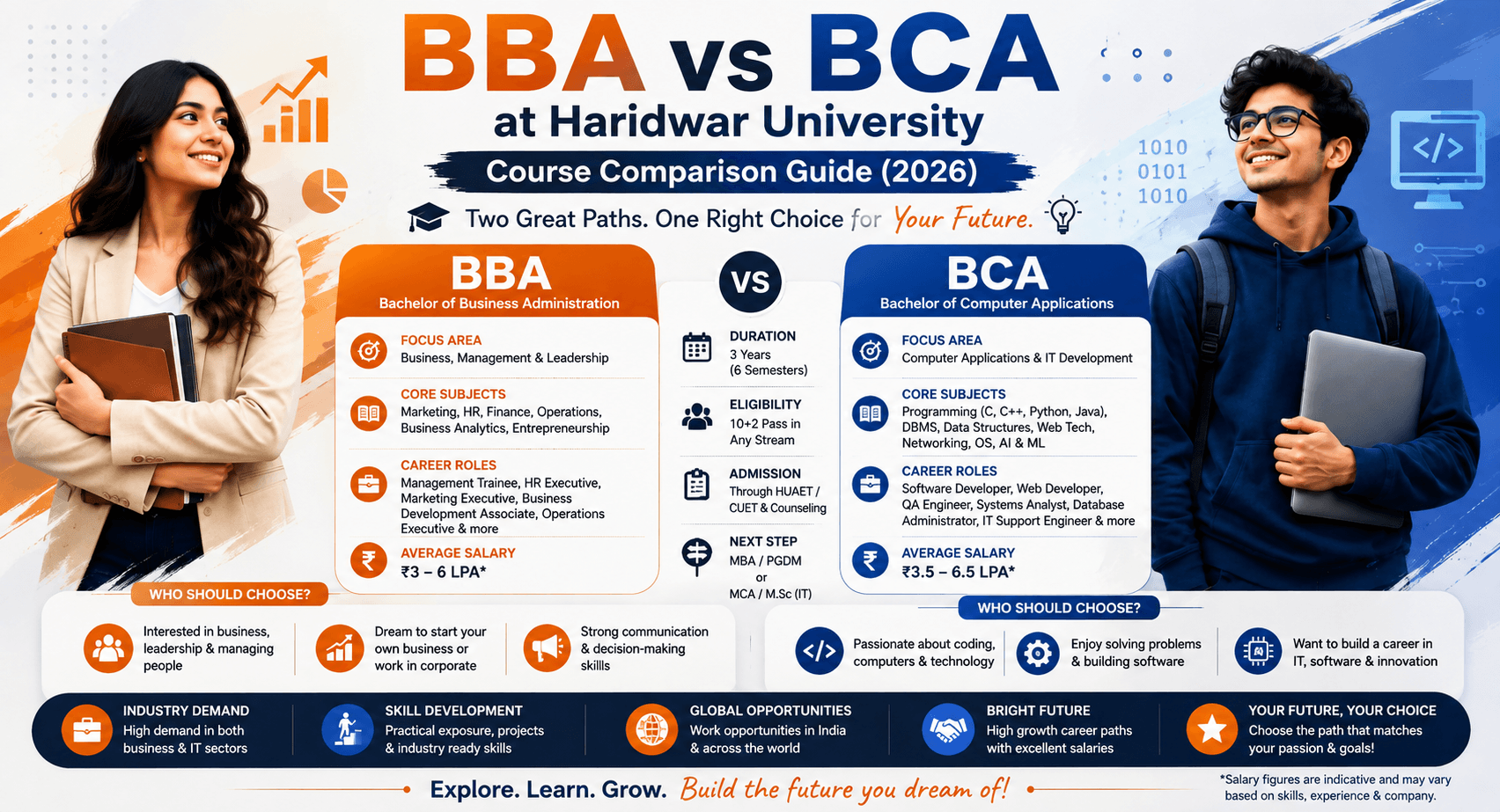
BBA vs BCA at Haridwar University: Course Comparison Guide (2026)
Dr. V.K. Saini
Director, Haridwar University
Table of Contents
Every counselling season, the same question comes up: BBA or BCA? This BBA vs BCA at Haridwar University guide answers it with facts. We use our own duration, syllabus, fees, and placement records. We don't use generic averages from other websites. Do you like leading a room, pitching ideas, and thinking about markets? Then one path fits better. Do you like debugging code until it finally works? Then the other one does. Read on for both, laid out honestly.
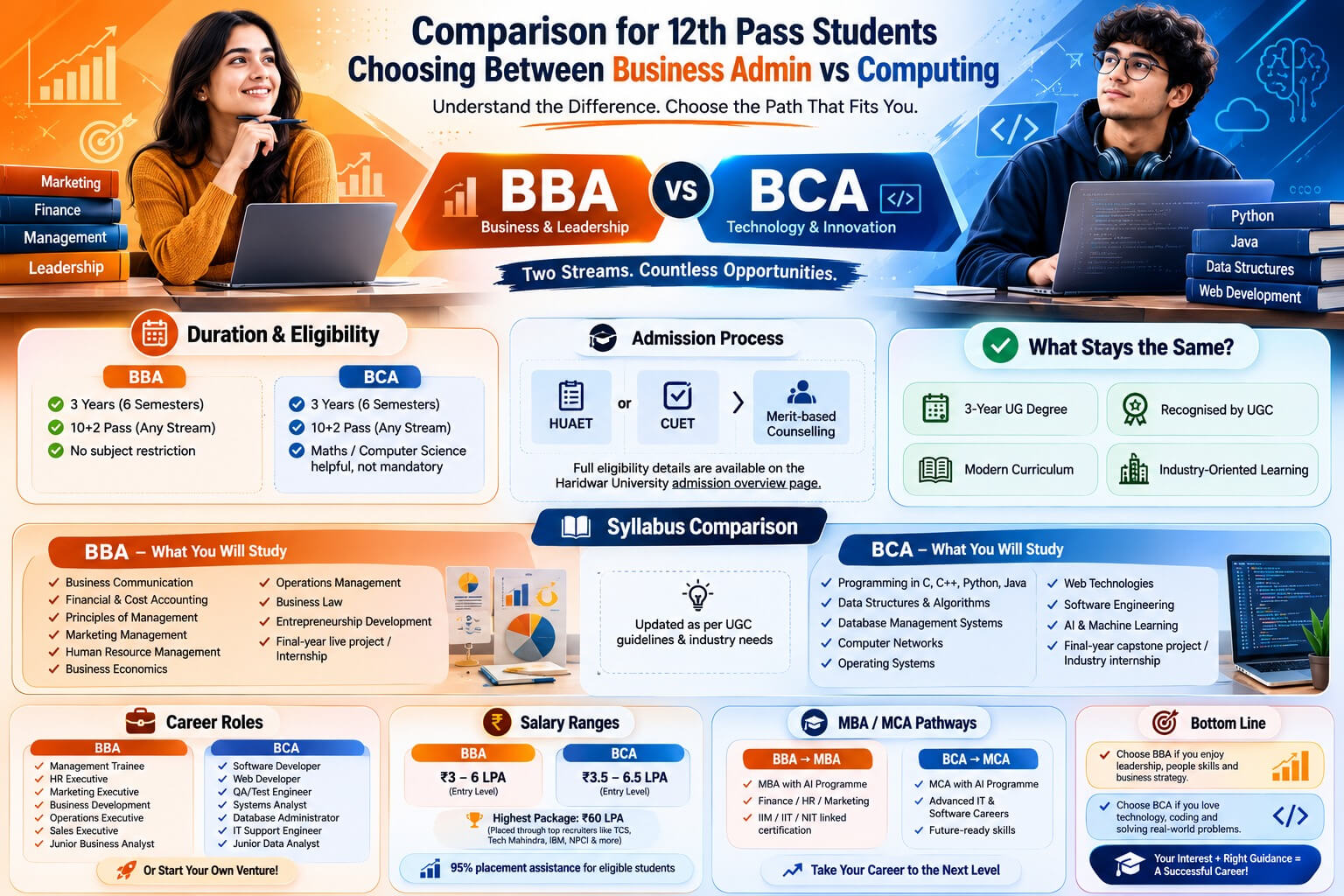
1. Comparison for 12th Pass Students Choosing Between Business Admin vs Computing
Choosing between BBA and BCA is not about which one is "better." It's about two different ways of thinking. Here's the decision broken into simple pieces: eligibility, what you'll study, where it can take you for work, what it pays, and where it leads after graduation. That way, you decide on facts, not guesswork.
A. Duration & Eligibility
Both programmes run for 3 years, split into 6 semesters. Both need a 10+2 pass from a recognised board. The university sets a minimum aggregate mark each year. BBA has no subject restriction. Students from Commerce, Science, or Arts are all welcome. BCA is also open to every stream. Students with Maths or Computer Science in Class 12 often find the first-semester coding labs easier. That's a head start, though — not a rule.
Both routes need HUAET, or a national score like CUET, before merit-based counselling. Full eligibility details are listed on the Haridwar University admission overview page.
B. Syllabus
BBA syllabus: Business Communication, Accounting, Principles of Management, Marketing, HR, Business Economics, Operations Management, Business Law, and Entrepreneurship. The final year includes a live project or internship with a company.
BCA syllabus: Programming in C, C++, Python, and Java. Data Structures, Database Management, Computer Networks, Operating Systems, Web Technologies, and Software Engineering. There's also an intro to AI & Machine Learning. The final year ends with a capstone project or internship.
Both syllabi are reviewed regularly. This keeps them in line with UGC guidelines and current industry needs.
C. Career Roles
This is where the two paths really split. BBA graduates commonly move into roles like Management Trainee, HR Executive, Marketing Executive, Business Development Associate, Operations Executive, or Sales Executive. Quite a few start their own ventures a few years in.
BCA graduates typically start as Software Developer, Web Developer, QA/Test Engineer, Systems Analyst, Database Administrator, IT Support Engineer, or Junior Data Analyst. For a full, government-verified list of job roles by sector, check the National Career Service portal.
D. Salary Ranges
HU doesn't publish separate salary numbers for BBA and BCA. So here's what the university does confirm on its own site. For the 2024 placement cycle, the highest package offered across HU was ₹60 LPA. The average package was ₹6 LPA. The placement rate was 86%. These numbers cover the whole university, not just BBA or BCA. In practice, BCA graduates often land IT and product-company roles near the average. BBA graduates often land sales, operations, or management-trainee roles, with a similar spread depending on the recruiter. For the latest numbers, check the Placement Overview page directly, not any third-party estimate — including this one.
E. MBA/MCA Pathways
Both degrees lead naturally into a postgraduate course at HU. BBA graduates commonly move into the university's MBA with AI programme (Finance, HR, or Marketing, with IIM/IIT/NIT-linked certification). BCA graduates typically move on to the MCA with AI programme, in the same Smart Computing college. Fees for both postgraduate options are listed on the Fees & Scholarships page, next to the undergraduate tables.
F. When to Choose Which (Personality & Career Goals)
Choose BBA if: you like leading a group project. You're comfortable pitching an idea or negotiating a deal. You're curious about markets, money, and people. If your goal is a leadership role, a family business, HR, marketing, or your own company one day, BBA builds that confidence fastest.
Choose BCA if: you like solving logic puzzles. You don't mind staring at an error message until it makes sense. You'd rather build something than sell it. If your goal is a career in software, product development, data, or your own tech start-up, BCA gives you the coding base and the habit of self-learning that IT expects from day one.
2. HU Offers Both
Haridwar University runs BBA under Roorkee College of Business Studies and BCA under Roorkee College of Smart Computing (which also covers AI & ML, Data Science, and Cyber Security). HU has been running for over 16 years. Per its own placement pages, it was the first university in North India to partner with the NASSCOM Foundation and L&T EduTech for industry training. Either way, both courses sit on the same campus, under the same Training & Placement Cell, with nearly the same fees. So the real choice is what you'd rather spend three years doing.
3. Real Alumni Example
HU's Placement Overview page names real students, not just company logos. It's worth looking at who's actually on it. Priti Singh went to programmers.io. Kajol Mishra and Rachit Kaushik were both placed at Chetu. Harshita Verna and Prince Yadav joined HCL. Anshu B Chhettri went to Infosys. Deepak Kumar-Ved Prakash joined Capgemini. Arghya Kar joined Imperial Shipping Services. Jaiveer Singh moved into Radiant Information Technology. Not every placement story at HU is a coding job.
The university doesn't tag these names as BBA or BCA on the public page. So treat this list as proof of range, not a programme-specific guarantee. The full set of names, photos, and recruiter logos — including TCS, Wipro, Accenture, Cognizant, IBM, Amazon, Google, Microsoft, and Oracle — is on the HU Alumni page, updated as new batches get placed.
4. Fees for Both Programs
Here's a useful fact about this BBA vs BCA at Haridwar University guide: the fee structures for both programmes are almost identical. That removes cost as a big deciding factor. Figures below come from HU's official Fees & Scholarships page for the 2026–27 academic year. They include tuition, enrolment, admission, exam, and uniform fees. Transport is charged separately, based on your bus route.
Both programmes cost about ₹2,12,000 in total over three years. This is before hostel and transport. Merit-based scholarships apply equally to both: up to 50% on tuition for top HUAET/12th-percentile scorers, 25% for UK-domicile students, 25% under the girls' education scholarship, and 10–50% under the sports quota. Each of these applies to the first year only, and only one scholarship is allowed per student. Hostel fees (₹85,000–₹1,05,000 per year, depending on room type) are the same for both streams.
5. HUAET (Haridwar University Admission Entrance Test)
HUAET is HU's own entrance test. It applies to BBA, BCA, and most other undergraduate courses. It has 50 objective questions, to be finished in 1 hour, based on your Class 12 stream — PCM, PCB, Commerce, or Arts. You can take it online. Results come by email within three working days. Admitted candidates then get 72 hours to confirm their seat. Full details and sample papers are on the official HUAET page. If you already have a valid CUET, JEE Main, or similar national-level score, you can submit that instead of sitting for HUAET.
It also helps to look at the bigger picture here. The Ministry of Education explains how UGC-recognised universities structure courses under India's National Education Policy. You can independently check a university's approval status through UGC and AICTE. For career planning and skilling programmes in either stream, Skill India / MSDE is a useful government resource.
6. Frequently Asked Questions (FAQs)
1. Which is better, BBA or BCA, at Haridwar University?
Neither is "better" on its own — it depends on your aptitude and goals. This BBA vs BCA at Haridwar University comparison shows that BBA suits students who like leadership, communication, and business strategy. BCA suits students who enjoy programming and technical problem-solving. Both have the same fee structure and similar placement support at HU.
2. What is the eligibility for BBA and BCA at HU?
Both need a 10+2 pass from a recognised board, in any stream. You must meet HU's minimum aggregate mark for that year. Neither course requires Maths or Commerce, though a Maths background helps with BCA's early coding classes.
3. Is HUAET compulsory for BBA and BCA admission?
HUAET is the default route if you don't have a qualifying national-level score. If you have a valid CUET or similar score, you can use that instead of sitting for HUAET.
4. What is the total fee for BBA and BCA at Haridwar University?
Both programmes cost about ₹2,12,000 over three years: ₹82,000 in Year 1, and ₹65,000 each in Years 2 and 3. This excludes hostel and transport, as per the official fee structure.
5. Can a BCA graduate switch to management later, or a BBA graduate switch to tech?
Yes. BCA graduates often do an MBA if they move toward product or business roles. BBA graduates sometimes pick up technical certifications or an MCA if they pivot toward IT. HU offers postgraduate options for both directions.
6. What was the highest and average placement package at Haridwar University?
Per HU's own published figures for the 2024 placement cycle, the highest package offered university-wide was ₹60 LPA. The average package was ₹6 LPA. The placement rate was 86%. These are institution-wide numbers, not separate BBA and BCA figures. Treat them as a benchmark for HU overall, not a guaranteed outcome for either course.
7. Which companies recruit BBA and BCA graduates from Haridwar University?
HU's Placement Overview page lists recruiters and named student placements. These include TCS, Wipro, Accenture, Cognizant, IBM, Amazon, Google, Microsoft, Oracle, HCL, Infosys, Capgemini, Chetu, and Byju's, among others, across both IT and business-process roles.
8. Does HU offer scholarships for BBA and BCA students?
Yes — merit-based scholarships of up to 50% on first-year tuition. There are also separate scholarships for UK-domicile students, girl students, and sports-quota candidates. These apply equally to both programmes.
9. Is BCA harder than BBA, or vice versa?
Difficulty is subjective. BCA's challenge is technical depth: coding, logic, and constantly learning new tools. BBA's challenge is breadth: case studies, presentations, and real-world business judgement. Most students find the one matching their natural interests noticeably easier.