

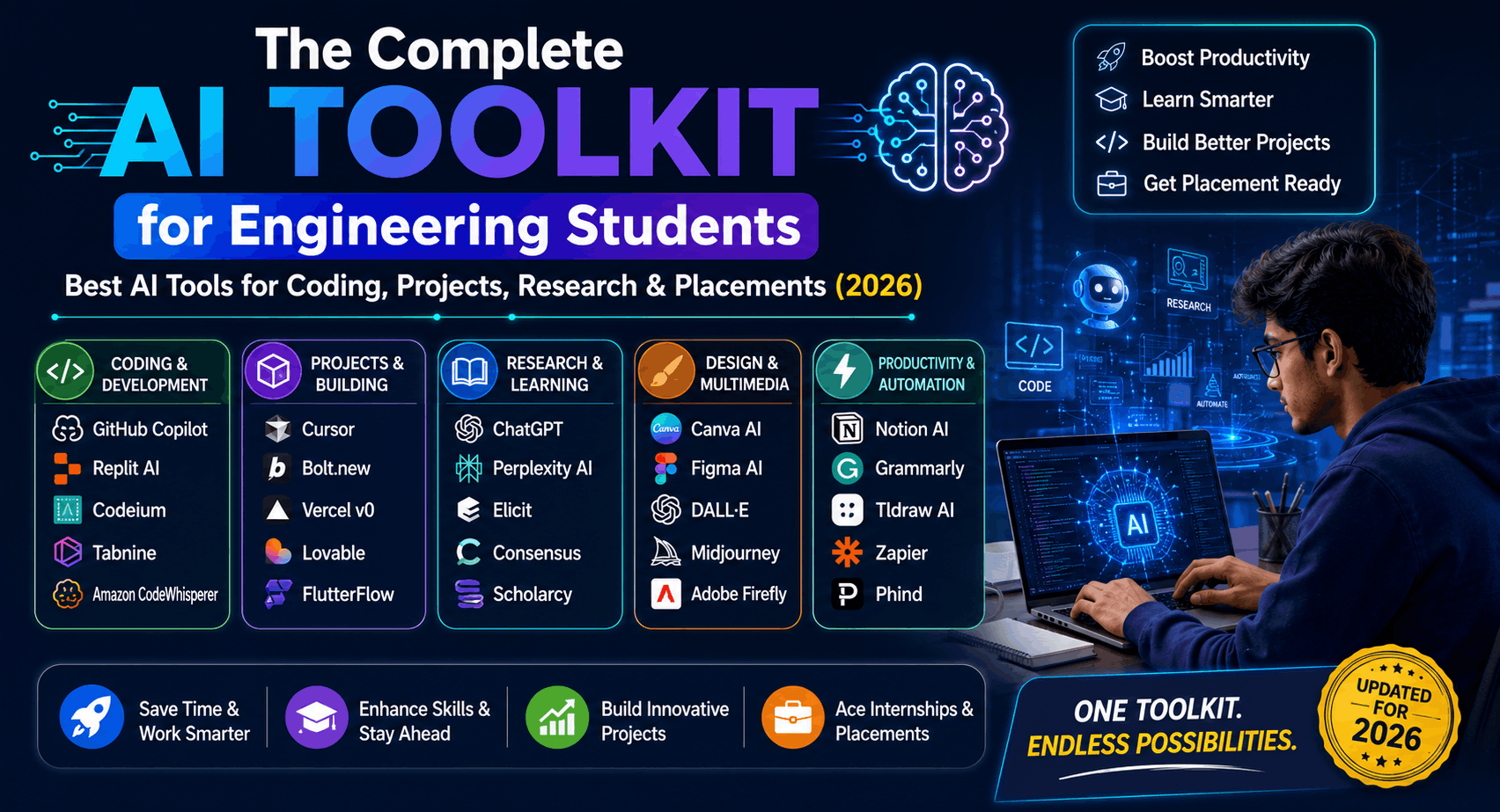
The Complete AI Toolkit for Engineering Students: Best AI Tools for Coding, Projects, Research & Placements (2026)
Haridwar University
Academic & Career Advisory
The Complete AI Toolkit for Engineering Students (2026)
Engineering education is evolving faster than ever. Whether you're writing code, preparing assignments, conducting research, building projects, or getting ready for campus placements, Artificial Intelligence (AI) has become an essential learning companion rather than just another technology trend.
Today's engineering students are expected to do much more than attend lectures and complete laboratory work. Employers increasingly value graduates who can solve problems, learn new technologies quickly, and work efficiently with modern digital tools. AI-powered applications are helping students meet these expectations by simplifying complex concepts, improving productivity, supporting technical research, and assisting with software development.
However, with hundreds of AI tools available today, choosing the right one can be confusing. Many students ask questions such as:
- Which AI tool is best for coding?
- What AI tool should I use for engineering projects?
- Which AI tools are useful for research papers?
- Are there free AI tools for engineering students?
- Which AI tools can help during placement preparation?
This guide answers all these questions in one place.
Instead of simply listing popular AI tools, this article explains which AI tool should be used for each stage of an engineering student's academic journey, from learning concepts and completing assignments to building projects and preparing for placements.
Whether you're pursuing Computer Science, Artificial Intelligence, Mechanical, Civil, Electrical, Electronics, or another engineering discipline, these AI tools can help you study smarter, improve your technical skills, and prepare for future careers.
If you are still deciding which engineering specialization best aligns with Artificial Intelligence, you may also find our guide on AI vs CSE: Which Engineering Branch to Choose After 12th? helpful before exploring these tools.
Why AI Tools Have Become Essential for Engineering Students
Artificial Intelligence is transforming almost every engineering discipline. From software development and manufacturing to healthcare, robotics, civil infrastructure, and smart cities, AI technologies are becoming part of everyday engineering practice.
As industries adopt AI-driven solutions, engineering graduates are expected to understand not only core technical concepts but also how to use AI responsibly to improve productivity and solve real-world problems. This shift is also changing how students learn.
Instead of spending hours searching through multiple websites or debugging code manually, students can now use AI tools to:
- Understand difficult engineering concepts
- Write and debug code more efficiently
- Conduct faster technical research
- Organize lecture notes
- Generate project ideas
- Prepare presentations
- Improve technical writing
- Practice interview questions
- Build stronger portfolios for placements
The goal is not to replace learning but to make learning more effective.
According to the World Economic Forum's Future of Jobs Report, AI literacy and digital skills are becoming increasingly valuable across industries, making them essential competencies for future engineers.
Similarly, NASSCOM highlights the growing demand for AI-related skills in India's technology ecosystem, encouraging students to build practical expertise alongside their engineering education.
AI Is Changing How Engineering Students Learn
Traditional engineering education has always focused on lectures, textbooks, laboratory sessions, and practical assignments. While these remain important, AI is making learning more personalized, interactive, and efficient.
For example, instead of searching multiple websites to understand a programming concept, students can ask an AI assistant to explain it with examples, compare different approaches, or generate practice questions.
Similarly, students working on final-year projects can use AI tools to:
- Explore innovative project ideas
- Review existing research papers
- Summarize lengthy technical documents
- Generate documentation drafts
- Identify coding errors
- Visualize data
- Prepare project presentations
This allows students to spend more time understanding concepts and applying their knowledge instead of repeatedly performing routine tasks.
However, using AI effectively requires choosing the right tool for the right purpose. A coding assistant may not be the best choice for research, while a research assistant may not be suitable for creating presentations. Understanding these differences is what makes students more productive.
For a deeper understanding of how Artificial Intelligence is reshaping classrooms, practical learning, and engineering education in India, read our detailed article on How AI Is Transforming Engineering Education in India.
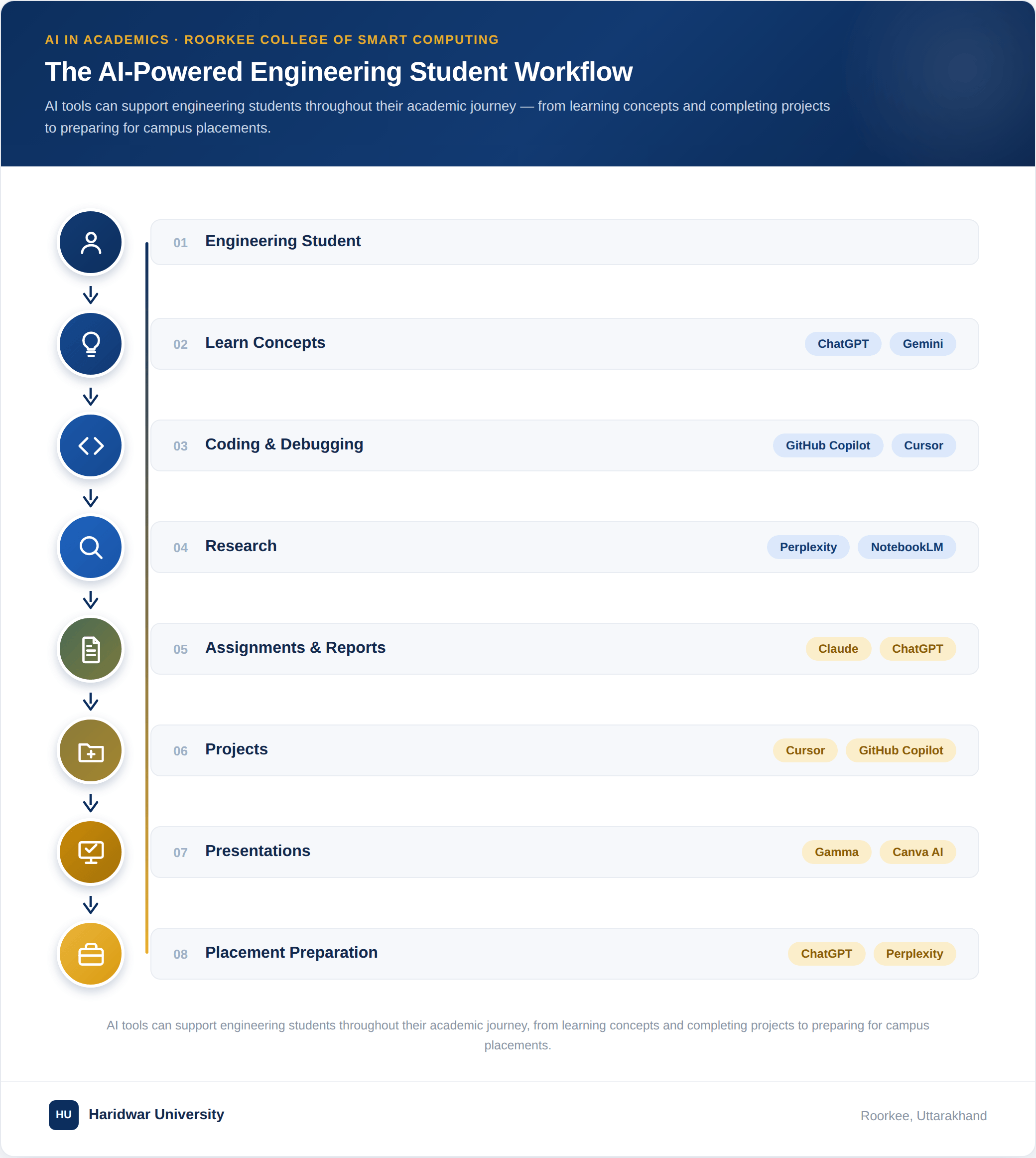
AI tools can support engineering students throughout their academic journey, from learning concepts and completing projects to preparing for campus placements.
How We Selected These AI Tools
Not every AI tool is suitable for engineering students. Some are designed for software developers, while others focus on content writing, business productivity, or enterprise automation.
To make this guide practical and student-focused, we evaluated each tool using the following criteria:
- Relevance to Engineering Education: The tool should help engineering students solve real academic challenges such as coding, technical writing, research, calculations, project development, or presentation preparation.
- Ease of Use: Students should be able to start using the tool with minimal setup, even without advanced AI knowledge.
- Free or Student-Friendly Access: Whenever possible, we have included AI tools that offer free plans or student-friendly pricing, making them accessible throughout the engineering journey.
- Practical Applications: Rather than recommending tools based only on popularity, we focus on how they can support everyday engineering tasks, including programming, debugging, literature review, technical documentation, project planning, design thinking, data analysis, and interview preparation.
- Industry Relevance: Many of these AI tools are already being used by software companies, startups, research organizations, and engineering teams worldwide. Learning them during college can help students build practical skills that employers increasingly value.
As you explore these tools, remember that AI should support your learning, not replace it. The most successful engineering students use AI to understand concepts, improve efficiency, and strengthen problem-solving abilities while continuing to develop their own technical knowledge.
Best AI Tools for Learning Engineering Concepts
Engineering students often spend considerable time understanding complex theories before applying them in assignments or practical work. AI-powered learning assistants can simplify difficult topics by providing explanations, examples, diagrams, quizzes, and personalized guidance. Instead of replacing textbooks or classroom learning, these tools should be used to strengthen conceptual understanding.
1. ChatGPT
ChatGPT has become one of the most widely used AI tools among engineering students because it can explain technical concepts in simple language while adapting to different learning levels. Whether you're learning Data Structures, Thermodynamics, Digital Electronics, Machine Learning, or Structural Analysis, ChatGPT can break complex topics into smaller, easier-to-understand sections.
Best for:
- Understanding engineering concepts
- Solving programming doubts
- Explaining mathematical formulas
- Brainstorming project ideas
- Preparing for viva examinations
Why engineering students should use it: Instead of copying answers, ask ChatGPT to explain concepts step by step or generate practice questions based on your syllabus. This encourages active learning and improves long-term understanding.
Recommended Resource: OpenAI ChatGPT
2. Google Gemini
Google Gemini integrates well with Google's ecosystem, making it useful for students who regularly work with Google Docs, Sheets, Slides, and Drive. It can summarize lengthy documents, generate study notes, and help organize research material while allowing students to continue working within familiar applications.
Best for:
- Study notes
- Summarizing lectures
- Brainstorming ideas
- Collaborative learning
Recommended Resource: Google Gemini
3. Claude
Claude is particularly helpful when students need clear explanations or want assistance with technical writing. Its ability to understand long documents makes it useful for reviewing research papers, improving laboratory reports, and refining project documentation.
Best for:
- Technical writing
- Laboratory reports
- Project documentation
- Report improvement
Recommended Resource: Anthropic Claude
Best AI Tools for Coding and Debugging
Programming has become an essential skill across almost every engineering discipline. Whether you're studying Computer Science, Artificial Intelligence, Electronics, Mechanical Engineering, or Civil Engineering, coding is increasingly used for simulations, automation, and data analysis. The following AI tools can improve coding productivity while helping students learn best practices.
4. GitHub Copilot
GitHub Copilot is an AI-powered coding assistant that helps developers write code faster by suggesting functions, completing repetitive code, and offering intelligent recommendations. Unlike code generators that encourage copying, GitHub Copilot works best when students already understand programming fundamentals and want assistance during development.
Best for:
- Writing code
- Code completion
- Debugging
- Learning programming syntax
- Software development projects
Popular programming languages: Python, C++, Java, JavaScript, C#, and Go.
Students pursuing B.Tech Artificial Intelligence & Machine Learning or B.Tech Computer Science & Engineering can particularly benefit from learning GitHub Copilot alongside traditional programming skills.
Recommended Resource: GitHub Copilot
5. Cursor AI
Cursor AI has quickly become one of the preferred AI-assisted code editors for developers because it combines an integrated development environment with conversational AI. Students can ask Cursor to explain code, identify bugs, suggest improvements, or generate functions directly within the coding workspace.
Best for:
- Final-year projects
- Software development
- Debugging
- Learning programming logic
- Building applications
Why it stands out: Rather than switching between an editor and a chatbot, students can interact with AI while writing code, making the development process more efficient.
Comparison Table: Best AI Tools for Coding
| AI Tool | Best For | Free Version | Ideal For |
|---|---|---|---|
| ChatGPT | Learning programming concepts | Yes | Beginners |
| GitHub Copilot | Code completion | Student access available | Intermediate & Advanced |
| Cursor AI | AI-assisted coding | Yes | Projects & Development |
| Gemini | Explaining code | Yes | Learning |
| Claude | Documentation & code explanation | Yes | Technical writing |
Best AI Tools for Research and Literature Review
Engineering education increasingly emphasizes innovation, technical research, and evidence-based problem solving. Whether you're preparing seminar reports, reviewing journal articles, or working on a final-year project, finding reliable information is often one of the most time-consuming tasks. Instead of relying on random websites, engineering students should use AI tools that prioritize credible sources and structured information.
6. Perplexity AI
Perplexity AI combines conversational search with source citations, making it one of the most valuable AI research assistants for students. Unlike traditional chatbots that may generate unsupported responses, Perplexity usually references the websites and publications it uses, allowing students to verify information independently.
Best for:
- Literature review
- Technical research
- Finding reliable sources
- Learning emerging technologies
- Current industry trends
Engineering applications: Final-year projects, research papers, technical seminars, innovation competitions, and industry case studies.
Recommended Resource: Perplexity AI
7. Google NotebookLM
NotebookLM is designed for learning from your own documents rather than searching the internet. Students can upload lecture notes, research papers, PDFs, or project reports and ask questions based on those materials. This makes NotebookLM particularly useful during examinations and project preparation.
Best for:
- Revision
- Organizing lecture notes
- Understanding research papers
- Preparing for viva examinations
- Reviewing project documentation
Why engineering students should use it: Instead of reading dozens of pages repeatedly, students can quickly identify key concepts, summaries, and insights from their own study material.
Recommended Resource: Google NotebookLM
Quick Comparison: Which AI Tool Should You Use?
| If You Need To... | Best AI Tool |
|---|---|
| Learn engineering concepts | ChatGPT |
| Write and debug code | GitHub Copilot / Cursor AI |
| Conduct technical research | Perplexity AI |
| Organize lecture notes | NotebookLM |
| Improve technical reports | Claude |
| Generate study summaries | Gemini |
This simple framework helps engineering students choose the right AI tool based on the task they are performing instead of trying to use one tool for everything.
Best AI Tools for Engineering Assignments and Technical Writing
Assignments, laboratory reports, and technical documentation are a regular part of engineering education. While AI can save time during drafting and editing, students should always ensure the final submission reflects their own understanding and follows their institution's academic integrity guidelines. The following tools can help improve the quality of technical writing without replacing genuine learning.
8. Claude
Claude is particularly effective at improving clarity, structure, and readability in technical documents. It can help students rewrite paragraphs, organize ideas logically, and simplify complex explanations while maintaining technical accuracy.
Best for:
- Laboratory reports
- Technical documentation
- Assignment drafting
- Project documentation
- Report editing
Engineering Use Case: Suppose you've completed a laboratory experiment on microprocessors or fluid mechanics. Claude can help improve the report's structure, grammar, and flow while allowing you to retain your original analysis and observations.
9. Grammarly
Engineering students often lose marks because of grammar mistakes, unclear sentence structure, or inconsistent writing. Grammarly helps identify spelling errors, grammar issues, punctuation mistakes, and readability improvements, making it particularly useful for project reports and research documentation.
Best for:
- Proofreading assignments
- Grammar correction
- Technical writing
- Resume improvement
- Email communication
Recommended Resource: Grammarly
Best AI Tools for Engineering Projects
One of the biggest challenges engineering students face is converting an idea into a complete project. From selecting a topic to writing code, preparing documentation, and presenting the final solution, AI tools can support every stage of project development. However, AI should never replace creativity or independent problem-solving. Instead, it should be used as a mentor that helps students learn faster and avoid repetitive work.
Recommended AI Tools for Projects
- ChatGPT: Useful for brainstorming project ideas, understanding algorithms, generating project timelines, and explaining technical concepts.
- GitHub Copilot: Ideal for writing code efficiently while learning programming best practices.
- Cursor AI: Excellent for debugging, refactoring, and managing large codebases during software development projects.
- Perplexity AI: Helpful for finding recent research papers, industry examples, and technical references for project reports.
- NotebookLM: Allows students to organize project notes, summarize research papers, and quickly revisit important information during development.
Comparison Table: AI Tools for Engineering Projects
| Project Task | Recommended AI Tool |
|---|---|
| Brainstorming project ideas | ChatGPT |
| Literature review | Perplexity AI |
| Coding | GitHub Copilot |
| Debugging | Cursor AI |
| Documentation | Claude |
| Organizing project notes | NotebookLM |
| Presentation preparation | Gamma AI |
Best AI Tools for Presentations and Technical Communication
Presenting technical ideas clearly is an essential engineering skill. Whether you're participating in seminars, project reviews, hackathons, or placement presentations, effective communication can significantly improve your impact.
10. Gamma AI
Gamma AI enables students to create professional-looking presentations with minimal effort. Instead of spending hours designing slides, students can focus on explaining engineering concepts and project outcomes.
Best for:
- Seminar presentations
- Project demonstrations
- Technical presentations
- Innovation competitions
- Placement presentations
11. Canva AI
Canva AI helps students create diagrams, posters, infographics, and visual presentations without advanced graphic design skills. Engineering students can use Canva AI to design project posters, research presentations, flowcharts, infographics, and technical illustrations. Visual communication often makes complex engineering concepts easier to understand.
Recommended Resource: Canva AI
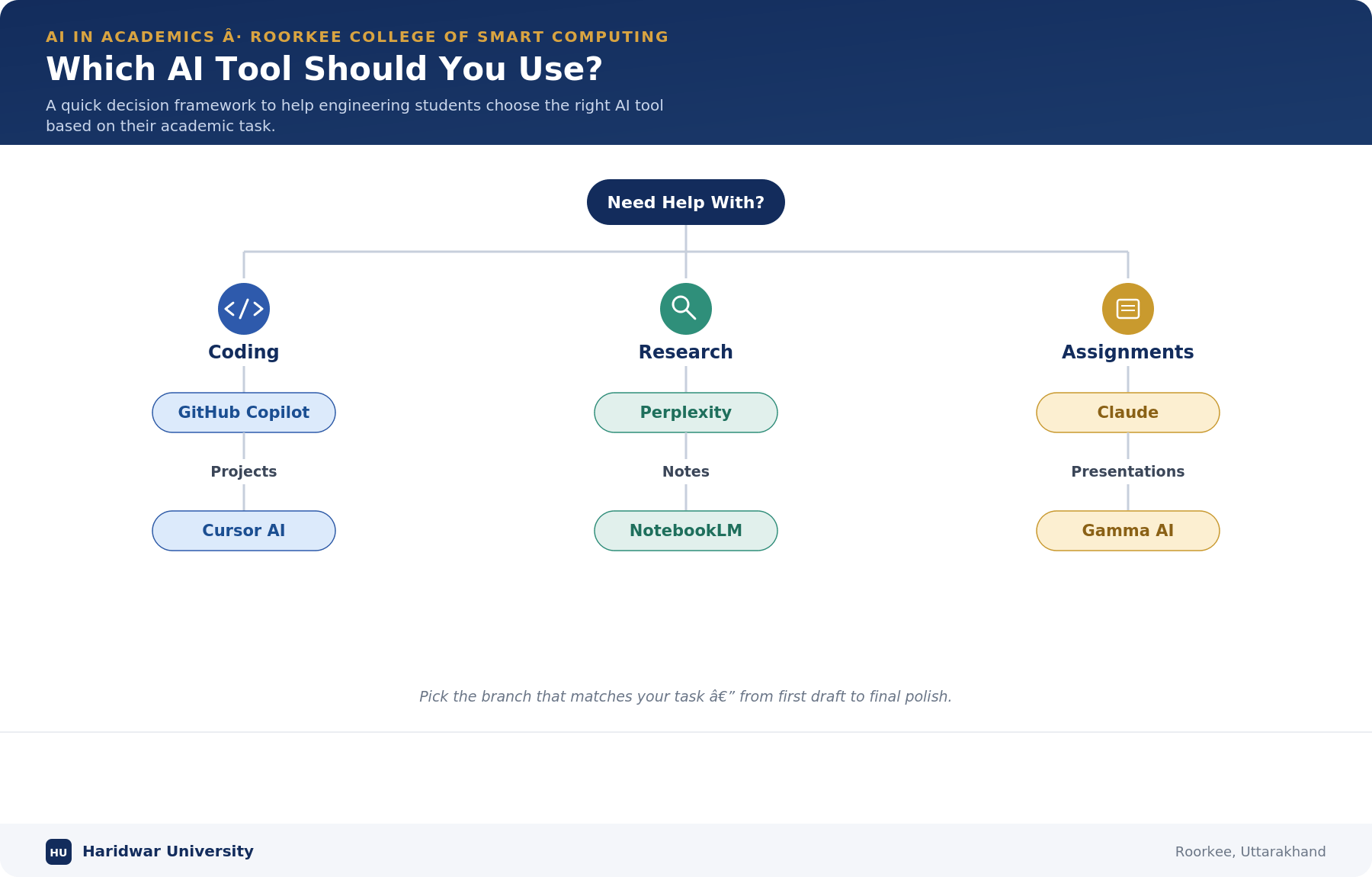
A quick decision framework to help engineering students choose the right AI tool based on their academic task.
Best AI Tools by Engineering Branch
Although many AI tools are useful across all disciplines, some are particularly beneficial depending on the engineering specialization.
| Engineering Branch | Recommended AI Tools | Primary Use |
|---|---|---|
| Computer Science & AI | GitHub Copilot, Cursor AI, ChatGPT | Coding & software development |
| Mechanical Engineering | ChatGPT, MATLAB, Perplexity | Simulation, calculations, research |
| Civil Engineering | ChatGPT, Canva AI, Perplexity | Structural analysis, documentation, presentations |
| Electrical & Electronics | ChatGPT, MATLAB, GitHub Copilot | Circuit design, programming, simulations |
| Artificial Intelligence & Machine Learning | ChatGPT, GitHub Copilot, NotebookLM, Perplexity | Model development, research, coding |
No matter which branch you choose, developing AI literacy can improve both academic performance and career readiness. Students interested in building AI-focused technical skills can explore B.Tech Artificial Intelligence & Machine Learning to understand how AI is integrated into undergraduate engineering education.
Free vs Paid AI Tools: Which Should Students Choose?
Many engineering students wonder whether paid AI subscriptions are necessary. For most academic work, the free versions of several leading AI tools are sufficient.
| AI Tool | Free Version | Recommended for Students |
|---|---|---|
| ChatGPT | Yes | Yes |
| Gemini | Yes | Yes |
| Claude | Yes | Yes |
| Perplexity AI | Yes | Yes |
| NotebookLM | Yes | Yes |
| Canva AI | Limited | Yes |
| Gamma AI | Limited | Yes |
| GitHub Copilot | Student access available | Yes |
Instead of subscribing to multiple premium tools, start with the free versions and upgrade only if your academic or project requirements demand additional features.
Using AI Responsibly: A Skill Every Future Engineer Needs
AI tools can significantly improve productivity, but they should never replace critical thinking or independent learning. Engineering is built on problem-solving, experimentation, and analytical reasoning. Simply copying AI-generated answers without understanding them may affect your learning and professional growth.
Here are a few best practices:
- Use AI to understand concepts before solving problems on your own.
- Verify technical information using textbooks, research papers, or trusted academic sources.
- Test AI-generated code before using it in projects.
- Avoid submitting AI-generated content as your original work where institutional policies prohibit it.
- Protect confidential data and project information when using online AI tools.
- Use AI to support learning, not to bypass it.
Developing responsible AI habits during college will prepare you for professional environments where ethical and secure AI usage is increasingly expected.
How AI Tools Can Help You Prepare for Engineering Placements
Campus placements have become increasingly competitive. Beyond strong technical knowledge, recruiters now expect candidates to demonstrate problem-solving abilities, communication skills, programming proficiency, and familiarity with modern technologies. AI tools can help engineering students prepare more effectively, but they should complement consistent practice rather than replace it.
Here's how AI can support placement preparation:
Resume Building
AI-powered writing assistants can help students improve resume structure, highlight achievements, and tailor resumes for specific job roles.
Useful Tools: ChatGPT, Claude, Grammarly
Aptitude Preparation
Students can generate unlimited aptitude questions, logical reasoning problems, and quantitative practice tests based on their placement syllabus.
Useful Tools: ChatGPT, Gemini
Coding Interview Practice
Students preparing for software engineering roles can use AI to solve coding challenges, understand algorithms, debug programs, practice interview questions, and learn different coding approaches.
Useful Tools: GitHub Copilot, Cursor AI, ChatGPT
Mock HR and Technical Interviews
AI assistants can simulate interview scenarios by asking role-specific questions and providing feedback on responses. Students can practice self-introduction, HR interview questions, technical concepts, project explanations, and behavioral questions. These exercises help improve confidence before actual campus interviews.
To understand current career opportunities and earning potential after developing AI-related skills, read our guide on AI Engineers Salary in India.
Developing AI Skills Beyond College
Learning how to use AI tools is only one part of becoming an industry-ready engineer. Employers continue to value students who combine technical knowledge with creativity, communication, teamwork, and problem-solving abilities. Engineering students should focus on building a balanced skill set that includes:
- Programming fundamentals
- Analytical thinking
- Mathematics
- Data analysis
- Version control using Git
- Cloud computing fundamentals
- AI literacy
- Technical communication
- Team collaboration
- Continuous learning
The combination of engineering fundamentals and responsible AI usage can make graduates more adaptable in a rapidly changing technology landscape.
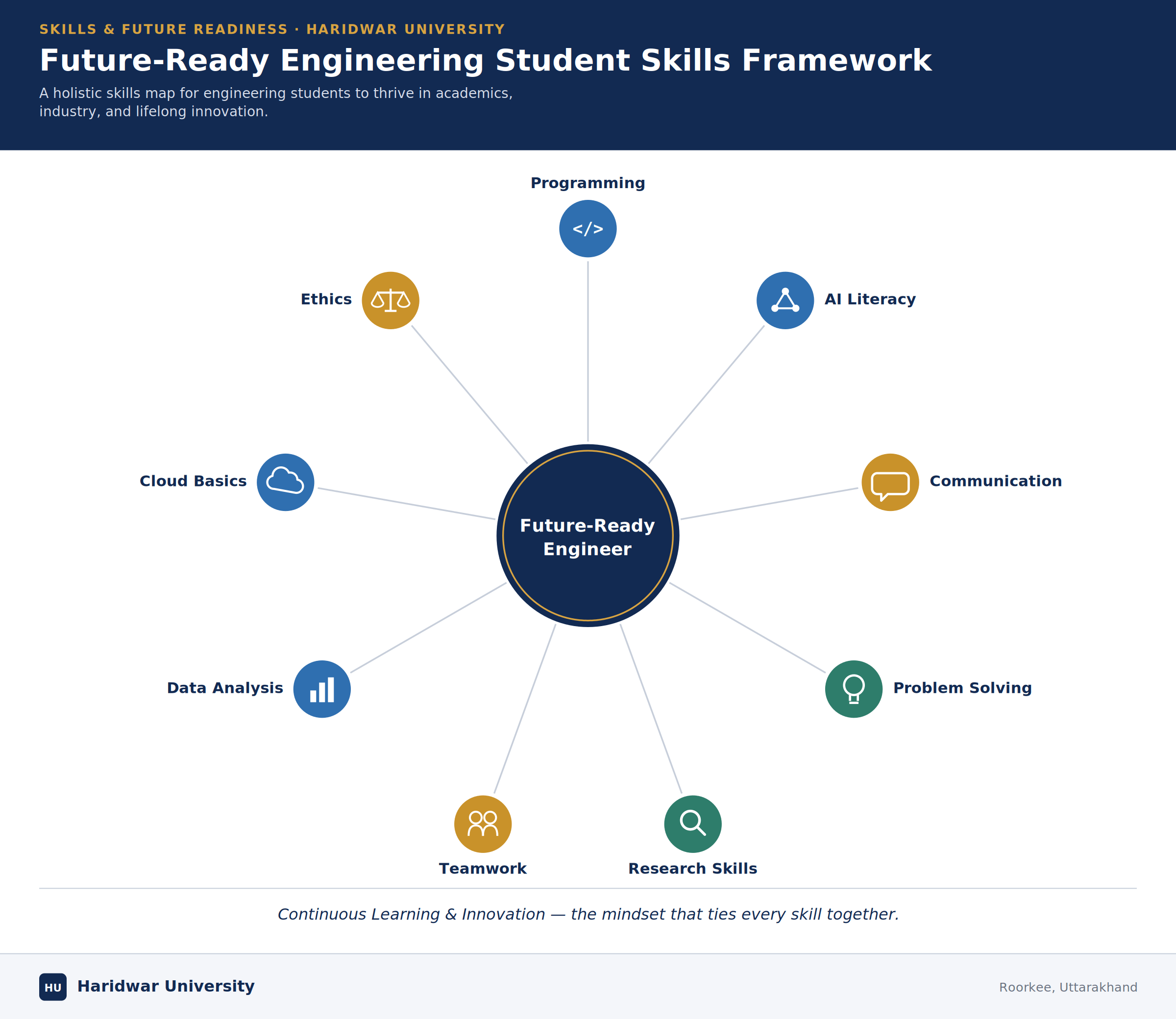
AI tools are most effective when combined with strong engineering fundamentals, technical expertise, communication, and continuous learning.
Tips for Using AI Tools Effectively During Engineering
AI tools are becoming increasingly powerful, but using them wisely is just as important as knowing which tools to use. Here are a few practical recommendations for engineering students:
- Start by understanding the concept before asking AI for solutions.
- Use AI to generate ideas rather than complete assignments.
- Verify technical information using textbooks, faculty guidance, and trusted academic sources.
- Review AI-generated code before using it in projects.
- Avoid sharing confidential project or internship data with public AI tools.
- Continue practicing calculations, programming, and problem-solving independently.
- Explore one or two AI tools deeply instead of switching between many platforms.
The students who benefit the most from AI are those who treat it as a learning assistant rather than a shortcut.
Frequently Asked Questions (FAQs)
Which is the best AI tool for engineering students?
There is no single best AI tool for every task. ChatGPT is excellent for learning concepts, GitHub Copilot and Cursor AI are ideal for coding, Perplexity AI supports research, NotebookLM helps organize study material, and Gamma AI simplifies presentations.
Are free AI tools enough for engineering students?
Yes. Most engineering students can complete assignments, research, coding practice, and project work using the free versions of ChatGPT, Gemini, Claude, Perplexity AI, NotebookLM, and Canva AI. Premium plans are generally useful only for advanced or professional requirements.
Can AI help with engineering projects?
Yes. AI tools can assist with project planning, coding, debugging, literature review, documentation, data analysis, and presentation preparation. However, students should use AI to support their own work rather than rely on automatically generated solutions.
Which AI tool is best for coding?
GitHub Copilot and Cursor AI are among the most popular AI coding assistants. ChatGPT is also useful for understanding programming concepts, debugging code, and explaining algorithms.
Which AI tool is best for engineering research?
Perplexity AI is an excellent option because it provides cited information and supports literature reviews. NotebookLM is also valuable for organizing and understanding research papers and lecture notes.
Should engineering students learn AI even if they are not studying AI or Computer Science?
Yes. AI is influencing nearly every engineering discipline, including Mechanical, Civil, Electrical, Electronics, Manufacturing, Robotics, and Healthcare Engineering. Understanding how to use AI responsibly can improve both academic performance and future career opportunities.
Conclusion
Artificial Intelligence is no longer limited to research laboratories or software companies. It has become an important part of engineering education, helping students learn faster, code more efficiently, conduct research, manage projects, and prepare for professional careers.
The most successful engineering students will not necessarily be those who use the greatest number of AI tools. Instead, they will be the ones who understand which tool to use, when to use it, and how to use it responsibly.
Rather than replacing technical knowledge, AI should strengthen it. Students who combine engineering fundamentals with AI literacy, critical thinking, and continuous learning will be better prepared for the opportunities and challenges of tomorrow's engineering profession.
If you're planning to build a career in Artificial Intelligence, explore our B.Tech Artificial Intelligence & Machine Learning to learn how industry-focused education can help you develop future-ready technical skills.
You can also explore our Engineering Programmes and Admissions 2026 to learn more about engineering education and career opportunities at Haridwar University.