

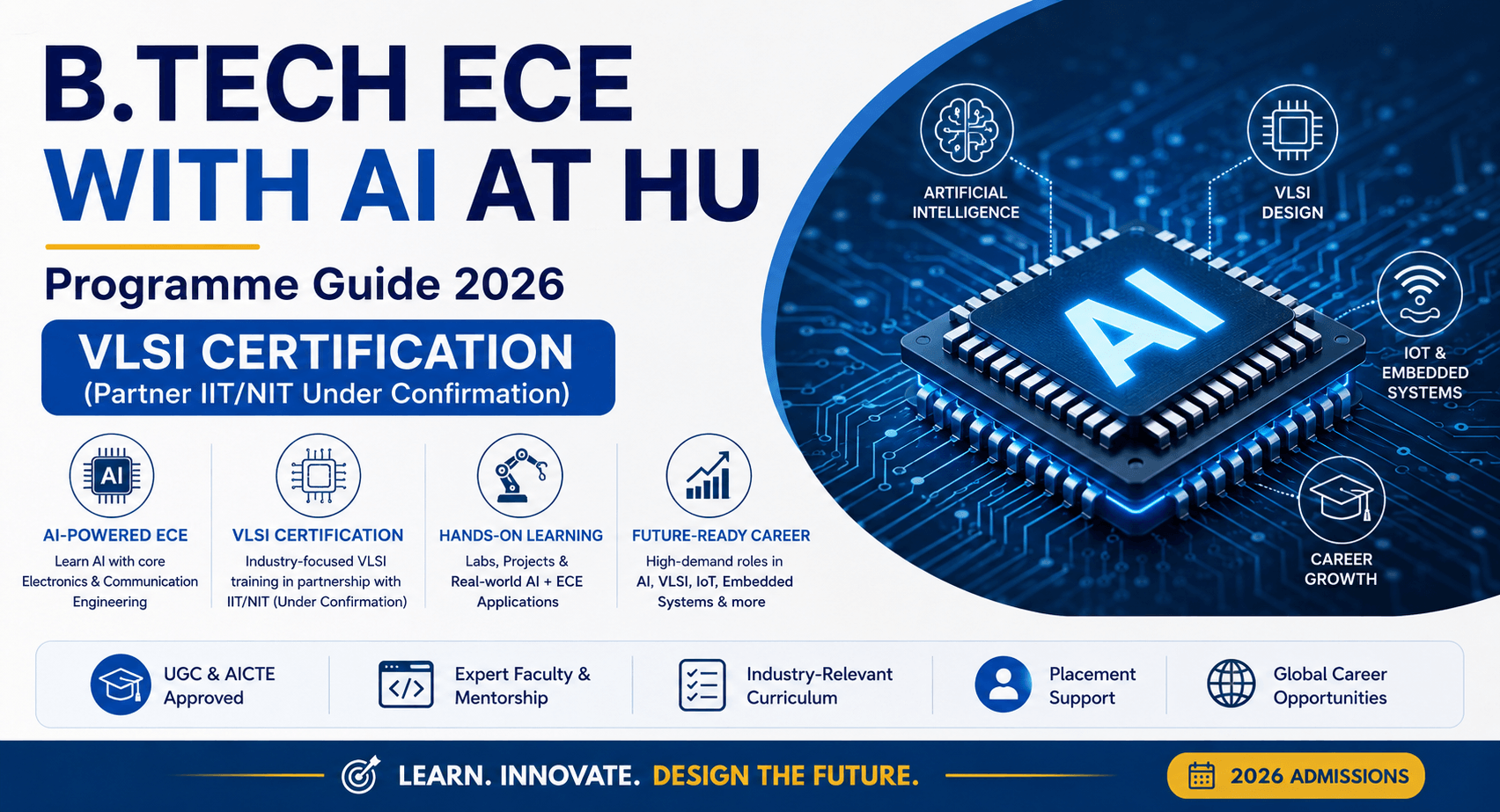
Choosing between a computing branch and a core electronics branch is one of the toughest calls a Class 12 science student makes today. If you have already weighed CSE, ME, and CE, the B.Tech ECE Haridwar University programme deserves a close look on its own merits — especially now that it is bundled with a VLSI certification (delivered with an IIT/NIT partner currently being confirmed), placing it directly in the path of India's semiconductor and AI-hardware push.
This guide walks through the curriculum, the VLSI differentiator, career outcomes, verified fees, and scholarship details for the 2026 admission cycle, drawing on figures published by Haridwar University on its official website.
Table of Contents
- ECE Deep-Dive: Completing the Branch Set
- The VLSI-Certification-from-IIT/NIT Differentiator, Explained
- Semiconductor-Boom Context: India's Fab Push
- Curriculum + AI Integration
- Career Roles After B.Tech ECE with AI
- Core-vs-IT Reality for ECE Graduates
- Salary Ranges (With Sources)
- Fee Structure (2026-27) & Scholarships
- Frequently Asked Questions (FAQs)
ECE Deep-Dive: Completing the Branch Set
Electronics and Communication Engineering (ECE) is the classic core branch that sits alongside Computer Science, Mechanical, and Civil Engineering in any well-rounded technical university. Where CSE trains you to write software and ME/CE train you to build physical systems, ECE trains you to design the chips, circuits, sensors, and communication networks that make every smart device — from a 5G smartphone to an IoT sensor — actually work.
At Haridwar University, ECE is offered through the Roorkee College of Engineering, the university's founding engineering institution, and is now delivered with an added Artificial Intelligence layer and an external VLSI certification.
On the regulatory side, Haridwar University operates as a state private university under The Haridwar University Act, 2022 (Act No. 16 of 2023) — a status confirmed on the Governor of Uttarakhand's official private-universities listing, where the university is registered with its sponsoring body, the Satyam Education Society (formerly running the Roorkee College of Engineering). The university's AICTE and UGC recognition for its technical programmes can be verified directly on the official AICTE and UGC portals. Prospective students should always re-confirm current recognition status directly on regulatory portals before admission.
If you enjoy physics, circuit theory, and hardware problem-solving more than pure software coding, and you want a degree that keeps both hardware and software career doors open, ECE with AI is a genuinely competitive alternative to a computing-branch degree — not a fallback option.
The VLSI-Certification-from-IIT/NIT Differentiator, Explained
The single biggest reason this programme stands out from a generic ECE degree is the VLSI (Very Large Scale Integration) certification delivered in partnership with an IIT/NIT. VLSI is the discipline of designing integrated circuits — the actual silicon chips — and it sits at the centre of India's semiconductor ambitions.
Instead of leaving chip-design exposure to a postgraduate specialisation, Haridwar University folds a recognised VLSI certification into the undergraduate B.Tech ECE track itself. Students graduate with both a core engineering degree and a credential that signals hands-on exposure to chip-design tools and concepts to recruiters.
Why undergraduate VLSI certification matters:
Most VLSI-specific training in India has traditionally been reserved for M.Tech students at premier institutes or offered as paid short-term certificates after graduation. Building the certification into the undergraduate degree gives students a distinct head start before they sit for GATE or campus recruitment.
Note: The specific partner institute (IIT/NIT) and exact syllabus module details are currently being confirmed as described on Haridwar University's programme listing. Applicants should verify the certifying partner institute with the admissions team.
Semiconductor-Boom Context: India's Fab Push
This programme is being launched at a moment when India's semiconductor sector is scaling up rapidly. As per the Press Information Bureau's Cabinet-approval release dated 5 May 2026, the total number of approved projects under the India Semiconductor Mission (ISM) has reached 12, with cumulative investment commitments of around Rs 1.64 lakh crore, spanning fabrication, compound-semiconductor, and packaging (ATMP/OSAT) units.
Two of these projects have already begun commercial shipments from India, with two more expected to follow soon. This builds on the Semicon India Programme and the follow-on India Semiconductor Mission 2.0 announced in the Union Budget 2026-27, aimed at strengthening equipment, materials, and design capability.
For an ECE student, this translates into a widening pipeline of design, testing, and fabrication support roles opening up inside India over the next several years, rather than opportunities being limited only to global design centres.
Curriculum + AI Integration
The B.Tech Hons. ECE with AI programme blends core electronics fundamentals with specialized hardware design and artificial intelligence concepts.
The VLSI component adds semiconductor-specific coursework such as digital IC design, HDL-based design flows (Verilog/VHDL), and chip verification concepts, supported by the university's electronics and computing laboratories.
This kind of academia-industry bridging is consistent with a broader national push: government-backed academic initiatives, such as IIT Roorkee's AI and Deep Learning certification programs, reflect the same intent of pairing core engineering fundamentals with practical AI skilling for the modern job market.
Career Roles After B.Tech ECE with AI
Graduates of this programme are not limited to one type of job. The combination of core ECE fundamentals, an AI layer, and a VLSI certification opens diverse career pathways:
1. VLSI Design
Entry-level roles as a digital or analog design trainee, RTL design assistant, or chip-verification associate at semiconductor and design-services companies.
2. Embedded Systems
Firmware and embedded-hardware roles building microcontroller-based products for consumer electronics, automotive, and industrial clients.
3. Internet of Things (IoT)
Designing and integrating sensor nodes, connectivity modules, and edge devices for smart-home, agriculture, and industrial IoT applications.
4. Telecom & Networking
Network engineering, RF, and communication-systems roles with telecom operators, equipment vendors, and network-infrastructure companies.
5. Semiconductor QA & Testing
Testing and quality-assurance roles at fabrication and packaging (OSAT/ATMP) units, an area growing quickly as India's approved semiconductor units move into commercial production.
Core-vs-IT Reality for ECE Graduates
A fair, practical point for prospective students: a core branch like ECE has historically seen a wider starting-salary spread than IT-heavy branches, because core hardware roles require specialised lab access and longer onboarding, while many ECE graduates also compete for generic IT and software-services jobs.
The VLSI certification is specifically designed to narrow this gap by giving ECE graduates a specialized, harder-to-replicate skill set that IT-branch graduates typically do not have, positioning them for core semiconductor and hardware roles rather than only generic software-services intake.
Salary Ranges (With Sources)
VLSI and core-electronics salaries in India vary widely by role, city, and experience. Industry benchmark sources indicate:
| Source / Benchmark | Median / Average Salary | Typical Range / Details |
|---|---|---|
| PayScale India (VLSI Engineer) | Rs 7.25 Lakh per annum | Rs 4.0 Lakh (25th percentile) to Rs 30 Lakh+ (Senior levels). (Historical benchmark last refreshed Dec 2020) |
| Glassdoor Bangalore (VLSI Design Engineer) | Rs 8.5 Lakh per annum | Rs 4.3 – 14.0 Lakh per annum (25th–75th percentile), top earners up to Rs 15 Lakh+. (Re-checked live August 2026) |
Fee Structure (2026-27) & Scholarships
Fees for B.Tech. Hons. ECE with AI (VLSI Certification — Partner IIT/NIT Under Confirmation) are published on Haridwar University's official Fees & Scholarships page. Across all four years, the total fee is Rs 4,77,000.
| Programme | 1st Year Total | 2nd Year | 3rd Year | 4th Year | Total 4-Year Fee |
|---|---|---|---|---|---|
| B.Tech. Hons. ECE with AI (VLSI Cert. Partner TBC) |
Rs 1,32,000 | Rs 1,15,000 | Rs 1,15,000 | Rs 1,15,000 | Rs 4,77,000 |
Note: Figures cover tuition, enrolment, admission, examination, and uniform charges. Hostel and transport charges are billed separately.
Available Scholarships
- Merit-Based Scholarships: Up to 80% scholarship on first-year tuition tied to JEE rank, Class 12 percentage, or CUET percentile.
- Flat 25% First-Year Scholarship: Applies to categories including girl students, Uttarakhand domicile holders, armed forces / freedom fighter / martyr wards, HU alumni siblings, orphan candidates, and children of university employees.
Frequently Asked Questions (FAQs)
Q1: What is the full focus of B.Tech ECE with AI at HU?
A: It is a four-year core Electronics and Communication Engineering degree that adds an Artificial Intelligence layer and an external VLSI certification, with the certifying IIT/NIT partner currently being confirmed.
Q2: Is the VLSI certification part of the degree or a separate add-on?
A: It is built into the same undergraduate programme structure rather than offered as a separate postgraduate add-on. No certification fee is itemised separately in the published fee table, but applicants should confirm details with the admissions office.
Q3: What is the total fee for B.Tech ECE with AI at Haridwar University?
A: Per the official fee sheet, the first-year total is Rs 1,32,000, followed by Rs 1,15,000 per year for 2nd, 3rd, and 4th years (Total: Rs 4,77,000 covering tuition, admission, exam, and uniform).
Q4: Are scholarships available for ECE students?
A: Yes. Merit scholarships of up to 80% on first-year tuition are tied to JEE rank, Class 12 marks, or CUET percentile, and flat 25% first-year scholarships apply to specific categories such as girl students and Uttarakhand domicile holders.
Q5: What careers can I pursue after this programme?
A: Typical entry points include VLSI design and verification, embedded systems, IoT product engineering, telecom and RF roles, and semiconductor quality assurance at fabrication or packaging units.
Q6: Is ECE a good choice compared to CSE/IT branches?
A: It is a strong choice for students who prefer hardware, circuits, and physics-driven problem solving; the added VLSI certification gives ECE graduates a specialized edge that generic IT-branch graduates do not have.
Q7: What is the average VLSI engineer salary in India?
A: Glassdoor live data (August 2026) shows a median total pay of roughly Rs 8.5 LPA in Bangalore (range Rs 4.3–14 LPA), while PayScale's benchmark average base pay is around Rs 7.25 LPA.
Q8: Does HU provide placement support for ECE with AI students?
A: Haridwar University publishes recruiter names and placement statistics on its placements overview page; ask the placement cell directly for branch-wise ECE data.
Q9: How do I apply for B.Tech ECE at Haridwar University for 2026?
A: Applications for the 2026 admission cycle can be submitted online through the university's official admissions portal.
Kickstart Your Engineering Career at Haridwar University
Admissions open for B.Tech ECE with AI & VLSI Certification (2026-27). Secure your seat in India's booming semiconductor and AI hardware movement today.