

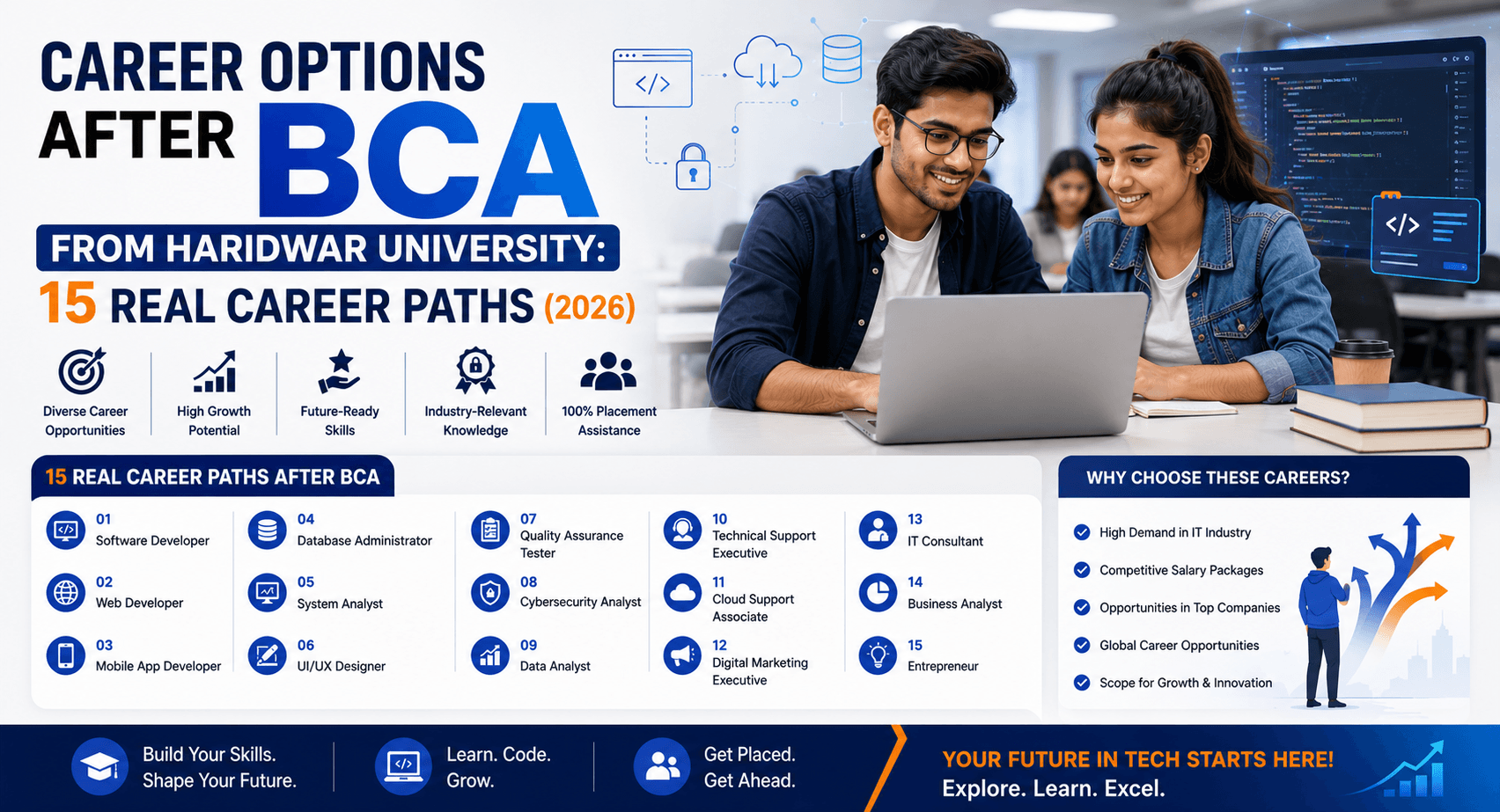
Career Options After BCA from Haridwar University: 15 Real Career Paths (2026)
Mr. Prajwal Chaudhary
Head, Training & Placement, Haridwar University
A Bachelor of Computer Applications (BCA) is no longer limited to software development alone. Today's graduates can build rewarding careers in cloud computing, data analytics, cybersecurity, product management, IT consulting, digital business, and many other technology-driven fields. As organisations continue investing in digital transformation, the demand for professionals with practical computing skills remains strong across startups, multinational companies, and government organisations.
Offered through the Roorkee College of Smart Computing at Haridwar University, the BCA programme combines programming, databases, software development, laboratory learning, industry-oriented projects, and practical training to prepare students for tech-driven careers.
This guide explores 15 real career options after BCA, expected salary ranges in 2026, essential skills, higher study pathways, placement support, and practical steps that can help you plan your technology career with confidence.
Table of Contents
Why a BCA Degree Offers More Career Options Than You Think
A common misconception is that BCA graduates can only become software developers. While software development remains one of the most popular career choices, the modern technology industry offers diverse roles that match different interests and strengths.
Some graduates enjoy writing code and building applications, while others prefer analysing data, managing cloud systems, solving business problems, supporting enterprise software, or coordinating technology projects. With continuous learning and relevant certifications, BCA graduates can also move into specialised domains such as Artificial Intelligence, Cybersecurity, DevOps, Data Science, and Product Management.
The key is not simply earning a degree but combining academic knowledge with practical projects, internships, communication skills, and continuous upskilling. Students who begin developing these capabilities during college are often better prepared for campus placements and long-term career growth.
15 Career Options After BCA (2026)
A BCA degree equips students with technical knowledge that can be applied across multiple industries. While many graduates begin their careers in software development, others move into cloud computing, data analytics, IT consulting, product management, and business technology roles.
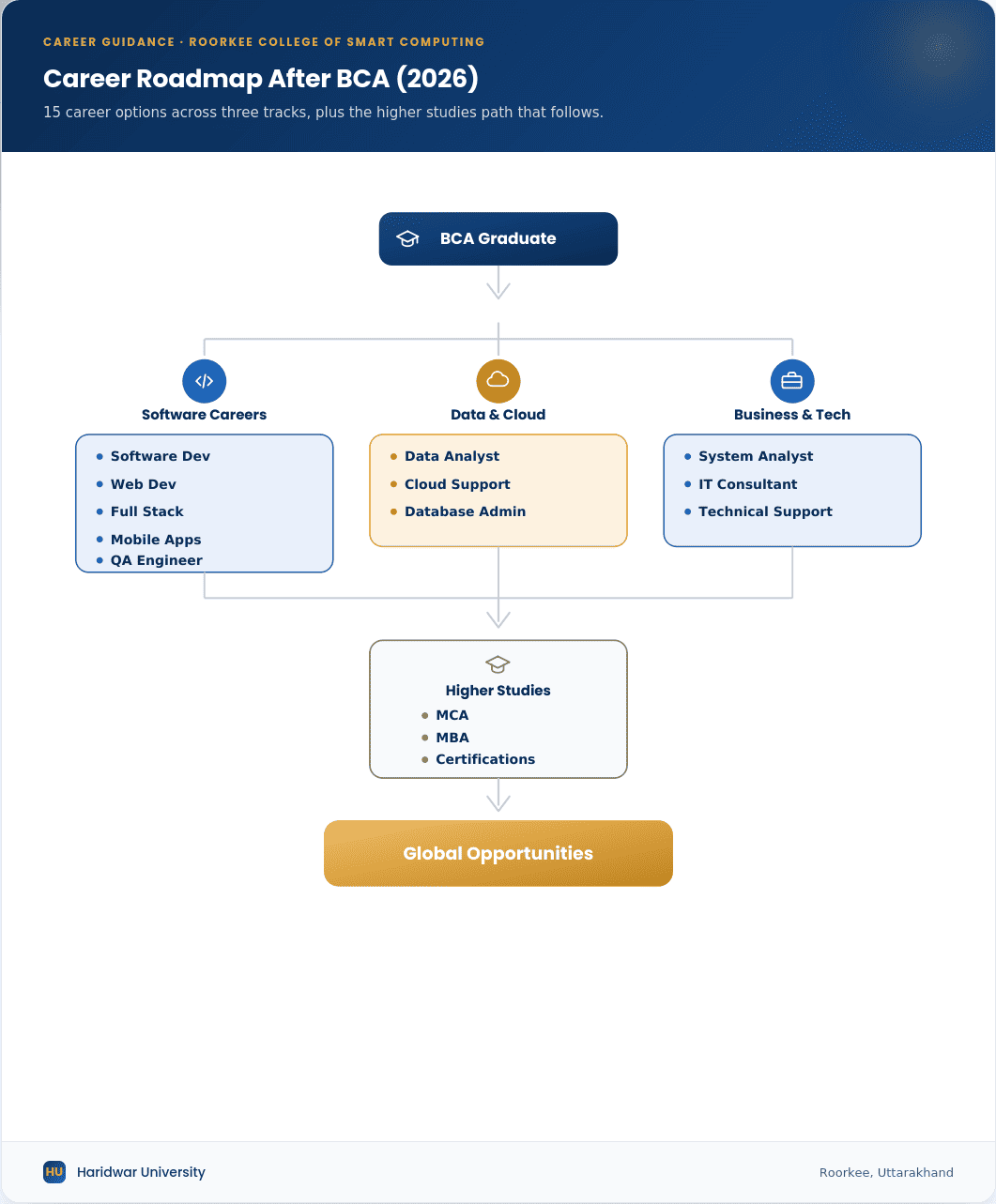
The best career path depends on your interests, technical skills, internships, and willingness to continue learning. The roadmap below illustrates some of the most common career directions available after completing a BCA.
1. Software Development Careers
Software development remains one of the most preferred career choices after BCA because organisations across every industry require applications, websites, and digital platforms. Students who develop strong programming skills, build projects, and gain internship experience often find excellent opportunities in this domain.
1. Software Developer
Software Developers design, build, test, and maintain applications used by businesses and consumers. They typically work with programming languages such as Java, Python, C++, or JavaScript to develop desktop, web, and enterprise applications.
- Freshers: ₹3–6 LPA
- Mid-level (3–5 years): ₹6–10 LPA
- Experienced: ₹10–18+ LPA
Skills Required: Programming (Java, Python, C++), Data Structures & Algorithms, Problem Solving, Git, SQL
2. Web Developer
Web Developers create responsive websites and web applications for businesses, e-commerce platforms, educational institutions, and startups. With growing digital adoption, demand for skilled front-end and back-end developers continues to increase.
- Freshers: ₹3–5.5 LPA
- Mid-level: ₹6–9 LPA
- Experienced: ₹10–15+ LPA
Skills Required: HTML5, CSS3, JavaScript, React, Node.js
3. Full Stack Developer
Full Stack Developers work on both the front-end and back-end of web applications, making them highly valued across startups and technology companies. Students who learn modern frameworks and build practical projects often enjoy faster career growth.
- Freshers: ₹4–7 LPA
- Mid-level: ₹8–12 LPA
- Experienced: ₹15–25+ LPA
Skills Required: MERN/MEAN Stack, REST APIs, Databases (MongoDB/SQL), Version Control (Git), Cloud Basics
4. Mobile Application Developer
As smartphones continue to dominate digital services, Mobile App Developers build Android and iOS applications for sectors such as banking, healthcare, education, logistics, and entertainment.
- Freshers: ₹4–6 LPA
- Mid-level: ₹7–11 LPA
- Experienced: ₹12–20+ LPA
Skills Required: Android Studio, Flutter, Kotlin, Java, UI Design Fundamentals
5. Software Test Engineer (QA)
Quality Assurance (QA) Engineers ensure software products function correctly before deployment. They perform manual and automated testing, identify bugs, and help improve software quality throughout the development lifecycle.
- Freshers: ₹3–5 LPA
- Mid-level: ₹5.5–8.5 LPA
- Experienced: ₹9–14+ LPA
Skills Required: Manual Testing, Automation Testing, Selenium, SQL, Analytical Thinking
* Salary ranges are approximate estimates compiled from AmbitionBox and interpreted alongside broader employment and digital skills trends published by NASSCOM FutureSkills Prime and LinkedIn Workforce Insights. Actual salaries vary by employer, location, skills, certifications, and experience.
2. Data & Cloud Careers
With businesses increasingly relying on cloud platforms, analytics, and digital infrastructure, BCA graduates with specialised technical skills are finding opportunities beyond traditional software development.
6. Data Analyst
Data Analysts collect, organise, and interpret data to help organisations make informed business decisions. This role is ideal for graduates who enjoy working with numbers, problem-solving, and business insights.
- Freshers: ₹4–6 LPA
- Mid-level: ₹7–10 LPA
- Experienced: ₹12–18+ LPA
Skills Required: SQL, Advanced Excel, Python, Power BI / Tableau, Data Visualisation
7. Cloud Support Engineer
As organisations migrate to cloud platforms, Cloud Support Engineers help deploy, maintain, and troubleshoot cloud infrastructure and services.
- Freshers: ₹4–6 LPA
- Mid-level: ₹7–11 LPA
- Experienced: ₹12–20+ LPA
Skills Required: AWS / Azure, Linux, Computer Networking, Cloud Fundamentals, Troubleshooting
8. Database Administrator (DBA)
Database Administrators manage, secure, and optimise organisational databases to ensure information remains accurate, available, and protected.
- Freshers: ₹4–5.5 LPA
- Mid-level: ₹6–9 LPA
- Experienced: ₹10–16+ LPA
Skills Required: SQL, Oracle / MySQL, Database Security, Backup & Recovery, Performance Optimisation
3. Business & Technology Careers
Not every BCA graduate chooses a programming-intensive role. Many technology companies recruit graduates who can bridge the gap between business requirements and technical solutions.
9. System Analyst
System Analysts evaluate business processes and recommend technology solutions that improve efficiency and performance by acting as a bridge between technical teams and business stakeholders.
- Freshers: ₹4–6 LPA
- Mid-level (3–5 years): ₹7–11 LPA
- Experienced: ₹12–18+ LPA
Skills Required: Business Analysis, Requirement Gathering, SQL, Technical Documentation, Problem Solving
10. IT Consultant
IT Consultants advise organisations on technology implementation, digital transformation, software selection, and process improvement while helping businesses improve operational efficiency.
- Freshers: ₹4–6 LPA
- Mid-level (3–5 years): ₹8–12 LPA
- Experienced: ₹15–22+ LPA
Skills Required: IT Strategy, Client Communication, Business Processes, Cloud Fundamentals, Project Coordination
11. Technical Support Engineer
Technical Support Engineers assist customers and organisations by resolving software, hardware, and network-related issues while ensuring smooth IT operations.
- Freshers: ₹3.5–5.5 LPA
- Mid-level (3–5 years): ₹6–8.5 LPA
- Experienced: ₹9–14+ LPA
Skills Required: Networking, Operating Systems, Troubleshooting, Customer Support, Communication
4. Product & Digital Careers
Technology companies also recruit graduates into roles that combine technical understanding with business strategy, customer experience, and digital product development.
12. Product Associate
Product Associates work with development, design, and business teams to help build and improve digital products throughout their lifecycle.
- Freshers: ₹5–8 LPA
- Mid-level (3–5 years): ₹9–15 LPA
- Experienced: ₹16–25+ LPA
Skills Required: Product Thinking, Agile Methodology, Market Research, Communication, Data Interpretation
13. UI/UX Associate
UI/UX Associates focus on improving user experience by designing intuitive interfaces, conducting usability research, and collaborating with development teams.
- Freshers: ₹4–7 LPA
- Mid-level (3–5 years): ₹8–12 LPA
- Experienced: ₹13–20+ LPA
Skills Required: Figma, Wireframing, User Research, Prototyping, Design Thinking
5. Career Growth Through Higher Studies
For students planning long-term career advancement, higher education remains an excellent option after BCA. Advanced degrees unlock specialized technical and leadership roles.
14. Master of Computer Applications (MCA)
An MCA helps students deepen their technical knowledge in software engineering, artificial intelligence, cloud computing, cybersecurity, and advanced programming. Graduates often become eligible for specialized technical roles with stronger long-term earning potential. (Learn more about MCA at Haridwar University).
Potential Salary After MCA:
- Early Career: ₹6–12 LPA
- Experienced Professionals: ₹12–20+ LPA
15. MBA or Professional Certifications
Students interested in leadership, consulting, or specialised technology domains may pursue an MBA or industry-recognised certifications in Cloud Computing, Data Science, Cybersecurity, Artificial Intelligence, or DevOps.
Potential Salary:
- Early Career: ₹8–15 LPA
- Experienced Professionals: ₹15–25+ LPA
As technology continues to evolve, professionals who combine a strong academic foundation with continuous learning often experience faster career progression and higher earning potential. Students interested in AI-focused technology careers can also explore AI Engineer Salary in India (2026) to understand how emerging technologies are shaping future salary trends.
Skills That Can Help You Stand Out
A BCA degree provides a strong academic foundation, but employers also look for practical skills that demonstrate job readiness. Students who begin building these skills during college often have a distinct advantage during internships and campus placements.
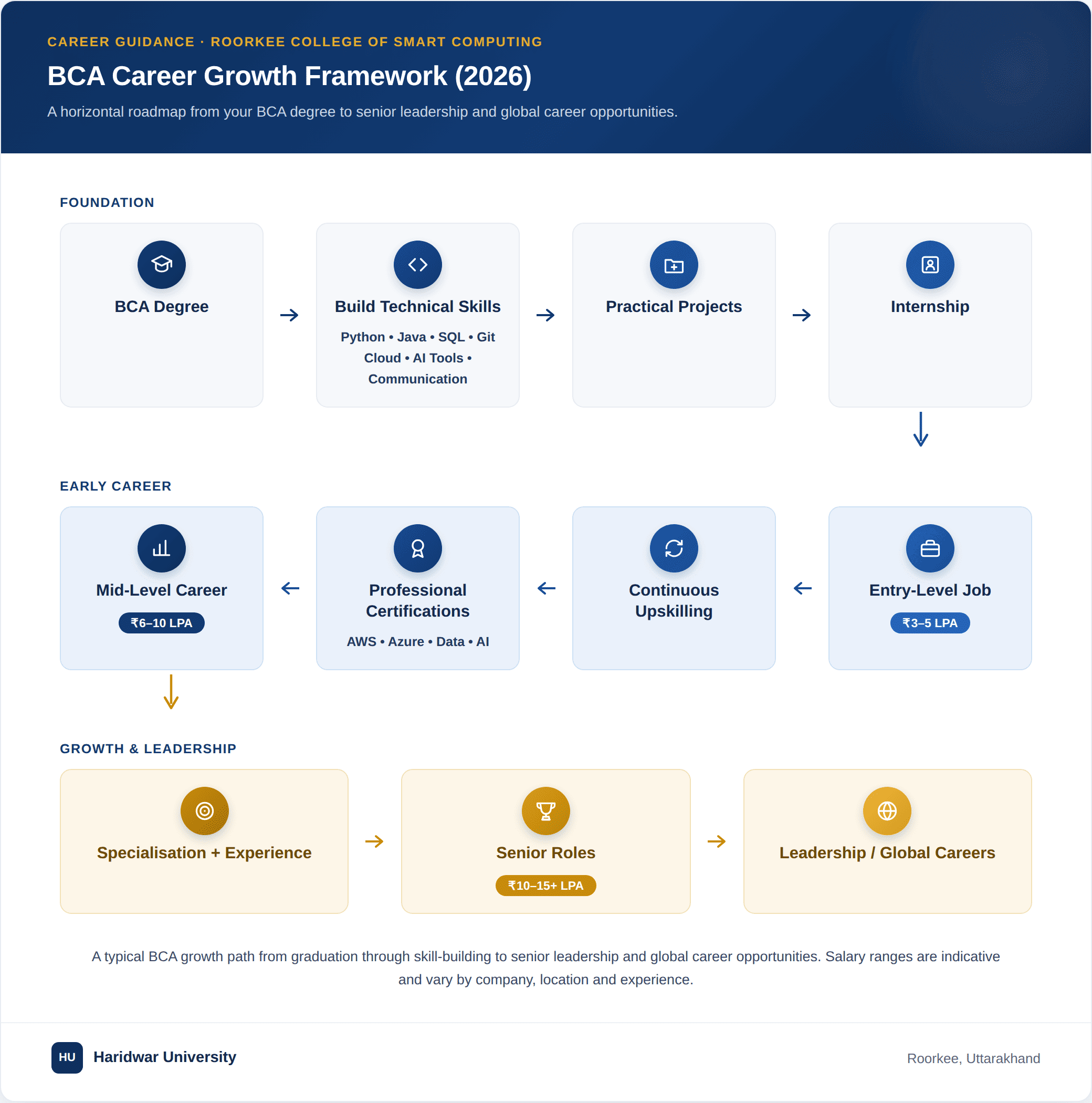
Some of the most valuable skills for BCA students include:
- Programming Fundamentals: Proficiency in languages such as Java, Python, or C++.
- Database Management: SQL, database design, and query optimization.
- Version Control: Git and GitHub for collaborative code management.
- Cloud Fundamentals: Basic understanding of AWS, Azure, or Google Cloud services.
- Data Structures & Algorithms: Essential for clearing technical rounds and interview coding tests.
- Problem-solving & Logic: Analytical reasoning and algorithmic thinking.
- Communication & Teamwork: Articulating ideas clearly and working in cross-functional teams.
- Responsible AI Tools Usage: Leveraging AI-powered tools for coding, debugging, and productivity.
Developing a portfolio of projects, participating in hackathons, and completing industry internships can further strengthen your profile and improve employability.
Placement Support at Haridwar University
Haridwar University supports students through its Training & Placement Cell by offering career counselling, aptitude preparation, resume-building sessions, mock interviews, industry interaction, internships, and campus recruitment activities.
Recruiters associated with university placement and industry engagement include top technology organisations such as TCS, Infosys, Wipro, Accenture, Cognizant, IBM, HCL Technologies, Capgemini, Chetu, Programmers.io, and Radiant Information Technology, among others.
* Note: These are university-wide placement figures across academic programmes. Students can visit the university's Training & Placement Cell for the latest recruiter details and placement activities.
Your Next Step After Choosing BCA
Building a successful technology career requires more than earning a degree. Focus on strengthening your programming skills, working on real projects, completing internships, earning relevant certifications, and continuously learning emerging technologies. These experiences not only improve employability but also prepare you for long-term career growth in the technology industry.
If you're planning to begin your journey in computer applications, explore the BCA Programme at Haridwar University to learn about the curriculum, eligibility, laboratories, scholarships, and admission process. You can also read our comprehensive BCA at Haridwar University: 3-Year Programme Guide, Careers & Salary for a detailed overview before applying.
Frequently Asked Questions
Is BCA a good career choice in 2026?
Yes. With growing demand for software, cloud computing, cybersecurity, artificial intelligence, and digital services, BCA graduates continue to have diverse career opportunities across industries.
Which career offers the highest salary after BCA?
Roles such as Full Stack Developer, Cloud Engineer, Data Analyst, Product Manager (with experience), and specialised software engineering positions generally offer higher earning potential. Salary depends on skills, experience, certifications, and employer.
Can BCA graduates apply for government jobs?
Yes. BCA graduates are eligible for various government recruitment opportunities, including positions offered through SSC, banking examinations, public sector organisations, railways, and state or central government departments, subject to specific recruitment criteria.
Can I pursue higher studies after BCA?
Absolutely. Many graduates continue with MCA, MBA, or professional certifications in Cloud Computing, Data Science, Cybersecurity, Artificial Intelligence, and related technology domains.
Can BCA graduates work abroad?
Yes. After gaining relevant technical skills, work experience, or internationally recognised certifications, BCA graduates may explore career opportunities with multinational companies or international employers.
Can I get a ₹1 lakh salary after BCA?
Yes, but typically not immediately after graduation. Entry-level salaries start lower, but professionals who gain experience, develop in-demand technical skills, and specialise in areas such as cloud computing, full stack development, AI, or data engineering achieve significantly higher packages over time.
Can I get a job after BCA without coding?
Yes. Although programming skills open many doors, BCA graduates can also pursue careers in technical support, system analysis, IT consulting, product management, UI/UX design, digital operations, and other technology-enabled business roles that require minimal coding.
What skills are most important for BCA graduates?
Along with programming knowledge, employers value SQL, database management, cloud fundamentals, Git, problem-solving, communication skills, teamwork, and practical project experience.
Which companies hire BCA graduates?
Technology companies, startups, IT service providers, fintech firms, healthcare organisations, educational institutions, and government departments recruit BCA graduates. Haridwar University students receive placement support involving major recruiters like TCS, Infosys, Wipro, Accenture, Cognizant, IBM, HCL, and Capgemini.
Start Your BCA Journey at Haridwar University
Combine academic excellence, practical lab training, industry certifications, and top placement opportunities with our industry-aligned BCA programme.
Apply for BCA Admission 2026 →