

Roorkee College of Smart Computing | Mini Project Roadmap
How 2nd and 3rd year BCA, MCA, and B.Tech CSE students can execute structured, semester-scoped software builds that evolve into high-impact final-year capstones.
Mini Project Ideas for 2nd & 3rd Year usually get searched the night before a college lab submission, which is the worst possible time to pick one. A truly effective mini project is small enough to finish cleanly between two sets of semester examinations and solid enough that you can discuss its architecture in a technical placement interview for ten minutes without running out of substance.
This comprehensive guide is designed for BCA, MCA, and B.Tech Computer Science students who want to build real software capability. It details curated ideas segmented by academic year, introduces a battle-tested three-part scoping filter, provides a 5-step roadmap for turning small builds into production-ready capstones, and explains how Haridwar University supports student developers with dedicated labs and transparent scholarships.
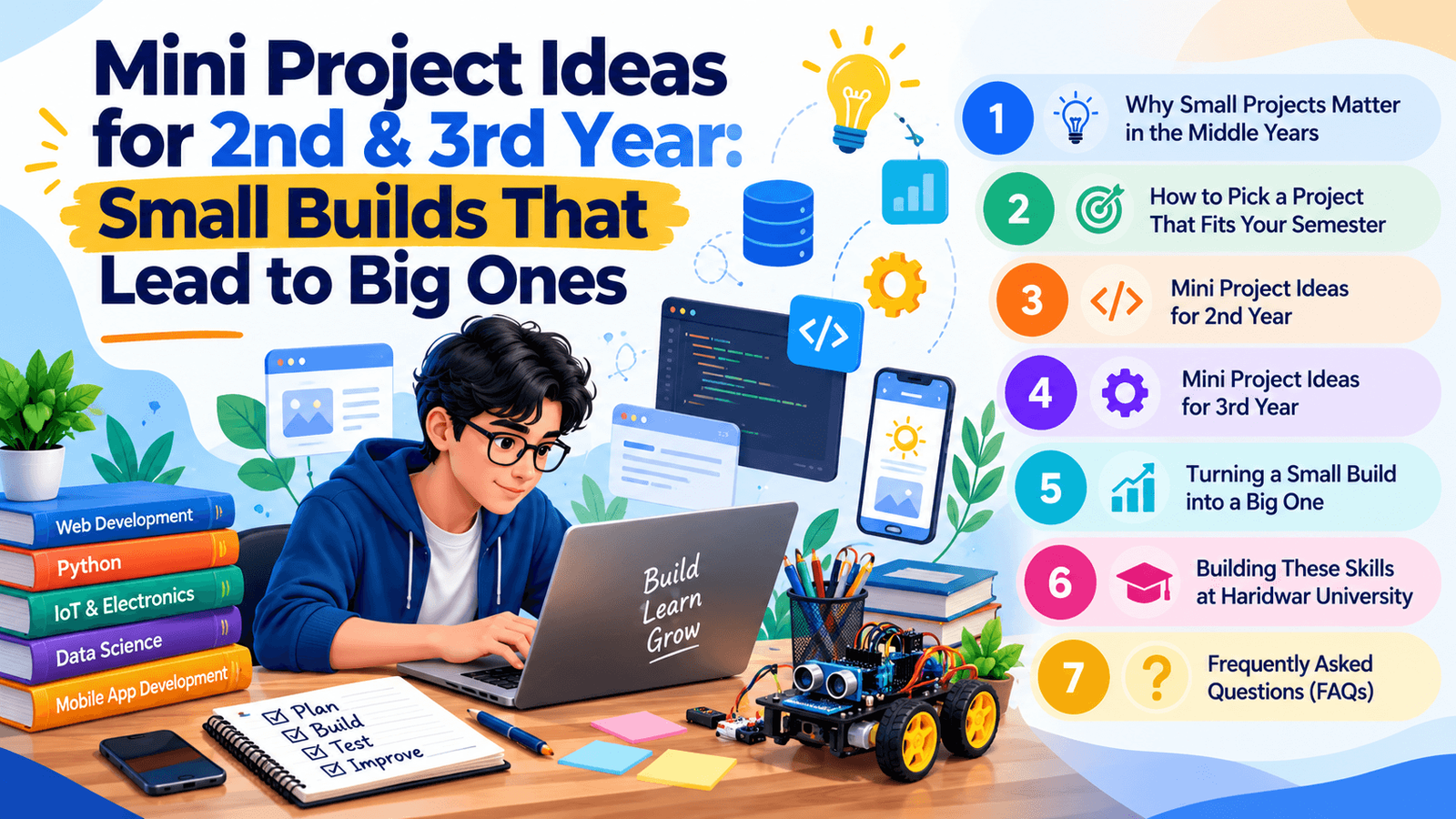
Table of Contents
- Why Small Projects Matter in the Middle Years
- How to Pick a Project That Fits Your Semester (The 3 Rules)
- Mini Project Ideas for 2nd Year: Start With Data and Logic
- Mini Project Ideas for 3rd Year: Add Users, Roles and Real Constraints
- Turning a Small Build Into a Big One (5-Step Sequence)
- Building These Skills at Haridwar University (Fees & Scholarships)
- Frequently Asked Questions (9 Comprehensive FAQs)
1. Why Small Projects Matter in the Middle Years
First year teaches programming syntax and basic algorithms. Final year demands a substantial capstone project. The two years in between are where many students drift into passive learning — and that drift carries a heavy career cost. A well-designed mini project bridges the gaps in your curriculum by synthesizing separate subjects: the database design from DBMS, the interface logic from web development, and the object-oriented structure from your core programming labs.
This philosophy mirrors national educational policy. As outlined in the National Education Policy (NEP) 2020, higher technical education is actively pivoting toward experiential, discovery-oriented, and learner-centered problem solving. Constructing functional applications by hand is the purest manifestation of that mandate.
A mini project that encounters architectural flaws in week three costs a few evenings to refactor. A final-year project that collapses in month six can cost an entire semester or derail campus placement eligibility. Make your architectural mistakes early in 2nd and 3rd year while the cost of failure is negligible.
2. How to Pick a Project That Fits Your Semester
Choosing among project ideas is primarily an exercise in scope management, not chasing exaggerated novelty. Three practical rules help keep your scope sharp:
⏱️ The Four-Week Test
If you cannot articulate the core functionality in a single sentence and build a working MVP in four weeks of part-time lab effort, aggressively prune features until you can.
💡 The One-New-Skill Rule
Rely on technologies you already understand and introduce exactly one unfamiliar concept — such as a REST API endpoint, a charting library, or a basic Scikit-learn model. Reinforce theory through free courses on NPTEL (IITs & IISc).
📊 The Real-Data Rule
Applications driven by authentic, external inputs are dramatically more compelling in interview demos than hardcoded placeholder strings. Establish your data pipeline before writing application logic.
Students inside the Roorkee College of Smart Computing apply these exact scoping filters to all semester lab submissions across our B.Tech Hons. CSE, BCA, and MCA programs.
3. Mini Project Ideas for 2nd Year: Start With Data and Logic
Second-year mini projects must emphasize clean architectural structure: unambiguous input validation, deterministic business logic, and a structured database backend.
1. Attendance and Marks Tracker with Alert Thresholds
Store student profiles, course enrollments, and continuous evaluation marks in a relational schema. Implement business logic that automatically calculates cumulative percentages and flags students falling below the mandatory 75% attendance threshold.
2. Personal Expense Tracker with Category Visualizations
Log daily expenditures, categorize spending (academics, food, travel, utilities), and render interactive monthly breakdown charts. Highly practical for student budgeting and easy to demonstrate on mobile browsers.
3. Library or Lab Equipment Inventory Manager
Track resource issuance, returns, equipment availability, and overdue fines. Enforces relational schema design (foreign keys, join tables, transaction history) far more effectively than theoretical textbook exercises.
4. District Data Analytics Dashboard
Extract public datasets from data.gov.in (India’s Open Government Data Platform) to benchmark administrative districts on agricultural yields, rainfall, or literacy. Teaches data sanitization, handling missing values, and API consumption.
5. Interactive Quiz Application with Persistent Score History
Construct a timed quiz platform with randomized question ordering, category selection, session persistence, and global leaderboards. Forces mastery over client-server state synchronization.
4. Mini Project Ideas for 3rd Year: Add Users, Roles and Real Constraints
By the third year, single-user applications no longer impress interviewers. Placement evaluators look for multi-tenant permissions, asynchronous communication, decoupled architectures, and defensive error handling. This is also when internship hunting intensifies on portals such as the AICTE Internship Portal.
1. Campus Event & Club Management Portal
Three distinct role dashboards: general students (view & register), student club organizers (create events & enforce seat limits), and faculty coordinators (approve budgets & export attendance CSVs).
2. Placement & Internship Application Tracker
Track company eligibility, application deadlines, interview progression rounds (OA, Technical, HR), and document links. Build automated email or WhatsApp reminder webhooks ahead of submission cutoffs.
3. Decoupled Role-Based Inventory System with REST API
Architect a completely decoupled REST API first, documenting endpoints in Swagger/Postman, and then connect a responsive frontend on top. Proves clean separation of concerns and API contract design.
4. Context-Aware Book or Movie Recommender
Implement collaborative or content-based filtering algorithms using Python. You do not need massive deep learning models to prove that you understand cosine similarity, sparse matrices, and feature extraction.
5. Department FAQ Chatbot (Rule-Based to NLP)
Begin with regex/intent classification answering university timetable and exam form questions. In the second iteration, integrate an open-source NLP model or embedding search to handle semantic query variants.
To align project builds with recruiter demands, Haridwar University’s Training & Placement Cell hosts regular corporate speaker talks, technical seminars, and mock interview drives where students receive direct feedback from senior technology leaders.
5. Turning a Small Build Into a Big One (5-Step Sequence)
Exceptional final-year engineering capstone projects are rarely created from scratch in one desperate push; they are evolved through disciplined iteration. Follow this five-phase sequence:
- Establish the Minimal End-to-End Pipeline: Build version 1.0 with raw inputs, basic processing, and simple outputs. A functional but visually unpolished application always beats an incomplete UI mockup.
- Add One Systematic Feature Weekly: Implement secure password authentication first, followed by multi-role permissions, input sanitization, and automated PDF/CSV report exports.
- Deploy Publicly with Architectural Documentation: Deploy your application live (on Render, Vercel, or AWS) and write an exhaustive GitHub README featuring architectural flowcharts, environment setup steps, and API endpoint tables. Build out your credentials on the Skill India Digital Hub.
- Conduct Peer Usability Testing: Give your working URL to five classmates. Observe where they get stuck, document edge-case crashes, and refactor the interface accordingly.
- Transition into Capstone Scope: When final year arrives, scale this validated foundation into an enterprise-grade system by adding microservices, Docker containerization, or real-time WebSockets.
Academic deadlines and exam pressures naturally peak mid-semester. Haridwar University’s comprehensive Student Welfare Service ensures that students have round-the-clock access to faculty mentoring, personal counseling, and academic support.
6. Building These Skills at Haridwar University
Haridwar University operates with full AICTE approval and UGC recognition, delivering computing programs through the specialized Roorkee College of Smart Computing. Students participate in hands-on live academic projects and leverage advanced computing research laboratories.
*Listed fees include tuition, enrollment, admission, examination, and university uniforms. Transport is charged separately. Lateral-entry 3-year B.Tech Hons. programs are available for polytechnic diploma holders.
Merit Scholarships & Financial Support Slabs
Haridwar University provides substantial tuition concessions for first-year students based on standardized benchmarks:
- Academic Merit (10% to 80%): Top 80% tuition waiver for JEE ranks up to 1,00,000 or above 90% in Class 12 / CUET percentile, scaling down to 10% for baseline merit bands.
- Girl Student Concession: 25% waiver on first-year tuition fees.
- Uttarakhand Domicile Scheme: 25% first-year tuition concession for permanent UK residents.
- Defense & Sibling Category: 25% first-year tuition waiver for wards of Armed Forces personnel or siblings of enrolled HU students.
- Sports Quota: 10% to 50% tuition concessions based on state, national, or international certificates.
Full scholarship slabs are detailed on the Fees & Scholarships page. Check program eligibility criteria and register via the Admission Overview page. Admissions confirm on deposit of ₹25,000 seat confirmation fee.
Start Building Your Computing Portfolio Today
Join Haridwar University’s Roorkee College of Smart Computing for mentorship, advanced laboratories, and 100% placement support.
7. Frequently Asked Questions (9 Comprehensive FAQs)
1. What is a mini project in a BCA, MCA or B.Tech course?
A mini project is a small, time-boxed software build executed during a regular academic semester, either individually or in a team of two to three students. It focuses on solving one discrete, well-defined problem — unlike a final-year capstone, which spans multiple semesters and demands broader novelty and scale.
2. How many mini projects should I finish in two years?
Two or three fully completed, well-documented projects are substantially more valuable than six half-finished repositories. Target one polished project per semester, ensuring at least one build is deployed live on a public URL and one operates on authentic, external data.
3. Which programming language should I use?
Stick to the programming language in which you can write logic fluidly. Python is well suited for data pipelines and machine learning; Java or C# excels in strongly typed enterprise logic; and JavaScript / TypeScript is essential for full-stack browser interfaces. Adopt a new language only when the project architecture strictly requires it.
4. Should I work alone or in a team?
Both models have clear advantages. Solo projects demonstrate your capability to manage every layer from schema design to frontend state. Team projects teach Git branching, code reviews, and modular collaboration. When presenting team projects, explicitly document your individual module contributions.
5. Can a mini project help me get an internship?
Yes, provided the project is live, accessible, and accompanied by a professional README. A working hosted URL demonstrates vastly more credibility to tech recruiters than a bullet point claiming familiarity with a framework. Pair your builds with applications on the AICTE Internship Portal.
6. Where can I find free, real data for a project?
Begin with data.gov.in (Open Government Data Platform India), which hosts thousands of machine-readable datasets spanning demographics, transport, and agriculture. Always cite the exact source table and retrieval date in your repository README.
7. How long should a mini project take?
Approximately four weeks of part-time effort is the optimal window. If your proposed feature set requires three months, prune non-essential components until an MVP fits four weeks, and schedule advanced modules for subsequent iterations.
8. What scholarships does Haridwar University offer computing students?
Haridwar University offers merit scholarships of 10% to 80% on first-year tuition based on JEE ranks, Class 12 percentages, or CUET percentiles. Female students receive a 25% waiver, Uttarakhand domicile holders receive a 25% concession, and sports quota awards range from 10% to 50%. Full criteria are published on the Fees & Scholarships page.
9. What are the fees for BCA and B.Tech CSE at Haridwar University?
For the 2026-27 academic session, BCA is charged at ₹82,000 in Year 1 and ₹65,000 per year in Years 2 and 3. B.Tech. Hons. CSE is ₹1,32,000 in Year 1 and ₹1,15,000 per year in subsequent years. Detailed inclusions and transport charges are listed on the official fees portal.