

Table of Contents
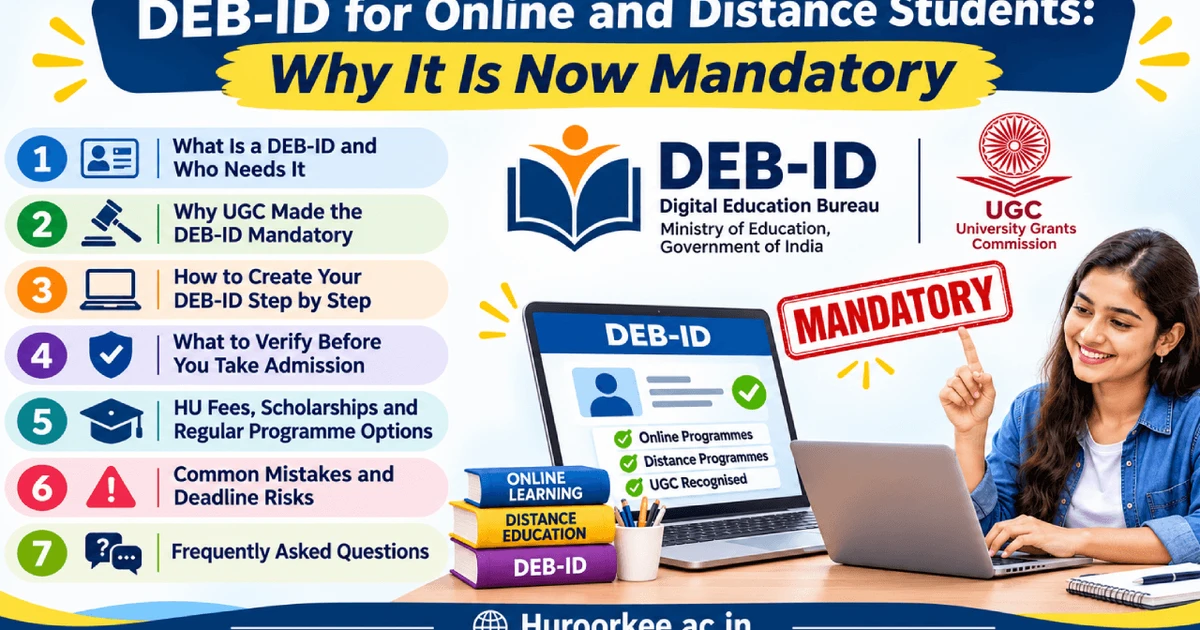
DEB-ID for Online and Distance Students is no longer something you can sort out after paying a fee. Since the academic session that began in October 2024, the University Grants Commission (UGC) has required every learner to hold this identity number before enrolling in an open and distance learning (ODL) or online programme. This guide explains what the ID is, why UGC brought it in, how to create it and what to check before you pay for admission. Everything below reflects regulations in force for the 2026-27 academic cycle.
If you are still choosing between a distance route and an on-campus degree, Section 5 also lists Haridwar University’s published 2026-27 fees and scholarships for regular programmes, helping you compare realistic figures directly.
1. What Is a DEB-ID and Who Needs It
Meaning and Purpose
DEB stands for the Distance Education Bureau, the specialized unit of the University Grants Commission that oversees and regulates which higher educational institutions (HEIs) are authorized to offer Open and Distance Learning (ODL) and web-based Online degree programmes across India.
The DEB-ID is a unique, standardized identification number generated directly by a candidate on the UGC-DEB student portal using their official Academic Bank of Credits (ABC) ID. The UGC announced this regulatory mechanism in its public notification dated 19 August 2024 (effective from the October 2024 academic cycle). Its primary mission is to establish verified student identity upfront and eradicate fraudulent or unauthorized distance admissions.
Who Needs It
Every Indian student intending to register for an approved ODL or online undergraduate, postgraduate, or diploma course at any recognized Central, State, Deemed, or Private University must hold an active DEB-ID before finalizing admission.
- Exemptions: Foreign international learners enrolled from outside India are currently the only exempt cohort, governed under a separate UGC verification framework.
- Regular On-Campus Students: Regular on-campus students do not require a DEB-ID. However, traditional on-campus admissions do require an ABC ID for credit transfers under the National Higher Education Qualifications Framework (NHEQF).
2. Why UGC Made the DEB-ID Mandatory
Protection from Unrecognised Programmes
The UGC noticed that numerous unauthorized study centres and deceptive distance providers had enrolled unsuspecting students in unapproved ODL/online courses, resulting in invalid degrees and severe career setbacks. At its 581st meeting on 25 June 2024, the Commission resolved to standardize the entire admissions funnel. The DEB-ID ensures that an enrolment can only be processed if the institution and the exact degree program hold valid UGC-DEB approval.
Cleaner Records and Transparent Data
Because the DEB-ID is generated directly from an Aadhaar-verified ABC ID, duplicate enrollments, ghost candidates, and fake enrollments are completely eliminated. Universities must transmit student admission datasets mapped directly to DEB-IDs through UGC API pipelines. When UGC extended the winter admission deadline to April, it simultaneously shifted the university data-upload cutoff, proving the strict administrative scrutiny placed on DEB-ID matching.
Equivalence and Value of the Degree
Under the UGC (Open and Distance Learning Programmes and Online Programmes) Regulations and the 2014 Specification of Degrees, an ODL or online degree awarded by an entitled institution is legally equivalent to conventional campus degrees for higher studies and government employment. However, this parity hinges entirely on valid regulatory recognition. To understand how awarding bodies and autonomous statutory privileges impact qualification value, review our comprehensive analysis on private university vs affiliated college benefits.
3. How to Create Your DEB-ID Step by Step
The UGC Distance Education Bureau mandates a strict chronological sequence for learners. Do not reverse this process:
The Official UGC-DEB Generation Sequence
- Step 1: Create your Academic Bank of Credits (ABC) ID via DigiLocker.
- Step 2: Navigate to the UGC-DEB Student portal (deb.ugc.ac.in/StudentDeBID).
- Step 3: Input your 12-digit ABC ID to fetch your authenticated DigiLocker profile.
- Step 4: Generate and record your unique lifelong DEB-ID.
- Step 5: Check the recognized HEI & programme directory on the DEB portal.
- Step 6: Submit the DEB-ID during online application at the chosen university.
Creating Your ABC ID First
If you haven't yet created an ABC ID, register via DigiLocker or the official ABC portal using your Aadhaar-linked mobile number. Ensure your spelling of name, father's name, and date of birth match your matriculation certificates exactly. A mismatch causes the DEB portal API to reject the generation request.
Your ABC ID is also essential for logging earned credits across multi-year academic progression. To learn how stored credits enable flexible exit benchmarks, explore our detailed explainer on 4-year UG degree exit options.
4. What to Verify Before You Take Admission
Institutional Recognition and Session Entitlement
Never rely on verbal reassurances from admission agents. Always check deb.ugc.ac.in for session-specific entitlement. UGC grants ODL and online entitlements for specific academic years and cycles (e.g., January-February or July-August). A university permitted to offer courses in 2024 might not hold permissions for 2026. Furthermore, universities must publish their statutory approvals, affidavits, and faculty declarations on their official websites.
Disciplines Prohibited from Online and Distance Delivery
A critical clause in UGC regulations strictly prohibits practical-intensive and professional disciplines from being offered through distance or online modes. Any institution offering the following programmes via ODL or online mode is operating unlawfully:
Barred from ODL / Online Mode under UGC Norms:
Engineering & Technology (B.Tech / M.Tech), Medical, Physiotherapy, Occupational Therapy, Para-Medical, Pharmacy (B.Pharm / D.Pharm), Nursing, Dental, Architecture, Law, Agriculture, Horticulture, Hotel Management, Catering Technology, and Aviation. In addition, M.Phil and Ph.D. degrees cannot be pursued online or via distance mode under any circumstances.
If you wish to pursue professional disciplines like Computer Science Engineering, Pharmacy, Allied Sciences, or Management, they must be completed through approved regular campus enrollment. Explore our accredited on-campus degree offerings via the Haridwar University Academic Programs catalogue.
Territorial Jurisdiction and Ban on Franchising
State Private Universities offering ODL courses cannot operate beyond the physical borders of their home state. They cannot establish study centres in other states or open off-shore franchise campuses. Moreover, UGC completely prohibits commercial franchise arrangements: all Learner Support Centres (LSCs) must be directly administered and staffed by the university itself.
5. HU Fees, Scholarships and Regular Programme Options
Haridwar University offers high-standard, industry-aligned conventional campus programmes. The university does not operate an ODL or online wing. For students weighing distance options against a rich, campus-based immersion with labs, mentorship, and direct recruitment drives, here is the published 2026-27 fee structure:
First-Year Merit Scholarships at HU
To make quality technical education accessible, Haridwar University awards handsome entry-level scholarships based on JEE Main ranks, CUET percentiles, or Class 12 / Graduation percentages:
In addition, HU offers a 25% first-year tuition scholarship for girl students to encourage women in STEM. Outstanding students maintaining 85%+ semester scores with clear first attempts also receive the ₹5,000 Award of Academic Excellence. Students needing loan documentation or bonafide certificates can consult the Student Welfare Service desk. For an in-depth breakdown of private institution grants, refer to our guide on how merit scholarships work in Indian private universities.
6. Common Mistakes and Deadline Risks
Frequent Student Errors
- Paying Tuition Before DEB-ID Validation: Unscrupulous agents often ask candidates to pay "booking fees" promising that registration numbers will be issued later. Any payment made prior to generating your DEB-ID puts your money and legal status at risk.
- Discrepancies in ABC ID Profile: Typos in Aadhaar-linked names, dates of birth, or gender trigger silent rejection on the DEB portal API.
- Overlooking Specific Program Approvals: Just because a university is recognized by UGC does not mean every individual ODL programme is entitled. Always cross-check the specific degree listing.
Dynamic Regulatory Deadlines
Admission cutoff windows for ODL and online learning are strictly governed by UGC cycles. For example, UGC revised the February session admission deadline from 30 March to 10 April. For the 2026-27 cycle, UGC invited fresh institutional applications between 1 and 15 September. Because dates can shift based on administrative notifications, treat all third-party timelines as tentative and rely exclusively on official notices at deb.ugc.ac.in.
If you are planning to apply for central government fee concessions, our tutorial on the National Scholarship Portal (NSP) explains how to submit verified applications without rejection. For complete instructions on campus seat allotment, visit the Haridwar University Admission Overview portal.
7. Frequently Asked Questions (FAQs)
What does DEB-ID stand for?
DEB stands for Distance Education Bureau, the regulatory division of the University Grants Commission (UGC). The DEB-ID is a unique identifier generated by a student via the official UGC-DEB student portal prior to enrolling in any distance or online course.
Is a DEB-ID mandatory for every distance and online course?
Yes. Starting with the academic session commencing October 2024 and continuing through 2026-27, holding a DEB-ID is a mandatory prerequisite for admission into any approved ODL or online programme in India. Foreign nationals are the sole exception.
Do I need an ABC ID before generating a DEB-ID?
Yes. The DEB portal requires your 12-digit Academic Bank of Credits (ABC) ID to authenticate your credentials. If you do not have one, generate it through DigiLocker first.
Does a DEB-ID ever expire?
No. Once generated, your DEB-ID remains valid for lifelong ODL and online learning. You can utilize the same ID for subsequent diploma, bachelor's, or master's degrees.
Can I apply first and create my DEB-ID later?
No. UGC guidelines mandate that learners must generate the DEB-ID before finalizing application forms and fee transactions. Generating it in advance prevents admission rejections.
Do regular campus students need a DEB-ID?
No. The DEB-ID specifically governs Open and Distance Learning and web-based Online courses. Conventional campus students do not need a DEB-ID, though they do use an ABC ID for credit tracking.
Can I study B.Tech, pharmacy, or nursing online?
No. UGC explicitly prohibits engineering, pharmacy, nursing, agriculture, medical, architecture, and several practical disciplines from being delivered via distance or online mode. These degrees require conventional full-time campus attendance.
How do I check whether a university is recognized by UGC-DEB?
Visit the official DEB portal at deb.ugc.ac.in. Navigate to the HEI directory to view state-wise, session-wise entitlement lists alongside permitted programme specializations.
Where can I check Haridwar University's fees and scholarships?
You can explore published 2026-27 fee schedules and scholarship slabs on HU's official website. For personalized counseling, connect with the Admissions Office at 9801012345 or 7500102111.
Planning Your Higher Education Journey at Haridwar University?
Whether you are evaluating distance learning regulations or seeking an industry-focused regular campus degree in Engineering, Technology, Commerce, or Management, Haridwar University provides world-class infrastructure, high-value merit scholarships, and dedicated placement support.