

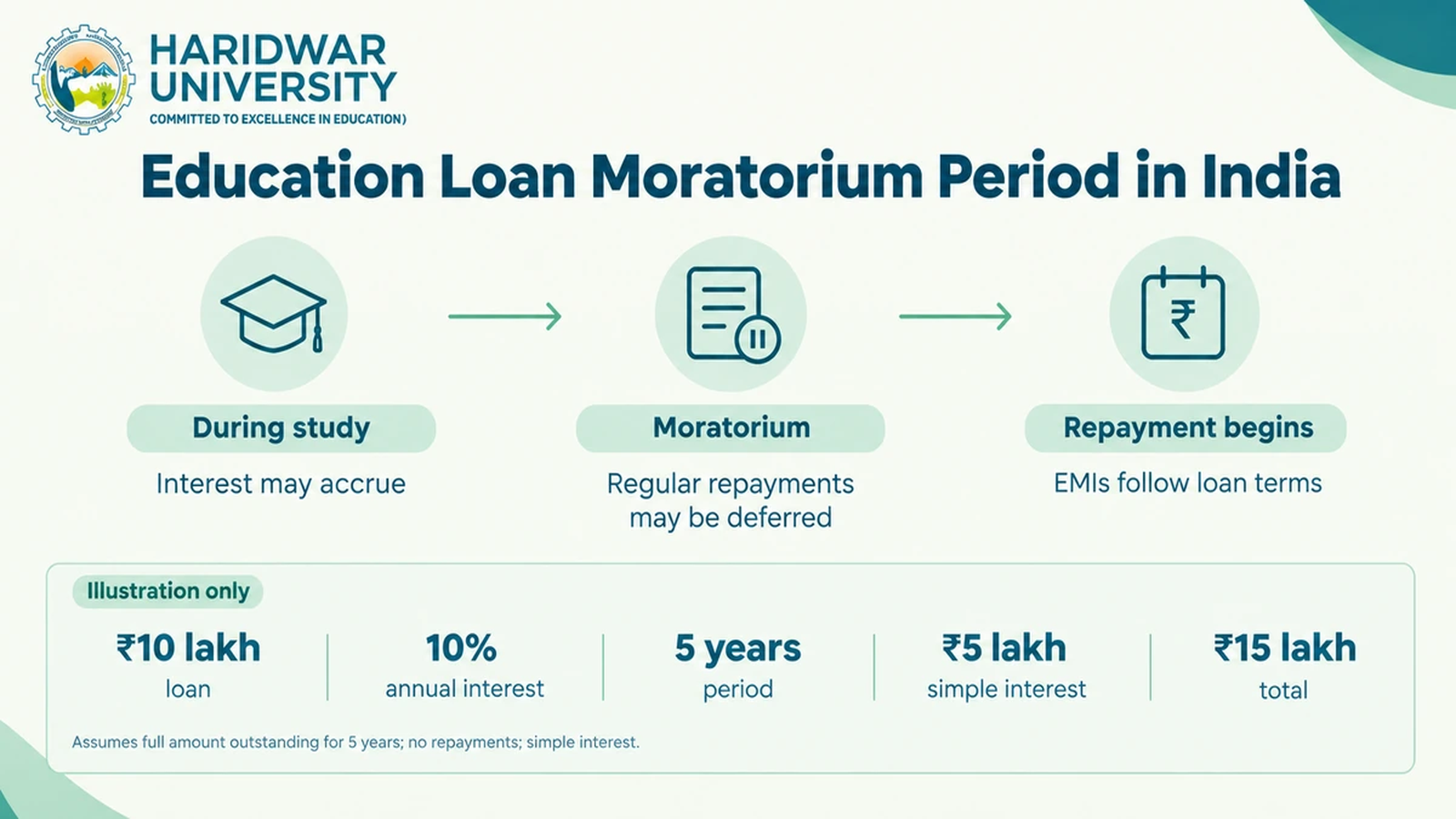
An education loan makes higher education accessible, but understanding the education loan moratorium period is just as vital as comparing annual interest rates. While a moratorium allows students to defer regular Equated Monthly Instalments (EMIs) during their course and for a specified grace window post-graduation, it does not mean that interest stops accumulating.
Looking beyond the sanctioned loan amount and the eventual monthly installment reveals a critical reality: how interest is treated during the study period directly dictates your outstanding balance upon graduation and your total repayment burden. Knowing these terms before signing a sanction letter empowers students and families to plan higher education funding prudently and avoid unexpected financial shocks.
Table of Contents
- • 1. What the Education Loan Moratorium Period Means
- • 2. How Long an Education Loan Moratorium Can Last
- • 3. How Interest Accumulates During the Moratorium
- • 4. How Paying Interest During the Moratorium Affects Repayment
- • 5. What Happens When the Moratorium Period Ends
- • 6. How to Compare Education Loans Moratorium Terms
- • 7. What Students and Parents Should Check Before Borrowing
- • 8. Frequently Asked Questions (FAQs)
- • 9. Planning for Repayment Before You Borrow
1. What the Education Loan Moratorium Period Means
The education loan moratorium period is the contractually agreed timeframe during which a borrower is permitted to defer regular EMI repayments under the lending institution's terms. It typically spans the entire academic course duration and includes an additional grace period after graduation, though the precise framework depends on the bank and loan scheme.
To evaluate education financing clearly, three core terms must be distinguished:
| Term | Operational Definition |
|---|---|
| Course Period | The formal academic duration required to complete the designated degree programme (e.g., 4 years for B.Tech., 2 years for MBA/M.Tech.). |
| Moratorium / Grace Period | The approved window during which principal and mandatory EMI payments are deferred. |
| Repayment Tenure | The multi-year schedule (commonly 10 to 15 years) permitted to repay the accumulated balance once regular EMIs commence. |
While connected, these concepts are not interchangeable. A moratorium provides essential breathing room before full repayments begin, but it rarely eliminates interest accumulation.
2. How Long an Education Loan Moratorium Can Last
There is no universal duration across Indian banking institutions. The moratorium length depends on the lender, scheme classification, course structure, and conditions specified in the formal sanction letter.
For example, public sector schemes such as the State Bank of India (SBI) Student Loan Scheme and the Indian Bank IBA Model Educational Loan Scheme define repayment holidays as Course Period + 12 months, or 6 months after securing employment, whichever is earlier.
Before committing to an agreement, verify five foundational parameters in writing:
- Whether the moratorium covers solely the academic course period or adds a formal post-completion holiday.
- The precise trigger event that starts the repayment clock.
- Whether securing employment before the grace period ends automatically initiates immediate EMI deductions.
- Whether interest must be serviced monthly during the study period or is allowed to accumulate.
- The maximum permissible repayment tenure under the specific banking product.
The most reliable source is the current sanction letter and the lender’s official scheme documentation.
3. How Interest Accumulates During the Moratorium
Interest treatment during the study period is one of the most critical factors influencing total loan cost. Under standard banking guidelines, simple interest accrues on disbursed funds throughout the moratorium. If this interest is left unserviced, it is compounded (capitalized) into the principal balance at the end of the moratorium.
To illustrate the financial impact, examine this simplified baseline comparison:
| Parameter | Baseline Scenario |
|---|---|
| Sanctioned Loan Disbursed | ₹10,00,000 |
| Illustrative Annual Interest Rate | 10.0% p.a. |
| Moratorium Span (Course + Grace) | 5 Years |
| Unserved Simple Interest Accrued | ₹5,00,000 |
| Principal Capitalized at EMI Start | ₹15,00,000 |
In practice, universities charge tuition and hostel fees semester by semester, meaning lenders disburse capital in tranches rather than upfront in full. Consequently, interest is calculated on progressive balances rather than the entire ₹10 lakh from day one. For detailed guidance on application protocols and documentation, review the comprehensive education loan guide for university students.
4. How Paying Interest During the Moratorium Affects Repayment
Borrowers may have different options depending on their lender and loan scheme. They might pay interest during the study period, make partial payments, or defer payments until the agreed repayment start date. Not every option is available under every loan.
The practical difference is straightforward: paying interest as it accrues may reduce the amount carried into the repayment stage, while deferring it can leave the borrower with a higher outstanding balance if the unpaid interest is added to the loan.
The SBI education loan repayment guidance explains that accrued interest during the course and moratorium may be added to the principal. It also describes how servicing the interest before repayment can affect the principal used to calculate EMIs under its terms.
Before choosing an approach, ask the lender to provide a written comparison showing:
- The outstanding balance if interest is paid during the moratorium.
- The projected balance if interest is deferred.
- The estimated EMI and repayment tenure under each option.
- Any conditions or charges associated with partial or early payments.
A lower EMI at the start does not always mean a lower total borrowing cost. Compare the full repayment obligation, not just the first monthly installment.
5. What Happens When the Moratorium Period Ends
When the agreed moratorium ends, repayment begins according to the loan agreement. The lender will determine the applicable EMI or repayment schedule based on the outstanding balance, interest rate, tenure, and other contractual terms.
Students should not assume that the first EMI will automatically fall a fixed number of months after graduation. The date may depend on the specific scheme and the conditions recorded in the sanction letter.
Before repayment starts, check the following:
- Repayment commencement date: Confirm the date in writing.
- Outstanding balance: Request an updated statement that includes any interest added to the loan.
- EMI amount: Verify the amount, due date, and payment method.
- Repayment tenure: Check how long the scheduled repayments will continue.
- Prepayment terms: Ask whether additional payments or early closure are permitted and whether any charges apply.
If employment or income is delayed, contact the lender promptly to understand the available options. Do not assume that a job-search delay automatically extends the moratorium.
6. How to Compare Education Loans Moratorium Terms
Evaluating an education loan solely through interest rates leaves significant costs hidden. A rigorous appraisal must account for moratorium mechanics, grace flexibility, and institutional funding alternatives:
| Evaluation Checkpoint | What Families Should Verify |
|---|---|
| Moratorium Scope | Course duration plus post-completion buffer (6 or 12 months). |
| Servicing Discount | Eligibility for a 1% interest rebate if interest is serviced during study. |
| Interest Subvention | Central Scheme for Interest Subsidy (CSIS) eligibility for economically weaker sections (EWS). |
| Amortization Span | Flexibility to select between 10, 12, or 15-year repayment windows. |
For a useful comparison, review the lender’s current official terms. For example, the Indian Bank IBA Educational Loan Scheme describes its own course and holiday-period arrangements. These should be compared with the terms offered by other lenders, rather than assumed to apply to every education loan.
Students should also evaluate how much funding they actually need. Haridwar University’s official fees and scholarships page provides information to help families review programme costs and available scholarship details. The programmes page can help applicants identify the course they intend to pursue.
Where a scholarship may reduce the amount borrowed, compare that option with taking a larger loan. Haridwar University’s guide to scholarships versus education loans explains this funding decision in greater detail.
7. What Students and Parents Should Check Before Borrowing
Before accepting an education loan, students and parents should establish the total funding requirement and understand the repayment conditions. The sanctioned loan amount is only one part of the decision.
Use this checklist before signing:
- Confirm the tuition fee and other expected education-related costs.
- Check the amount that will be disbursed and when each disbursement will occur.
- Read the moratorium conditions in the sanction letter.
- Confirm whether interest accrues during the course and moratorium.
- Ask how unpaid interest will be treated when repayment begins.
- Request a projected repayment schedule, including EMI and total estimated repayment.
- Review the conditions for early repayment or partial payments.
- Compare scholarships and other funding sources before deciding how much to borrow.
Families should also keep a realistic allowance for living expenses and changes in personal circumstances. A repayment plan based on an optimistic starting salary can become difficult if employment takes longer than expected.
A clear written explanation from the lender is more useful than relying on general online claims about standard moratorium periods or repayment rules.
8. Frequently Asked Questions (FAQs)
1. Is an education loan moratorium period interest-free?
Not necessarily. Interest continues to accumulate during the moratorium even though monthly EMIs are deferred. Unless you qualify for a government interest subsidy scheme (such as CSIS), interest will accrue on all disbursed funds throughout your study period.
2. Can I repay an education loan during the moratorium period?
Yes. Most Indian banks permit borrowers to pay simple interest monthly or make voluntary principal payments during the moratorium without penalty, reducing subsequent EMI obligations.
3. What happens to unpaid interest after the moratorium?
Unpaid interest accrued during the study and grace periods is capitalized—meaning it is added to the principal balance—and regular EMIs are calculated on this combined higher total.
4. Does the moratorium period include the course duration?
Yes. The moratorium typically spans the entire academic course duration plus an additional 6 to 12 months of post-course buffer time to help graduates secure employment.
5. When do education loan EMIs begin?
EMIs begin at the conclusion of the moratorium period or approximately six months after obtaining employment, whichever occurs earlier, as specified in your sanction contract.
6. Can the moratorium period be extended if I do not find a job?
Extensions are not granted automatically. Graduates encountering delayed placements must contact their bank branch proactively to explore formal repayment restructuring options permitted under banking policies.
7. Should I pay interest during the moratorium or defer it?
If household finances permit, paying monthly simple interest during the course is strongly recommended. It eliminates compounding, qualifies you for interest concessions, and substantially reduces long-term debt.
9. Planning for Repayment Before You Borrow
Students and parents should view the education loan moratorium period as dedicated time to structure a disciplined repayment blueprint, rather than a reason to postpone financial planning. While the moratorium offers valuable breathing space during university years, total borrowing costs are ultimately determined by interest terms, capitalization policies, and repayment schedules.
Before signing loan documentation, compare cumulative obligations across lenders, understand how interest is computed, and leverage available merit scholarships to minimize borrowing. Entering higher education with financial clarity ensures a seamless transition into professional life.
Fund Your Degree with Transparent Guidance & Scholarships
Haridwar University provides direct admission counseling, transparent fee structures, merit scholarships up to 80% on tuition, and complete institutional loan support documentation.