

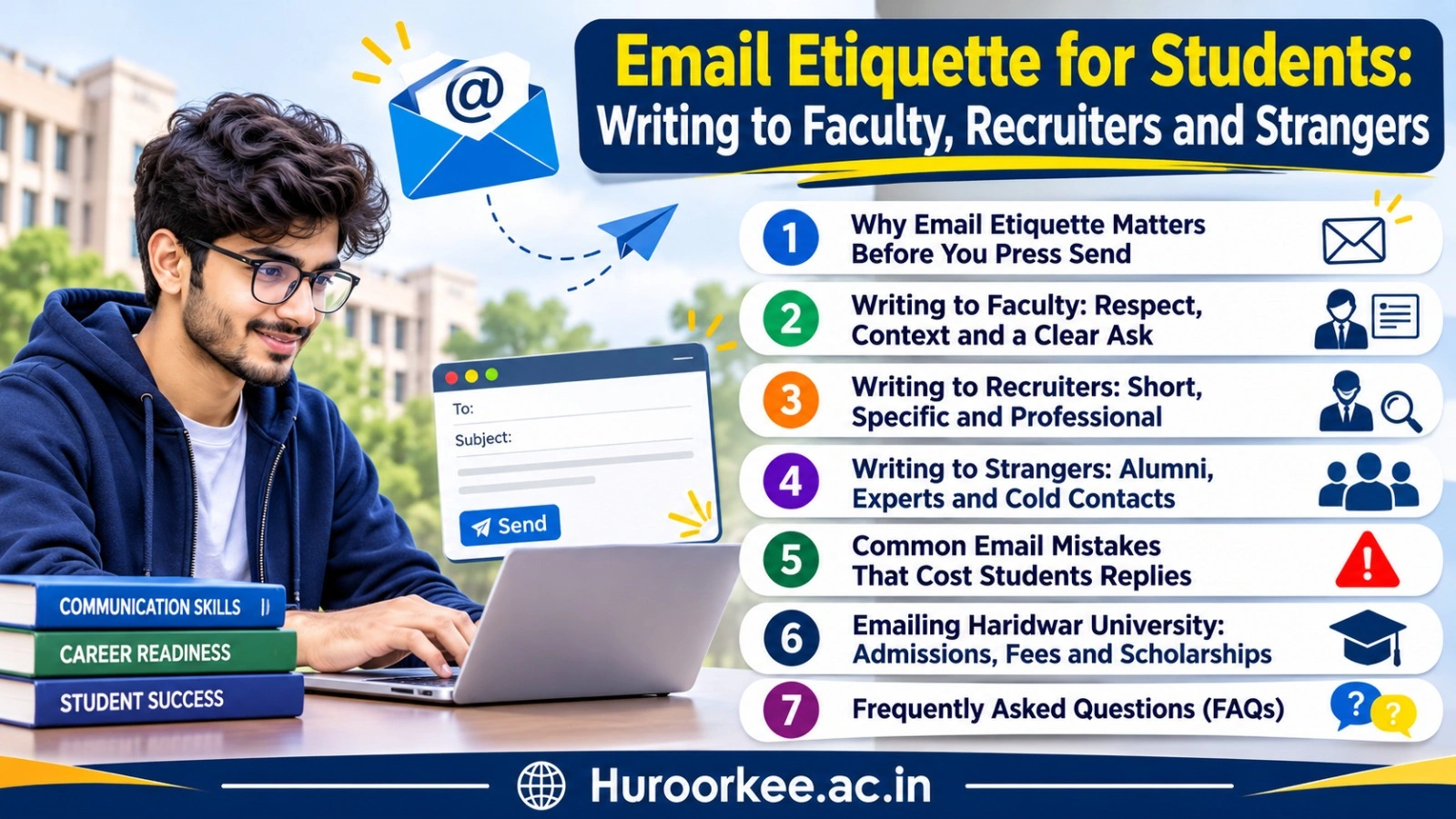
Email Etiquette for Students: Writing to Faculty, Recruiters and Strangers
Dr Aadesh K. Arya
Pro Vice-Chancellor, Haridwar University
A single email can open a door or close it without a sound. Email Etiquette for Students: Writing to Faculty, Recruiters and Strangers comes down to one habit: write for the person who has to read your message between a lecture, a meeting and a full inbox. This guide covers what to write, what to leave out and how to adjust your tone for each reader, with examples from everyday campus life at Haridwar University and beyond.
Quick Comparison: Who Are You Writing To?
| Reader | Greeting | Tone | What to include |
|---|---|---|---|
| Faculty | Dear Professor / Dr. + surname | Respectful, formal | Name, programme, year, roll number, one clear request |
| Recruiter | Dear Mr./Ms. + surname, or Dear Hiring Team | Professional, brief | Role applied for, two lines on fit, résumé as PDF |
| Stranger | Dear + name, after checking the spelling | Polite, curious, short | How you found them and one specific question |
Table of Contents
- 1. Why Email Etiquette Matters Before You Press Send
- 2. Writing to Faculty: Respect, Context and a Clear Ask
- 3. Writing to Recruiters: Short, Specific and Professional
- 4. Writing to Strangers: Alumni, Experts and Cold Contacts
- 5. Common Email Mistakes That Cost Students Replies
- 6. Emailing Haridwar University: Admissions, Fees and Scholarships
- 7. Frequently Asked Questions (FAQs)
1. Why Email Etiquette Matters Before You Press Send
Email is still the main channel between a student and the working world. Faculty use it for approvals and feedback, recruiters use it to fix interview slots, and professionals use it to decide whether a stranger deserves a few minutes of their attention. Good habits in this one medium cost nothing to build and pay off for years.
Your Name and Address Are the First Impression
Before anyone reads a word, they see who sent it. An address like cooldude_007 says something you never meant to say. Use a plain address built from your real name and set the display name to your full name, not a nickname. If your university gives you an official student address, use it when writing to faculty.
Know Where to Turn When Things Go Wrong
Not every email exchange stays pleasant. If a message from a senior or anyone else leaves you upset, Haridwar University's student welfare service page explains that the university strongly condemns ragging, and the 24x7 toll-free number 1800-180-5522 is listed on the university website. You do not have to handle it alone.
2. Writing to Faculty: Respect, Context and a Clear Ask
Teachers read many student emails, and a lot are vague. Make yours easy to answer in a line or two.
Subject Line and Greeting
Put the purpose in the subject, for example "Request for meeting: B.Tech CSE, Database Systems project". Open with "Dear Professor Sharma" or "Dear Dr. Mehta", using the title the person actually holds. Avoid starting with "Hi sir" or a bare "Hello".
Say Who You Are and What You Need
Give your name, programme, year and roll number in the first two lines, then make one request. If you are asking for a recommendation letter, a project guide or advice on exams such as GATE, mention what you have already done. The university's GATE preparation guide shows the kind of groundwork that makes such a request easy to say yes to.
A short example:
Subject: Meeting request: Database Systems project
Dear Dr. Rao, I am Ankit Verma, B.Tech CSE, third year (Roll No. XXXXXXX). I have drafted a project proposal on library management and would value your feedback. Could we meet at a time that suits you this week? I can share the draft beforehand. Thank you for your time. Regards, Ankit Verma
3. Writing to Recruiters: Short, Specific and Professional
A recruiter reads your email the way you scan a menu: quickly, looking for the one thing that fits.
Applying and Following Up
Let the subject carry the role and your name, such as "Application for Software Trainee: Priya Singh". In the body, write three or four short lines covering who you are, why this role and what is attached. If you hear nothing, follow up once, politely, and thank them whatever the outcome. Preparing your answers in advance also helps, and the HR interview questions guide for freshers pairs well with a clean email.
Attachments, File Names and Links
Name files sensibly, for example Priya_Singh_Resume.pdf, never final_final2.docx. Send a PDF unless asked otherwise and mention the attachment in the body so it does not look accidental. Check that any portfolio or GitHub link opens without a login. Genuine openings can also be found on the government's National Career Service portal, where registration is online and free of charge.
4. Writing to Strangers: Alumni, Experts and Cold Contacts
Alumni, authors and industry professionals have no duty to reply, so give them a reason to want to.
Earn the Reply
Say how you found them, show that you did some homework and ask one specific question that can be answered briefly. "Can you tell me about your career?" is too large. "Which skill helped you most in your first year as a data analyst?" is easy to answer. Do not attach a résumé to a first message unless you are invited to.
Protect Yourself From Fake Emails
Cold email works in both directions. Be careful with unknown senders who ask for money, OTPs, passwords or an "urgent" registration fee, and never click a link you cannot verify. If you suspect fraud, call the national cyber crime helpline 1930 or file a report on the government's National Cyber Crime Reporting Portal.
5. Common Email Mistakes That Cost Students Replies
Small slips add up, and most advice on email etiquette for students comes down to fixing these five.
| Common mistake | Better habit |
|---|---|
| A vague subject such as "Hi" or "Query" | Name the purpose and your programme in the subject |
| Slang, emojis or all capital letters | Use full sentences and normal punctuation |
| Asking for approval at the last minute | Write early and allow the reader time to respond |
| Using reply-all by habit | Reply only to the sender unless everyone needs the answer |
| Sending without proofreading | Read the message aloud once before you send it |
When Your Email Is a Complaint
If a problem is still unresolved at college level, the UGC's e-Samadhaan portal works as a single-window system for grievances. Keep the tone factual: dates, names and what you would like done.
6. Emailing Haridwar University: Admissions, Fees and Scholarships
Prospective students often write to a university for the first time with a question about fees. The best approach, and a fair test of your email etiquette for students, is to read the official Fees & Scholarships page first, then send a specific query to the admission team naming the programme, the year and the scholarship category you mean. At the time of writing, the page lists a tuition fee of ₹62,000 for B.Tech Hons. CSE and ₹30,000 for BCA, and states that a student is eligible for only one scholarship.
Merit Scholarship Slabs on First-Year Tuition Fees
| Tier | JEE rank | Marks (12th / graduation / diploma) or CUET percentile | Scholarship |
|---|---|---|---|
| 1 | 1 to 1,00,000 | Above 90% | 80% |
| 2 | 1,00,001 to 2,00,000 | Above 80% up to 90% | 50% |
| 3 | 2,00,001 to 3,00,000 | Above 70% up to 80% | 20% |
| 4 | 3,00,001 to 6,00,000 | Above 60% up to 70% | 10% |
The same page lists a 25% first-year tuition scholarship to promote girls' education and sports-quota scholarships ranging from 10% to 50%, depending on the level of the certificate.
When you are ready, apply through the official application page rather than through a link in an unsolicited message.
7. Frequently Asked Questions (FAQs)
1. What is the best subject line for an email to a professor?
State the purpose and your identity in one line, such as "Request for meeting: B.Tech CSE, Database Systems project". A specific subject helps the professor decide quickly and find your message later.
2. Should I address faculty as Sir or Madam?
Use their title and surname, for example "Dear Professor Sharma" or "Dear Dr. Mehta". "Sir" and "Madam" are fine inside the message, but the greeting should name the person.
3. Can I use emojis or slang with recruiters?
No. Keep the language plain and professional in every email to a recruiter.
4. How do I follow up if a recruiter does not reply?
Send one polite follow-up in the same thread, restating the role and your interest in a line or two.
5. Is it acceptable to email a stranger for career advice?
Yes, if you are respectful and specific. Explain how you found them, ask one question that is easy to answer and thank them whether or not they reply.
6. Which file format should I attach to a job email?
Send a PDF unless the employer asks for something else. Name the file clearly, such as Priya_Singh_Resume.pdf, and mention it in the body of the email.
7. How should I end a formal email?
Close with thanks and a sign-off such as "Regards" or "Sincerely", followed by your full name and programme or contact details.
8. What should I do if I get a suspicious email?
Do not click links or share OTPs or passwords. Call 1930 or report it on cybercrime.gov.in, and tell a teacher or the university if it claims to come from the institution.
9. Where can I check Haridwar University fees and scholarships?
The official Fees & Scholarships page on huroorkee.ac.in lists programme-wise fees and scholarship slabs. For specific queries, write to the admission team with your programme and category.
Build Your Future at Haridwar University
Explore our degree programmes, merit scholarships up to 80%, career readiness support, and student welfare services. Apply online through the official Haridwar University portal.